Archetype Data vs Leadgibbon: B2B Data Showdown 2026
Archetype Data vs Leadgibbon compared on coverage, accuracy, pricing, and workflow fit — plus where a dedicated email finder beats both for cold outbound in 2026.
TL;DR
- Archetype Data leans into firmographic and intent-style enrichment for teams that want to score and segment accounts before they reach out.
- Leadgibbon is a lightweight list-builder: pull B2B contacts, export to a spreadsheet, and move on — cheaper, simpler, less depth.
- Neither tool is built primarily as a high-recall email finder, which is why outbound teams often bolt on a dedicated email finder to fill gaps and verify before send.
- If your bottleneck is finding and verifying working addresses, accuracy and cost-per-valid-email matter more than database size.
- Use the comparison table below to match the tool to your actual workflow — prospecting, enrichment, or list export.
Choosing between Archetype Data and Leadgibbon comes down to one question: do you need deep account intelligence or fast, cheap contact lists? This guide breaks down both on coverage, accuracy, pricing, and outbound fit — and shows where a purpose-built email finder closes the gap neither fully covers.
What is Archetype Data?#
Archetype Data positions itself as a B2B data and enrichment layer. The pitch is intelligence, not just rows: firmographics (company size, industry, tech stack), contact attributes, and signals you can use to prioritize which accounts deserve a rep's time. Teams that run account-based motions like this model because it answers "who should I talk to and why" before anyone drafts an email.
The trade-off is that intelligence-heavy platforms tend to be priced and packaged for revenue teams, not solo founders. You're buying segmentation and scoring, and you pay for the depth whether or not you use all of it. Coverage is broad, but "broad database" and "high deliverability on the specific 200 people you want to email this week" are not the same metric — a distinction we'll return to.
What is Leadgibbon?#
Leadgibbon is the opposite philosophy: a no-frills B2B list-builder. You search for contacts by role and company, it returns names, companies, and email addresses, and you export to CSV or Google Sheets. It built its early reputation as a simple, affordable way to assemble outreach lists without a sales-ops platform sitting on top.
That simplicity is the selling point and the ceiling. There's little scoring, limited enrichment depth, and the workflow assumes you'll take the export somewhere else — your CRM, a sequencer, a spreadsheet — to actually do the work. For a freelancer or a small team running straightforward cold outbound, that's often enough. For a RevOps function that needs data enrichment feeding scoring models, it's thin.
Archetype Data vs Leadgibbon: how do they compare?#
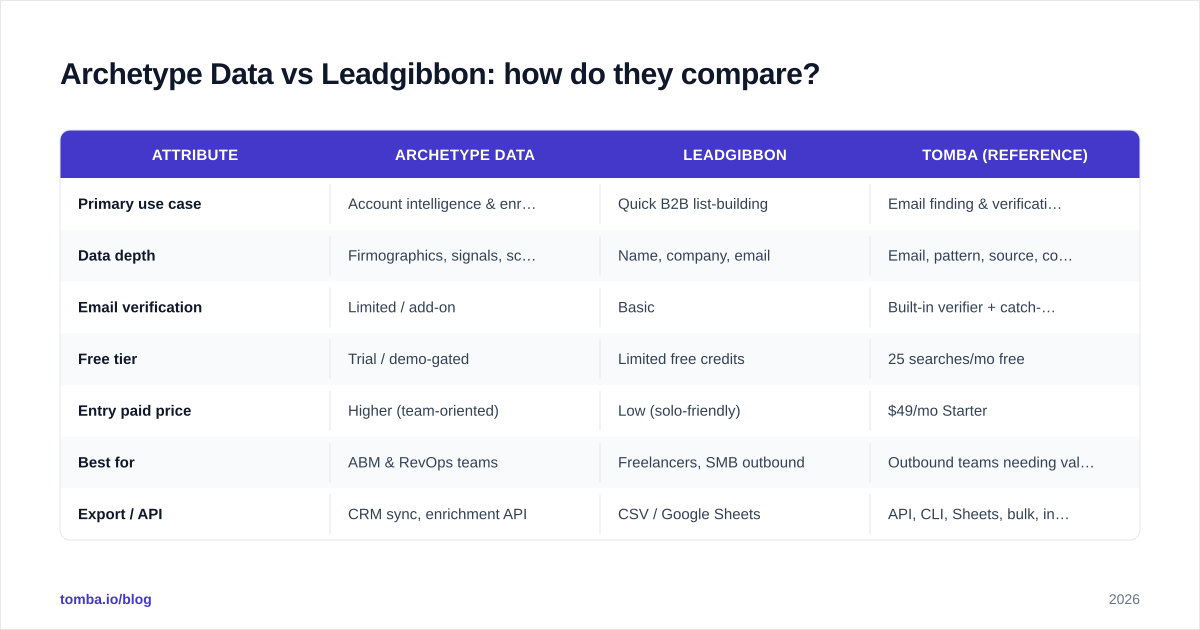
Here's the head-to-head on the attributes that actually change your day-to-day. Pricing for both varies by seat and volume, so treat the figures as representative tiers rather than locked quotes.
| Attribute | Archetype Data | Leadgibbon | Tomba (reference) |
|---|---|---|---|
| Primary use case | Account intelligence & enrichment | Quick B2B list-building | Email finding & verification |
| Data depth | Firmographics, signals, scoring | Name, company, email | Email, pattern, source, confidence |
| Email verification | Limited / add-on | Basic | Built-in verifier + catch-all check |
| Free tier | Trial / demo-gated | Limited free credits | 25 searches/mo free |
| Entry paid price | Higher (team-oriented) | Low (solo-friendly) | $49/mo Starter |
| Best for | ABM & RevOps teams | Freelancers, SMB outbound | Outbound teams needing valid emails |
| Export / API | CRM sync, enrichment API | CSV / Google Sheets | API, CLI, Sheets, bulk, integrations |
| Accuracy guarantee | Varies | Not emphasized | Verification before send |
The pattern is clear. Archetype Data wins on depth and segmentation. Leadgibbon wins on price and speed-to-list. Neither is engineered, first and foremost, around the question every cold emailer eventually hits: is this address actually going to land in an inbox?

Which one has better data accuracy?#
Accuracy is where database-size marketing and inbox reality diverge. A provider can claim hundreds of millions of contacts and still hand you a stale address for the one VP you care about. What matters for outbound is cost per valid, deliverable email — not the raw row count on the pricing page.
Archetype Data's strength is breadth and context, which helps you target well. But broad B2B databases drift: people change jobs, domains get acquired, and role-based addresses go dead. Leadgibbon's lists are convenient, but the tool doesn't lead with verification, so a meaningful slice of any export needs to be checked before you send or you'll burn sender reputation on bounces.
This is the gap a dedicated verifier fills. Running every list through an email verifier before the first send protects your sender reputation and keeps bounce rates under the thresholds mailbox providers police. For domains that accept everything, a catch-all verifier tells you whether an address is genuinely routable or just silently accepted.
If you want to see how email-data tools stack up on accuracy specifically, this benchmark is a useful reference point:

The takeaway: a tool that finds and verifies in one pass usually beats a big static list plus a separate cleanup step, both on hit rate and on total cost.
Is Archetype Data or Leadgibbon better for cold outbound?#
For pure cold outbound, Leadgibbon is faster to start and Archetype Data targets better — but both leave verification to you. That's the honest summary.
Cold outbound has three jobs: find the right people, get working addresses, and protect deliverability. Archetype Data nails job one (targeting). Leadgibbon makes job one cheap. Neither owns jobs two and three the way a finder-plus-verifier stack does. If you push unverified lists from either tool into a sequencer, your bounce rate climbs and your domain's email deliverability suffers within a week.
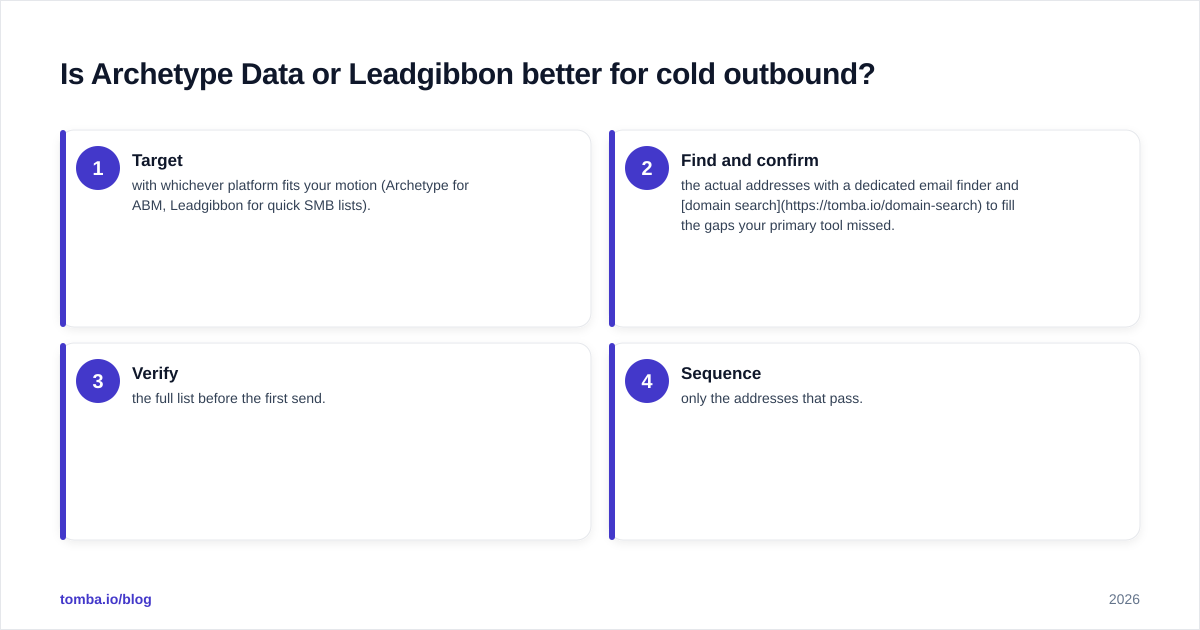
A practical stack looks like this:
- Target with whichever platform fits your motion (Archetype for ABM, Leadgibbon for quick SMB lists).
- Find and confirm the actual addresses with a dedicated email finder and domain search to fill the gaps your primary tool missed.
- Verify the full list before the first send.
- Sequence only the addresses that pass.
That four-step flow is why most teams don't pick one tool — they pair a targeting source with a finder/verifier that's optimized for deliverability rather than database bragging rights.
How does pricing compare?#
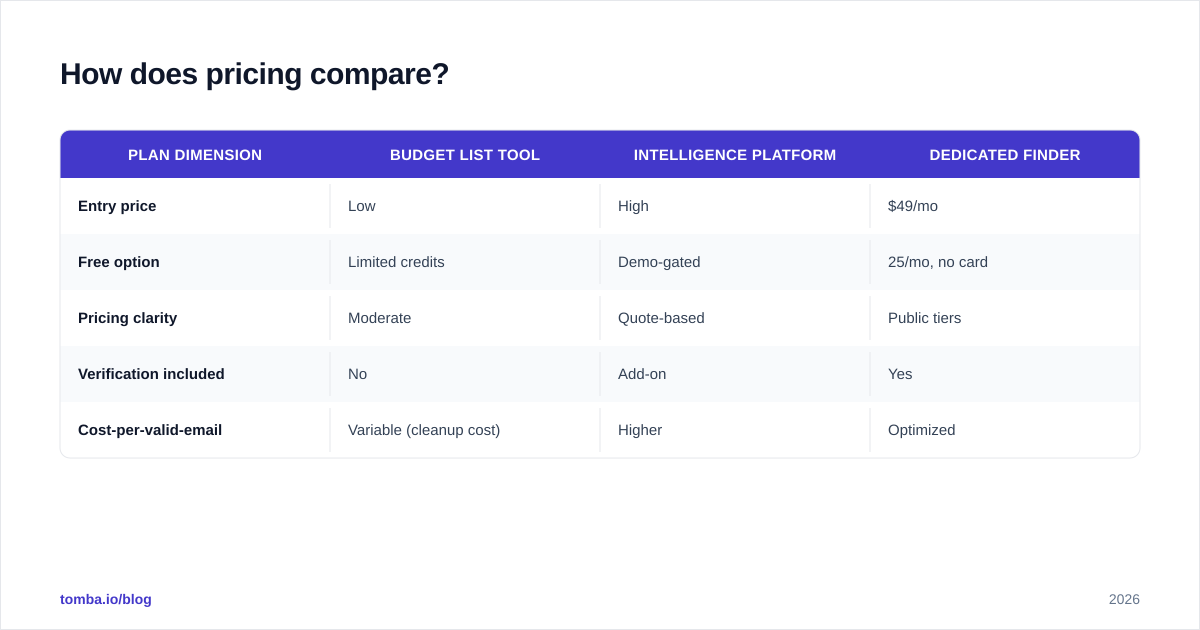
Pricing philosophy mirrors product philosophy. Leadgibbon is built to be affordable for individuals and small teams — low entry cost, pay-for-what-you-export. Archetype Data is packaged for teams buying intelligence, so the entry point is higher and scales with seats and data volume.
When you compare, normalize on cost per valid email, not list price. A cheap list with a 25% bounce rate is more expensive than a slightly pricier source that ships 95% deliverable, once you account for burned domains and re-sends.
For reference, a dedicated finder like Tomba prices transparently: a free tier (25 searches/mo), then $49/mo Starter, $99/mo Growth, $249/mo Pro, and custom Enterprise. Full Tomba pricing is public, which makes the per-credit math easy to run against either competitor.
| Plan dimension | Budget list tool | Intelligence platform | Dedicated finder |
|---|---|---|---|
| Entry price | Low | High | $49/mo |
| Free option | Limited credits | Demo-gated | 25/mo, no card |
| Pricing clarity | Moderate | Quote-based | Public tiers |
| Verification included | No | Add-on | Yes |
| Cost-per-valid-email | Variable (cleanup cost) | Higher | Optimized |
If you're a solo operator, Leadgibbon's price is hard to argue with for a quick list. If you're a team running scored, account-based plays, Archetype Data's depth can justify its cost. If your KPI is valid emails sent without trashing deliverability, the finder-plus-verifier route usually wins the cost-per-outcome comparison.
For a broader look at how the email-data category prices and packages, this comparison table is a handy reference:

Who should pick which tool?#
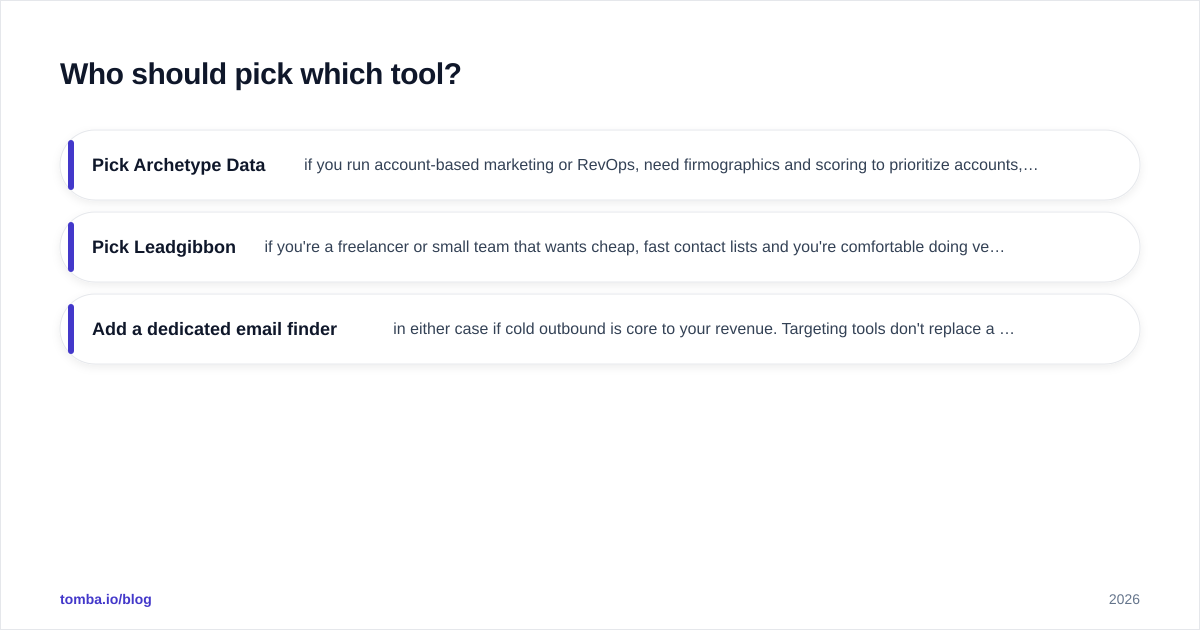
- Pick Archetype Data if you run account-based marketing or RevOps, need firmographics and scoring to prioritize accounts, and have the budget for an intelligence platform. You're buying who to target and why.
- Pick Leadgibbon if you're a freelancer or small team that wants cheap, fast contact lists and you're comfortable doing verification and sequencing elsewhere. You're buying speed and simplicity.
- Add a dedicated email finder in either case if cold outbound is core to your revenue. Targeting tools don't replace a finder that's tuned for recall and a verifier tuned for deliverability — they sit upstream of it.
There's no universal winner. There's a winner for your motion. The mistake is assuming a big database or a cheap list removes the need to verify before you send — it doesn't.
Where does an email finder fit alongside these tools?#
A dedicated finder is the connective tissue. Use Archetype Data or Leadgibbon to decide who, then use a finder to get the working address and confirm it's deliverable. Tools like the Tomba bulk email finder let you run an entire exported list at once, while integrations push results straight into your CRM or sequencer so there's no manual CSV shuffle.
Independent review sites are the place to sanity-check vendor claims before you commit. Cross-reference user reviews on G2 and Capterra, and if you're building an ABM motion, the analyst framing from Gartner on account-based platforms is worth the read. Treat every vendor's own accuracy stat as a starting hypothesis, then verify on your own list.
The bottom line#
Archetype Data and Leadgibbon solve different halves of the same problem. Archetype gives you intelligence to target; Leadgibbon gives you a cheap, fast list. Both still hand the verification problem back to you — and verification is where cold outbound lives or dies.
If your real goal is reaching prospects with addresses that actually work, start with the tool built for exactly that. Tomba's Email Finder finds professional emails by domain, name, or company, verifies them before you send, and starts free with 25 searches a month — no card required. Pair it with whichever targeting source fits your motion, and you stop choosing between depth and deliverability. You get both.
// get started
Find, verify and enrich your first contacts today
Start on the free plan with 25 searches a month, then scale when your team is ready.
Free plan · No credit card required · GDPR & CCPA
// about the author