Archetype Data vs Leadzenai: B2B Data Showdown 2026
Archetype Data vs Leadzenai, compared on coverage, accuracy, pricing, and workflow fit so you can pick the right B2B data engine for 2026 outbound.
Choosing between Archetype Data and Leadzenai usually comes down to one question: which one feeds your pipeline contacts that are actually real? Both promise enriched B2B records, intent signals, and a steady flow of leads. But coverage, accuracy, and price diverge enough that the wrong pick quietly taxes every campaign you run.
This is a neutral breakdown. No vendor here is perfect, and the best answer for your team depends on geography, budget, and how much you care about verified contact data versus raw volume.
TL;DR — Archetype Data vs Leadzenai at a glance#
- Archetype Data leans into firmographic depth and segmentation — strong when you need to define and target precise account profiles, weaker on guaranteed-deliverable email at scale.
- Leadzenai leans into volume and real-time lookups — good for filling a list fast, but accuracy varies and you should expect to verify before sending.
- Neither is a dedicated verification engine. Both benefit from a separate email verifier step before you push contacts into a sequence.
- Pricing favors Leadzenai at entry level; Archetype Data tends to cost more but bundles richer attributes.
- If accuracy is your priority, pairing either tool — or replacing both — with a verification-first platform like Tomba is the cheapest insurance you can buy.
What is Archetype Data?#
Archetype Data is a B2B data and audience-segmentation platform. Its pitch is precision: build an ideal customer profile from firmographic and technographic attributes, then pull matching companies and contacts. Think of it as a tailor rather than a fishing net — you describe the exact fit you want, and it returns records shaped to that spec.
Teams gravitate to Archetype Data when they run account-based motions. If your GTM plan starts with "we sell to 200-person fintech companies using a specific tech stack," the segmentation filters do real work. The trade-off is that depth-first tools often sacrifice raw contact freshness, and email deliverability is rarely the headline metric.
What is Leadzenai?#
Leadzenai is a lead-generation and contact-discovery tool built around speed and breadth. You search by company, role, or industry and it returns contact lists you can export quickly. Its strength is the "I need 500 leads by Friday" use case — the volume is there, and the interface is built for fast list-building.
The catch with volume-first tools is predictable: a meaningful slice of any large export will be stale, role-changed, or undeliverable. That is not unique to Leadzenai — it is the nature of scraping and aggregating contact data at scale. The fix is the same everywhere: verify before you send.
How do Archetype Data and Leadzenai compare on features?#
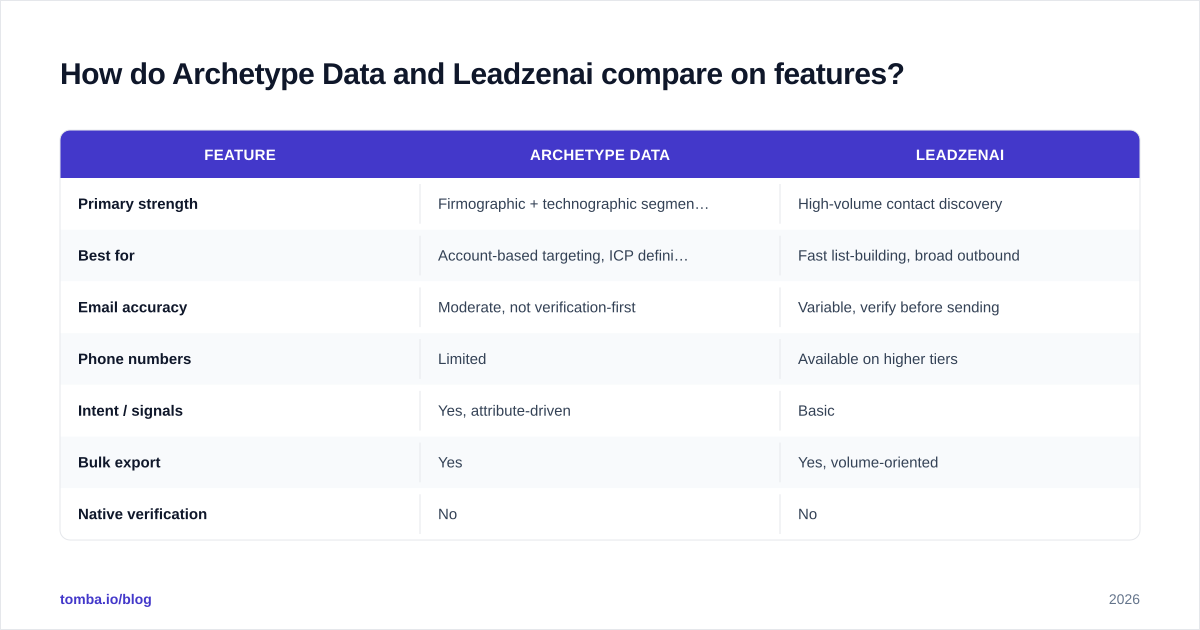
The two tools optimize for different ends of the same workflow. Archetype Data optimizes the targeting step; Leadzenai optimizes the list-building step. Here is how the core attributes line up.
| Feature | Archetype Data | Leadzenai |
|---|---|---|
| Primary strength | Firmographic + technographic segmentation | High-volume contact discovery |
| Best for | Account-based targeting, ICP definition | Fast list-building, broad outbound |
| Email accuracy | Moderate, not verification-first | Variable, verify before sending |
| Phone numbers | Limited | Available on higher tiers |
| Intent / signals | Yes, attribute-driven | Basic |
| Bulk export | Yes | Yes, volume-oriented |
| Native verification | No | No |
| Entry pricing | Higher | Lower |
The honest read: if you already know exactly who you want, Archetype Data helps you find the right accounts. If you just need contacts and a lot of them, Leadzenai moves faster. Neither replaces a dedicated verification layer, which is why so many teams bolt one on.
Which tool has better data accuracy?#
Accuracy is where head-to-head data comparisons get uncomfortable, because every vendor benchmarks itself favorably and real-world results depend on your exact segments. The pattern across independent testing is consistent: segmentation-first tools return tighter account matches but looser contact-level deliverability, while volume-first tools return more contacts with a higher undeliverable rate.

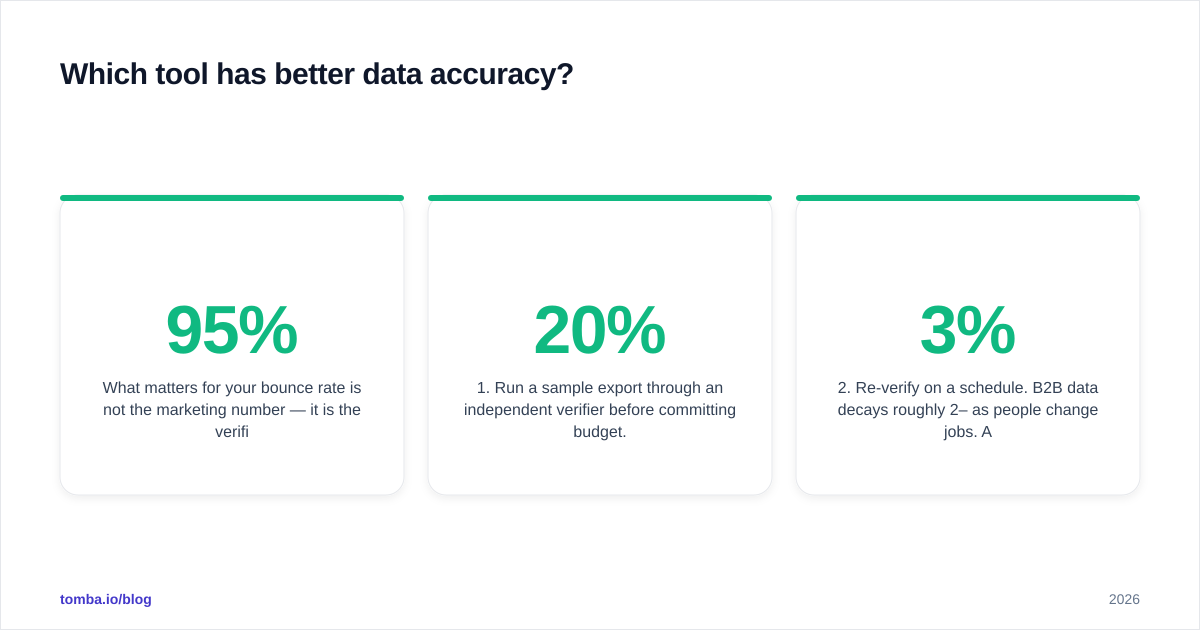
What matters for your bounce rate is not the marketing number — it is the verified-deliverable rate on your list, in your market. A tool that claims 95% accuracy globally can still hand you a 70% deliverable list for niche EU mid-market roles. That is why we recommend treating any data tool's accuracy claim as a starting hypothesis, then validating with a real verification pass.
Two practical accuracy tactics regardless of which platform you choose:
- Run a sample export through an independent verifier before committing budget. If 100 contacts come back with a 20% catch-all-or-invalid rate, you have your answer.
- Re-verify on a schedule. B2B data decays roughly 2–3% per month as people change jobs. A list that was clean in January is measurably worse by April.
For both steps, a catch-all verifier matters more than people expect — catch-all domains accept every address at the SMTP layer, so naive checks mark them "valid" when they may bounce. Resolving those properly is the difference between a clean send and a reputation hit.
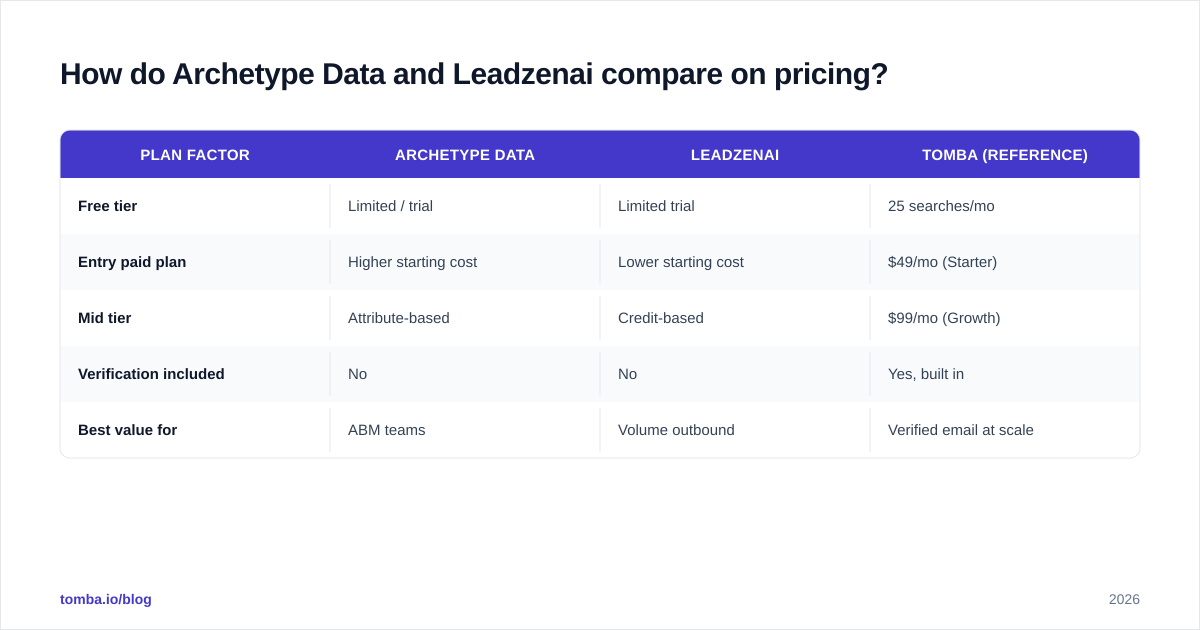
How do Archetype Data and Leadzenai compare on pricing?#
Pricing structures differ enough that a flat "cheaper/more expensive" verdict misleads. Archetype Data prices for depth — you pay for the segmentation engine and richer attributes. Leadzenai prices for access and volume, with a lower entry point that scales by credits or seats.
| Plan factor | Archetype Data | Leadzenai | Tomba (reference) |
|---|---|---|---|
| Free tier | Limited / trial | Limited trial | 25 searches/mo |
| Entry paid plan | Higher starting cost | Lower starting cost | $49/mo (Starter) |
| Mid tier | Attribute-based | Credit-based | $99/mo (Growth) |
| Verification included | No | No | Yes, built in |
| Best value for | ABM teams | Volume outbound | Verified email at scale |
Because exact published numbers shift, confirm current rates on each vendor's own pricing page before you buy. For context on a verification-first alternative, the full Tomba pricing ladder runs Free (25 searches), Starter $49/mo, Growth $99/mo, Pro $249/mo, and Enterprise custom — with verification bundled rather than billed as a separate add-on.
The hidden cost in any data-tool comparison is the bounce tax. If a cheaper tool gives you a list with a 15% invalid rate, you pay in damaged sender reputation, wasted sending volume, and lower inbox placement on the contacts that are real. Cheap data that hurts deliverability is not cheap.
Which integrates better with your stack?#
Both tools support CSV export and common CRM destinations, which covers the basic workflow. The deeper question is whether the tool fits into automated enrichment rather than manual list dumps.
- Archetype Data tends to slot into ABM and marketing-ops stacks where segments drive campaigns.
- Leadzenai fits sales-ops workflows where reps pull lists on demand.
If your team runs enrichment programmatically, API quality becomes the deciding factor. A clean email finder API lets you enrich records the moment a lead enters your CRM, instead of batch-exporting and re-importing. When you evaluate any of these tools, ask for rate limits, response-time SLAs, and whether verification is part of the same call or a separate product.
When should you choose Archetype Data?#
Pick Archetype Data when:
- You run account-based marketing and need tight ICP segmentation.
- Firmographic and technographic precision matters more than raw contact count.
- Your team defines audiences first and finds contacts second.
- Budget allows for a depth-first tool and you have a separate verification step.
Skip it if you mainly need high volumes of individual contacts fast, or if guaranteed-deliverable email is your single most important metric.
When should you choose Leadzenai?#
Pick Leadzenai when:
- You need to build large contact lists quickly.
- Breadth across industries and roles matters more than per-record depth.
- Your reps self-serve lists and you have a verification gate downstream.
- Entry-level cost is a hard constraint.
Skip it if your outbound lives or dies on deliverability and you cannot add a verification layer, or if you need deep ABM-grade segmentation.
Is there a more accurate alternative to both?#
Yes — and it is worth considering before you lock into either. The recurring weakness in this comparison is that neither Archetype Data nor Leadzenai is verification-first. You get data, then you have to prove it is sendable. That second step is exactly where a focused tool earns its keep.
Tomba approaches the problem from the deliverability end. The email finder returns professional addresses with a confidence score, every result can run through built-in verification, and domain search maps a whole company's addressable contacts at once. For teams replacing a manual export-then-verify dance, that consolidation removes a tool from the stack. You can also enrich existing records through data enrichment instead of buying a separate platform.
This is not a claim that Tomba beats both tools on every axis — Archetype Data's segmentation depth and Leadzenai's raw volume each have real strengths. It is a claim that if accuracy and deliverability are your top priority, a verification-first engine is the safer foundation, and you can layer segmentation or volume tools on top of it.
For a broader market read on how the major email-finder and data tools stack up on accuracy and price, this independent-style comparison is a useful reference:

How to test Archetype Data vs Leadzenai before you commit#
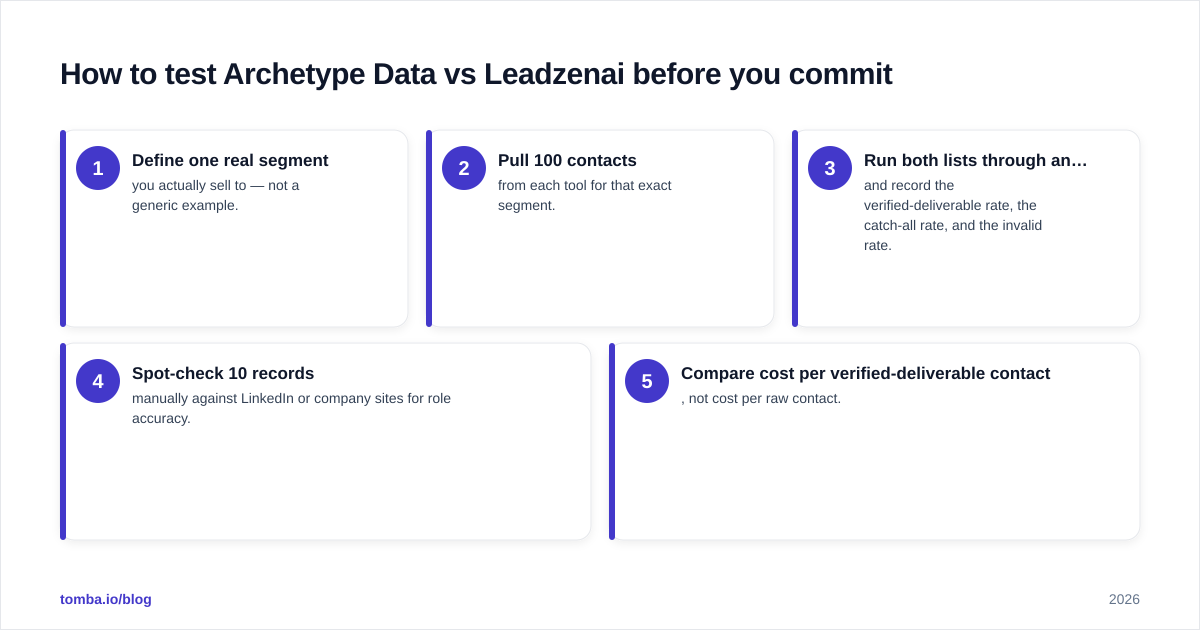
Do not decide on marketing pages. Run a 30-minute bake-off:
- Define one real segment you actually sell to — not a generic example.
- Pull 100 contacts from each tool for that exact segment.
- Run both lists through an independent verifier and record the verified-deliverable rate, the catch-all rate, and the invalid rate.
- Spot-check 10 records manually against LinkedIn or company sites for role accuracy.
- Compare cost per verified-deliverable contact, not cost per raw contact.
That last metric is the one that predicts your campaign results. A tool that looks expensive per credit can be cheaper per usable contact, and vice versa. For deeper context on the underlying methodology, vendor-neutral review sites like G2 and Capterra carry hands-on user reviews of both categories, and HubSpot's research on data decay is a good primer on why re-verification is non-negotiable.
Final verdict#
There is no universal winner between Archetype Data and Leadzenai — there is only the right fit for your motion. Choose Archetype Data for ABM-grade segmentation depth. Choose Leadzenai for fast, high-volume list-building on a tighter budget. In both cases, treat the contact data as a hypothesis and verify before you send, because the cost of a bad list shows up in your deliverability long after the invoice clears.
If your top priority is contacts that are actually deliverable — and you would rather not stitch a separate verifier onto whichever tool you pick — start with Tomba. The Tomba Email Finder gives you scored, verifiable B2B emails with verification built in, a free tier of 25 searches to test against your own segments, and an API to enrich leads the moment they hit your CRM. Run the 100-contact bake-off above, compare cost per verified contact, and let the deliverable rate make the decision for you.
// get started
Find, verify and enrich your first contacts today
Start on the free plan with 25 searches a month, then scale when your team is ready.
Free plan · No credit card required · GDPR & CCPA
// about the author