Archetype Data vs ListKit: B2B Lead Data Compared (2026)
Archetype Data vs ListKit: which B2B lead-data platform actually ships clean, verified lists in 2026? We compare data quality, pricing, and workflow fit.
Choosing between Archetype Data and ListKit comes down to one question: do you want a data-enrichment engine you build campaigns on top of, or a done-for-you list builder that hands you a ready-to-send CSV? Both promise clean B2B contact data, but they solve different halves of the outbound problem.
TL;DR#
- ListKit is a fast, list-first tool: filter by ICP, pull verified leads, export to your sequencer. Built for SDRs who want lists today, not a data pipeline.
- Archetype Data leans toward enrichment and signal-driven targeting — intent, technographics, and account scoring layered on top of contact records.
- Data freshness and verification are the real differentiators. A cheap list that bounces costs you domain reputation, not just credits.
- Neither replaces a dedicated email finder + verifier if accuracy is your bottleneck — pairing a list tool with the Tomba Email Finder closes the gap.
- Best pick depends on motion: high-volume SDR teams lean ListKit; RevOps and account-based teams lean Archetype.
What are Archetype Data and ListKit?#
ListKit is a B2B lead list builder. You define an ideal customer profile — title, industry, headcount, geography — and it returns a list of contacts with emails and (in many cases) phone numbers, pre-filtered and triple-verified before export. Its pitch is speed: go from filter to loaded sequence in minutes, without stitching together three tools.
Archetype Data positions itself further up the stack. Instead of just "here is a list," it emphasizes enrichment and targeting signals — firmographics, technographics, and buying intent attached to accounts and contacts. The idea is that you target the right accounts first, then enrich the people inside them, rather than spraying a flat list.
Think of it like grocery shopping. ListKit is the meal-kit box: portioned, labeled, ready to cook tonight. Archetype is the well-stocked pantry with a nutrition label on every item — more flexible, more powerful for someone who plans menus a week out, but it asks more of you up front.
How do Archetype Data and ListKit compare on features?#
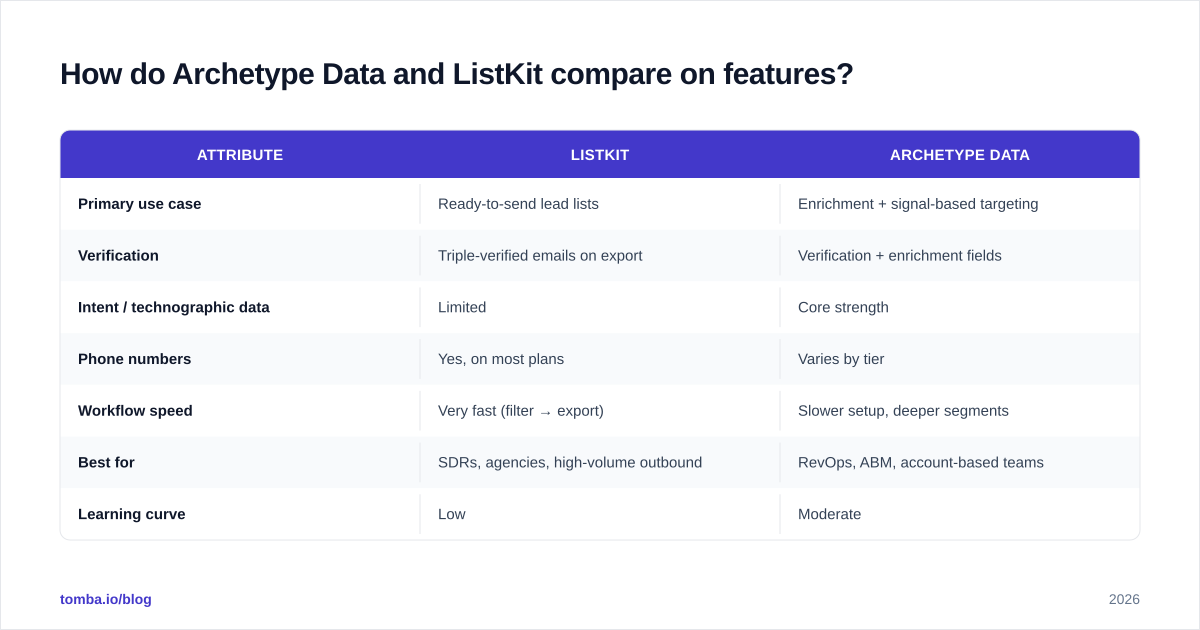
The honest summary: ListKit optimizes for time-to-list, Archetype optimizes for targeting depth. Here is the side-by-side.
| Attribute | ListKit | Archetype Data |
|---|---|---|
| Primary use case | Ready-to-send lead lists | Enrichment + signal-based targeting |
| Verification | Triple-verified emails on export | Verification + enrichment fields |
| Intent / technographic data | Limited | Core strength |
| Phone numbers | Yes, on most plans | Varies by tier |
| Workflow speed | Very fast (filter → export) | Slower setup, deeper segments |
| Best for | SDRs, agencies, high-volume outbound | RevOps, ABM, account-based teams |
| Learning curve | Low | Moderate |
| Export targets | CSV + native sequencer pushes | CSV + CRM enrichment syncs |
If your team's pain is "we never have enough good leads loaded," ListKit's speed wins. If the pain is "we waste reps on accounts that were never going to buy," Archetype's targeting layer earns its keep.
Which has better data quality and accuracy?#
Data quality is where most lead-data tools quietly lose you money, because a bounced email doesn't just waste a credit — it dings your sender reputation and drags down every future campaign from that domain.
ListKit makes verification a headline feature, validating emails before they ever hit your export. That reduces bounces meaningfully versus raw scraped lists. Archetype Data verifies too, but its value proposition is less "zero bounces" and more "right account, right context" — so you should still run an independent check on the contact-level emails it enriches.
Here is the part both vendors gloss over: no single provider has perfect coverage. Coverage and accuracy vary by region, seniority, and company size. The teams who get the cleanest results treat any list — Archetype's or ListKit's — as a starting point, then re-verify with a dedicated email verifier before launch. Catch-all domains in particular slip through most platforms; a catch-all verifier is what separates a 2% bounce rate from a 9% one.

A simple rule that has saved more deliverability than any tool switch: if a list provider can't tell you when a record was last verified, assume it's stale and re-check it yourself.
How do Archetype Data and ListKit price?#
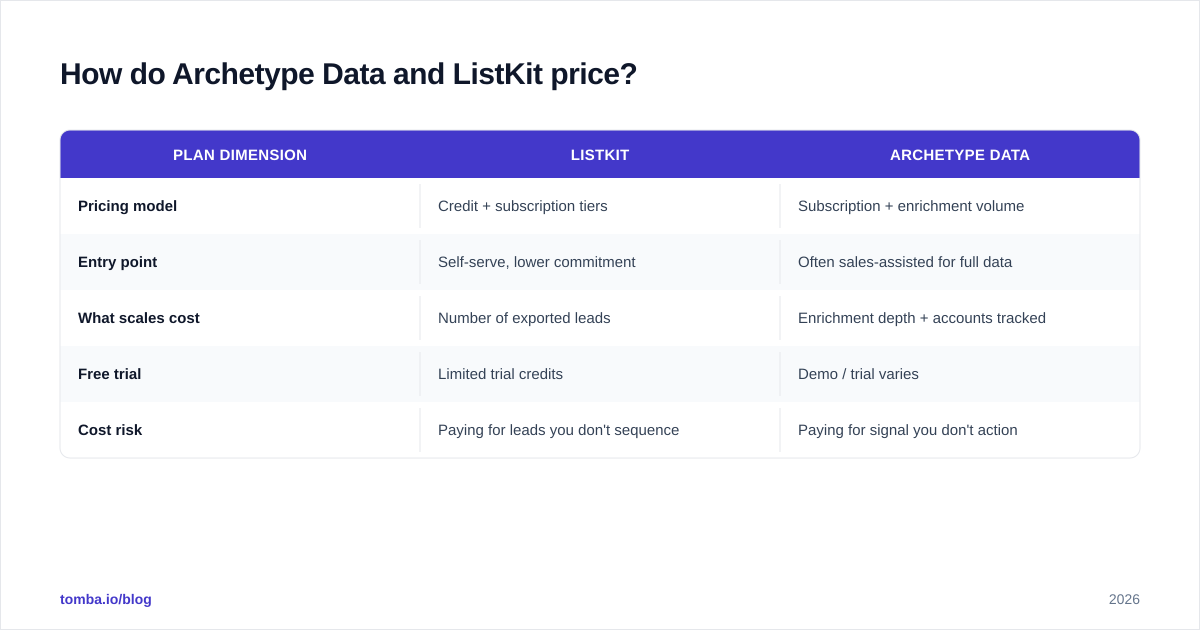
Pricing for both is credit- or seat-based and shifts with promos, so treat specifics as directional and confirm on each vendor's current page. The structural difference matters more than the sticker number.
| Plan dimension | ListKit | Archetype Data |
|---|---|---|
| Pricing model | Credit + subscription tiers | Subscription + enrichment volume |
| Entry point | Self-serve, lower commitment | Often sales-assisted for full data |
| What scales cost | Number of exported leads | Enrichment depth + accounts tracked |
| Free trial | Limited trial credits | Demo / trial varies |
| Cost risk | Paying for leads you don't sequence | Paying for signal you don't action |
ListKit's cost risk is over-exporting: it's so fast to pull leads that you can burn credits on lists nobody sequences. Archetype's cost risk is the opposite — paying for rich intent and technographic data your reps never actually act on. Both are real, and both are solved by process, not by the tool.
For comparison, a standalone data tool like Tomba runs a Free tier (25 searches/month), then Starter at $49/mo, Growth at $99/mo, and Pro at $249/mo — see full Tomba pricing. That's worth benchmarking against, because if you mainly need verified emails by domain or name, a focused finder can be cheaper than a full list platform.
Is Archetype Data better than ListKit?#
Neither is universally "better" — they're tuned for different go-to-market motions. Map the tool to your motion:
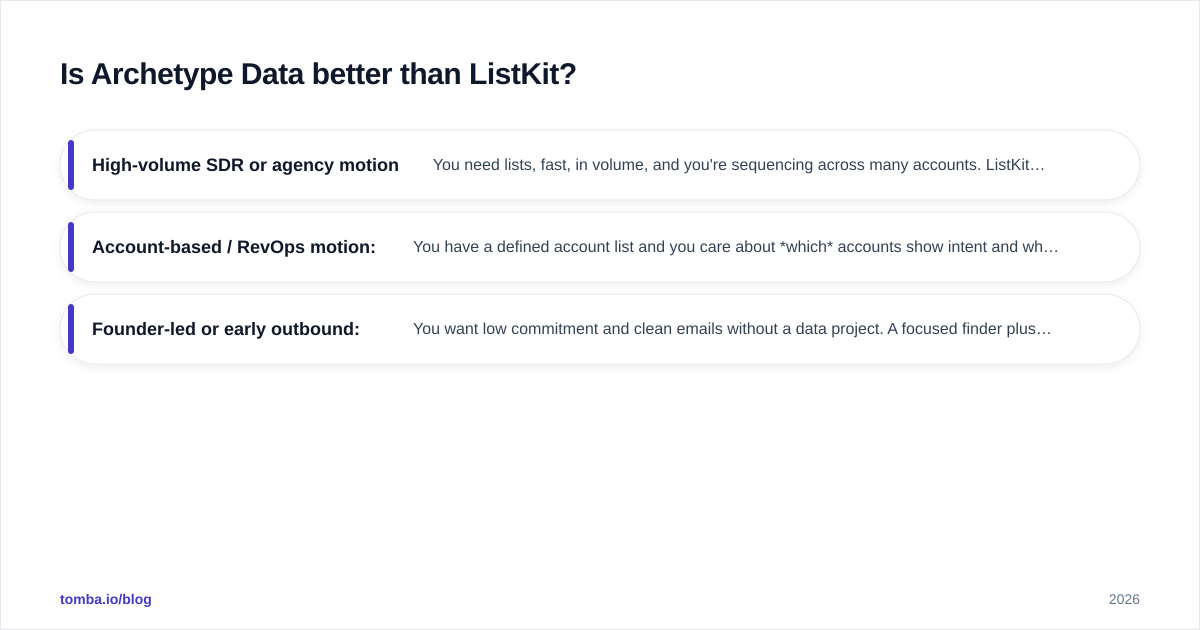
- High-volume SDR or agency motion: You need lists, fast, in volume, and you're sequencing across many accounts. ListKit's speed and triple-verification fit this best.
- Account-based / RevOps motion: You have a defined account list and you care about which accounts show intent and what stack they run. Archetype's enrichment and signals do more for you here.
- Founder-led or early outbound: You want low commitment and clean emails without a data project. A focused finder plus a verifier often beats both until volume justifies a platform.
The mistake is buying the deeper tool for a shallow problem. If you can't yet describe your ICP precisely, Archetype's targeting power is wasted — you'll default to broad filters and get a flat list anyway, at a higher price.
What should you actually do? A decision framework#
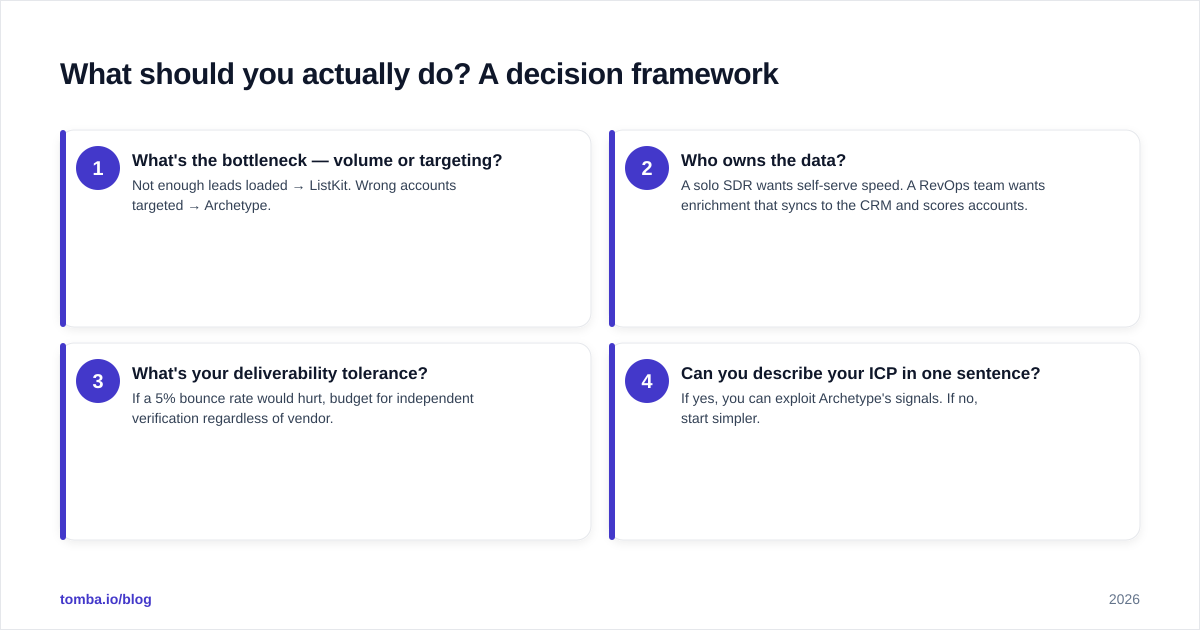
Run your situation through four questions before you commit to either:
- What's the bottleneck — volume or targeting? Not enough leads loaded → ListKit. Wrong accounts targeted → Archetype.
- Who owns the data? A solo SDR wants self-serve speed. A RevOps team wants enrichment that syncs to the CRM and scores accounts.
- What's your deliverability tolerance? If a 5% bounce rate would hurt, budget for independent verification regardless of vendor.
- Can you describe your ICP in one sentence? If yes, you can exploit Archetype's signals. If no, start simpler.
Whichever you pick, build a verification step into your workflow. Pull the list, then run it through a bulk email finder and verifier so the only records that reach your sequencer are ones you trust. For broader vendor research, independent review sites like G2 and Capterra carry real user feedback on both tools' data freshness and support — useful counterweight to vendor claims.
How do these stack up against the wider B2B data market?#
ListKit and Archetype are two answers in a crowded category that also includes Apollo, ZoomInfo, Clearbit, and dozens of finders. The broader trend, well documented by analysts at Gartner, is consolidation: buyers want fewer tools that do enrichment, finding, and verification in one flow rather than a stack of point solutions.
That's exactly why pairing a list tool with a dependable finder-plus-verifier matters. Archetype gives you targeting, ListKit gives you speed, but the email accuracy that determines whether your campaign lands is a separate discipline. A focused provider with transparent data sources lets you treat verification as a controlled, auditable step instead of a vendor promise you can't inspect.
The bottom line#
Pick ListKit if your problem is "we need clean lists, fast, in volume." Pick Archetype Data if your problem is "we need to target and enrich the right accounts with intent and technographic signal." Most teams under-target and under-verify, so whichever platform you choose, the highest-ROI move is adding a real verification layer on top.
Before you load a single list into your sequencer, run the contacts through the Tomba Email Finder and verifier to confirm the emails are deliverable. It's the cheapest insurance you'll buy this quarter — protecting your domain reputation costs far less than rebuilding it. Start free with 25 searches and see how much of your existing list actually holds up.
Ready to find emails that actually work?
Join 150,000+ professionals who stopped guessing and started sending. Free credits on signup — no credit card required.
Get the Tomba newsletter
Practical outbound tactics and product updates — once every two weeks.
About the author