Archetype Data vs Reachstream: B2B Data Compared (2026)
Choosing between Archetype Data and Reachstream? We compare data accuracy, coverage, pricing, and compliance so you can pick the right B2B data provider in 2026 — and show where a verification-first approach beats buying static lists.
Picking a B2B data provider is mostly a bet on one thing: how fresh and accurate the records are on the day you actually hit "send." Archetype Data and Reachstream both promise large contact databases at startup-friendly prices, but they make very different trade-offs on coverage, compliance, and how you pay. This guide breaks down where each one fits, where each one frustrates teams, and when you should skip the static-list model altogether.
TL;DR — Archetype Data vs Reachstream at a glance#
- Archetype Data leans toward enriched, account-level intelligence and intent signals, which suits ABM and mid-market sales teams that already know their target accounts.
- Reachstream is a volume-and-affordability play: large downloadable contact lists with simple credit packs, attractive to SMBs and early-stage outbound teams.
- Neither tool guarantees deliverability. Purchased B2B lists decay 22–30% per year, so verification on the day you send matters more than raw database size.
- Pricing models differ sharply: Archetype skews toward subscription/seat plus enrichment, Reachstream toward pay-as-you-go credits.
- The smarter pattern in 2026 is to source narrowly, then verify and enrich at send time with a tool like Tomba rather than buying a giant list and praying.
What are Archetype Data and Reachstream?#
Both are B2B contact-data vendors, but they sit at slightly different points on the spectrum.
Archetype Data positions itself as a data intelligence layer: company firmographics, technographics, contact records, and (depending on plan) intent or buying signals. The pitch is "know which accounts are in-market, then reach the right person." That makes it a fit for account-based marketing (ABM) and teams running a defined target account list.
Reachstream is closer to a classic contact database with a self-serve storefront. You filter by industry, title, geography, and company size, then export the matching contacts using credits. The pitch is reach and price: a lot of records, a low barrier to entry, minimal commitment.
The distinction matters because it changes what "good data" even means. For Archetype, value is in signal quality — is this account actually in-market? For Reachstream, value is in list economics — how many usable contacts do I get per dollar?
How do Archetype Data and Reachstream compare on features?#
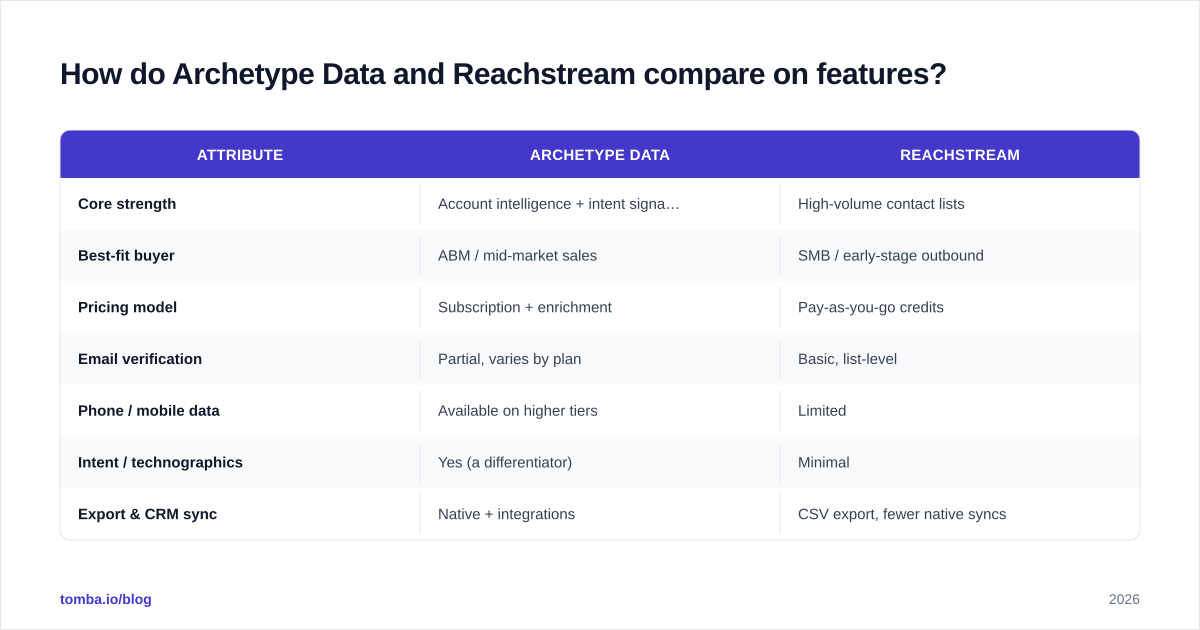
Here is the head-to-head on the attributes that actually move pipeline. Treat vendor-published accuracy numbers skeptically — independent review sites like G2 and Capterra are a better reality check than any marketing page.
| Attribute | Archetype Data | Reachstream |
|---|---|---|
| Core strength | Account intelligence + intent signals | High-volume contact lists |
| Best-fit buyer | ABM / mid-market sales | SMB / early-stage outbound |
| Pricing model | Subscription + enrichment | Pay-as-you-go credits |
| Email verification | Partial, varies by plan | Basic, list-level |
| Phone / mobile data | Available on higher tiers | Limited |
| Intent / technographics | Yes (a differentiator) | Minimal |
| Export & CRM sync | Native + integrations | CSV export, fewer native syncs |
| Free trial / tier | Demo-gated | Limited free credits |
| Realistic data decay | Same industry reality: 2–3%/mo | Same industry reality: 2–3%/mo |

Two things jump out. First, Archetype's edge is context — intent and technographic layers that help you prioritize, not just contact. Second, Reachstream's edge is friction — you can be exporting contacts within minutes of signing up, with no annual commitment.
But notice the bottom row: both vendors face the same physics. A B2B contact record degrades roughly 2–3% every month as people change jobs, companies rebrand, and inboxes get retired. No database vendor escapes that, which is why your verification step matters more than the logo on the list.
Which one is more accurate?#
Accuracy is the question everyone asks and the one no vendor can honestly answer with a single number. "95% accurate" usually means at the moment the record was last refreshed — not on the day you email it.
A more useful way to think about accuracy is in two layers:
- Match accuracy — did the provider correctly attach this person to this company and title?
- Deliverability accuracy — will an email to this address actually land in an inbox today?
Archetype tends to do well on layer one because its enrichment pipeline cross-references firmographic and technographic sources. Reachstream competes on layer-one volume but is more variable on layer two, since large bulk lists tend to carry more stale and catch-all addresses.
The fix for both is the same: re-verify before you send. Run any purchased list through a dedicated email verifier to strip dead addresses, spam traps, and risky catch-all domains. A 50,000-row list that's 78% deliverable is worth far more than a 200,000-row list you blast unverified into a spam folder.
If you want to understand why records vary so much between providers, it comes down to sourcing. Vendors that blend public web data, opt-in partners, and live SMTP validation tend to beat vendors that resell aging third-party files. That sourcing transparency is exactly what you should interrogate in a demo — ask both Archetype and Reachstream where the data comes from and how often it's re-validated. (For a reference point on what transparent sourcing looks like, see how Tomba documents its data sources.)
How does pricing compare for Archetype Data vs Reachstream?#
Pricing is where the two diverge most, and it changes who should buy each.
Archetype Data uses a subscription-style model, often seat-based with enrichment and intent features gated to higher tiers. That's predictable if you have steady volume and want the signal layer, but it can feel expensive if you only need contacts occasionally.
Reachstream uses credit packs. You buy credits, you spend them on exports, you top up when you run dry. That's friendly to spiky, project-based prospecting — a campaign this month, nothing next month — but the per-contact math can creep up at scale, and credits sometimes expire.
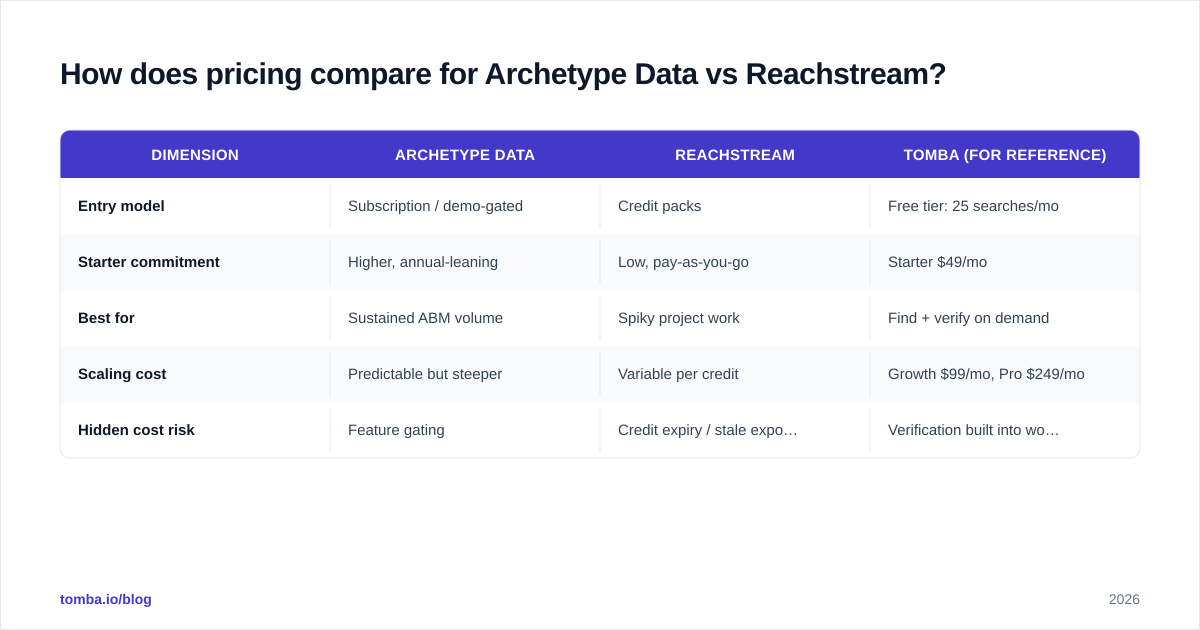
| Dimension | Archetype Data | Reachstream | Tomba (for reference) |
|---|---|---|---|
| Entry model | Subscription / demo-gated | Credit packs | Free tier: 25 searches/mo |
| Starter commitment | Higher, annual-leaning | Low, pay-as-you-go | Starter $49/mo |
| Best for | Sustained ABM volume | Spiky project work | Find + verify on demand |
| Scaling cost | Predictable but steeper | Variable per credit | Growth $99/mo, Pro $249/mo |
| Hidden cost risk | Feature gating | Credit expiry / stale exports | Verification built into workflow |
A quick gut check: if your motion is "we have 300 named accounts and we work them all quarter," Archetype's subscription + intent can pay for itself. If your motion is "we need 5,000 contacts for one campaign and then we're done," Reachstream's credits are cheaper. And if your motion is "I need the right email for this specific person, verified, right now," neither static-list model is the most efficient — that's an email-finder workflow. You can compare the credit math against transparent Tomba pricing to see the difference between buying lists and finding contacts on demand.

Is buying a B2B list even the right move in 2026?#
Often, no — and this is the part most comparison posts skip.
The list-buying model made sense when data was scarce and expensive to assemble. In 2026 the bottleneck has flipped. Data is abundant; deliverability and compliance are the scarce resources. A few realities to sit with:
- Decay is relentless. With 2–3% monthly erosion, a list is meaningfully worse 90 days after purchase. You're paying upfront for an asset that depreciates fast.
- Spam-trap risk scales with volume. The bigger and older the purchased list, the higher the odds it contains traps that wreck your sender reputation.
- Compliance is non-negotiable. GDPR and CAN-SPAM put the burden on you, the sender, not the data vendor. Bulk lists with thin consent trails are a liability.
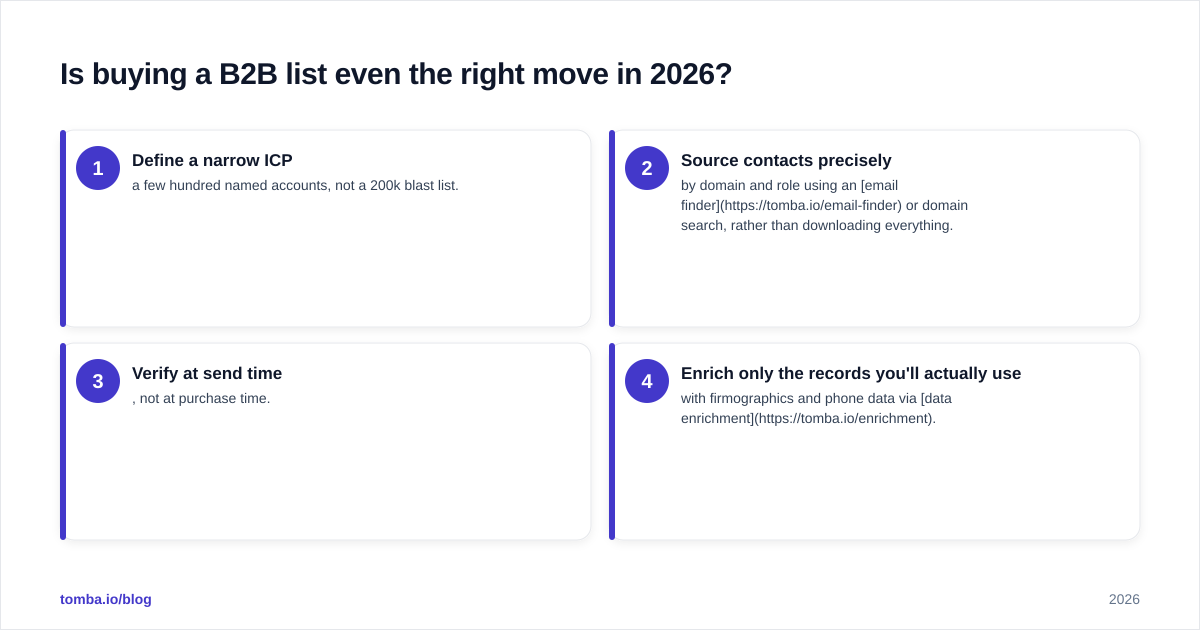
The alternative pattern that high-performing outbound teams use looks like this:
- Define a narrow ICP — a few hundred named accounts, not a 200k blast list.
- Source contacts precisely by domain and role using an email finder or domain search, rather than downloading everything.
- Verify at send time, not at purchase time.
- Enrich only the records you'll actually use with firmographics and phone data via data enrichment.
This "find-verify-enrich" loop produces a smaller, fresher, more deliverable contact set than either Archetype's or Reachstream's bulk export — and you only pay for what you use.
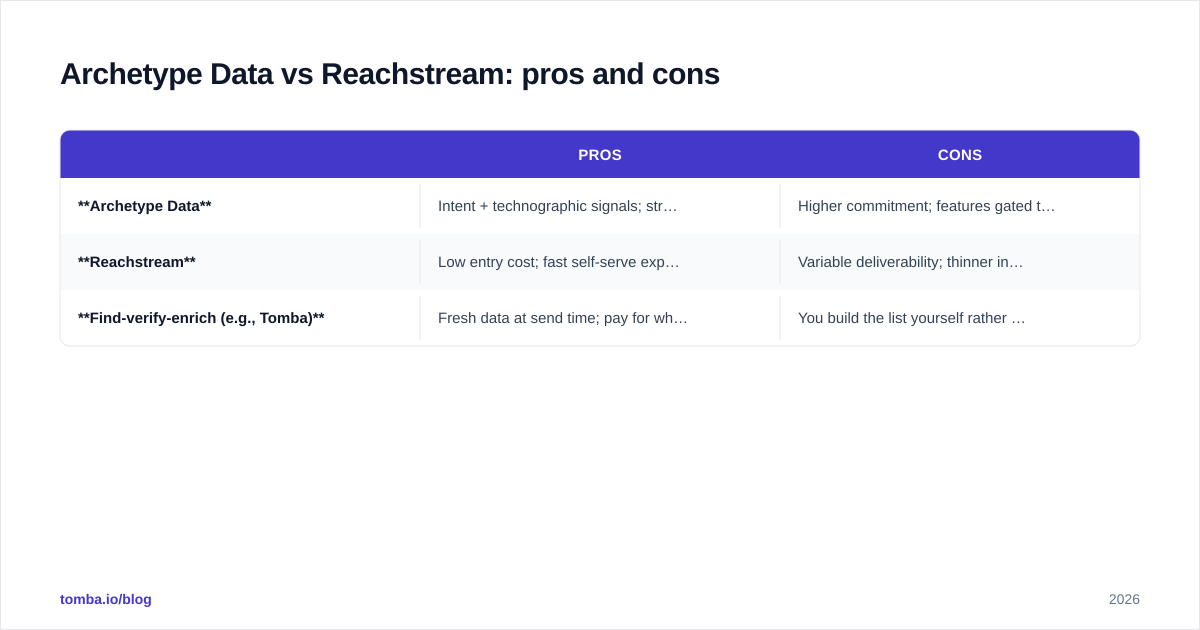
Archetype Data vs Reachstream: pros and cons#
To make the trade-offs concrete:
| Pros | Cons | |
|---|---|---|
| Archetype Data | Intent + technographic signals; strong account-level enrichment; predictable subscription | Higher commitment; features gated to upper tiers; overkill for simple list pulls |
| Reachstream | Low entry cost; fast self-serve exports; flexible credits | Variable deliverability; thinner intent data; credit/expiry friction |
| Find-verify-enrich (e.g., Tomba) | Fresh data at send time; pay for what you use; built-in verification | You build the list yourself rather than downloading one wholesale |
How should you choose between them?#
Match the tool to your motion, not to the longest feature list.
Choose Archetype Data if you run account-based marketing, you already have a defined target account list, and intent or technographic signals would change who you reach out to first. The subscription cost is justified when prioritization is your real problem.
Choose Reachstream if you're an SMB or early-stage team running occasional, project-based campaigns, you're price-sensitive, and you can tolerate doing your own verification pass on every export. The credit model keeps you from over-committing.
Skip both — or use them as a starting layer — if your core need is reaching specific people with verified contact details on demand. In that case a B2B database paired with live email finding and verification will out-deliver any static list, because freshness beats volume every time.
A practical hybrid many teams land on: use a signal source (Archetype-style intent or your own product data) to decide which accounts matter, then use a find-and-verify tool to pull the actual contacts cleanly. You get the prioritization upside without inheriting a decaying mega-list.
What about compliance and data sourcing?#
Don't treat this as a footnote. Whichever vendor you pick, you're the sender of record, so you inherit the compliance risk.
Ask every provider — Archetype, Reachstream, or anyone else — three direct questions:
- Where does the data originate? Public web, opt-in partners, co-registration, or resold third-party files? The further from a real opt-in, the riskier.
- How often is each record re-validated? "Quarterly" is very different from "at export."
- What's the suppression and opt-out workflow? You need a clean way to honor unsubscribes and deletion requests.
Reachstream's official site is reachstream.com; review both vendors' data and privacy documentation before you commit, and cross-check against third-party reviews rather than trusting the sales deck. Vendors that can't clearly answer the sourcing question are the ones most likely to leave you holding compliance risk.
The bottom line#
Archetype Data and Reachstream solve different problems. Archetype is for teams that need signal — knowing which accounts to chase and reaching them with context. Reachstream is for teams that need cheap reach — fast, flexible exports without a big commitment. Both are reasonable picks for their respective buyers, and both share the same Achilles' heel: a purchased list is only as good as its freshness on send day.
That's the real takeaway. In 2026, the winning move isn't picking the database with the biggest number on the homepage. It's building a tight, verified, recently-sourced contact set and treating the database as a starting point rather than a finished asset.
If your priority is reaching the right people with addresses that actually deliver, start with the Tomba Email Finder. Find professional emails by name, company, or domain, verify them before you send, and enrich only the records you'll use — so your outbound runs on fresh data instead of a list that started decaying the moment you downloaded it. Spin up the free tier (25 searches a month) and test it against any list you're considering buying; the deliverability difference shows up fast.
Ready to find emails that actually work?
Join 150,000+ professionals who stopped guessing and started sending. Free credits on signup — no credit card required.
Get the Tomba newsletter
Practical outbound tactics and product updates — once every two weeks.
About the author