Archetype Data vs SignalHire: 2026 B2B Data Tool Comparison
Archetype Data vs SignalHire compared on coverage, accuracy, phone data, pricing, and compliance — plus where a verification-first stack beats both in 2026.
Archetype Data vs SignalHire: Which B2B Contact Source Wins in 2026?
Picking a contact-data provider is less about the logo on the dashboard and more about what survives contact with your CRM. Two names that come up in B2B prospecting shortlists are Archetype Data and SignalHire — but they solve overlapping problems in very different ways. This breakdown stays neutral: where one is stronger, it gets the credit.
TL;DR#
- SignalHire is a contact-finding tool built around a browser extension and recruiter-style workflows — strong on phone numbers and LinkedIn lookups, priced per credit.
- Archetype Data leans toward dataset-style B2B records and enrichment, better suited to teams that want lists and account data rather than one-at-a-time lookups.
- Accuracy is the real battleground. Both publish coverage numbers; neither replaces an independent verification step before you hit send.
- Pricing models differ: SignalHire meters credits per revealed contact, while dataset providers typically bill by record volume or seat.
- If your priority is verified email deliverability and predictable cost, pairing either tool with a dedicated email verifier — or using a verification-first finder outright — beats trusting raw exports.
What is Archetype Data?#
Archetype Data positions itself as a B2B data and enrichment source: company firmographics, contact records, and attributes you can append to existing rows. Think of it less like a search box and more like a warehouse — you tell it the shape of the account or persona you want, and it returns structured records you load into a CRM or sequencer.
That model fits revenue and revenue operations teams who build territories and total-addressable-market lists, then hand clean rows to reps. The strength is breadth and structure. The weakness, common to every dataset vendor, is freshness: a record assembled three months ago may point at someone who has already changed jobs, and bulk datasets rarely re-verify at the moment you export.
What is SignalHire?#
SignalHire is a contact finder aimed at recruiters and salespeople who work prospect-by-prospect. Its core surface is a Chrome extension that reveals emails and phone numbers from a LinkedIn profile or a company page, plus a search app for building lists. It bills on credits — one credit per revealed contact — which makes per-lead cost easy to reason about and easy to overspend if your team reveals indiscriminately.
SignalHire's standout is phone coverage. For roles where a dial matters more than an email — staffing, executive search, field sales — that direct-dial layer is the reason teams pick it. You can see how users rate that coverage on G2's SignalHire listing and on the official SignalHire site.
How do Archetype Data and SignalHire actually differ?#
The cleanest way to think about it: Archetype Data sells records, SignalHire sells reveals. One is a list you pull from; the other is a lookup you trigger. That single distinction drives almost every downstream difference — pricing, workflow, freshness, and who on your team touches the tool.
Use the framework above to place your own need. If you batch-build territories quarterly, a dataset model amortizes well. If reps chase named accounts daily and need a phone in the next five minutes, a reveal model is the better muscle.

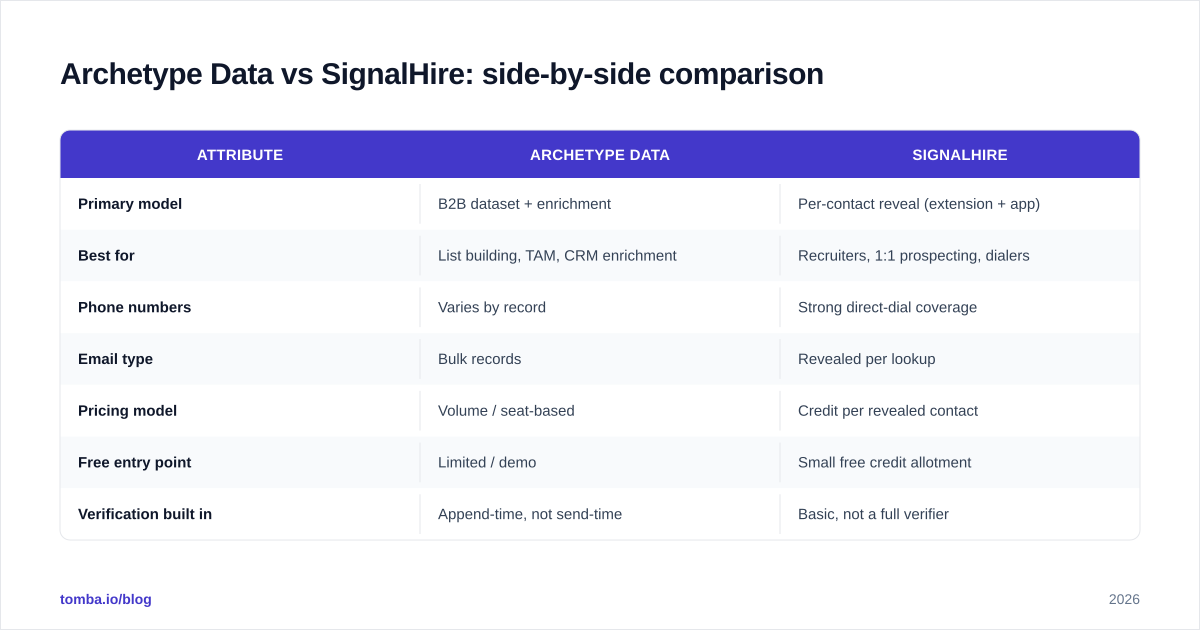
Archetype Data vs SignalHire: side-by-side comparison#
| Attribute | Archetype Data | SignalHire |
|---|---|---|
| Primary model | B2B dataset + enrichment | Per-contact reveal (extension + app) |
| Best for | List building, TAM, CRM enrichment | Recruiters, 1:1 prospecting, dialers |
| Phone numbers | Varies by record | Strong direct-dial coverage |
| Email type | Bulk records | Revealed per lookup |
| Pricing model | Volume / seat-based | Credit per revealed contact |
| Free entry point | Limited / demo | Small free credit allotment |
| Verification built in | Append-time, not send-time | Basic, not a full verifier |
| Workflow fit | Ops-driven, batch | Rep-driven, on-demand |
Two caveats. First, both vendors revise plans often, so confirm live numbers on their own pages before you commit. Second, "coverage" and "accuracy" are not the same metric — a provider can have a record for 90% of your list and still be wrong about the email on a third of them.
How accurate is each one?#
Accuracy is where shortlists are won or lost, and it is the number you should pressure-test hardest. Vendor-published accuracy is measured on the vendor's terms; your list, your geography, and your seniority mix will produce a different result.

A reveal-style tool like SignalHire often looks more accurate on a single high-profile profile because it resolves in real time. A dataset like Archetype Data can look stronger in bulk because it returns something for almost every row — but "something" includes stale and catch-all addresses that quietly tank your bounce rate. The honest answer for both: measure on a 200-contact sample of your own ICP before scaling. Reveal 200, verify all 200 independently, and count the true valids.
That independent step is the part teams skip and later regret. Running exports through a dedicated email verifier, and handling catch-all domains with a proper catch-all verifier, is what protects your sender reputation regardless of which source produced the address.
Which is better for cold outreach and deliverability?#
For cold email at volume, the limiting factor is rarely how many addresses you can pull — it is how many are safe to send to. Neither Archetype Data nor SignalHire is a deliverability tool, and treating either export as send-ready is the most common way to torch a domain.
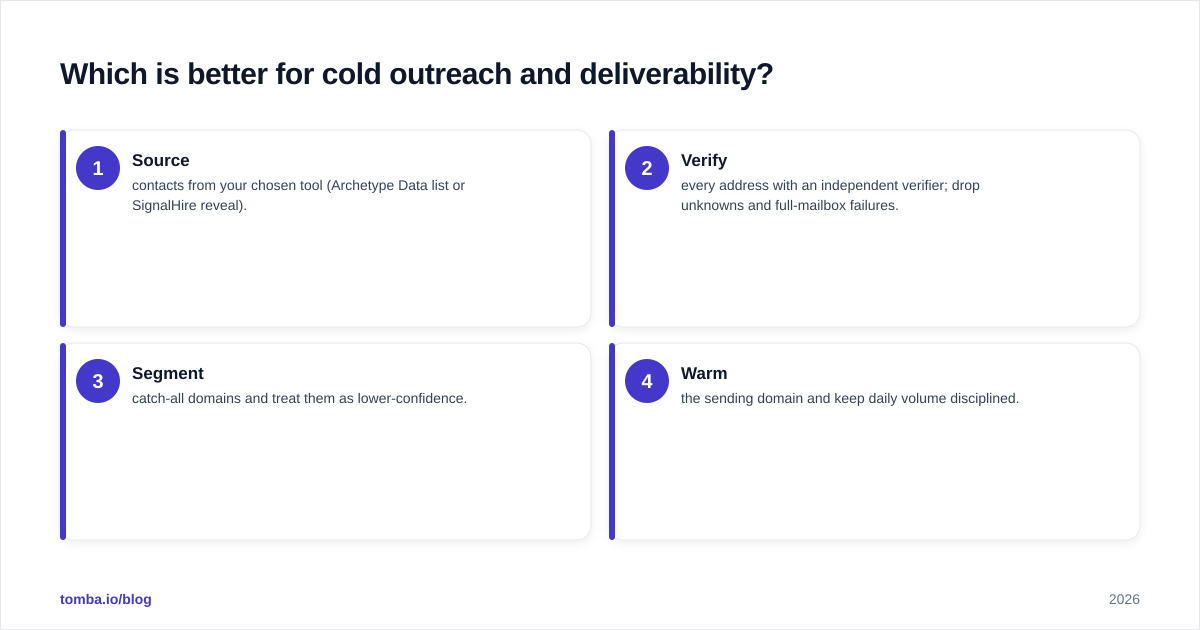
Build the workflow in this order:
- Source contacts from your chosen tool (Archetype Data list or SignalHire reveal).
- Verify every address with an independent verifier; drop unknowns and full-mailbox failures.
- Segment catch-all domains and treat them as lower-confidence.
- Warm the sending domain and keep daily volume disciplined.
Skip step two and you inherit whatever decay the dataset carried. This is exactly why a verification-first finder appeals to outbound teams — the verify step is not a separate purchase you might forget. See Tomba pricing for how a finder-plus-verifier bundle compares to stacking two vendors.
When should you pick Archetype Data?#
Choose a dataset-style provider like Archetype Data when:
- You build territories and TAM lists quarterly and need structured rows, not one-off lookups.
- Your motion is ops-led — a RevOps or data team owns enrichment and feeds clean records to reps.
- You enrich an existing CRM at scale and care more about firmographic completeness than a single direct dial.
- Predictable, volume-based billing suits your finance team better than fluctuating per-reveal credits.
The trade-off you accept is freshness risk, which you offset with a verification pass before any record reaches a sequencer.
When should you pick SignalHire?#
Choose SignalHire when:
- You are a recruiter or 1:1 seller who works named profiles on LinkedIn and needs contact details on the spot.
- Phone numbers are mission-critical and a direct dial is worth more to you than a bulk email list.
- You prefer pay-per-reveal economics and can keep your team disciplined about which profiles to spend credits on.
- Your volume is moderate — heavy daily reveals can make credit pricing climb faster than a flat plan.
The trade-off is that credit costs scale with usage, and the built-in checks are not a substitute for a dedicated verifier.
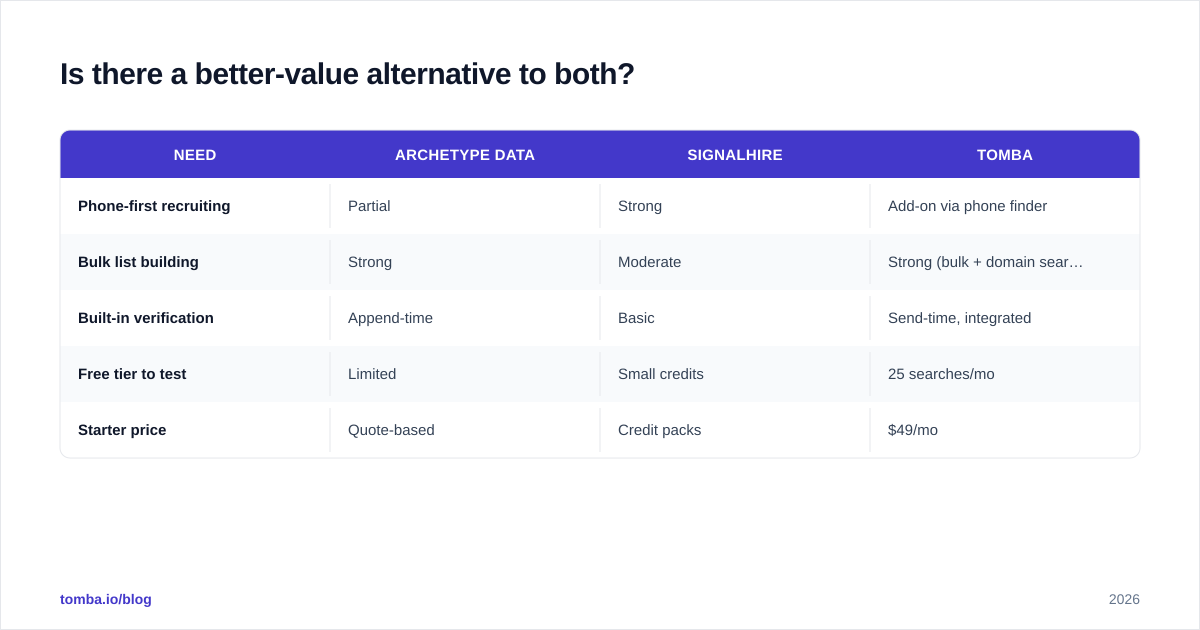
Is there a better-value alternative to both?#
Often, yes — especially if your real goal is verified email at predictable cost rather than either extreme. A finder that treats verification as a first-class step closes the gap between "we have a record" and "we can safely send."
Tomba sits in that lane. The email finder resolves addresses by name and domain, domain search returns every public address on a company in one pass, and verification is built into the same workflow rather than bolted on. For LinkedIn-driven prospecting, the LinkedIn finder covers the same profile-to-email job recruiters lean on SignalHire for, and the bulk email finder handles list-scale work that overlaps with dataset providers.
| Need | Archetype Data | SignalHire | Tomba |
|---|---|---|---|
| Phone-first recruiting | Partial | Strong | Add-on via phone finder |
| Bulk list building | Strong | Moderate | Strong (bulk + domain search) |
| Built-in verification | Append-time | Basic | Send-time, integrated |
| Free tier to test | Limited | Small credits | 25 searches/mo |
| Starter price | Quote-based | Credit packs | $49/mo |
On entry cost, Tomba's published tiers — Free (25 searches/mo), Starter $49/mo, Growth $99/mo, Pro $249/mo — make budgeting straightforward versus quote-based datasets or variable credit burn. Compare the full Tomba pricing before deciding, and cross-check independent reviews on Capterra so you are not relying on any single vendor's framing.
How should you actually decide?#
Run a real bake-off, not a feature-sheet debate. Pick 200 accounts that match your ideal customer profile and put all three through the same gauntlet: source the contact, export it, verify it with an independent checker, and count true valids plus reachable phones. The tool that delivers the most verified, send-safe contacts per dollar wins — and that ranking frequently differs from whoever has the prettiest dashboard.
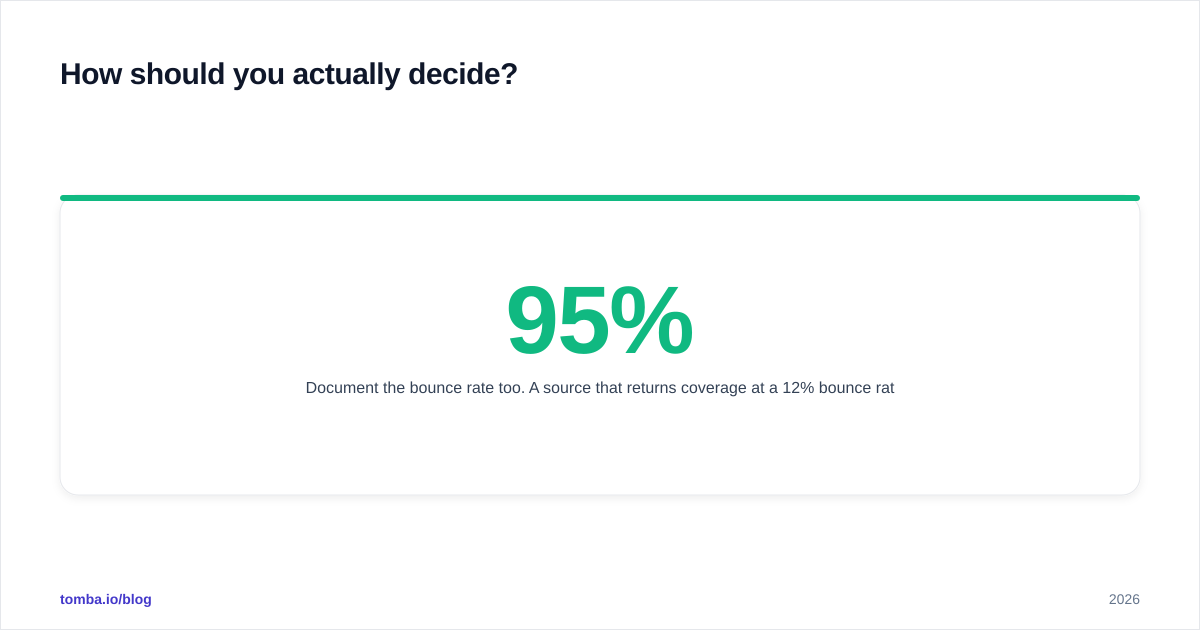
Document the bounce rate too. A source that returns 95% coverage at a 12% bounce rate is more expensive than one returning 80% coverage at a 2% bounce rate, once you price in the domain-reputation damage. Quality of the valid set beats raw coverage every time.
Final verdict#
There is no universal winner between Archetype Data and SignalHire — there is only a winner for your motion. Pick SignalHire if phones and 1:1 recruiter-style reveals drive your pipeline. Pick Archetype Data if you build structured lists and enrich a CRM at volume. But whichever you choose, the verification step is non-negotiable: it is the difference between a list and a liability.
If you would rather not stitch a finder and a verifier together from two vendors, start free with the Tomba Email Finder. You get 25 searches a month at no cost, verification baked into the same flow, and a $49/mo Starter tier when you scale — so the address that lands in your sequencer is one you can actually send to. Run the 200-contact test, count the verified valids, and let the numbers pick your stack.
// get started
Find, verify and enrich your first contacts today
Start on the free plan with 25 searches a month, then scale when your team is ready.
Free plan · No credit card required · GDPR & CCPA
// about the author