Archetype Data vs Smarte: B2B Data Tools Compared (2026)
Archetype Data vs Smarte: a neutral 2026 breakdown of coverage, accuracy, pricing, and fit so you pick the right B2B contact-data engine for outbound.
Choosing a B2B contact-data vendor is less about who has the biggest logo and more about whose records survive contact with your CRM. Archetype Data and SMARTe both promise accurate emails, direct dials, and enrichment at scale — but they solve slightly different problems for slightly different teams. This guide breaks down where each one wins, where each one frustrates buyers, and how to decide without burning a quarter on a bad contract.
TL;DR#
- Archetype Data leans toward AI-built, intent-flavored prospecting data and is attractive to founders and lean GTM teams who want enriched lists fast.
- SMARTe is a more established sales-intelligence platform known for global mobile/direct-dial coverage (strong in EMEA and APAC) and GDPR-conscious sourcing.
- Neither tool is a pure email-verification engine — budget for a dedicated email verifier regardless of which you pick.
- Pricing for both is quote-based and seat-driven, so the real cost depends on credits, exports, and integrations, not the sticker number.
- For teams that mainly need accurate, verified email discovery by domain or name, a focused tool like Tomba is often cheaper and more precise than a full data suite.
What are Archetype Data and Smarte?#
Both products sit in the B2B data and intelligence layer of the sales stack: they supply the contact and company records that feed your sequences, dialer, and CRM.
Archetype Data positions itself as a modern, AI-assisted prospecting and enrichment platform. The pitch is speed — describe an ideal customer profile, and the system assembles contacts with firmographic and signal data attached. It appeals to early-stage and product-led teams that want to skip the heavy configuration of legacy databases.
SMARTe is a sales-intelligence and data-enrichment provider with a longer track record. Its reputation is built on phone and mobile coverage outside North America and on compliance-aware sourcing, which makes it a frequent shortlist entry for enterprises selling into Europe and Asia-Pacific. You can read independent user reviews of both on G2 and Capterra before committing.
The short version: Archetype optimizes for fast list assembly, SMARTe optimizes for reach and compliance at scale. The rest of this article tests that framing.
How should you evaluate a B2B data vendor?#
Before comparing features line by line, anchor on the dimensions that actually predict ROI. Most teams over-index on raw record counts and under-index on freshness and match rate — the metrics that decide whether your reps reach a human.
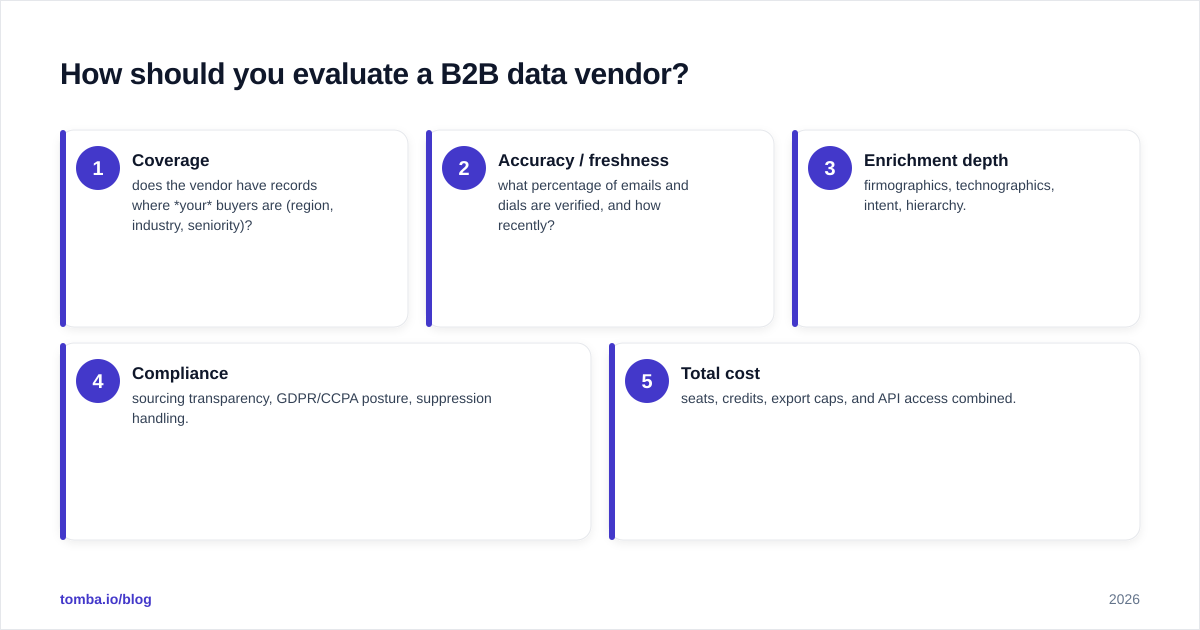
Use these five criteria:
- Coverage — does the vendor have records where your buyers are (region, industry, seniority)?
- Accuracy / freshness — what percentage of emails and dials are verified, and how recently?
- Enrichment depth — firmographics, technographics, intent, hierarchy.
- Compliance — sourcing transparency, GDPR/CCPA posture, suppression handling.
- Total cost — seats, credits, export caps, and API access combined.
A vendor that scores 9/10 on coverage but 4/10 on freshness will quietly tank your email deliverability, because stale addresses generate hard bounces that damage your sending reputation.

Archetype Data vs Smarte: how do they compare?#
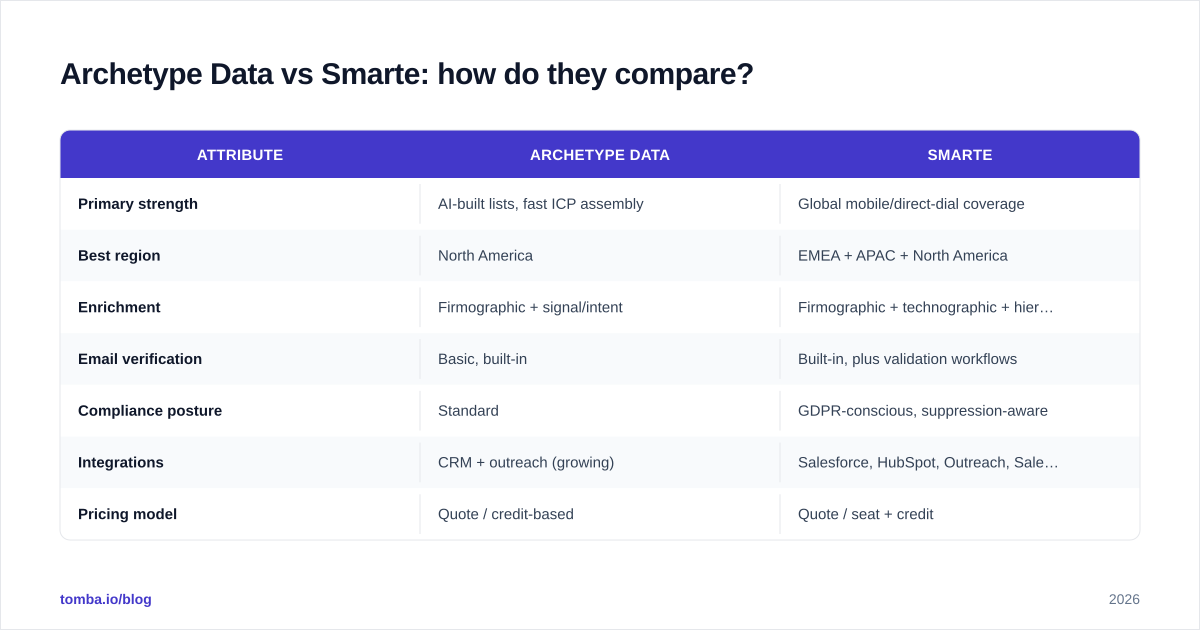
Here is the head-to-head across the criteria that matter. Treat the accuracy and pricing figures as directional — both vendors quote per deal, and self-reported match rates always run optimistic until you test against your own list.
| Attribute | Archetype Data | SMARTe |
|---|---|---|
| Primary strength | AI-built lists, fast ICP assembly | Global mobile/direct-dial coverage |
| Best region | North America | EMEA + APAC + North America |
| Enrichment | Firmographic + signal/intent | Firmographic + technographic + hierarchy |
| Email verification | Basic, built-in | Built-in, plus validation workflows |
| Compliance posture | Standard | GDPR-conscious, suppression-aware |
| Integrations | CRM + outreach (growing) | Salesforce, HubSpot, Outreach, Salesloft |
| Pricing model | Quote / credit-based | Quote / seat + credit |
| Free trial | Limited | Demo-gated |
| Ideal buyer | Founders, lean GTM teams | Mid-market to enterprise sales orgs |
A few takeaways from the table:
- If your buyers sit in Europe or Asia-Pacific, SMARTe's phone coverage is the single biggest differentiator and usually justifies the heavier sales process.
- If you are a small team that wants lists today, Archetype's lower-friction onboarding is the draw.
- Neither replaces a standalone verification step. Both numbers improve dramatically when you run exports through a dedicated checker before loading them into sequences.
Which tool is more accurate?#
Accuracy is the question that actually decides the contract, and the honest answer is: it depends on your segment, and you must test it.
Vendor-published accuracy claims (often "95%+") are measured under ideal conditions across their entire database. Your slice — say, VP-level contacts at 200–500 employee SaaS companies in DACH — may behave very differently. The only credible test is a blind sample: pull 100 contacts you can independently confirm, run them through each tool, and measure true match rate and bounce rate.
In practice, SMARTe tends to hold up better on international direct dials, while both perform comparably on North American corporate email. Archetype's intent and signal layer is useful for prioritization but should not be confused with contact accuracy — a "hot" account with a dead email address still bounces.
This is why mature RevOps teams treat any data vendor as a sourcing layer and add a separate verification layer on top. Running discovered addresses through an email verification pass — including catch-all detection — is what keeps bounce rates under the 2–3% threshold that mailbox providers reward. If you skip it, even excellent source data degrades the moment it ages.
For teams that also need to fill gaps the big databases miss, pairing a suite with a precise email finder that resolves individual name-plus-domain lookups closes the long tail that bulk databases leave empty.
How do Archetype Data and Smarte handle pricing?#
Both vendors use quote-based pricing, which means the published comparisons you find online are mostly guesswork. What you can rely on is the shape of the cost.
| Cost factor | What to watch |
|---|---|
| Seats | Per-user pricing scales fast on enterprise plans |
| Credits | Exports/reveals are metered — model your monthly volume |
| Export caps | Some tiers throttle bulk downloads |
| API access | Often a premium add-on, not included |
| Annual lock-in | Discounts require 12-month commitments |
To avoid surprises:
- Ask for the credit-to-contact ratio in writing. "Unlimited" rarely means unlimited.
- Confirm whether API and CRM sync are included or upsells.
- Negotiate a paid pilot with a real success metric (match rate on your sample), not a generic demo.
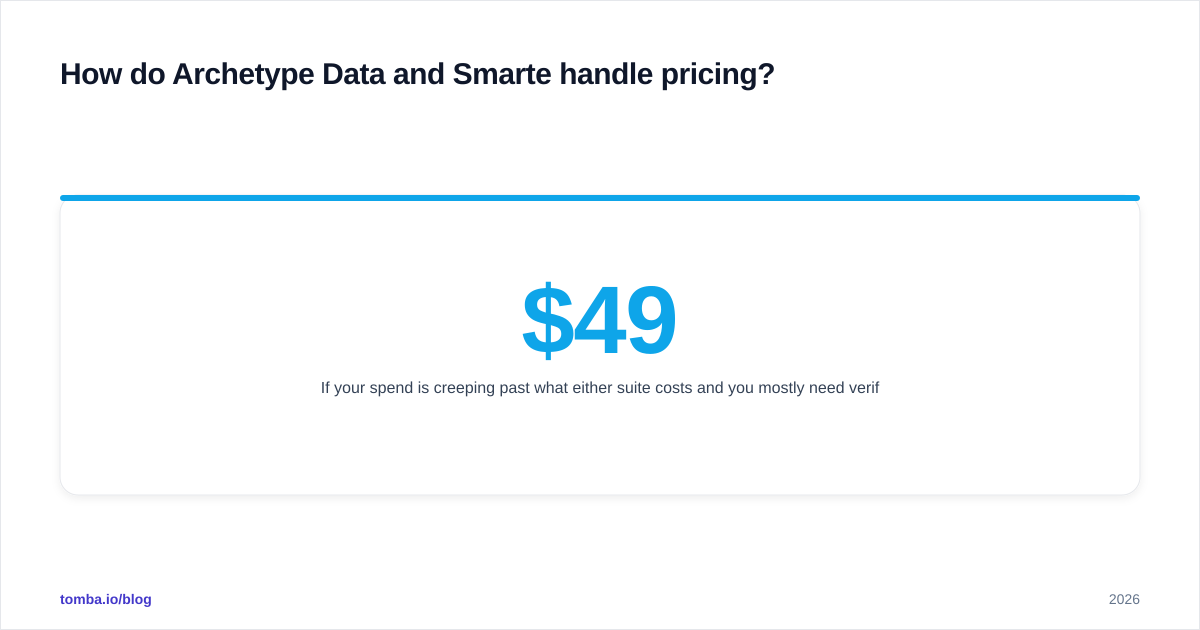
If your spend is creeping past what either suite costs and you mostly need verified emails rather than a full intelligence platform, compare the math against transparent, published Tomba pricing: a Free tier with 25 searches/month, Starter at $49/mo, Growth at $99/mo, and Pro at $249/mo. For many outbound teams, a focused finder plus verifier costs a fraction of an enterprise data seat.
Who should choose Archetype Data?#
Archetype Data is the better fit when:
- You are a founder or small GTM team that needs lists without a procurement cycle.
- Speed of list assembly matters more than deep international coverage.
- You want intent and signal data bundled with contacts to prioritize accounts.
- Your motion is primarily North American email outreach.
The trade-off is maturity. Newer platforms iterate quickly but can have thinner integration ecosystems and less battle-tested compliance documentation. If your legal team scrutinizes data sourcing, ask pointed questions early.
Who should choose Smarte?#
SMARTe is the stronger choice when:
- You sell into EMEA or APAC and need accurate mobile/direct dials.
- Compliance and suppression handling are non-negotiable (regulated industries, public companies).
- You run a mid-market or enterprise sales org with established Salesforce/Outreach workflows.
- You want deeper firmographic and hierarchy data for account mapping.
The trade-off is process: enterprise sales-intelligence platforms come with demos, onboarding, and annual commitments. That overhead pays off at scale but is friction for a three-person team that just needs 500 verified emails this week. Independent analyst coverage on sites like Gartner can help validate enterprise claims during procurement.
Do you actually need a full data suite?#
Here is the contrarian take most vendor comparisons won't give you: many teams buy a heavyweight data platform to solve a problem that a lightweight finder-plus-verifier stack solves for less.
Ask yourself what you're really buying:
- If you need intent signals, account hierarchies, and global dials, a full suite earns its cost.
- If you mostly need accurate emails by domain or name, plus verification, a focused toolset is faster and cheaper.
A lean stack often looks like this: use domain search to map every reachable contact at a target company, use a finder to resolve specific people, run a data enrichment pass for firmographics, and verify everything before it touches your sequencer. You can read where the underlying records come from on Tomba's data sources page — transparency that's worth demanding from any vendor, Archetype and SMARTe included. Vendors like SMARTe publish their own positioning on their official site, and it's worth reading their sourcing claims with the same skepticism.
The point isn't that suites are bad — it's that "buy the biggest database" is the wrong default. Match the tool to the motion.
What does a smart evaluation process look like?#
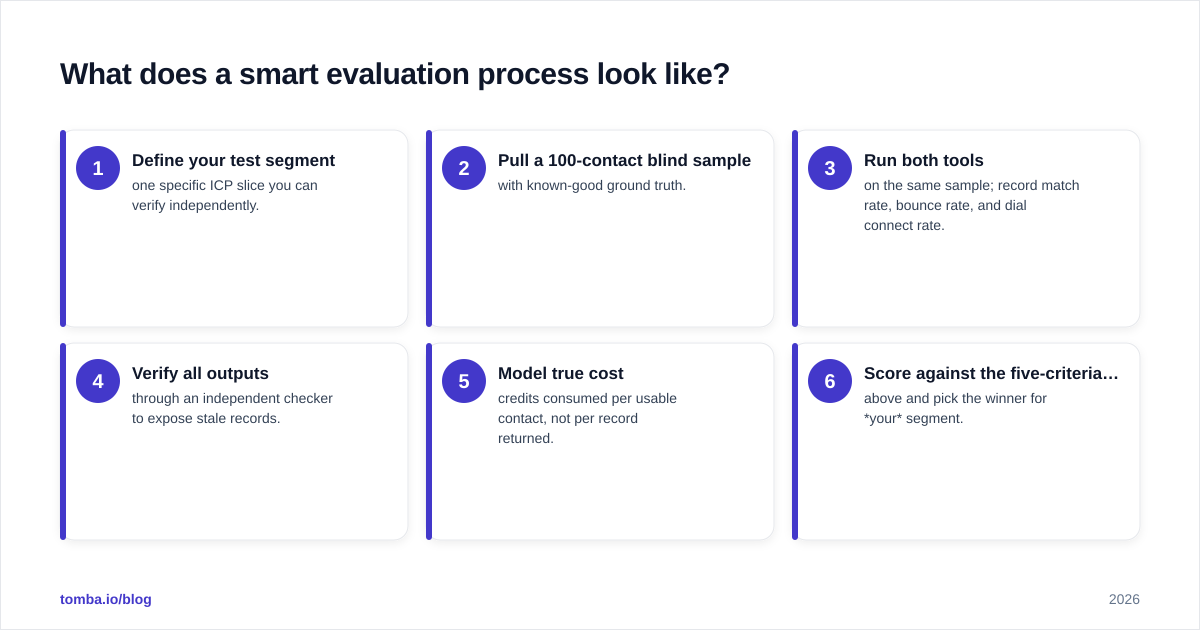
Run a structured bake-off instead of trusting marketing pages:
- Define your test segment — one specific ICP slice you can verify independently.
- Pull a 100-contact blind sample with known-good ground truth.
- Run both tools on the same sample; record match rate, bounce rate, and dial connect rate.
- Verify all outputs through an independent checker to expose stale records.
- Model true cost — credits consumed per usable contact, not per record returned.
- Score against the five-criteria framework above and pick the winner for your segment.
This process takes a week and routinely saves teams five figures a year, because the "obvious" winner on paper is frequently the loser on your specific data.
Final verdict: Archetype Data vs Smarte#
There is no universal winner — there is a winner for your motion.
- Choose SMARTe if international reach, direct dials, and compliance are your priorities and you have the budget and process for an enterprise platform.
- Choose Archetype Data if you're a lean team that values speed, intent signals, and a low-friction start in a primarily North American market.
- Choose neither as a complete solution — both need a dedicated verification layer, and many teams discover that a focused finder-plus-verifier stack covers 80% of their need at 20% of the cost.
Whatever you pick, the non-negotiable is verification. Source data ages the day it's collected, and unverified records are the fastest way to wreck a sending reputation.
Get accurate emails without the enterprise contract#
If your real job is reaching the right people — not administering a data platform — start with the part that drives replies: accurate, verified email discovery. The Tomba Email Finder resolves professional emails by name, company, or domain, backs them with verification and catch-all detection, and starts free with 25 searches a month before scaling to a transparent $49/mo Starter plan. Test it against your blind sample alongside Archetype Data and SMARTe, and let your own bounce rate pick the winner.
// get started
Find, verify and enrich your first contacts today
Start on the free plan with 25 searches a month, then scale when your team is ready.
Free plan · No credit card required · GDPR & CCPA
// about the author