Archetype Data vs Sparklane: B2B Data Compared (2026)
Choosing between Archetype Data and Sparklane in 2026? We break down pricing, data accuracy, coverage, signals, and integrations so you can pick the B2B intelligence platform that actually fits your pipeline.
You have a budget for one B2B data platform this quarter, and two names keep landing on the shortlist: Archetype Data and Sparklane. Both promise cleaner accounts, warmer contacts, and fewer hours wasted on dead leads. They get there very differently.
This is a neutral breakdown of how the two compare in 2026 — on data model, accuracy, signals, pricing, and where each one actually earns its seat in your stack. No marketing gloss, just the trade-offs that change which tool you sign.
TL;DR — Archetype Data vs Sparklane at a glance#
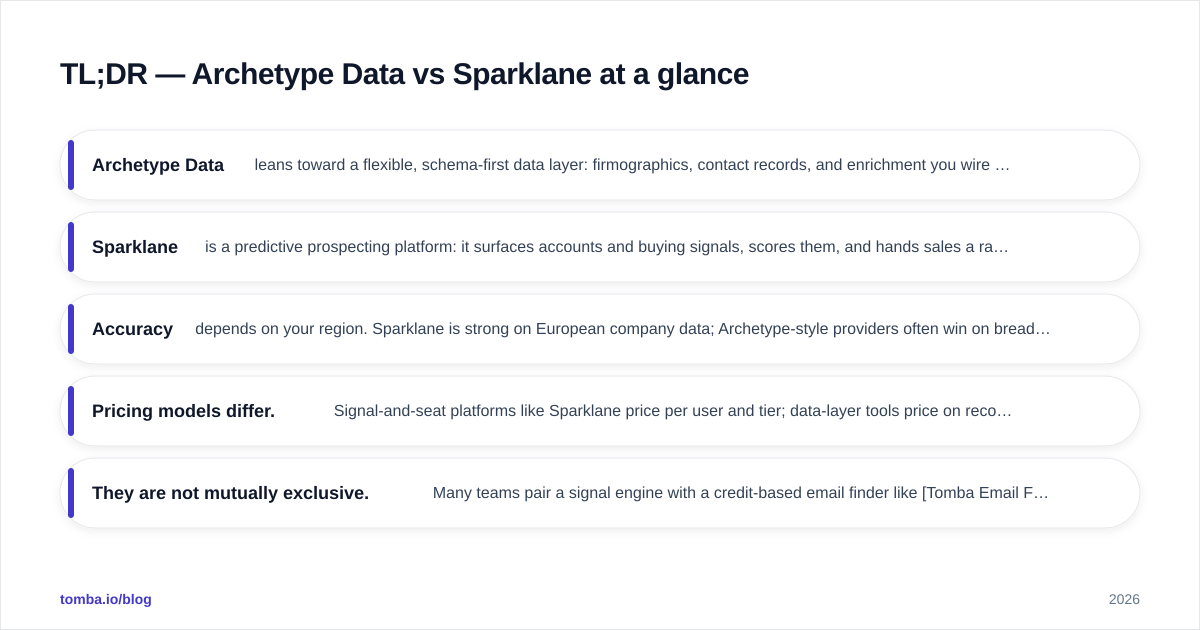
- Archetype Data leans toward a flexible, schema-first data layer: firmographics, contact records, and enrichment you wire into your own CRM and models. Best for RevOps teams that want raw, structured data they control.
- Sparklane is a predictive prospecting platform: it surfaces accounts and buying signals, scores them, and hands sales a ranked list. Best for outbound teams that want decisions, not just data.
- Accuracy depends on your region. Sparklane is strong on European company data; Archetype-style providers often win on breadth and API-level contact coverage.
- Pricing models differ. Signal-and-seat platforms like Sparklane price per user and tier; data-layer tools price on records, credits, or API volume — which changes your cost curve as you scale.
- They are not mutually exclusive. Many teams pair a signal engine with a credit-based email finder like Tomba Email Finder to fill contact gaps cheaply.
What is Archetype Data?#
Archetype Data sits in the "B2B data layer" category — think structured firmographic and contact records you pull into your own systems. The pitch is control: you get account attributes (industry, size, revenue, tech stack), contact records, and enrichment endpoints, then you decide how to model, score, and route them.
Tools in this category win when your team already has a CRM, a data warehouse, or a lead-scoring model and just needs reliable inputs. You are not paying for someone else's opinion of which account is hot — you are paying for clean fields you can trust and combine with your own first-party signals.
The trade-off: a data layer gives you raw material, not a workflow. If your reps want a ready-to-call list every Monday, a pure data tool means you (or your RevOps team) still have to build the scoring and routing on top. That is power for the technical, friction for the impatient.
What is Sparklane?#
Sparklane is a predictive lead-generation and sales-intelligence platform, well known in the European market. Instead of handing you a database to query, it watches the market for buying signals — hiring spikes, funding rounds, leadership changes, expansion news — scores accounts against your ideal customer profile, and delivers a prioritized list of who to contact now.
The value is the decision layer. A rep logs in and sees "these 30 accounts moved this week, here's why." That removes the blank-page problem of outbound. For teams without a data engineer to build scoring models, that pre-built intelligence is the entire point.
The trade-off runs the other direction: you get Sparklane's interpretation of relevance, packaged. You have less granular control over the underlying records, and coverage is strongest in the regions and segments Sparklane focuses on. If you operate globally or need deep contact-level data piped into a custom model, a signal platform alone may leave gaps.

How do Archetype Data and Sparklane actually differ?#
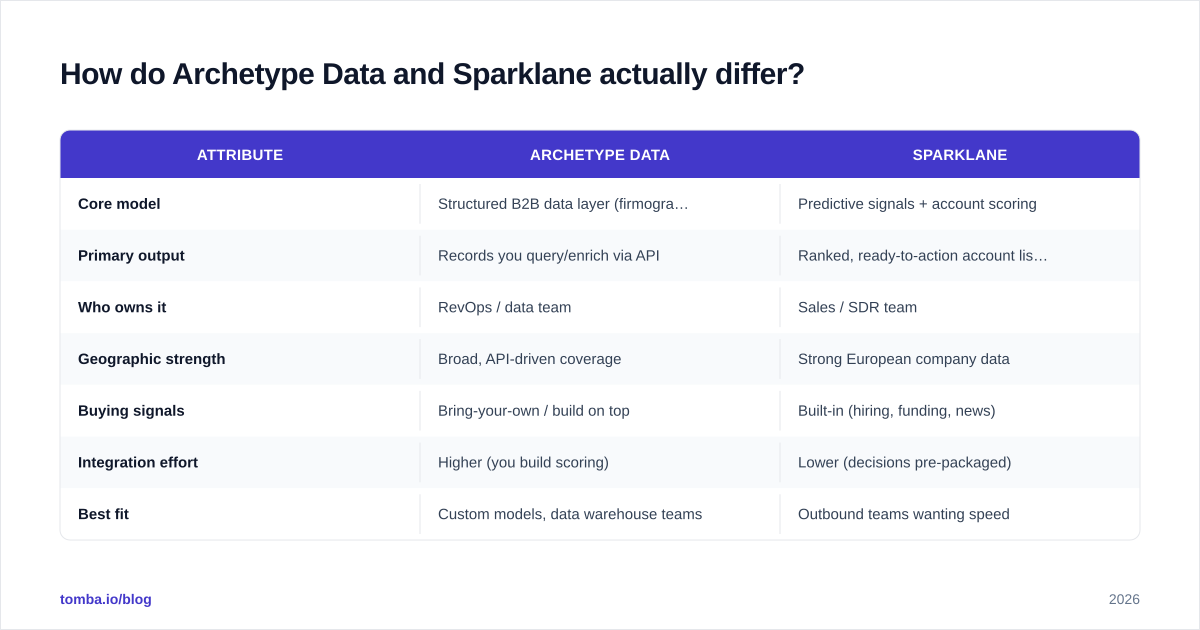
The cleanest way to think about it: one sells structured data, the other sells prioritized decisions. That distinction drives almost every other difference — pricing, integration effort, and who on your team owns the tool.
Use the framework above as a gut check. If your bottleneck is "we have leads but don't know who to prioritize," you want a signal engine. If your bottleneck is "our CRM is full of stale, half-empty records," you want a data layer. Most teams discover, honestly, that they have both problems — which is why the build-your-own-stack route in the last section is so common.
| Attribute | Archetype Data | Sparklane |
|---|---|---|
| Core model | Structured B2B data layer (firmographics + contacts) | Predictive signals + account scoring |
| Primary output | Records you query/enrich via API | Ranked, ready-to-action account lists |
| Who owns it | RevOps / data team | Sales / SDR team |
| Geographic strength | Broad, API-driven coverage | Strong European company data |
| Buying signals | Bring-your-own / build on top | Built-in (hiring, funding, news) |
| Integration effort | Higher (you build scoring) | Lower (decisions pre-packaged) |
| Best fit | Custom models, data warehouse teams | Outbound teams wanting speed |
| Typical pricing axis | Records / credits / API volume | Per seat + tier |
Which one is more accurate?#
Accuracy is not a single number — it depends on what you measure and where you sell. Account-level firmographics (company exists, size band, industry) tend to be reliable across both. The gap shows up at the contact level: direct emails, phone numbers, and decision-maker mapping.
Signal-led platforms optimize for "is this account worth your time," and their contact data is a supporting feature, not the headline. Data-layer providers optimize for field completeness and freshness across large volumes. If your campaigns live or die on reaching a named VP's inbox, scrutinize contact accuracy specifically — request a sample and verify it against your own list before you commit.
This is also where a dedicated verification step pays off regardless of platform. No provider is 100% fresh, so running new contacts through an email verifier before a send protects your sender reputation and keeps bounce rates low. Treat vendor accuracy claims as a starting point, then verify. For independent perspective, cross-check vendor reviews on G2 and Capterra where buyers report real bounce and match rates.
How do Archetype Data and Sparklane price?#
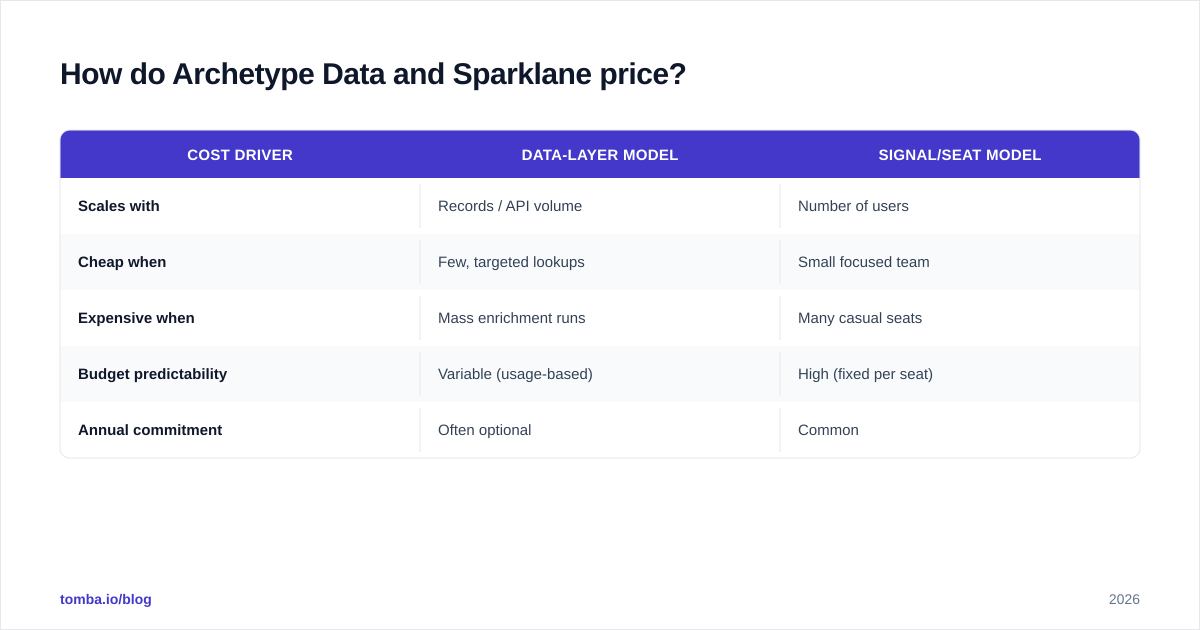
Pricing philosophy follows product philosophy, and it matters more than the sticker number because it determines your cost curve as you scale.
- Signal/seat platforms (Sparklane-style): you typically pay per user plus a feature tier. Cost scales with headcount. Predictable if your team size is stable; expensive if you want to give 40 reps access "just to look."
- Data-layer tools (Archetype-style): you usually pay on records, enrichment credits, or API call volume. Cost scales with usage. Cheap to start, but a big enrichment run or a chatty integration can spike the bill.
| Cost driver | Data-layer model | Signal/seat model |
|---|---|---|
| Scales with | Records / API volume | Number of users |
| Cheap when | Few, targeted lookups | Small focused team |
| Expensive when | Mass enrichment runs | Many casual seats |
| Budget predictability | Variable (usage-based) | High (fixed per seat) |
| Annual commitment | Often optional | Common |
When you compare quotes, normalize to cost per actioned contact, not cost per seat or per credit. A cheap seat that produces unworkable lists is more expensive than a usage-based tool that delivers contacts your reps actually convert. Analyst frameworks from Gartner on sales intelligence are useful for structuring that total-cost view.

Which should you choose: Archetype Data or Sparklane?#
Pick based on your bottleneck, not the feature list.
Choose a data-layer tool like Archetype Data if:
- You have a data warehouse or a custom lead-scoring model
- RevOps owns enrichment and wants control over fields and freshness
- You sell across many regions and need broad, API-first coverage
- You'd rather pay for usage than for seats
Choose a signal platform like Sparklane if:
- Your SDRs need a prioritized list, not a query interface
- You sell into Europe and value strong local company data
- You don't have engineering time to build scoring
- Predictable per-seat budgeting matters to finance
Choose neither alone — build a hybrid if:
- You want signals and deep contact data without overpaying for either
That third option is more common than vendors admit. A lean, effective 2026 stack often looks like: a focused signal source to find accounts in motion, your CRM as the system of record, and a credit-based finder to pull verified contacts on demand.
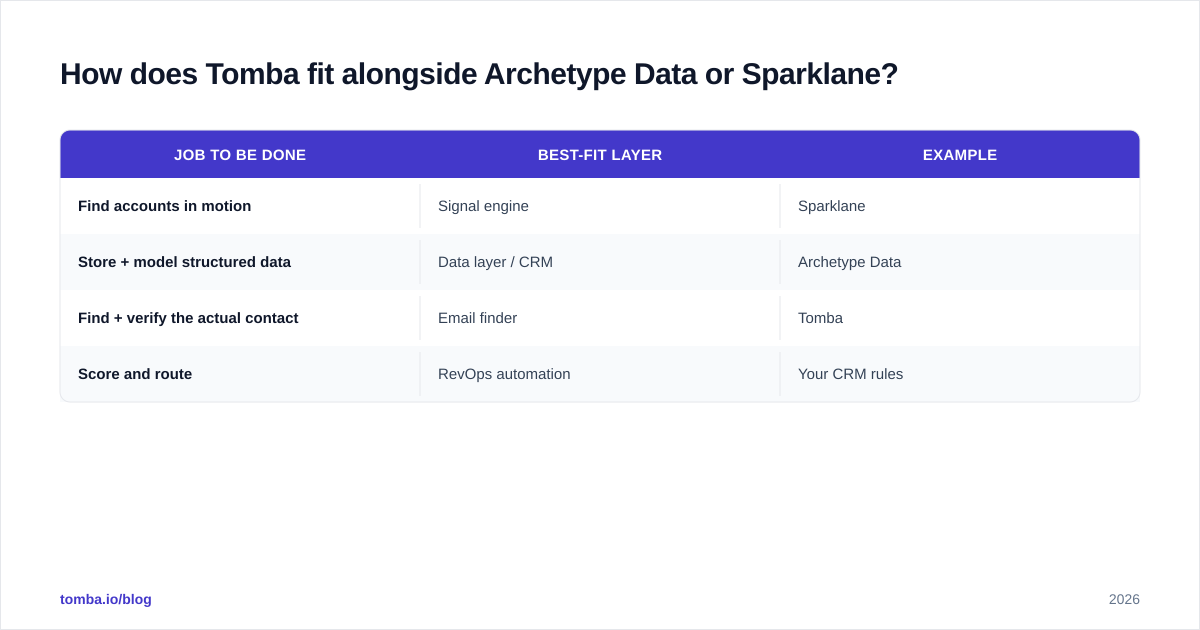
How does Tomba fit alongside Archetype Data or Sparklane?#
Tomba is not a predictive signal engine and does not try to be. It is the contact-data layer — the part that turns "this account looks hot" into "here is the verified email of the person who decides."
Where Tomba complements both platforms:
- Fill contact gaps cheaply. When Sparklane flags an account but the named buyer's email is missing, find email addresses by domain and name without paying for another full seat.
- Enrich on your terms. Use data enrichment and domain search to top up records your data layer left thin.
- Verify before you send. Built-in verification keeps bounce rates and sender reputation healthy.
- Pay for what you use. Tomba's pricing runs Free (25 searches/mo), Starter $49/mo, Growth $99/mo, Pro $249/mo, and Enterprise — a usage-based curve that pairs well with seat-priced signal tools.
The point is not "replace your platform with Tomba." It's that the contact-finding job is often cheaper and more accurate as a dedicated tool than as a bundled afterthought inside a bigger suite.
| Job to be done | Best-fit layer | Example |
|---|---|---|
| Find accounts in motion | Signal engine | Sparklane |
| Store + model structured data | Data layer / CRM | Archetype Data |
| Find + verify the actual contact | Email finder | Tomba |
| Score and route | RevOps automation | Your CRM rules |
The honest verdict#
There is no universal winner between Archetype Data and Sparklane — they answer different questions. Sparklane is the stronger pick when your team needs prioritized decisions and sells into Europe. A data-layer tool like Archetype Data is the stronger pick when you have the technical muscle to model your own data and want broad, usage-priced coverage.
What both leave on the table is fast, verified contact data at a credit-based price. That gap is exactly where a focused finder earns its place — and why so many 2026 stacks run a signal engine and a dedicated email tool rather than betting everything on one suite.
If your real pain is reaching the right person once you've identified the right account, start with the Tomba Email Finder. The free tier gives you 25 searches a month to test match rates against your own list — verify the accuracy yourself before you spend a cent, then plug it alongside whichever intelligence platform you choose.
Ready to find emails that actually work?
Join 150,000+ professionals who stopped guessing and started sending. Free credits on signup — no credit card required.
Get the Tomba newsletter
Practical outbound tactics and product updates — once every two weeks.
About the author