Archetype Data vs Tomba: B2B Email Data Compared (2026)
A neutral, hands-on breakdown of Archetype Data vs Tomba for B2B email finding, verification, and enrichment — pricing, accuracy, coverage, and the right fit for your stack in 2026.
Choosing between Archetype Data and Tomba comes down to one question: do you need a self-serve email-finding engine with transparent pricing and a fast API, or a managed B2B data feed you negotiate by contract? Both put contact data in front of your sales team, but they solve the problem from opposite ends.
This is a neutral comparison. We mention where Tomba is the stronger pick and where it isn't, so you can map each tool to your actual workflow instead of a feature checklist.
TL;DR — Archetype Data vs Tomba at a glance#
- Tomba is a self-serve email finder, verifier, and enrichment platform with public pricing (Free, $49, $99, $249/mo) and an instant API. Best for teams that want to start today.
- Archetype Data positions as a B2B data/intelligence provider — typically quote-based, contract-led, and aimed at larger data-ops buyers.
- On accuracy and verification, Tomba pairs finding with SMTP-level verification and catch-all handling in one flow; data-feed vendors often hand you raw records to verify yourself.
- On time-to-value, Tomba wins for SMBs and individual reps; a managed data provider can win for enterprise data warehousing at volume.
- If you want predictable per-seat cost and an API you can wire up in an afternoon, Tomba is the safer default.

What is Archetype Data?#
Archetype Data sits in the broad "B2B data and intelligence" category — vendors that supply company and contact records, firmographics, and enrichment for sales and marketing teams. Tools in this space usually emphasize database scale, account-level intelligence, and integrations into a data warehouse or CRM.
The trade-off with most data-feed vendors is commercial, not technical. Pricing is commonly quote-based, onboarding involves a sales cycle, and you often commit to an annual contract sized to your record volume. That model fits a RevOps team building a central B2B database, but it's heavier than a single SDR needs to verify 200 prospects before a Monday send.
Because public, line-item pricing for Archetype Data isn't consistently published, treat any specific dollar figures you see in third-party listings with caution and confirm directly. We've kept the comparison below to capabilities and commercial model rather than inventing numbers.
What is Tomba?#
Tomba is a self-serve email finder and verification platform. You give it a name and domain (or just a domain) and it returns professional email addresses, scored for confidence and checked against the mail server.
The product is a suite, not a single endpoint:
- Email finder — find addresses by name, company, or domain
- Email verifier — SMTP checks, syntax, MX, and risk scoring
- Domain search — pull every public address pattern for a company
- Catch-all verifier — handle the domains that accept everything
- Phone finder and data enrichment — round out the record
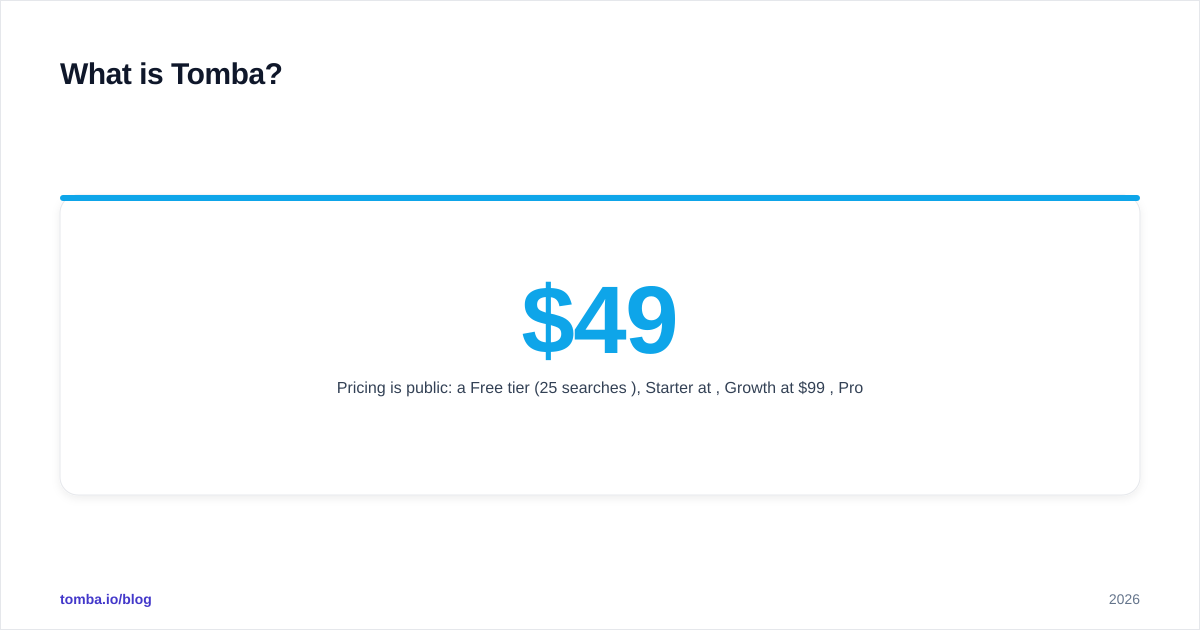
Pricing is public: a Free tier (25 searches/mo), Starter at $49/mo, Growth at $99/mo, Pro at $249/mo, and custom Enterprise. You can see the full Tomba pricing without a sales call.
How do Archetype Data and Tomba compare?#
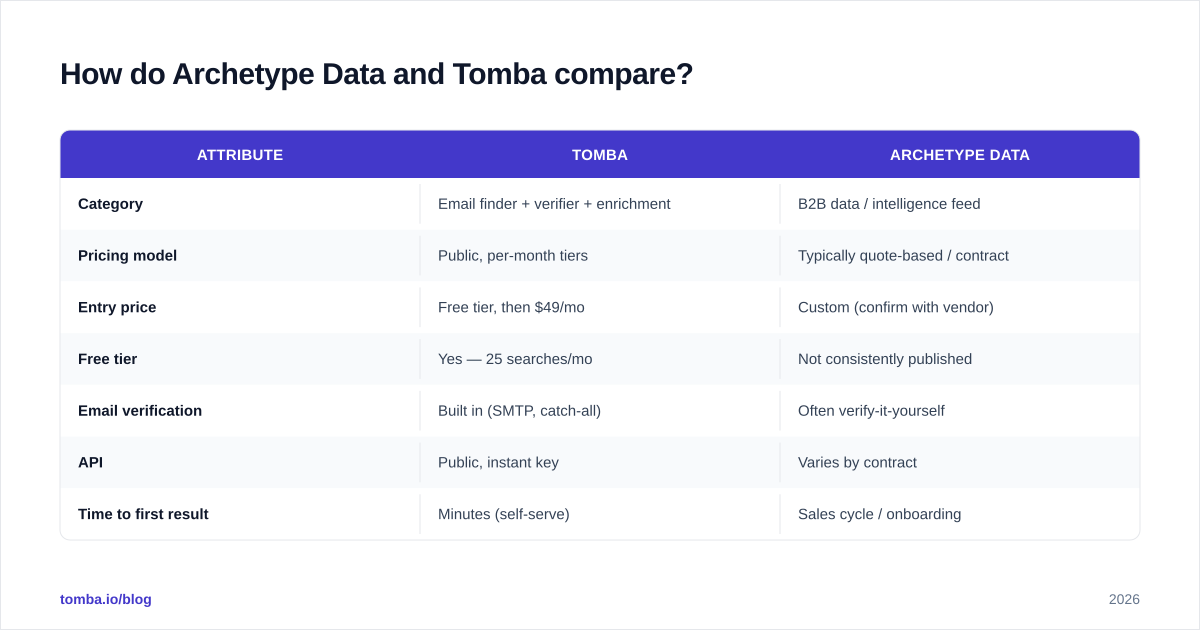
Here is the side-by-side. Where Archetype Data's public details are limited, the cell reflects the typical managed-data-vendor model rather than a confirmed spec.
| Attribute | Tomba | Archetype Data |
|---|---|---|
| Category | Email finder + verifier + enrichment | B2B data / intelligence feed |
| Pricing model | Public, per-month tiers | Typically quote-based / contract |
| Entry price | Free tier, then $49/mo | Custom (confirm with vendor) |
| Free tier | Yes — 25 searches/mo | Not consistently published |
| Email verification | Built in (SMTP, catch-all) | Often verify-it-yourself |
| API | Public, instant key | Varies by contract |
| Time to first result | Minutes (self-serve) | Sales cycle / onboarding |
| Best for | SMBs, SDRs, agencies, devs | Enterprise data-ops at volume |
The pattern is clear: Tomba optimizes for self-serve speed and price transparency; a managed data vendor optimizes for scale and account-level depth under contract.

Which one is more accurate?#
Accuracy is two jobs, and the winner depends on whether a tool does both. Finding an address is step one; confirming it won't bounce is step two. A lot of buyers conflate them and then wonder why their bounce rate climbs.
Tomba couples finding with verification in the same call path. Every result carries a confidence score, and you can run the email verifier or catch-all verifier to filter risky addresses before they ever hit your sequencer. That matters because bounce rate feeds directly into sender reputation — a list that's 95% findable but unverified can still wreck your email deliverability.
Managed data feeds vary. Some ship pre-verified records; many hand you raw contacts and expect your stack to validate them. If Archetype Data delivers a record dump, budget for a verification pass either way — which is a step Tomba folds in.
Use this simple framework to decide what "accurate enough" means for your motion:
For independent benchmarking, cross-check vendor claims against third-party review sites like G2 and Capterra rather than trusting any single marketing page — including ours.
How does the pricing really compare?#
Predictability is the deciding factor for most teams. Tomba's tiers are flat and public, so you can model cost per lead before you commit. Quote-based vendors trade that predictability for volume discounts that only pay off at scale.
A worked example: at the Growth plan ($99/mo) you get a fixed monthly credit pool you can spend across finding, verification, and enrichment. There's no procurement cycle, and you can downgrade or cancel without renegotiating a contract. For a 1-5 person sales team, that flexibility usually beats a larger annual commitment.

Where a managed feed wins on price: if you're enriching hundreds of thousands of records into a warehouse and can commit annually, a negotiated per-record rate can undercut per-seat tooling. That's an enterprise data-ops scenario, not a prospecting one.
Which has better coverage and data sources?#
Coverage is where the two models genuinely differ, and neither is universally "more." Tomba builds from public web sources, domain patterns, and verification signals — strong for finding work emails tied to a domain or name. You can read about where Tomba gets data directly.
Large data-feed vendors compete on database size and firmographic depth — total contact counts, intent signals, and account hierarchies. If your use case is account-based marketing across a fixed target list, that breadth can matter more than per-lookup speed.
A practical test: take 25 of your real target accounts and run them through both. Count not just how many emails come back, but how many survive verification. Raw match rate flatters every vendor; verified match rate is the number that pays your bills.
When should you pick Archetype Data over Tomba?#
Be honest about your stage. Pick a managed B2B data provider when:
- You're enriching a data warehouse, not just prospecting in a CRM.
- You need account-level intelligence and intent signals, not just emails.
- You have the procurement runway for an annual contract and a dedicated data-ops owner.
- Your volume is high enough that negotiated per-record pricing beats per-seat tooling.
In those cases the contract overhead is worth it, and the depth justifies the onboarding.
When is Tomba the better choice?#
Pick Tomba when speed, price transparency, and verification-in-the-loop matter more than warehouse-scale breadth:
- You're an SDR, founder, agency, or small team that needs results today.
- You want finding and verification in one flow to protect deliverability.
- You need a clean email finder API you can integrate without a contract.
- You want to start free and scale your spend in $49 increments, not annual leaps.
Tomba also slots into existing tools — there's a HubSpot integration, a Google Sheets add-on, and a Chrome extension — so you can keep your current workflow and add finding plus verification on top.

What about the developer experience?#
If you're building, not just buying, this section decides it. Tomba ships a public API with an instant key, plus a CLI and an MCP server for AI workflows. You can prototype an enrichment job in an afternoon and check the structured response against your own data before committing budget.
Managed data feeds usually expose an API too, but access, rate limits, and schema are negotiated as part of the contract — which is fine for a planned integration and slow for an experiment. For bulk lead generation where you want to script find-then-verify across thousands of rows, Tomba's self-serve model removes the procurement bottleneck. Documentation quality and SDK breadth are worth checking against the vendor's own docs and a neutral source like Wikipedia's overview of email verification for the underlying concepts.
The bottom line: Archetype Data vs Tomba#
There's no single winner — there's a fit. If you're an enterprise data-ops team building a contact warehouse with intent signals and you can sign an annual deal, a managed B2B data provider earns its keep. If you're a sales team, agency, or developer who wants verified emails fast, with public pricing and an API you control, Tomba is the more practical default.
Most teams under 50 people will get to value faster with Tomba, then graduate to a heavier data stack only if and when warehouse-scale enrichment becomes the bottleneck.
Ready to test it on your own list? Spin up the Tomba Email Finder on the free tier — 25 searches, no contract, no sales call. Run your 25 hardest target accounts through it, count the verified matches, and let the numbers decide. If it earns the upgrade, the $49/mo Starter plan is one click away.
// get started
Find, verify and enrich your first contacts today
Start on the free plan with 25 searches a month, then scale when your team is ready.
Free plan · No credit card required · GDPR & CCPA
// about the author