Archetype Data vs Warpleads (2026): Honest B2B Data Comparison
Archetype Data vs Warpleads compared on data accuracy, export limits, pricing, and verification. See which B2B lead tool actually fits your outbound motion in 2026.
Picking a B2B data source feels simple until your first campaign bounces at 22% and your domain reputation tanks. Archetype Data and Warpleads sit on opposite ends of the same problem: one leans into curated, intent-rich data; the other leans into raw export volume. This guide breaks down where each wins, where each hurts you, and how to decide without burning a month of sending reputation finding out.
TL;DR#
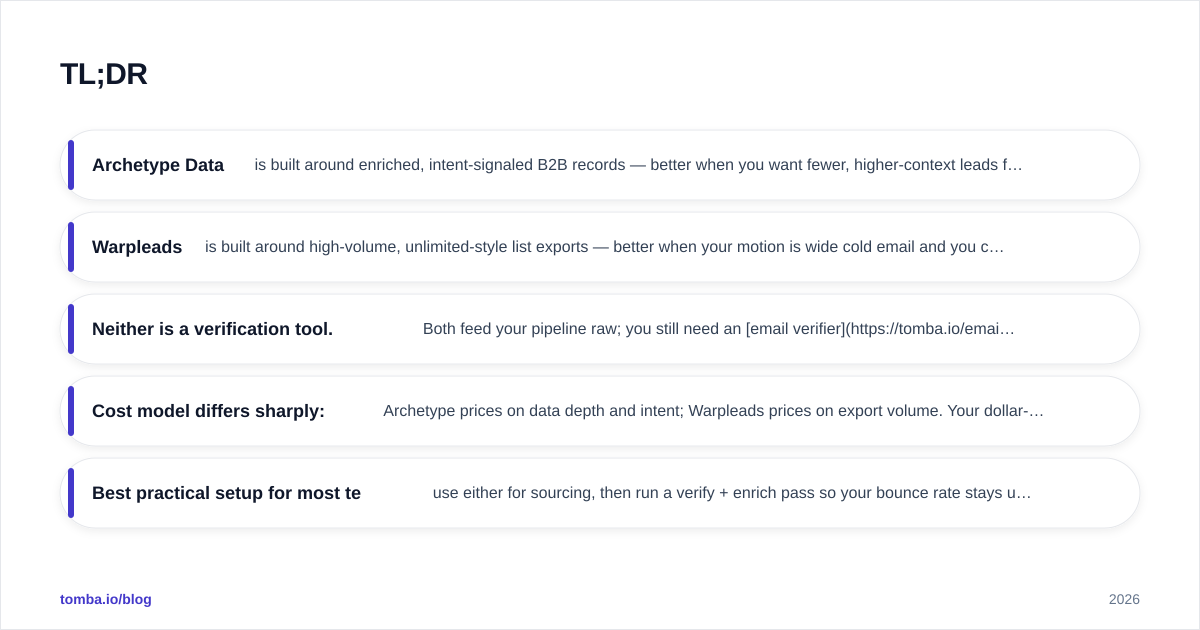
- Archetype Data is built around enriched, intent-signaled B2B records — better when you want fewer, higher-context leads for targeted account-based outbound.
- Warpleads is built around high-volume, unlimited-style list exports — better when your motion is wide cold email and you can verify in a separate step.
- Neither is a verification tool. Both feed your pipeline raw; you still need an email verifier before you send, or you eat the bounce penalty.
- Cost model differs sharply: Archetype prices on data depth and intent; Warpleads prices on export volume. Your dollar-per-usable-lead can flip depending on how clean the list is.
- Best practical setup for most teams: use either for sourcing, then run a verify + enrich pass so your bounce rate stays under 3%.
What is Archetype Data?#
Archetype Data is a B2B data provider focused on enriched company and contact records, typically bundled with firmographic and intent signals. The pitch is quality over quantity: instead of dumping ten thousand vaguely-matched contacts, it aims to give you accounts that look like your best customers — same size, same tech stack, same buying signals — with decision-maker contacts attached.
That "looks like your best customers" idea is literally where the name comes from: you define an archetype (your ideal customer profile) and the platform surfaces matches. For account-based outbound, this is the right shape of data. You're not trying to email the world; you're trying to reach 300 accounts that actually fit.
The trade-off is that curated data costs more per record and gives you fewer records. If your campaign math needs 50,000 sends a month to hit quota, a precision tool can feel slow and expensive.
What is Warpleads?#
Warpleads is a lead-generation platform built around volume export. The core promise is scale: large, exportable B2B lists, often marketed with unlimited or high-cap export tiers, so you can fill the top of a wide cold-email funnel fast. If your strategy is spray-test-and-measure across many ICPs, that volume is genuinely useful.
The catch with any volume-first source is freshness and accuracy. Big databases drift — people change jobs, companies fold, catch-all domains hide invalid mailboxes. Warpleads gives you reach, but the burden of proving each address is deliverable lands on you. That's not a knock unique to Warpleads; it's true of every volume provider. It just matters more when the whole value prop is "lots of leads."

Archetype Data vs Warpleads: the core difference#
Conclusion first: Archetype optimizes for precision per lead; Warpleads optimizes for leads per dollar. Everything else follows from that one axis.
If you sell a high-ACV product where each closed deal is worth five figures, a handful of well-researched, intent-backed contacts beats a giant list. The cost of a wrong email there isn't the bounce — it's the wasted rep-hour personalizing to the wrong person. Archetype's model fits.
If you sell a low-ACV, high-velocity product where you need volume to find signal, paying premium prices per record is the wrong trade. You want reach, you accept some waste, and you verify aggressively downstream. Warpleads' model fits.
The mistake teams make is buying the wrong shape of data for their motion — then blaming the tool when the campaign underperforms. The data was fine; the strategy-to-data match was broken.
How do they compare on features and pricing?#
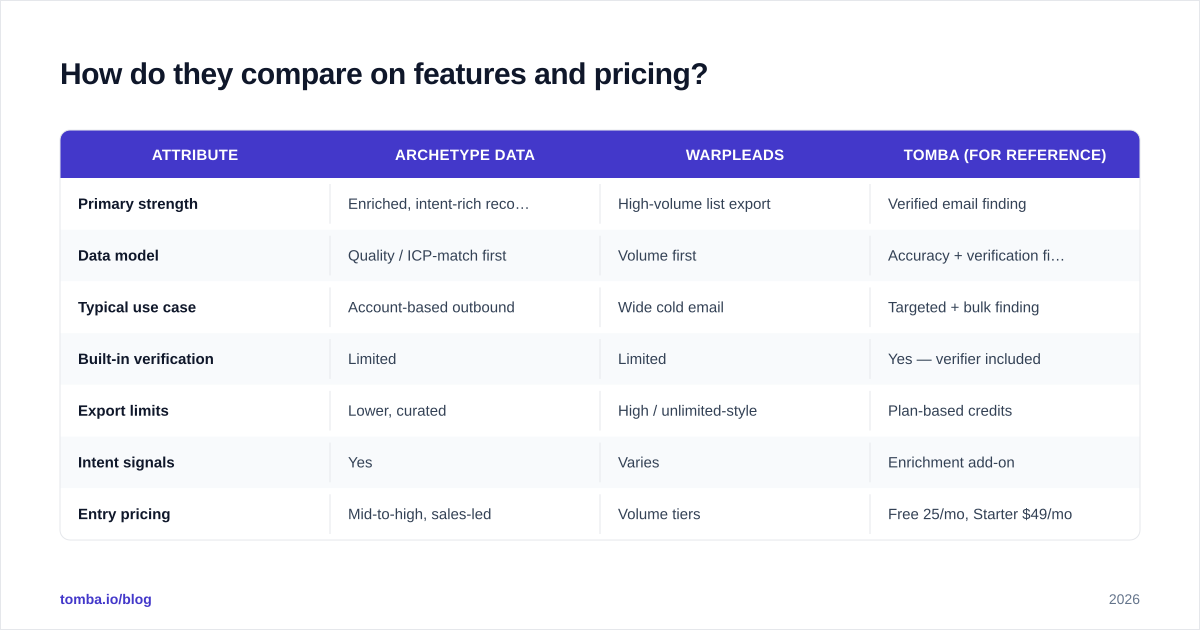
Here's the side-by-side. Treat pricing as directional — both vendors gate exact numbers behind sales or change tiers — but the shape of each model is what matters for your decision.
| Attribute | Archetype Data | Warpleads | Tomba (for reference) |
|---|---|---|---|
| Primary strength | Enriched, intent-rich records | High-volume list export | Verified email finding |
| Data model | Quality / ICP-match first | Volume first | Accuracy + verification first |
| Typical use case | Account-based outbound | Wide cold email | Targeted + bulk finding |
| Built-in verification | Limited | Limited | Yes — verifier included |
| Export limits | Lower, curated | High / unlimited-style | Plan-based credits |
| Intent signals | Yes | Varies | Enrichment add-on |
| Entry pricing | Mid-to-high, sales-led | Volume tiers | Free 25/mo, Starter $49/mo |
| Best for | High-ACV, few accounts | Low-ACV, many accounts | Teams needing clean, ready-to-send data |
A few honest caveats on this table. Archetype and Warpleads both shift packaging often, so confirm current terms directly. And the "verification" rows matter more than they look: a list of 50,000 unverified contacts isn't 50,000 leads — after dedup, role mismatches, and dead mailboxes, your usable count can drop 30–50%. That's why dollar-per-usable-lead, not dollar-per-record, is the number to track.
Which one has better data accuracy?#
Neither vendor publishes a third-party-audited accuracy number you can fully trust, so judge accuracy by process, not marketing claims. Curated sources like Archetype tend to have higher base accuracy because the dataset is smaller and refreshed more deliberately. Volume sources like Warpleads trade some accuracy for reach — which is a fair trade if you verify.
The non-negotiable rule: whatever you source, verify before you send. A 22% bounce rate doesn't just waste sends — it signals mailbox providers that you're a spammer, and your sender reputation drops for every campaign after. Keeping bounces under 3% is the difference between landing in the inbox and landing in spam jail.

This is where a dedicated finder-plus-verifier stack earns its keep. Tools like Tomba's email finder return a confidence score and run an SMTP-level check at lookup time, so the address is validated as it enters your pipeline rather than after a campaign blows up. If you're sourcing from a volume provider, pairing it with a verifier isn't optional — it's the only thing standing between you and a burned domain.
When should you choose Archetype Data?#
Choose Archetype Data when:
- Your ACV is high enough that research time per contact pays off.
- You run account-based plays and need intent signals, not just emails.
- Your reps personalize heavily and want context (tech stack, firmographics) attached to each record.
- You'd rather have 500 great-fit accounts than 50,000 maybes.
Skip it when your motion needs raw volume and your margins can't absorb premium per-record pricing.
When should you choose Warpleads?#
Choose Warpleads when:
- You run wide cold email and need to feed a large funnel continuously.
- You're testing multiple ICPs and need reach to find which segment responds.
- Your downstream verification and sequencing are already solid, so you can clean lists at scale.
- Your ACV is low enough that volume, not precision, drives pipeline.
Skip it if you don't have a verification step in place — volume without verification is just a faster way to damage your domain.
What's the smartest way to use either tool?#
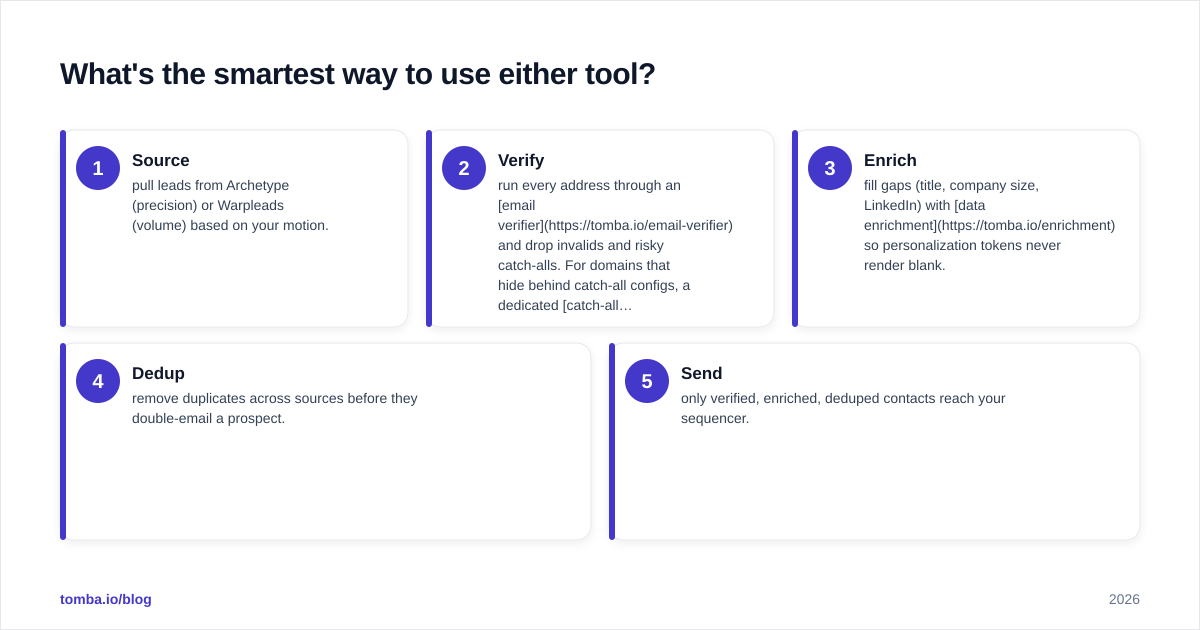
Conclusion first: use Archetype or Warpleads for sourcing, then standardize a verify-and-enrich step before anything hits your sequencer. The sourcing layer and the deliverability layer are different jobs, and trying to make one tool do both is where teams get burned.
A clean pipeline looks like this:
- Source — pull leads from Archetype (precision) or Warpleads (volume) based on your motion.
- Verify — run every address through an email verifier and drop invalids and risky catch-alls. For domains that hide behind catch-all configs, a dedicated catch-all verifier tells you which mailboxes are actually safe to send to.
- Enrich — fill gaps (title, company size, LinkedIn) with data enrichment so personalization tokens never render blank.
- Dedup — remove duplicates across sources before they double-email a prospect.
- Send — only verified, enriched, deduped contacts reach your sequencer.
This is also why a single combined platform can beat a two-vendor stack on total cost. If your finder already verifies at lookup, you skip a whole tool and a whole reconciliation headache. For teams doing this at scale, a bulk email finder plus included verification often comes in cheaper per usable lead than a volume list you then pay a separate verifier to clean.
How does this compare to an all-in-one finder?#
Both Archetype and Warpleads are sourcing specialists — they're good at getting contacts into your hands, less focused on guaranteeing each one is deliverable. That's a legitimate design choice, but it means you're always assembling a stack.
An all-in-one finder collapses sourcing and verification. Tomba, for example, combines domain search (find every contact at a target company), the email finder, and the verifier under one set of credits, with transparent pricing — a free tier at 25 searches/month, Starter at $49/month, Growth at $99/month, and Pro at $249/month. You're not comparing "cheaper or more expensive" so much as "one bill that includes verification" versus "two bills where you do the cleaning."
For a deeper look at how vendors stack up on raw accuracy and price, the broader category comparison is worth a scan:

If you want third-party signal beyond vendor marketing, check live user reviews on G2 and Capterra before committing — sort by recency, since data tools change quality fast, and weight reviews from companies your size.
The bottom line: which should you pick?#
Conclusion first: match the tool to your motion, not to the louder marketing.
- High-ACV, account-based, few targets → Archetype Data. Pay for precision and intent.
- Low-ACV, high-velocity, wide funnel → Warpleads. Pay for volume, and verify hard.
- You want sourcing and deliverability in one bill → an all-in-one finder beats stitching two specialists together.
Whatever you choose, the deliverability layer is not optional. Volume without verification burns your domain; precision without verification still drifts as people change jobs. The teams that win in 2026 treat verified, enriched, deduped as the only definition of a real lead — everything before that is just a list.
Ready to source clean, verified leads?#
If you'd rather skip the two-vendor juggling act, start with the Tomba Email Finder. Find professional email addresses by domain, name, or company, get a confidence score and SMTP-level verification at the moment of lookup, and enrich each contact without bolting on a second tool. Run your first 25 searches free, then scale on a plan that fits your volume — so the leads entering your sequencer are deliverable from day one, not after a campaign teaches you the hard way.
// get started
Find, verify and enrich your first contacts today
Start on the free plan with 25 searches a month, then scale when your team is ready.
Free plan · No credit card required · GDPR & CCPA
// about the author