Archetype Data vs Zintlr: Which B2B Data Tool Wins 2026?
Archetype Data vs Zintlr compared on data depth, accuracy, pricing, and workflow fit. See which B2B data platform deserves your 2026 prospecting budget.
Choosing a B2B data provider feels a lot like buying tires: every vendor swears theirs are the grippiest, but you only learn the truth on a wet road at 70 mph. Archetype Data and Zintlr both promise accurate contact records and richer prospect context, yet they solve slightly different problems. This breakdown cuts through the marketing and shows you where each tool actually earns its keep.
TL;DR#
- Archetype Data leans toward broad firmographic and contact coverage with an enrichment-first workflow — good for teams feeding a CRM or data warehouse at scale.
- Zintlr leans toward prospecting intelligence, including its signature personality/"behavioral" insights layered on top of contact data — good for SDRs who want a conversation angle, not just an email.
- On raw accuracy and verification, neither is a substitute for a dedicated email verifier in your stack; both should be validated before send.
- Pricing transparency favors Zintlr's published tiers; Archetype skews toward custom/contact-sales quotes for serious volume.
- If your core need is simply finding and verifying business emails reliably, a focused tool like the Tomba Email Finder often beats paying enrichment-platform prices for a feature you use 80% of the time.
What are Archetype Data and Zintlr?#
Both products sit in the B2B data and intelligence category, but they were built with different center-of-gravity.
Archetype Data is positioned as a contact and company data provider. Its pitch is coverage and enrichment: take a thin record (a name, a domain, a LinkedIn URL) and return a fuller profile — title, company, firmographics, and contact points. Teams typically use it to clean and append existing lists or to power outbound at scale through an API or CRM sync.
Zintlr is positioned as a prospecting and sales intelligence platform. Alongside contact data, its differentiator is "personality intelligence" — behavioral and DISC-style profiling meant to help reps tailor messaging. The promise is less "here's an email" and more "here's an email and how this person likes to be sold to."
Put simply: Archetype optimizes for completeness of the record, Zintlr optimizes for context around the person. That framing matters more than any single feature checkbox, because it predicts which one will frustrate you.
How do Archetype Data and Zintlr compare on features?#
Here is the head-to-head on the attributes that actually change a buying decision. Treat vendor-published coverage numbers skeptically — every data company counts records differently, and "600M contacts" tells you nothing about how many are current in your ICP.
| Attribute | Archetype Data | Zintlr |
|---|---|---|
| Primary use case | List enrichment & data append | Prospecting + sales intelligence |
| Signature feature | Bulk enrichment / API throughput | Personality & behavioral profiles |
| Contact data (email/phone) | Yes | Yes |
| Firmographic data | Strong | Moderate |
| Built-in verification | Limited | Limited |
| Chrome extension | Varies | Yes |
| Pricing transparency | Mostly custom/quote | Published tiers |
| Best fit | RevOps / data teams | SDR / AE prospecting |
| Free option | Trial-based | Free/low tier available |
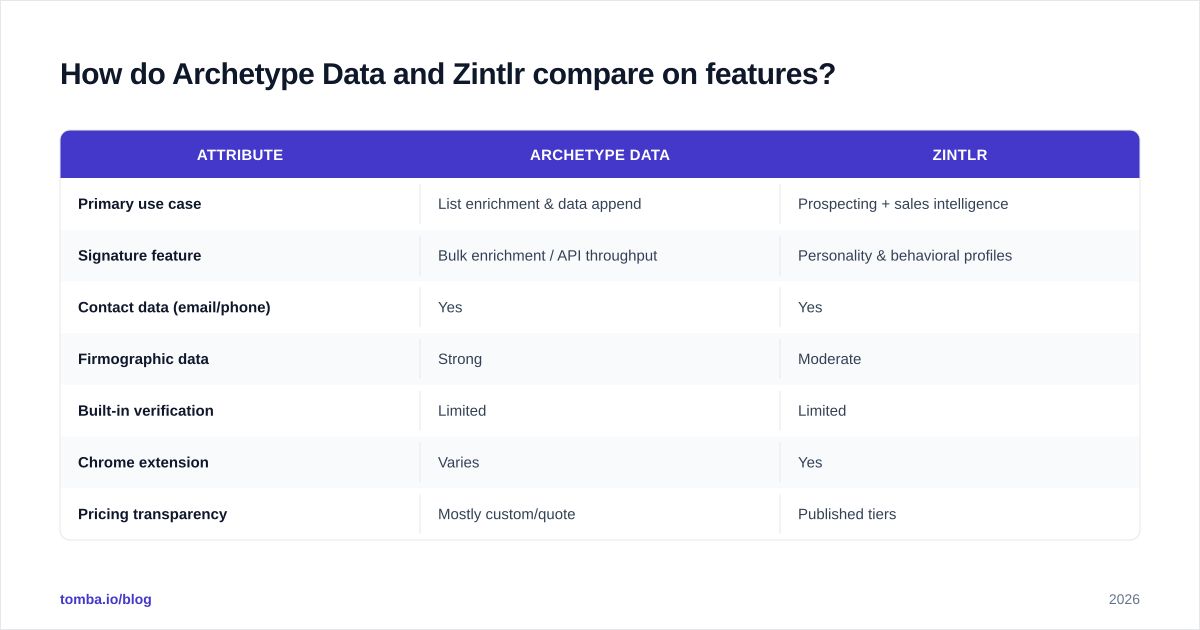
The pattern is consistent: Archetype is the tool you wire into a pipeline and forget about; Zintlr is the tool a rep opens in the browser before writing a first-touch email. Neither is wrong — they're answering different questions.

Which tool has better data accuracy?#
Short answer: test both on your own ICP before you trust either, and verify everything downstream regardless.
Here's the uncomfortable truth about every B2B data vendor, Archetype and
Zintlr included: accuracy is hyper-local to your segment. A provider that nails US SaaS VPs might be 60% stale on EU manufacturing directors. The aggregate "95% accuracy" claim on a homepage is an average across segments you may never sell into. Independent reviews on G2 and Capterra are useful precisely because they break down satisfaction by company size and industry — read those before the sales deck.
A few practical realities:
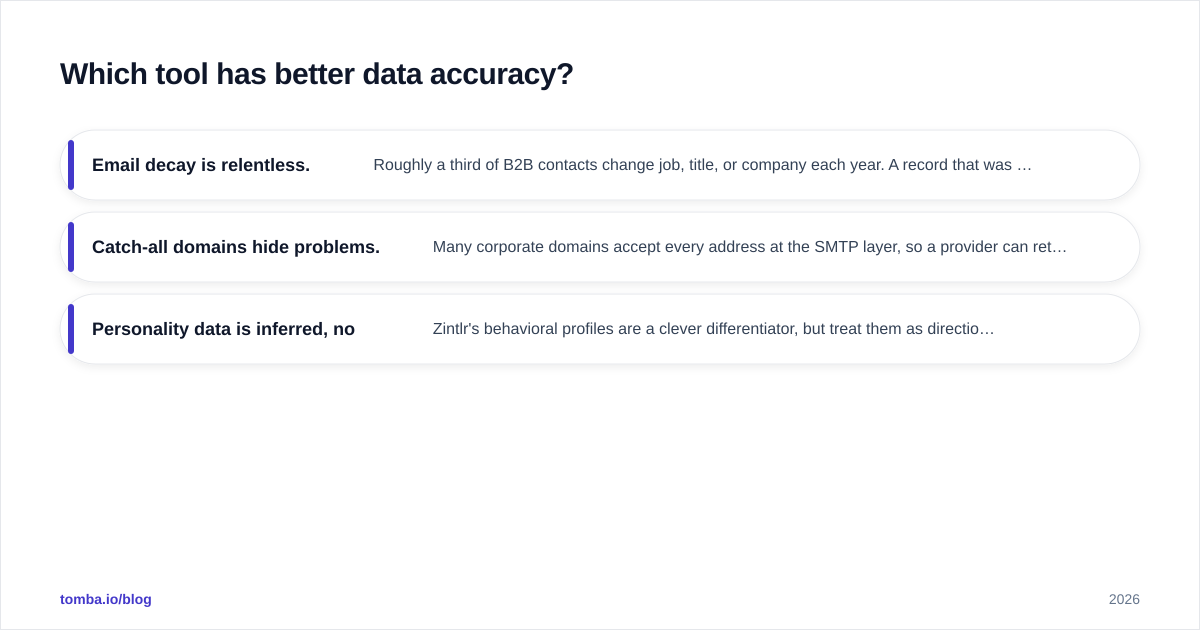
- Email decay is relentless. Roughly a third of B2B contacts change job, title, or company each year. A record that was perfect last quarter can bounce today. This is why a one-time enrichment from either tool degrades fast without re-validation.
- Catch-all domains hide problems. Many corporate domains accept every address at the SMTP layer, so a provider can return a "valid-looking" email that no human reads. You need a dedicated catch-all verifier to separate real inboxes from black holes.
- Personality data is inferred, not measured. Zintlr's behavioral profiles are a clever differentiator, but treat them as directional hints, not gospel. Inferred DISC types from public signals are an educated guess, and over-personalizing on a wrong guess can backfire.
The honest workflow, no matter which platform you pick: enrich with Archetype or Zintlr, then run the output through an independent email verification pass before it ever touches a sending tool. Skipping that step is how good domains end up on blocklists.

How does pricing compare for Archetype Data vs Zintlr?#
Pricing is where the two diverge most in buyer experience, even more than in raw dollars.
**
Zintlr** publishes tiered plans with a free or low-cost entry point, which makes it easy to trial without a sales call. That transparency is a real advantage for small teams and solo founders who want to know the number before they commit a calendar slot to a demo.
Archetype Data trends toward custom quotes for meaningful volume. That's typical of enrichment-first vendors — they price on records, API calls, and contract length, and they want a conversation to scope it. The upside is volume discounts; the downside is you can't comparison-shop in five minutes.
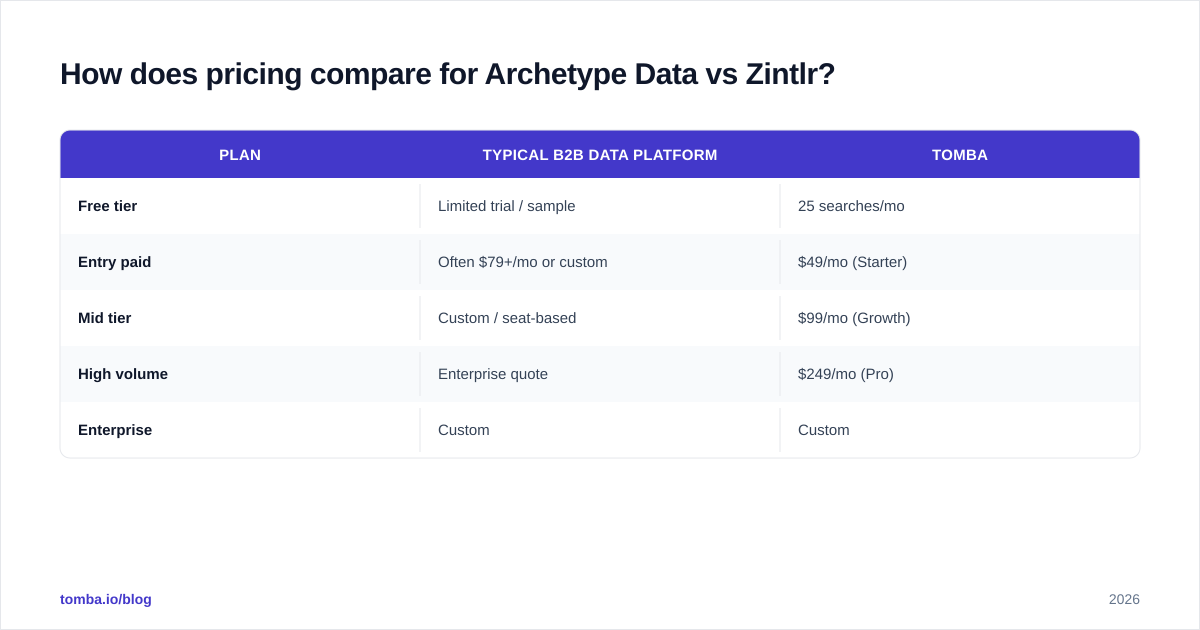
For reference, here's how a focused email-finding tool prices against the "platform" model, because that contrast is often the real decision:
| Plan | Typical B2B data platform | Tomba |
|---|---|---|
| Free tier | Limited trial / sample | 25 searches/mo |
| Entry paid | Often $79+/mo or custom | $49/mo (Starter) |
| Mid tier | Custom / seat-based | $99/mo (Growth) |
| High volume | Enterprise quote | $249/mo (Pro) |
| Enterprise | Custom | Custom |
The lesson isn't "platforms are overpriced." It's that if you're paying enterprise enrichment rates but only using the contact-finding 80% of the time, you're subsidizing features you don't touch. Map your actual monthly usage before signing. You can see full Tomba pricing for the line-by-line comparison.
Who should choose Archetype Data?#
Pick Archetype Data if you recognize yourself here:
- You run RevOps or data engineering and need to append or clean records at volume, through an API or scheduled sync.
- Your CRM is the source of truth, and you want enrichment to happen to records already in motion, not in a browser tab.
- You care more about firmographic completeness (industry, size, revenue, tech stack) than about per-rep messaging hints.
- You have the procurement patience for a custom quote and the volume to justify it.
Archetype's enrichment-first design rewards teams that treat data as infrastructure. If your prospecting motion is "load a clean list into a sequencer and go," its throughput model fits. The trade-off is that the in-the-moment, rep-facing experience is thinner than Zintlr's.
Who should choose Zintlr?#
Pick Zintlr if this is closer to your reality:
- You're an SDR or AE who researches prospects one at a time and wants a conversation angle before the first touch.
- The personality/behavioral layer genuinely changes how you write — and you'll actually use it, not just admire it in the dashboard.
- You want transparent, self-serve pricing and the ability to start small without a procurement cycle.
- Browser-based prospecting (extension + on-page lookups) matches how your team already works.
Zintlr shines for individual contributors and small teams who live in the prospecting workflow. The risk to watch: don't over-index on inferred personality data. It's a tiebreaker for how you phrase something, not a reason to skip the fundamentals of relevance and timing.
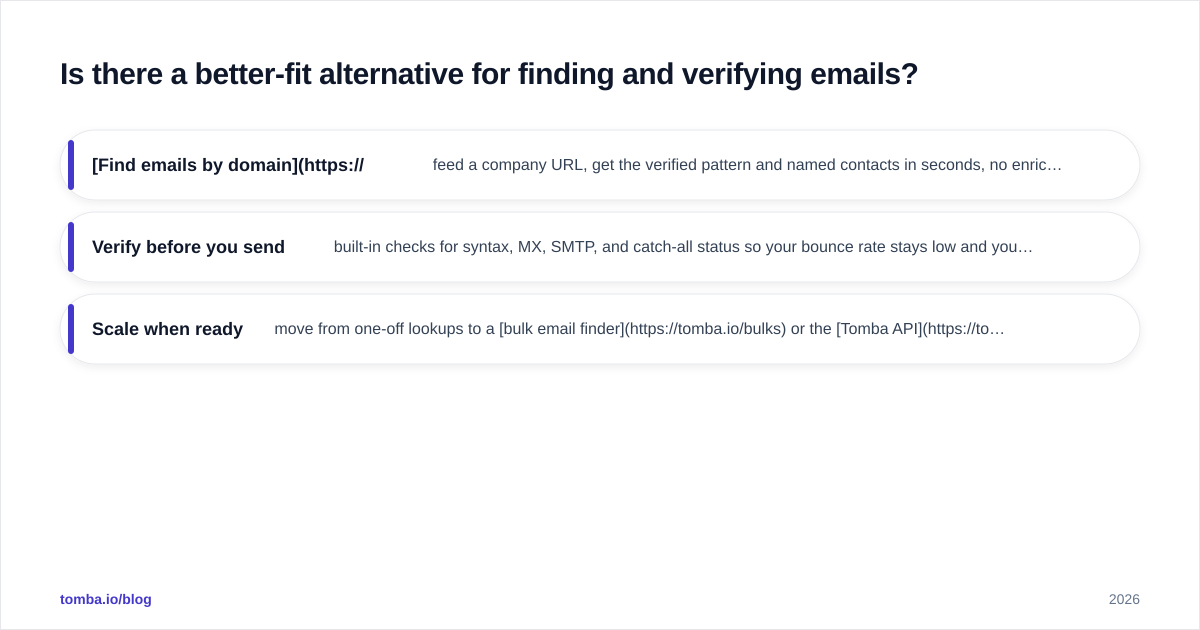
Is there a better-fit alternative for finding and verifying emails?#
Often, yes — and it's worth naming the elephant in the room.
A large share of teams evaluating Archetype Data vs
Zintlr don't actually need a full intelligence platform. They need to reliably find a decision-maker's email, confirm it's real, and move on. If that's 80% of your use, a dedicated email-finding tool is faster and cheaper than renting a platform.
That's where a focused workflow wins:
- Find emails by domain — feed a company URL, get the verified pattern and named contacts in seconds, no enrichment contract required.
- Verify before you send — built-in checks for syntax, MX, SMTP, and catch-all status so your bounce rate stays low and your sender reputation stays intact.
- Scale when ready — move from one-off lookups to a bulk email finder or the Tomba API without changing vendors.
This isn't an argument that data platforms are useless. If you genuinely need behavioral intelligence (Zintlr) or warehouse-scale enrichment (Archetype), buy the platform. But if you've been eyeing those tools mostly to get good emails, you may be overbuying. Run a 25-search free trial of a dedicated finder against the same accounts and compare hit rate and bounce rate honestly. The data will tell you which tier you actually live in.
Archetype Data vs Zintlr: the verdict#
There's no universal winner — there's a winner for your motion.
- Choose Archetype Data for enrichment-first, high-volume, RevOps-owned data pipelines where firmographic completeness and API throughput matter most.
- Choose Zintlr for rep-facing prospecting where transparent pricing and personality-driven personalization change how you write the first email.
- Choose a dedicated email finder + verifier if your real job is finding and confirming business emails, and the rest of the platform would mostly sit unused.
Whatever you pick, build verification into the workflow. The fanciest enrichment in the world is worthless if a third of it bounces — and that's a problem you solve at the verification layer, not the data-vendor layer. For more on how providers source and refresh records, Tomba documents its own data sources openly, which is a useful benchmark to hold any vendor against.
Find verified emails without overpaying for a platform#
If your shortlist of Archetype Data vs Zintlr was really a hunt for accurate, send-ready business emails, start with the tool built for exactly that. The Tomba Email Finder locates professional emails by name, domain, or company and verifies them before they reach your sequencer — so you protect your deliverability and your budget. Spin up the free tier (25 searches a month, no card), run it against the same accounts you'd test on any enrichment platform, and compare the hit rate yourself. If you later need true enrichment or behavioral data, you'll know precisely what you're paying extra for — instead of paying enterprise rates for a feature you use a fraction of the time.
// get started
Find, verify and enrich your first contacts today
Start on the free plan with 25 searches a month, then scale when your team is ready.
Free plan · No credit card required · GDPR & CCPA
// about the author