AroundDeal vs BookYourData (2026): Which B2B Data Wins?
AroundDeal vs BookYourData compared on accuracy, pricing, coverage, and workflow fit—plus where each one quietly costs you more than the sticker price.
You have a quarter to hit, a list to build, and two tools open in tabs: AroundDeal and BookYourData. Both promise accurate B2B contacts. Both charge you for the privilege. Only one fits how your team actually prospects—and the wrong pick burns budget on data that bounces.
This is a working comparison, not a brochure. We line up AroundDeal and BookYourData on accuracy, pricing, coverage, compliance, and the messy real-world details that decide whether a list converts or clogs your sequencer.
TL;DR — AroundDeal vs BookYourData at a glance#
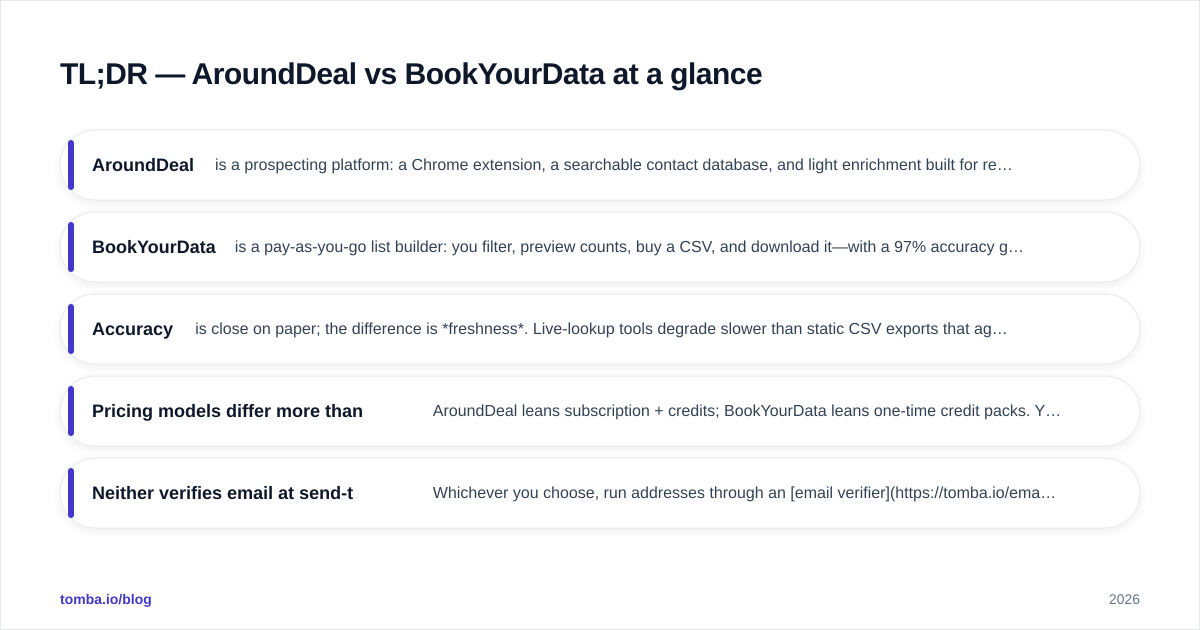
- AroundDeal is a prospecting platform: a Chrome extension, a searchable contact database, and light enrichment built for reps working LinkedIn and company sites in real time.
- BookYourData is a pay-as-you-go list builder: you filter, preview counts, buy a CSV, and download it—with a 97% accuracy guarantee and credit-back on bad records.
- Accuracy is close on paper; the difference is freshness. Live-lookup tools degrade slower than static CSV exports that age the moment you download them.
- Pricing models differ more than prices. AroundDeal leans subscription + credits; BookYourData leans one-time credit packs. Your buying rhythm decides which is cheaper.
- Neither verifies email at send-time by default. Whichever you choose, run addresses through an email verifier before you load a sequence.
What is AroundDeal?#
AroundDeal is a B2B sales intelligence platform built around a browser extension and a contact database that markets coverage in the hundreds of millions of profiles. The core motion is reactive: you land on a LinkedIn profile or a company website, click the extension, and AroundDeal surfaces emails, phone numbers, and firmographic data on the spot.
It positions itself as an all-in-one prospecting layer—database search, enrichment, and basic engagement features—aimed at SDRs and founders who prospect account by account. You can read the vendor's own framing on the AroundDeal homepage, and cross-check user sentiment on G2.
The strength is workflow proximity. The data appears where you already work, so there's no export-import loop. The trade-off is that credit-metered, profile-by-profile lookups get expensive once you need volume.
What is BookYourData?#
BookYourData is a self-service B2B contact list builder with a pay-as-you-go core. You open the list builder, stack filters (job title, industry, location, company size, technology), watch the live record count update, and buy exactly the slice you want. It's known for a 97% accuracy guarantee: if more than 3% of records bounce or are invalid, you get credits back.
The model is transactional. There's no requirement to subscribe—buy 1,000 records this month, zero next month. You can review the model on the BookYourData homepage. That makes it attractive for one-off campaigns, event lists, or ABM pushes where you know the exact segment and want a clean CSV without a recurring commitment.
The catch is the catch of every list product: the moment you download, the data starts to decay. People change jobs, companies rename, domains migrate. A guarantee on the day of purchase says nothing about week six.

AroundDeal vs BookYourData: the core difference#
The headline isn't "which has better data"—both pull from similar public-web and contributed sources. The real fork is how you consume it.
AroundDeal is a live-lookup tool. You query a specific person or domain and get the freshest record the system can assemble at that moment. BookYourData is a batch-export tool. You define a segment once and receive a static snapshot.
That distinction drives everything downstream: cost per useful contact, how fast your list rots, and how well each fits your sales motion.
If your reps prospect reactively—one promising account at a time, often from LinkedIn—live lookup wins. If you run planned campaigns against a defined ICP and want everything in one file for your ops team, batch export wins. Most teams actually need both at different moments, which is why a third option (covered below) keeps coming up.

How do they compare on features and pricing?#
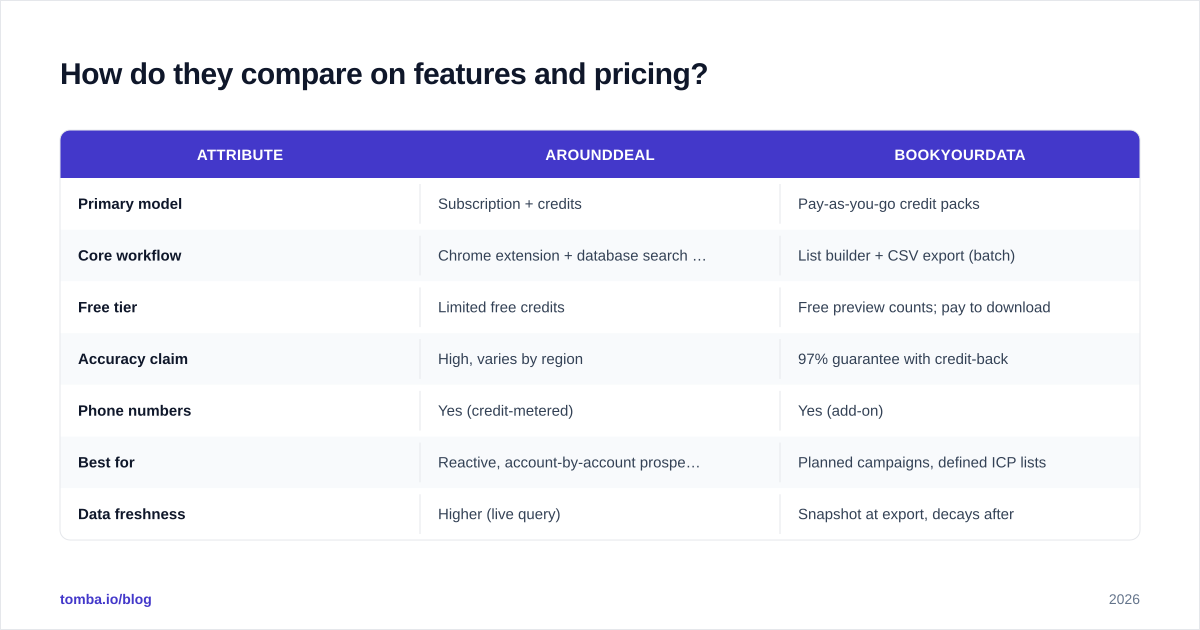
Here's the side-by-side. Treat specific prices as directional—both vendors adjust tiers—and verify current numbers on their sites before you buy.
| Attribute | AroundDeal | BookYourData |
|---|---|---|
| Primary model | Subscription + credits | Pay-as-you-go credit packs |
| Core workflow | Chrome extension + database search (live) | List builder + CSV export (batch) |
| Free tier | Limited free credits | Free preview counts; pay to download |
| Accuracy claim | High, varies by region | 97% guarantee with credit-back |
| Phone numbers | Yes (credit-metered) | Yes (add-on) |
| Best for | Reactive, account-by-account prospecting | Planned campaigns, defined ICP lists |
| Data freshness | Higher (live query) | Snapshot at export, decays after |
| Compliance posture | GDPR/CCPA stated | GDPR/CCPA stated |
| API access | Available | Available |
A few things the table can't capture:
Credits aren't comparable across tools. One AroundDeal credit and one BookYourData record don't map cleanly—each vendor bundles email, phone, and enrichment differently. Always price a real sample list, not the per-credit headline.
The guarantee has fine print. A 97% accuracy guarantee typically covers syntax-valid, deliverable-on-purchase addresses. It rarely covers a contact who left the company three weeks ago but whose old address still technically accepts mail. Read what "valid" means in each vendor's terms.
Subscription vs one-time changes the math at volume. If you pull lists every week, a subscription with rollover often beats repeated credit-pack purchases. If you pull twice a year, pay-as-you-go avoids paying for idle months. Model your own cadence; see how a transparent tier structure reads on the Tomba pricing page for a baseline comparison.
Which has more accurate data?#
Accuracy is the whole game, so be precise about what it means. There are two failure modes, and they're different:
- Invalid at capture — the address was wrong, mistyped, or guessed. Verification catches this.
- Valid-then-stale — the address was correct when collected but the person moved on. Only freshness catches this.
BookYourData's 97% guarantee mostly addresses failure mode one, measured on download day. AroundDeal's live lookup helps with failure mode two because each query reassembles the record from current signals. Neither fully solves the other's weakness.
The practical answer: whichever tool you pick, verify before you send. A standalone email verification pass on your final list—checking MX records, catch-all status, and deliverability—is the single highest-ROI step in the entire workflow. It costs pennies per address and protects the sender reputation that determines whether your next campaign even reaches the inbox.
For teams pulling large segments, run the export through a bulk verify job rather than spot-checking. A 3% guaranteed bounce rate on 10,000 contacts is still 300 hard bounces—enough to dent deliverability if you load them all into one warm domain.
Which fits your sales motion?#
Tool choice should follow workflow, not the other way around. Map yourself to one of these:
You're a founder or solo SDR prospecting from LinkedIn. AroundDeal's extension fits the rhythm—you're already on the profile, the data appears, you move on. Batch exports would sit unused.
You're running a defined ABM or event campaign. BookYourData's list builder lets you scope the exact segment, see the count before you pay, and hand ops a clean file. Live lookup would be slow and pricey for hundreds of known accounts.
You're a RevOps team feeding a CRM and a sequencer. You need both a queryable B2B database for enrichment and clean bulk exports for campaigns—plus an API so the data flows without manual CSVs. This is where single-mode tools start to chafe.
You're enriching inbound or existing records. You don't need a list at all—you need data enrichment that fills gaps on contacts you already have. Check whether either tool's enrichment endpoint covers your fields before committing.
The honest read: AroundDeal and BookYourData each nail one motion and stretch awkwardly into the other. If your team does both reactive prospecting and planned campaigns—as most do—you'll either run two tools or look for one that does both natively.
Where does Tomba fit in this comparison?#
Full disclosure: this is the Tomba blog, so weigh this section accordingly—but the architectural point stands on its own.
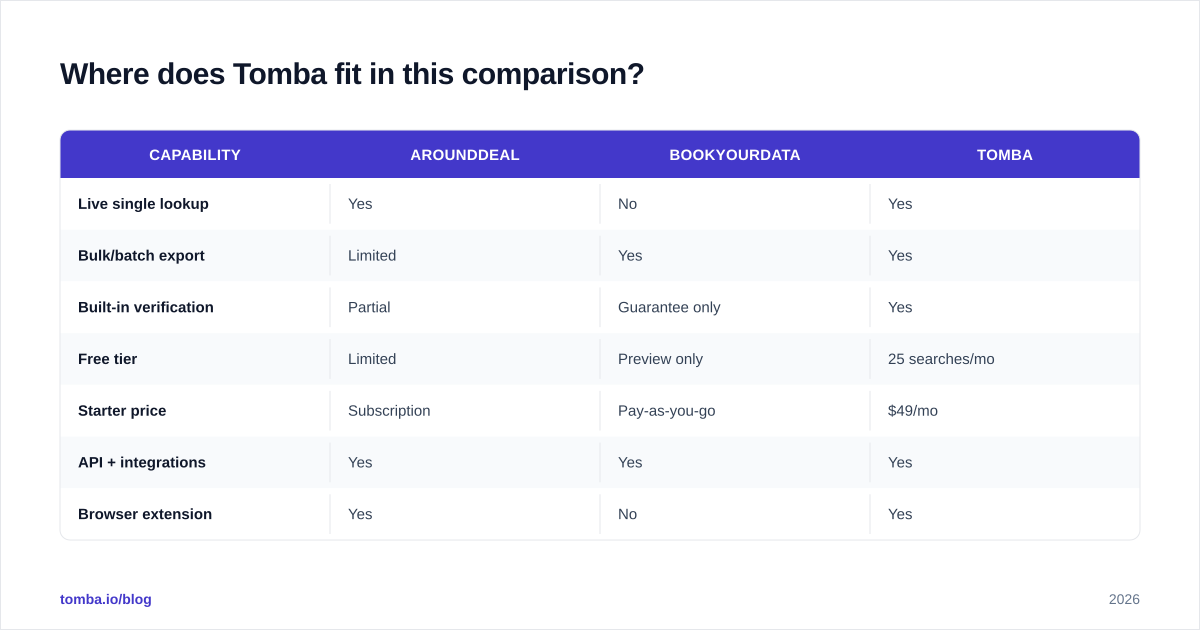
Tomba is built to cover both motions from one source. The email finder does live, on-demand lookups by name, company, or domain—the AroundDeal-style reactive flow. The domain search and bulk email finder cover the BookYourData-style "give me everyone matching this segment" batch flow. And every result can run through built-in verification before it leaves the platform.
| Capability | AroundDeal | BookYourData | Tomba |
|---|---|---|---|
| Live single lookup | Yes | No | Yes |
| Bulk/batch export | Limited | Yes | Yes |
| Built-in verification | Partial | Guarantee only | Yes |
| Free tier | Limited | Preview only | 25 searches/mo |
| Starter price | Subscription | Pay-as-you-go | $49/mo |
| API + integrations | Yes | Yes | Yes |
| Browser extension | Yes | No | Yes |
Tomba's tiers run Free (25 searches/mo), Starter $49/mo, Growth $99/mo, Pro $249/mo, and Enterprise custom. The point isn't that Tomba beats both on every axis—it's that consolidating live lookup, bulk export, and verification removes the two-tool tax and the verify-elsewhere step. Where the data comes from is documented on the data sources page so you can judge coverage for your regions before trusting it.
What about compliance and data sourcing?#
Both AroundDeal and BookYourData state GDPR and CCPA alignment, and both rely on a mix of public web data and contributed records. That's standard for the category—but "stated compliance" is your starting point for diligence, not the end of it.
Before you buy from either:
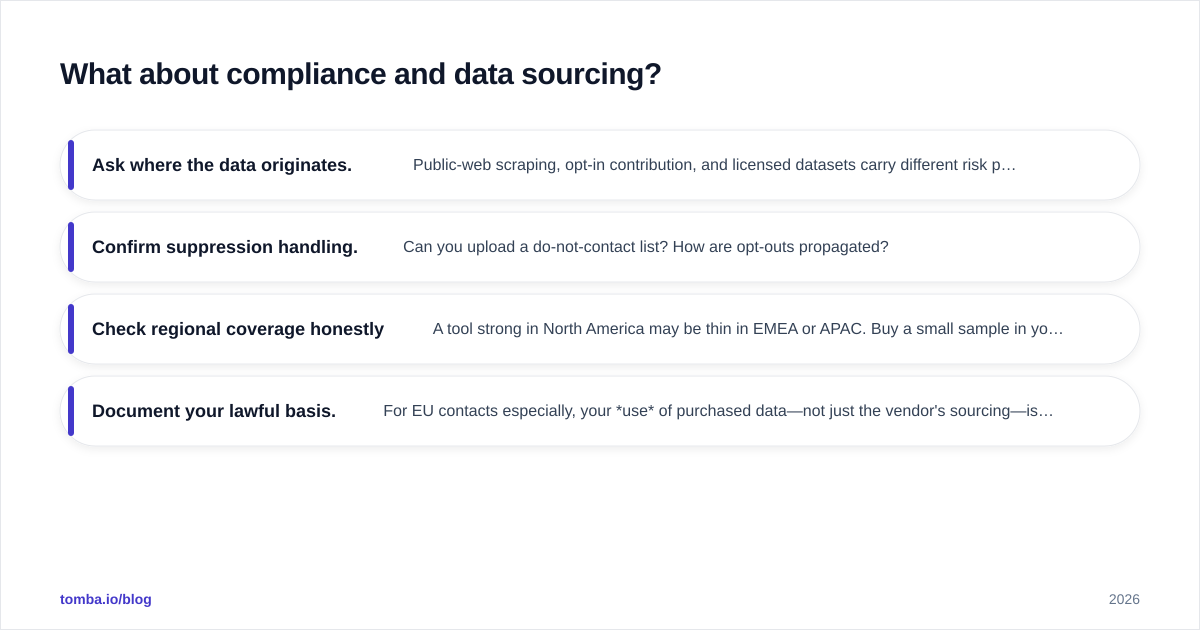
- Ask where the data originates. Public-web scraping, opt-in contribution, and licensed datasets carry different risk profiles for your jurisdiction.
- Confirm suppression handling. Can you upload a do-not-contact list? How are opt-outs propagated?
- Check regional coverage honestly. A tool strong in North America may be thin in EMEA or APAC. Buy a small sample in your target geography first.
- Document your lawful basis. For EU contacts especially, your use of purchased data—not just the vendor's sourcing—is what regulators examine.
This applies identically to any provider, Tomba included. The vendor's compliance page is the floor; your own legal review is the requirement.
The verdict: which should you choose?#
Choose AroundDeal if your team prospects reactively—LinkedIn-first, account-by-account—and values fresh, live lookups inside the browser more than bulk exports. The extension-driven workflow is its real advantage.
Choose BookYourData if you run defined, planned campaigns and want a clean CSV for a known segment without a subscription. The pay-as-you-go model and accuracy guarantee suit one-off, high-precision pulls.
Choose neither—consolidate— if you do both motions, feed a CRM, and want verification baked in rather than bolted on. Running two single-mode tools plus a separate verifier is the hidden cost most comparisons skip.
Whatever you pick, the non-negotiable is verification before send. The cheapest list in the world is expensive if 8% bounces and torches your domain reputation.
Want live lookup and bulk export from one source, with verification built in and a free tier to test coverage in your market? Start with the Tomba Email Finder—run 25 free searches against your real ICP, verify the results, and compare the hit rate against your current AroundDeal or BookYourData exports before you commit a dollar.
// get started
Find, verify and enrich your first contacts today
Start on the free plan with 25 searches a month, then scale when your team is ready.
Free plan · No credit card required · GDPR & CCPA
// about the author