Arounddeal vs Bounceless: B2B Data vs Email Checks (2026)
Arounddeal finds B2B contacts; Bounceless cleans your list. Here's which one your outbound stack actually needs in 2026 — and where they overlap.
Arounddeal vs Bounceless: Which B2B Tool Do You Actually Need?
People search "Arounddeal vs Bounceless" as if they're picking one or the other. They're not really competitors — they sit at two different points in the same pipeline. Arounddeal finds contact data. Bounceless cleans email lists. Confusing them is how teams end up paying for the wrong tool and wondering why their bounce rate is still 12%.
This guide breaks down what each tool does, where they overlap, what they cost, and how to decide — including the case where the honest answer is "you need both, plus something neither one does well."
TL;DR#
- Arounddeal is a B2B contact and company database (emails, phone numbers, LinkedIn data, intent signals) — a prospecting and enrichment tool.
- Bounceless is a dedicated email verification service — it tells you whether an address is deliverable before you send.
- They are complementary, not interchangeable: one builds your list, the other protects your sender reputation.
- If you must pick one, choose by your bottleneck: no leads → Arounddeal; high bounce rate → Bounceless.
- For most outbound teams, the cleanest setup is a single platform that finds and verifies in one step — which is where a tool like Tomba's email finder changes the math.
What is Arounddeal?#
Arounddeal is a B2B data platform built around prospecting. You search its contact database by job title, company, industry, or location and pull back work emails, direct-dial phone numbers, and LinkedIn profile data. It layers on a Chrome extension for grabbing contacts off LinkedIn, plus engagement and intent features aimed at sales teams running outbound at scale.
In other words, Arounddeal answers the question "Who do I contact, and how do I reach them?" It competes with the prospecting side of tools like Apollo, RocketReach, and Lusha. The whole value proposition is coverage and freshness of contact records.
What Arounddeal does not do well is guarantee that every email it returns is currently deliverable. Like every database vendor, its records decay — people change jobs, domains get retired, mailboxes get deactivated. Vendors quote high match rates, but a match is not the same as a verified, inbox-ready address. That gap is exactly the problem Bounceless exists to solve.
What is Bounceless?#
Bounceless is an email verification (or "list cleaning") service. You upload a list of addresses you already have, and it checks each one — syntax, domain/MX records, SMTP response, and known traps — then labels every address as deliverable, risky, or undeliverable. The point is to strip out the addresses that would bounce before they ever hit your email service provider.
Bounceless answers a completely different question: "Will this address I already have actually land in an inbox?" It competes with ZeroBounce, NeverBounce, and similar verifiers — not with prospecting databases.
Why does this matter so much? Because bounce rate is a direct input to sender reputation. Mailbox providers like Google and Microsoft treat a high bounce rate as a spam signal. Cross 2–3% and your email deliverability starts to suffer across your entire domain — even for the addresses that were valid.
Arounddeal vs Bounceless: how do they actually differ?#
Here's the core distinction in one table.
| Attribute | Arounddeal | Bounceless |
|---|---|---|
| Primary job | Find B2B contacts & company data | Verify deliverability of existing emails |
| Stage in pipeline | Top — list building | Pre-send — list cleaning |
| Core output | New emails, phones, LinkedIn data | Pass/risky/fail label per address |
| Has a contact database | Yes | No |
| Verifies emails | Limited / not the focus | Yes — the entire product |
| Best for | SDRs, prospecting, enrichment | Deliverability, ops, email marketing |
| Competes with | Apollo, RocketReach, Lusha | ZeroBounce, NeverBounce |
| Risk if used alone | Stale or unverified addresses | Empty without a list to clean |
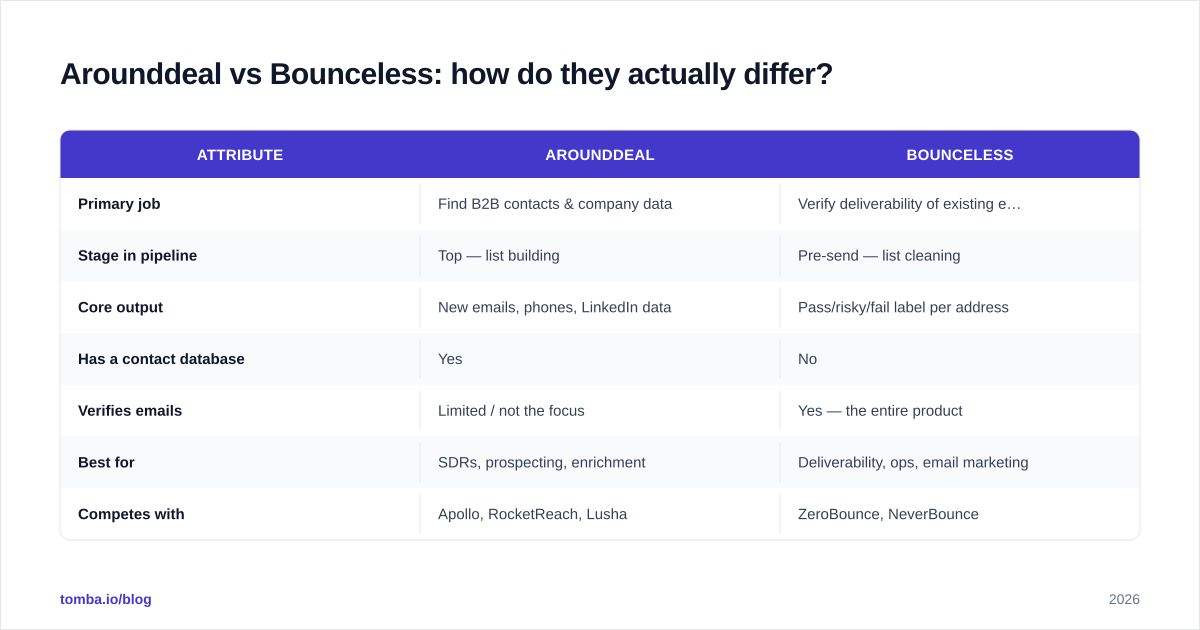
The takeaway: asking "Arounddeal or Bounceless?" is like asking "a fishing rod or a fillet knife?" One gets you the catch; the other prepares it. You can't substitute one for the other.

Where do the two tools overlap?#
There is a narrow overlap, and it's worth being precise about it.
Modern prospecting databases, Arounddeal included, run some verification on the addresses they return — at minimum a format and domain check, often a basic SMTP probe. So when Arounddeal hands you an email, it isn't pure guesswork.
But there's a structural reason this isn't enough on its own:
- Records age between the time they were verified and the time you send. A "valid" record from three months ago may be dead today.
- Database vendors optimize for coverage, which means they'll surface a plausible-but-unconfirmed address rather than return nothing.
- Catch-all domains (where the server accepts everything) defeat naive verification — you need a dedicated catch-all verifier to make a real judgment.
So even if you build your list entirely in Arounddeal, running it through a verifier like Bounceless before a big campaign is sound practice. The overlap exists, but it's thin enough that the two tools still earn their keep separately.
Which one should you choose?#
Pick based on the bottleneck you actually have right now.
Choose Arounddeal if:
- You don't have enough leads in the first place.
- Your reps spend hours hunting for contact info manually.
- You need phone numbers and LinkedIn data, not just emails.
- You're building net-new lists from scratch each quarter.
Choose Bounceless if:
- You already have lists (from a CRM, past events, scraping, or another database).
- Your bounce rate is creeping above 2–3%.
- You're about to email an old or imported list and want to de-risk it.
- Deliverability — not lead volume — is your constraint.
The honest third option: most teams need both functions, but maintaining two separate tools (and two bills, two integrations, two CSV round-trips) is friction. Each export-import handoff is a place for data to get lost or go stale. This is why find-and-verify-in-one-step platforms have taken over the mid-market — the verification happens at the moment of discovery, not days later in a separate tool.
How does an all-in-one approach compare?#
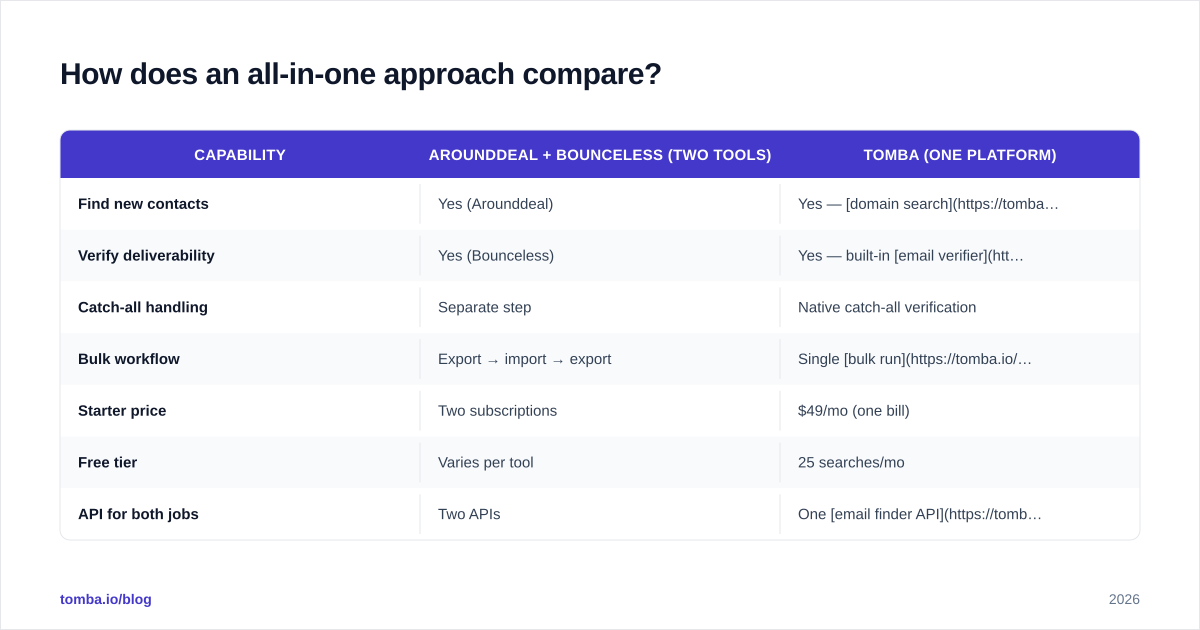
If your real goal is "deliverable B2B contacts in my CRM," then splitting that across a finder and a verifier is an implementation detail you may not want to own. Here's how the standalone-stack approach stacks up against a consolidated one.
| Capability | Arounddeal + Bounceless (two tools) | Tomba (one platform) |
|---|---|---|
| Find new contacts | Yes (Arounddeal) | Yes — domain search + finder |
| Verify deliverability | Yes (Bounceless) | Yes — built-in email verifier |
| Catch-all handling | Separate step | Native catch-all verification |
| Bulk workflow | Export → import → export | Single bulk run |
| Starter price | Two subscriptions | $49/mo (one bill) |
| Free tier | Varies per tool | 25 searches/mo |
| API for both jobs | Two APIs | One email finder API |
The consolidated model isn't automatically "better" — if you've already standardized on Arounddeal for its database and Bounceless for verification and both work, there's no urgent reason to rip them out. But if you're assembling a stack from scratch in 2026, doing find-and-verify in one pass removes an entire class of busywork and keeps your data fresh at the point of use.
For full numbers, compare the Tomba pricing tiers against what you'd pay for two separate subscriptions — the math usually favors consolidation once you factor in seats on both tools.
What about accuracy and data quality?#
Accuracy is the metric that matters most, and it's also the most abused one in this category. Vendors quote "97% accuracy" without defining the denominator. A few things to hold them to:
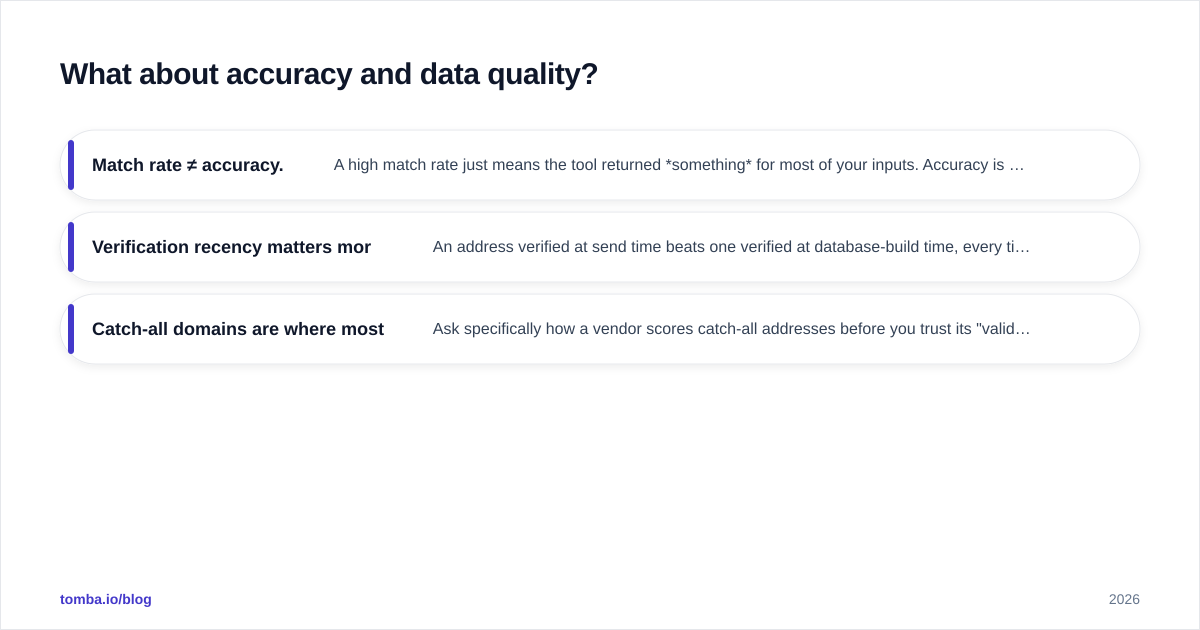
- Match rate ≠ accuracy. A high match rate just means the tool returned something for most of your inputs. Accuracy is whether that something is correct and deliverable.
- Verification recency matters more than the headline number. An address verified at send time beats one verified at database-build time, every time.
- Catch-all domains are where most tools quietly fail. Ask specifically how a vendor scores catch-all addresses before you trust its "valid" label.
For Arounddeal, accuracy is a function of how fresh its database is. For Bounceless, accuracy is the SMTP-level verification quality. For an all-in-one, it's both at once — which is why transparency about data sources is a fair thing to demand from any vendor you're evaluating. You can sanity-check any provider's claims against third-party reviews on G2 rather than taking the marketing page at face value.
How do they fit into a real outbound workflow?#
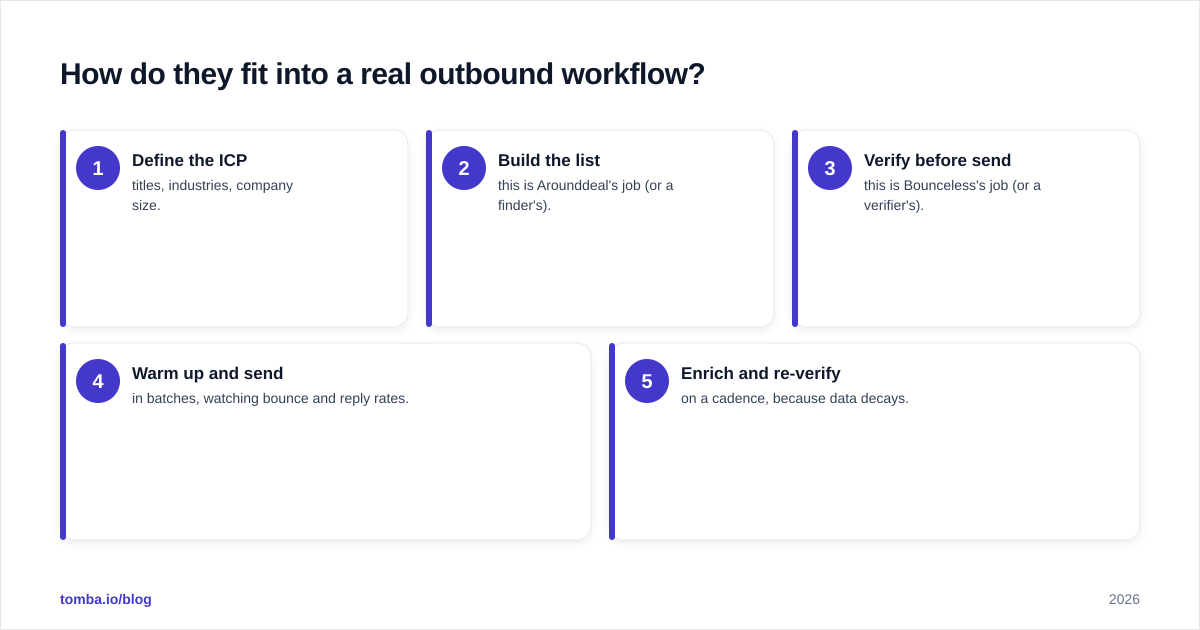
A clean 2026 outbound pipeline looks like this:
- Define the ICP — titles, industries, company size.
- Build the list — this is Arounddeal's job (or a finder's).
- Verify before send — this is Bounceless's job (or a verifier's).
- Warm up and send in batches, watching bounce and reply rates.
- Enrich and re-verify on a cadence, because data decays.
Steps 2 and 3 are the ones this whole comparison is about. Whether you run them as two tools or one, never skip step 3. Sending an unverified list is the single fastest way to torch a domain you've spent months warming. If you want to standardize on one workflow, doing discovery and verification together — then pushing clean records straight to your CRM via native integrations — collapses five manual handoffs into one.
Final verdict#
Arounddeal and Bounceless aren't rivals — they're neighbors. Arounddeal builds the list; Bounceless protects your reputation before you mail it. If you have a leads problem, start with the database. If you have a bounce problem, start with the verifier. If you're building a stack from zero and don't want to babysit two subscriptions and the CSV shuffle between them, consolidate.
That last path is where Tomba's Email Finder fits best: it finds professional emails by name, domain, or company and verifies them in the same step, with catch-all handling, bulk processing, and a free tier (25 searches/mo) so you can test the data quality before paying. Start on the free plan, run your hardest list through it, and judge it on deliverable contacts — not on a marketing accuracy number.
// get started
Find, verify and enrich your first contacts today
Start on the free plan with 25 searches a month, then scale when your team is ready.
Free plan · No credit card required · GDPR & CCPA
// about the author