AroundDeal vs Clearalist 2026: Which B2B Data Tool Wins?
AroundDeal and Clearalist solve two halves of the same problem: finding contacts and keeping them clean. Here's a feature-by-feature breakdown for 2026 — plus where each one quietly falls short.
You're picking a B2B data tool and the two names on the table are AroundDeal and Clearalist. One sells you contacts. The other promises to keep your list clean. They sound like rivals, but they actually sit at opposite ends of the same pipeline — and confusing the two is how teams end up paying twice for half a workflow.
This breakdown cuts through the marketing. You'll get a side-by-side on pricing, data accuracy, verification depth, and coverage, plus an honest read on where each tool leaves a gap you'll have to fill with something else.
TL;DR — AroundDeal vs Clearalist at a glance#
- AroundDeal is a prospecting and contact-discovery platform — a LinkedIn-leaning database where you search for people and pull emails and phone numbers.
- Clearalist leans toward list hygiene and email verification — you bring a list, it tells you what's deliverable.
- They are complements, not direct competitors: discovery vs. validation. Buying one rarely covers both jobs.
- On raw email accuracy, neither publishes audited benchmarks, so treat their headline percentages with caution and run your own bounce test.
- If you want find + verify in one place with transparent pricing and an API, a consolidated tool like Tomba Email Finder is worth pricing against the pair.
What is AroundDeal?#
AroundDeal is a B2B sales-intelligence platform built around a contact database and a browser extension. Its core job is discovery: you search by title, company, industry, or location — or surf LinkedIn with the extension active — and it surfaces business emails, direct dials, and company firmographics. The pitch is "find the right people fast," and it competes in the same lane as Apollo, Lusha, and RocketReach.
The strength here is the front of the funnel. AroundDeal is where you go when you have an ideal customer profile but not yet a list of names. It builds the list.
What it is not is a dedicated cleaning engine. AroundDeal verifies emails at the point of capture, but it isn't designed to ingest a 50,000-row CSV you exported from a trade-show scanner three years ago and tell you which addresses still resolve. That's a different tool's job.
What is Clearalist?#
Clearalist sits at the other end: validation and hygiene. You arrive with a list — exported from a CRM, scraped, or bought — and Clearalist checks each address for syntax errors, dead domains, role accounts (info@, sales@), and mailbox existence via SMTP probing. The output is a deliverability verdict per row so you can suppress the junk before it torches your sender reputation.
This matters because email deliverability is fragile. A list with a 15% bounce rate signals "spammer" to inbox providers, and your good emails start landing in spam too. A verifier's whole reason to exist is keeping your bounce rate under the ~2-3% threshold mailbox providers tolerate.
What Clearalist is not is a discovery engine. It doesn't generate new contacts. Feed it nothing and it gives you nothing. You still need a source for the addresses in the first place.
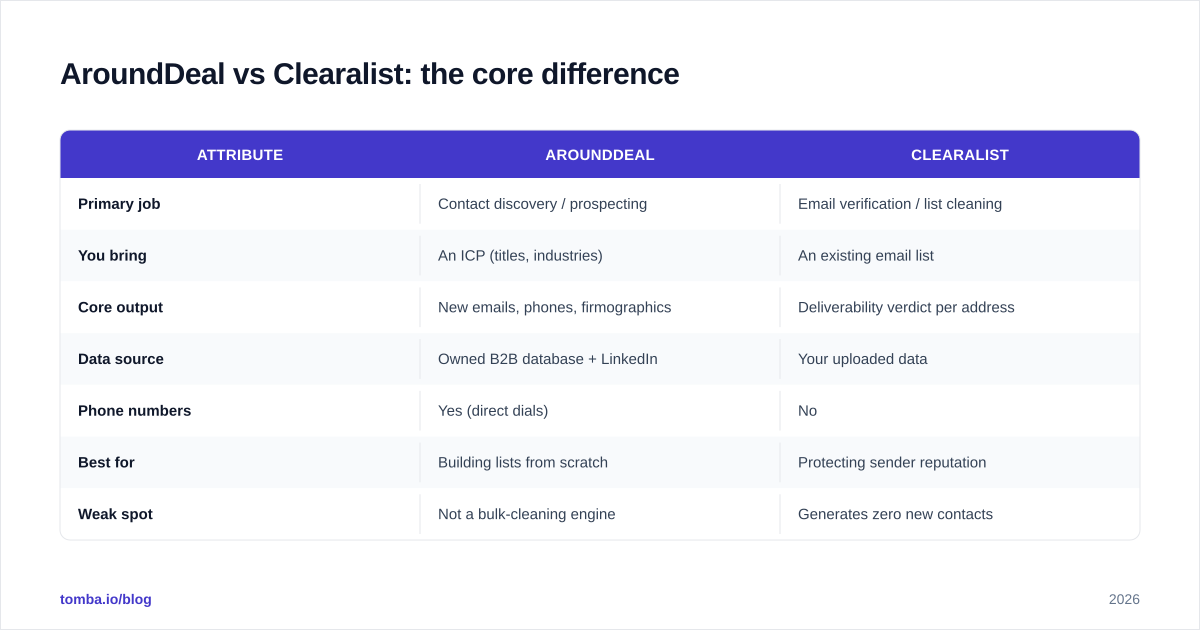
AroundDeal vs Clearalist: the core difference#
Here's the mental model. Think of building an outbound list like cooking: AroundDeal is the grocery run — it gets you the raw ingredients (names, emails, phones). Clearalist is washing and trimming — it throws out the spoiled produce before it ruins the dish. You need both steps. Doing only one leaves you with either an empty fridge or a salad full of rot.
Technically: AroundDeal is a data provider (it owns and sells a contact database), while Clearalist is a data processor (it acts on a list you supply). That single distinction explains almost every difference in pricing, accuracy claims, and use case below.
| Attribute | AroundDeal | Clearalist |
|---|---|---|
| Primary job | Contact discovery / prospecting | Email verification / list cleaning |
| You bring | An ICP (titles, industries) | An existing email list |
| Core output | New emails, phones, firmographics | Deliverability verdict per address |
| Data source | Owned B2B database + LinkedIn | Your uploaded data |
| Phone numbers | Yes (direct dials) | No |
| Best for | Building lists from scratch | Protecting sender reputation |
| Weak spot | Not a bulk-cleaning engine | Generates zero new contacts |
| API access | Yes | Yes (verification) |
The takeaway: comparing them on a single "winner" axis is the wrong question. The real question is which gap are you trying to close — and whether you'd rather close both with one tool.
Which has better data accuracy?#
Short answer: neither publishes independently audited accuracy numbers, so verify before you trust.
AroundDeal's accuracy depends on how fresh its database is for your target segment. It tends to be strong on tech, mid-market, and North American contacts, and thinner on long-tail SMBs and non-English-speaking regions — the same coverage pattern every database vendor fights. Its emails are pattern-matched and SMTP-checked at capture, but databases decay at roughly 2-3% per month as people change jobs, so a contact pulled six months ago may already be stale.
Clearalist's accuracy is a different metric entirely — it's about catch rate: how reliably it flags a bad address as bad, and how few good addresses it wrongly kills (false positives). The hard cases are catch-all domains, where the server accepts every address whether the mailbox exists or not. Most verifiers, Clearalist included, return "risky/unknown" on catch-alls and leave the judgment to you. If a large share of your list is catch-all, that's a real limitation — and a catch-all verifier with deeper resolution becomes valuable.

The practical move regardless of vendor: run a small paid pilot, send to a 500-contact sample, and measure the actual bounce rate. A tool claiming "98% accuracy" that delivers an 8% bounce rate on your segment is lying to you with a true-sounding number. Your inbox is the only benchmark that counts.
)
How do AroundDeal and Clearalist compare on pricing?#
Both use credit- or volume-based models, and both gate the useful features behind paid tiers — the free plans are sampling tools, not production workhorses.
AroundDeal prices by credits, where one credit reveals one contact's details. Heavy prospecting burns credits fast, and direct-dial phone reveals often cost more credits than email. Clearalist prices by verification volume — you pay per address checked, usually in declining-cost blocks as volume rises.
The hidden cost is the stacking problem: if you run AroundDeal for discovery and Clearalist for cleaning, you're paying two subscriptions, reconciling two exports, and managing two APIs. For a small team, that overhead is real money and real time.
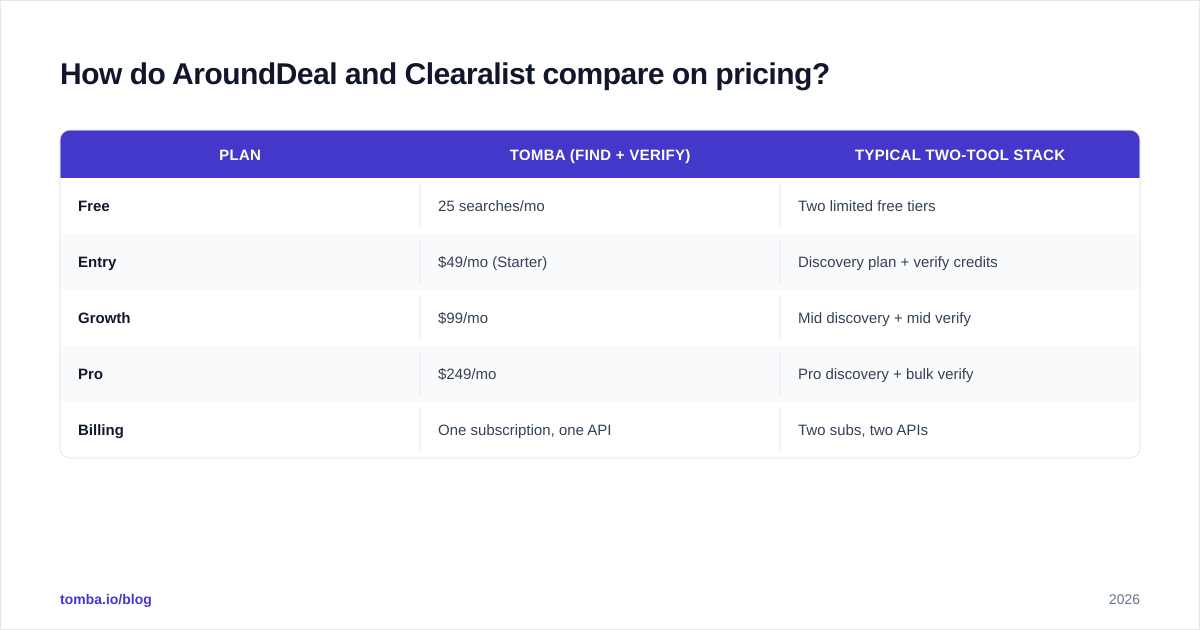
For comparison, a consolidated tool folds both jobs into one bill. Here's how Tomba's published tiers look against the two-tool approach:
| Plan | Tomba (find + verify) | Typical two-tool stack |
|---|---|---|
| Free | 25 searches/mo | Two limited free tiers |
| Entry | $49/mo (Starter) | Discovery plan + verify credits |
| Growth | $99/mo | Mid discovery + mid verify |
| Pro | $249/mo | Pro discovery + bulk verify |
| Billing | One subscription, one API | Two subs, two APIs |
You can see the full Tomba pricing breakdown for exact credit math. The point isn't that one number beats another — it's that paying once for find-and-verify usually undercuts two specialist subscriptions once you account for the integration tax.
When should you choose AroundDeal?#
Pick AroundDeal when discovery is your bottleneck. You have a clear ICP, you live in LinkedIn, and you need a steady flow of new names with phone numbers attached. If your SDRs spend their day finding people rather than cleaning spreadsheets, AroundDeal's extension-driven workflow earns its keep.
It's also the better fit if direct dials matter to your motion. Clearalist doesn't touch phone data, so a phone-heavy outbound team gets nothing from it on that front. For phone coverage specifically, also weigh a dedicated phone finder against AroundDeal's per-credit dial costs.
Skip AroundDeal as your only tool if your real pain is a giant aging list that's bouncing. It won't fix that.
When should you choose Clearalist?#
Pick Clearalist when deliverability is your bottleneck. You already have lists — maybe lots of them, maybe old ones — and your bounce rate is creeping up or your domain reputation is slipping. A focused verifier is the right scalpel.
It's also sensible as a second-stage filter on data from any source, including AroundDeal: capture broadly, then verify hard before you load anything into your sending tool. Pairing discovery with an independent email verifier pass is genuinely good hygiene.
Skip Clearalist as your only tool if you don't yet have contacts to clean. It's a filter, not a faucet.
)
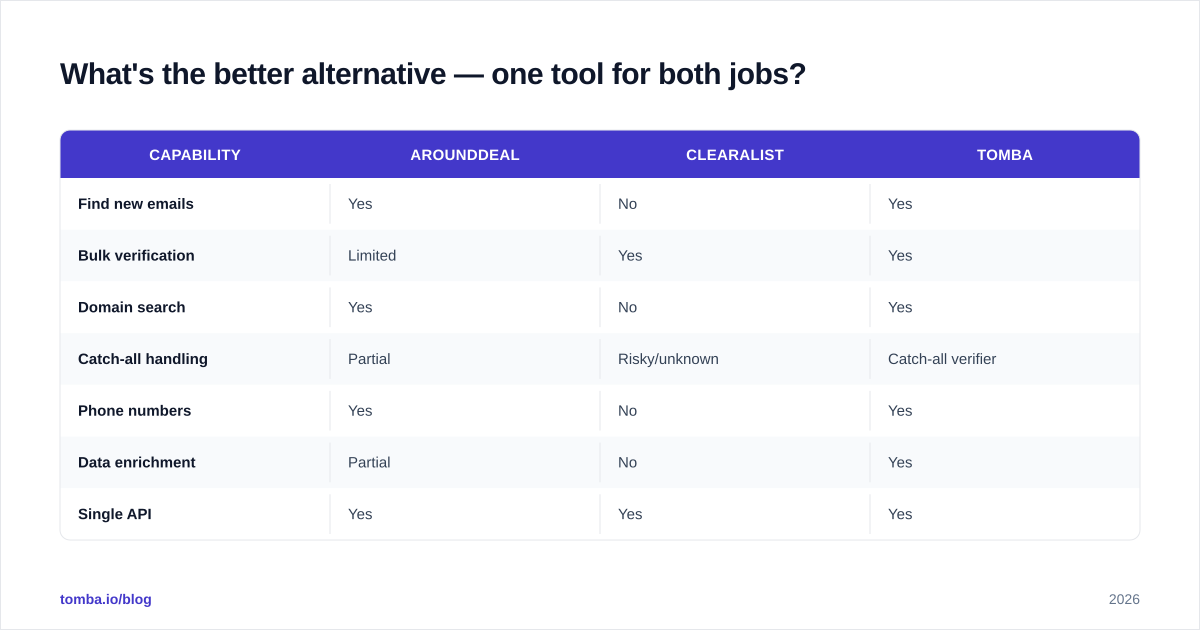
What's the better alternative — one tool for both jobs?#
If reading this far made you think "I actually need both," that's the honest conclusion for most outbound teams — and it's exactly the case for a consolidated platform.
Tomba covers the full chain in one place: find email addresses by name or domain, run a domain search to map every contact at a company, verify in bulk, and resolve catch-alls — under a single API and one bill. That removes the stacking problem entirely.
| Capability | AroundDeal | Clearalist | Tomba |
|---|---|---|---|
| Find new emails | Yes | No | Yes |
| Bulk verification | Limited | Yes | Yes |
| Domain search | Yes | No | Yes |
| Catch-all handling | Partial | Risky/unknown | Catch-all verifier |
| Phone numbers | Yes | No | Yes |
| Data enrichment | Partial | No | Yes |
| Single API | Yes | Yes | Yes |
| Free tier | Yes | Yes | 25 searches/mo |

This isn't to say Tomba beats AroundDeal at every discovery edge case or out-verifies a pure-play hygiene tool on every catch-all. It's that for the common team that needs find + verify + enrich without juggling vendors, one platform is simpler and usually cheaper. Compare each tool's specifics — independent reviews on G2 and Capterra are useful for cutting through vendor copy, and AroundDeal's own LinkedIn presence gives a sense of its data lineage.
How to decide in five minutes#
Run this quick framework against your actual workflow rather than the feature lists:
- Is your problem finding people or cleaning a list? Finding → discovery tool. Cleaning → verifier. Both → consolidated platform.
- Do you need phone numbers? If yes, Clearalist alone is out.
- How big and old is your existing list? Big and stale → verification is urgent regardless of what else you buy.
- How many vendors do you want to manage? Lean teams should weight single-platform options heavily.
- What does the real bounce rate look like on a 500-row pilot? Let data, not marketing percentages, settle the tie.
If you want to skip the spreadsheet entirely, the free email checker lets you test a single address right now, and the bulk email finder handles list-scale discovery once you've picked a direction.
The bottom line#
AroundDeal and Clearalist aren't really competitors — they're two halves of a pipeline. AroundDeal builds the list; Clearalist keeps it clean. If you only have one of those problems, buy the matching specialist. If you have both — which most outbound teams do — paying for two tools and stitching them together is the expensive path.
Start with the Tomba Email Finder free tier (25 searches a month, no card) and put find-and-verify-in-one-place up against the two-tool stack on your own data. Run the 500-contact bounce test, check the credit math, and let the inbox decide. That's the only benchmark that has ever mattered.
Ready to find emails that actually work?
Join 150,000+ professionals who stopped guessing and started sending. Free credits on signup — no credit card required.
Get the Tomba newsletter
Practical outbound tactics and product updates — once every two weeks.
About the author