AroundDeal vs Clearout 2026: Which B2B Data Tool Wins?
AroundDeal sells contact data; Clearout verifies it. We compare accuracy, pricing, and use cases head-to-head so you pick the right tool in 2026.
TL;DR
- AroundDeal is a B2B contact-data and prospecting platform (emails, phones, company intel, Chrome extension). Clearout is primarily an email verification engine with a lighter email-finder bolted on.
- They solve different halves of the same problem: AroundDeal helps you find contacts; Clearout helps you confirm the addresses won't bounce.
- On raw email-finding breadth, AroundDeal wins. On verification depth and bounce protection, Clearout wins.
- Neither is a complete stack on its own — most teams pair a finder with a verifier, which is where a tool like Tomba Email Finder plus its built-in verifier becomes relevant.
- Pricing models differ sharply: AroundDeal uses monthly credit plans, Clearout uses pay-as-you-go verification credits that never expire.
What are AroundDeal and Clearout?#
Short version: AroundDeal is a data source, Clearout is a data filter. Putting them in the same ring is a bit like comparing a grocery store to a refrigerator — related, frequently used together, but not actually the same product.
AroundDeal is a B2B intelligence platform built around a database of roughly 100M+ contacts. You search by company, role, or industry, then pull emails, direct-dial phone numbers, and firmographic data. It leans into the prospecting workflow: build a list, enrich it, push it to your CRM. The Chrome extension that scrapes LinkedIn profiles is its most-used feature.
Clearout started life as an email verification service and that's still its center of gravity. Its job is to take a list of addresses and tell you which ones are deliverable, risky, or invalid — catching typos, spam traps, and dead mailboxes before you hit send. Clearout also offers an email finder, but it's a complement to verification rather than the headline act.
So the honest framing for AroundDeal vs Clearout is: are you short on contacts or short on confidence that your contacts are real?

How do AroundDeal and Clearout compare at a glance?#
| Attribute | AroundDeal | Clearout |
|---|---|---|
| Primary job | B2B prospecting & contact data | Email verification |
| Email finder | Yes (core feature) | Yes (secondary) |
| Email verifier | Basic | Advanced (multi-step, real-time) |
| Phone numbers | Yes (direct dials) | No |
| Chrome extension | Yes (LinkedIn scraping) | Yes (finder/verify) |
| Free tier | Limited monthly credits | 100 free verifications |
| Pricing model | Monthly credit subscription | Pay-as-you-go, credits don't expire |
| Catch-all handling | Limited | Strong, with confidence scoring |
| Best for | List building from scratch | Cleaning lists you already have |
| API access | Yes | Yes (well-documented) |
The table makes the split obvious. If you tried to run cold outreach on AroundDeal alone, you'd ship to a chunk of stale addresses. If you ran Clearout alone, you'd have a spotless list of... nobody, because verification assumes you already collected the emails somewhere.
Which tool finds more emails?#
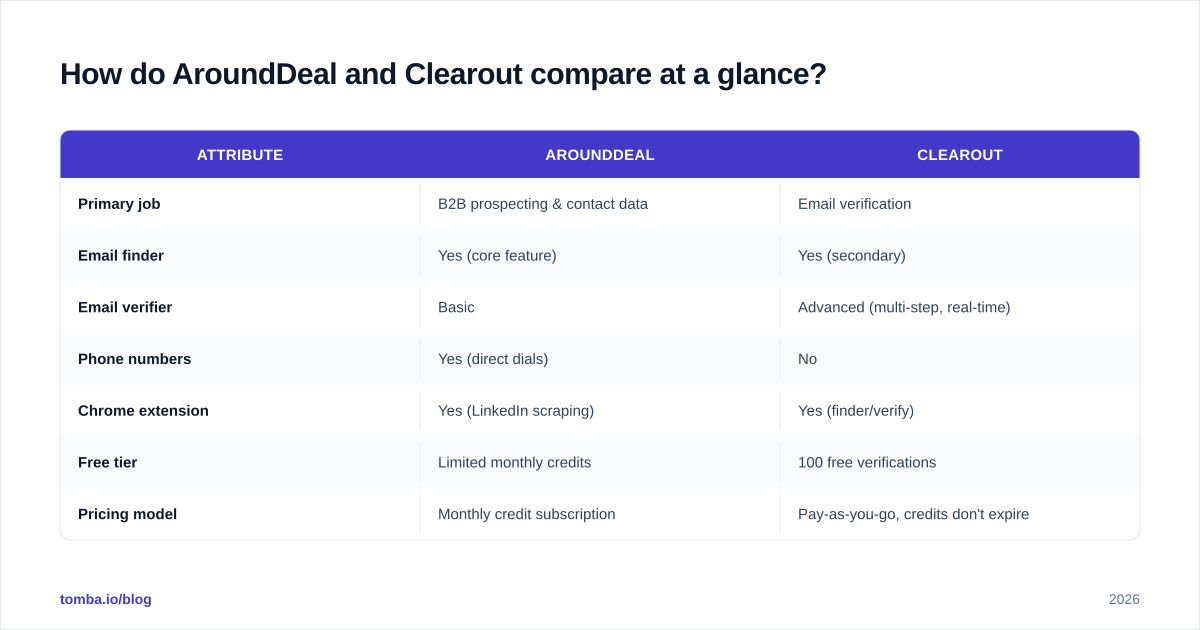
AroundDeal, comfortably — that's its entire reason to exist.
AroundDeal indexes contacts at the company and role level, so you can ask "give me every VP of Marketing at SaaS companies in Germany" and get a list with emails attached. That's a finder built for volume prospecting. Clearout's finder works more narrowly: you feed it a name and a domain, and it attempts to construct and confirm the address. It's accurate when it returns something, but it's not a discovery engine for building lists from thin air.
That said, "finds more" is not the same as "finds correctly." A larger database means more stale rows — people change jobs every few years, and B2B data decays at roughly 25-30% annually according to most industry estimates. This is exactly why an accuracy benchmark matters more than a raw database-size brag.

When you're evaluating any finder — AroundDeal, Clearout, or an alternative — push past the marketing number and ask for the deliverable rate, not just the found rate. A tool that returns 90% of addresses but only 60% land in an inbox is worse than one that returns 70% with 95% deliverability. If you want to test this yourself, run the same 100 names through each tool's email finder and verify the output against a neutral checker.
Which tool verifies emails better?#
Clearout, and it isn't close.
Verification is Clearout's specialty. It runs a multi-layer process: syntax check, MX record lookup, SMTP handshake, role-account detection, disposable-domain filtering, and spam-trap screening. Crucially, it scores catch-all domains with a confidence level instead of just shrugging and marking them "unknown" — a meaningful edge, because catch-all servers accept every address at the SMTP layer and defeat naive verifiers.
AroundDeal does light validation on the data it serves, but it's not a dedicated hygiene tool. If your deliverability or sender reputation is on the line, you want a purpose-built verifier in the loop. Bouncing 8% of a cold campaign can tank your domain reputation fast, and no amount of contact volume saves you once mailbox providers start routing you to spam.
This is the core tension in AroundDeal vs Clearout: one fills the top of the funnel, the other protects the bottom. If your existing list is dirty, a catch-all verifier or a dedicated email verifier does more for your numbers than another data source ever could.

How does pricing compare?#
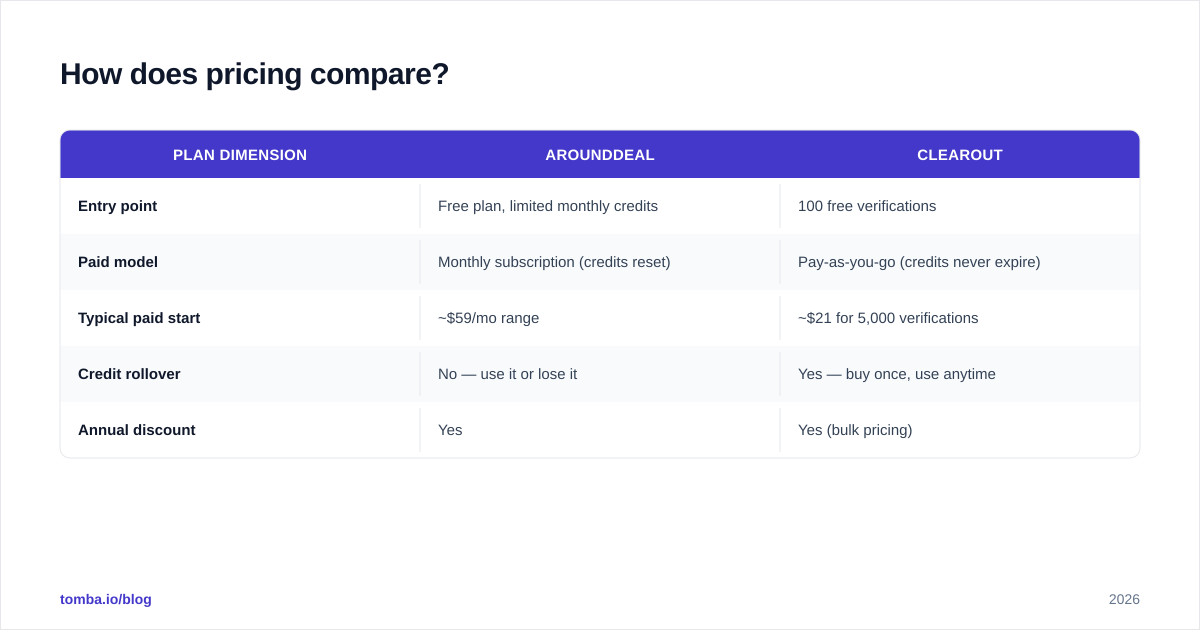
The pricing philosophies are genuinely different, and that difference should drive your decision more than feature checklists.
| Plan dimension | AroundDeal | Clearout |
|---|---|---|
| Entry point | Free plan, limited monthly credits | 100 free verifications |
| Paid model | Monthly subscription (credits reset) | Pay-as-you-go (credits never expire) |
| Typical paid start | ~$59/mo range | ~$21 for 5,000 verifications |
| Credit rollover | No — use it or lose it | Yes — buy once, use anytime |
| Annual discount | Yes | Yes (bulk pricing) |
AroundDeal's monthly-reset model punishes uneven usage. If you prospect heavily one month and barely touch it the next, you're paying for credits you never use. It rewards teams with steady, predictable list-building cadence.
Clearout's pay-as-you-go credits suit spiky usage — clean a big list in Q1, sit idle in Q2, return in Q3 without losing what you paid for. For agencies and seasonal campaigns, that flexibility is worth real money.
Worth noting for cost comparison: a combined finder-plus-verifier platform can undercut buying two separate subscriptions. For reference, Tomba pricing bundles finding and verification — Free (25 searches/mo), Starter $49/mo, Growth $99/mo, and Pro $249/mo — so you're not stacking an AroundDeal bill on top of a Clearout bill.
What are the real-world use cases for each?#
Reach for AroundDeal when you need to build lists from nothing. You have a target market — say, fintech companies in North America — but no contacts yet. AroundDeal's database and LinkedIn extension turn an empty spreadsheet into a few hundred named prospects with emails and phone numbers. It's a top-of-funnel discovery tool.
Reach for Clearout when you already have a list and need it clean. You exported 10,000 leads from a webinar, an old CRM, or a partner data swap, and you don't trust the addresses. Clearout filters out the bounces before you mail. It's a quality-control checkpoint.
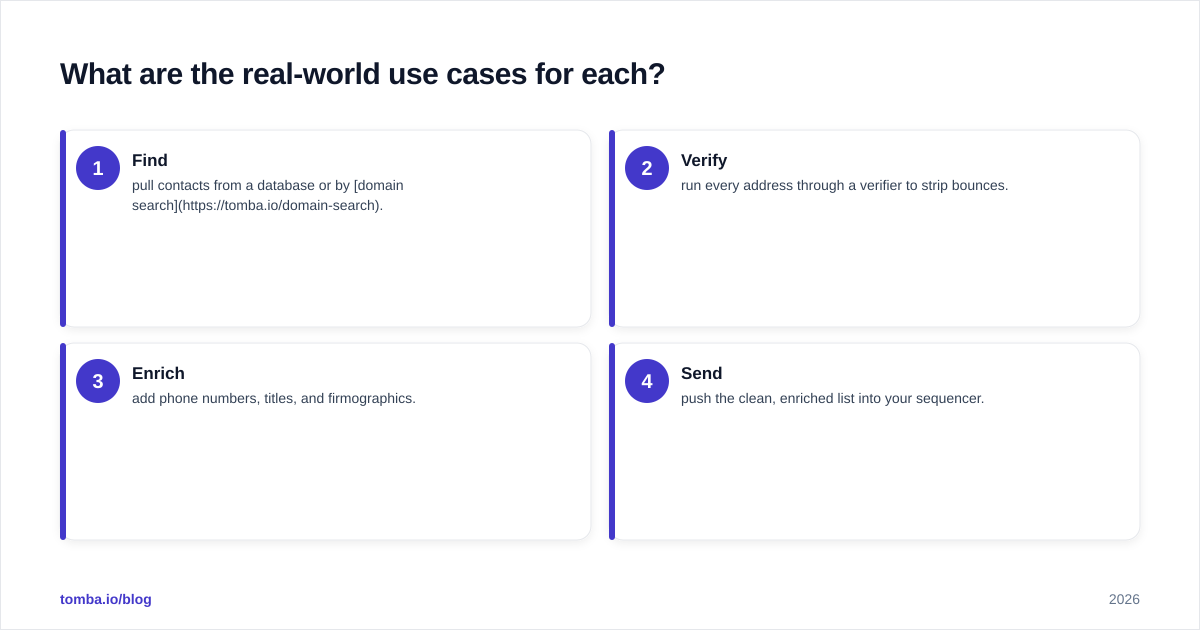
Here's the workflow most experienced teams actually run:
- Find — pull contacts from a database or by domain search.
- Verify — run every address through a verifier to strip bounces.
- Enrich — add phone numbers, titles, and firmographics.
- Send — push the clean, enriched list into your sequencer.
AroundDeal covers steps 1 and 3. Clearout covers step 2. Notice that neither covers the whole pipeline alone — which is the single most important takeaway in this comparison.
Is there a tool that does both finding and verifying?#
Yes — and that's the practical alternative to running AroundDeal and Clearout side by side.
The AroundDeal-vs-Clearout debate exists partly because each tool is half a solution. Buying both means two subscriptions, two dashboards, two APIs, and a manual hand-off between them. For a lot of teams, a single platform that finds and verifies in one pass is simpler and cheaper.

This is where Tomba fits the conversation. It combines an email finder, an email verifier, domain search, a catch-all verifier, bulk email finder processing, and data enrichment under one roof. You find an address and confirm its deliverability without exporting a CSV and uploading it somewhere else. For prospecting at scale, removing that hand-off step is where the real time savings live.
To be fair to both incumbents: if you specifically need AroundDeal's direct-dial phone coverage, or Clearout's deep catch-all confidence scoring as a standalone service, those are legitimate reasons to pick the specialist. Cross-check the live ratings on G2 before you commit — both tools have active user reviews that surface edge cases this article can't.
AroundDeal vs Clearout: which should you choose?#
Decision rule, stated plainly:
- Choose AroundDeal if your bottleneck is not having enough contacts and you want phone numbers alongside emails. It's a prospecting database first.
- Choose Clearout if your bottleneck is bounce rates and list quality and you already have addresses to clean. It's a verification specialist first.
- Choose a combined platform if you'd rather not pay for and stitch together two tools — the find-and-verify pipeline in one place usually wins on cost and simplicity.
There's no universal winner here because they're optimized for different jobs. The mistake is buying one and expecting it to do the other's work: AroundDeal won't protect your sender reputation, and Clearout won't fill an empty pipeline.
The bottom line#
AroundDeal and Clearout aren't really rivals — they're two stages of the same outbound machine. AroundDeal is the better finder and gives you phones; Clearout is the better verifier and protects deliverability. If you only buy one, buy the one that fixes your actual bottleneck, not the one with the longer feature list.
But if you're tired of paying two vendors and babysitting a CSV hand-off between them, consolidate. Tomba Email Finder finds professional email addresses by domain, name, or company and verifies them in the same workflow — with a free tier of 25 searches a month to test it on your own target accounts before you spend a dollar. Run your hardest 50 prospects through it and compare the deliverable rate against whatever you're using now. That single test will tell you more than any comparison table, including this one.
Ready to find emails that actually work?
Join 150,000+ professionals who stopped guessing and started sending. Free credits on signup — no credit card required.
Get the Tomba newsletter
Practical outbound tactics and product updates — once every two weeks.
About the author