AroundDeal vs CompanyData.com vs BoldData: 2026 Comparison
AroundDeal, CompanyData.com, and BoldData all sell B2B data — but they solve different problems. Compare coverage, accuracy, pricing, and delivery before you buy.
B2B data vendors love to sound interchangeable. AroundDeal, CompanyData.com, and BoldData all promise "accurate company and contact data," but they are built for three different jobs — and buying the wrong one is how teams end up with a 100,000-row CSV nobody trusts.
This guide breaks down what each platform actually sells, where the data comes from, what it costs, and which workflow each one fits. No vendor is universally "best." The right pick depends on whether you need live prospecting, a static company database, or a built-to-order marketing list.
TL;DR — Which one should you pick?#
- AroundDeal — a live sales-intelligence platform (search UI, Chrome extension, API) for SDRs and recruiters who prospect contact-by-contact in real time.
- CompanyData.com — a firmographic company database for analysts and ops teams who need account-level coverage, NAICS/SIC codes, and bulk firmographics more than individual emails.
- BoldData — a done-for-you list provider: you describe a target segment, they deliver a custom B2B file. Best for one-off campaigns and niche international targeting.
- Common trap: all three sell volume, not verification. Whatever you buy, run it through an independent email verifier before you send — list age, not list size, is what kills deliverability.
- Pricing shape: AroundDeal is credit/subscription SaaS, CompanyData.com is database-licence/per-record, BoldData is per-list project quotes.
What is AroundDeal?#
AroundDeal is a B2B sales-intelligence platform — closest in shape to Apollo or RocketReach. You search a database of company and contact records through a web app or its Chrome extension, pull verified emails and phone numbers, and push them into your CRM or sequencer.
Its strength is the live prospecting loop: filter by title, industry, location, and headcount, then reveal contacts one at a time or in modest bulk. It leans heavily on the Asia-Pacific region, where its coverage is genuinely deeper than most Western-built tools, while still carrying global records.
Who it fits: SDRs, recruiters, and founders doing hands-on outbound who want a self-serve tool with a free starting tier and per-credit reveals. You can read independent user reviews on G2 to sanity-check coverage in your specific region before committing.
What is CompanyData.com?#
CompanyData.com is a company-first database, not a contact-reveal tool. Think firmographics at scale: legal entity names, addresses, revenue bands, employee counts, industry codes (NAICS/SIC), and corporate hierarchies, licensed in bulk or queried by record.
It answers account-level questions — "give me every manufacturing company in Texas with 50–200 employees and $10M+ revenue" — far better than it answers "give me the VP of Sales' direct email." Individual decision-maker contacts exist, but they are secondary to the firmographic layer.
Who it fits: RevOps, market researchers, and ABM teams building a B2B database or total-addressable-market model, scoring accounts, or enriching an existing CRM with clean company attributes. If your bottleneck is account coverage and segmentation rather than personal emails, this is the category you want.
What is BoldData?#
BoldData is a managed list service. You do not log into a self-serve app and reveal contacts; you tell BoldData your target — industry, country, job titles, company size — and their team compiles a custom B2B mailing/contact list and delivers it as a file. They specialize in international and hard-to-source segments, with strong European and global coverage across 300M+ companies in their backend.
Who it fits: marketers running a defined one-off campaign, event teams needing a regional list fast, or anyone targeting a niche vertical where self-serve tools come up empty. The trade-off is that a delivered file is a snapshot — accurate the day it ships, decaying every week after.
That decay is the whole ballgame, which is the next thing to understand.
)
How fresh is the data, really?#
Conclusion first: freshness is the single biggest differentiator, and it tracks the delivery model. A live API or search UI lets you reveal a record today; a delivered list was assembled before it reached you.
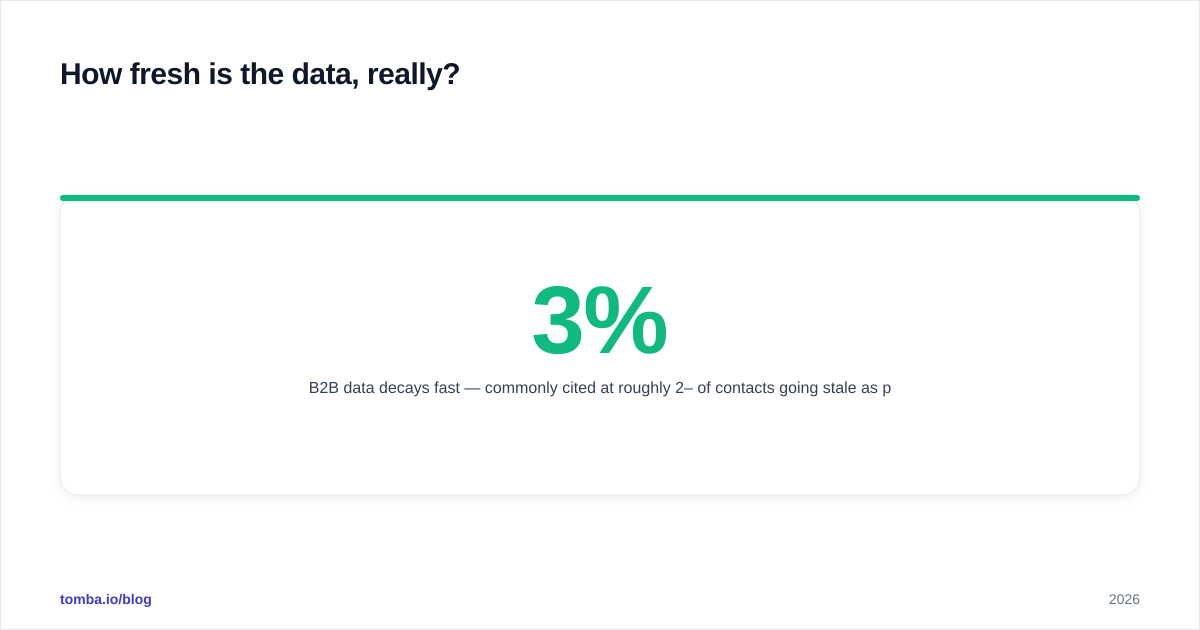
B2B data decays fast — commonly cited at roughly 2–3% of contacts per month going stale as people change jobs, which compounds to ~30% per year. A list that was 95% accurate at delivery can drift below 80% within a quarter. That is why "number of records" is a vanity metric and verification-at-send-time is the real one.
This is also where a verification layer matters regardless of vendor. Whether you reveal a contact in AroundDeal, license records from CompanyData.com, or receive a file from BoldData, treat the source as a candidate list and confirm each address against live SMTP and catch-all checks before it touches your sending domain. Bad data does not just waste sends — it damages sender reputation and drags down deliverability for your good emails too.
)
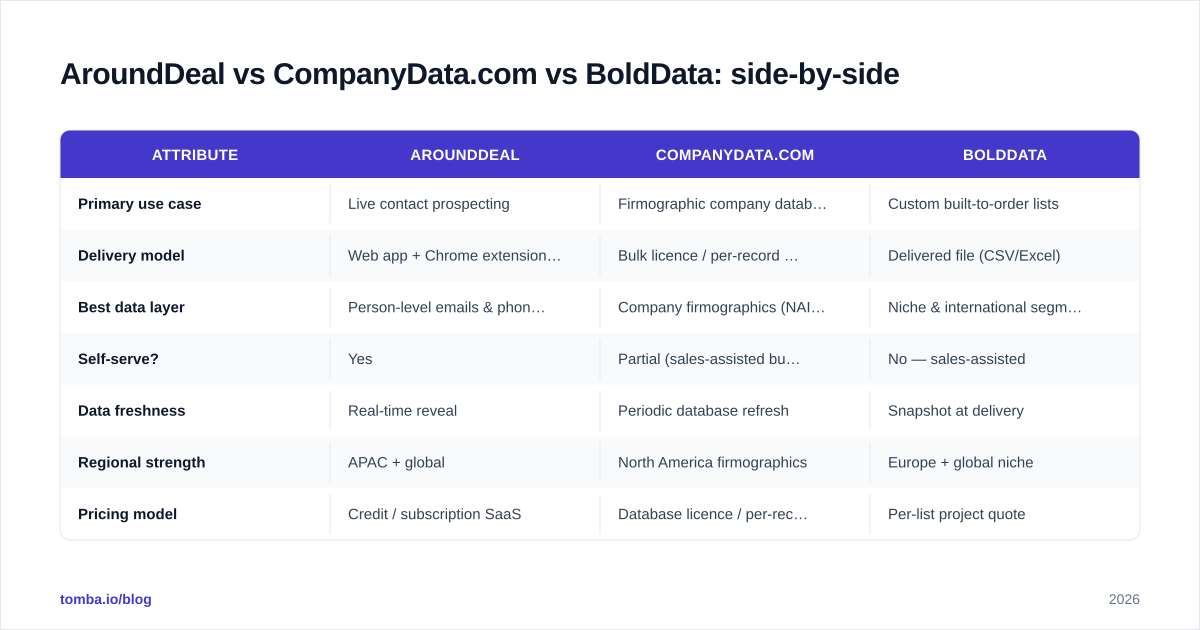
AroundDeal vs CompanyData.com vs BoldData: side-by-side#
| Attribute | AroundDeal | CompanyData.com | BoldData |
|---|---|---|---|
| Primary use case | Live contact prospecting | Firmographic company database | Custom built-to-order lists |
| Delivery model | Web app + Chrome extension + API | Bulk licence / per-record query | Delivered file (CSV/Excel) |
| Best data layer | Person-level emails & phones | Company firmographics (NAICS/SIC) | Niche & international segments |
| Self-serve? | Yes | Partial (sales-assisted bulk) | No — sales-assisted |
| Data freshness | Real-time reveal | Periodic database refresh | Snapshot at delivery |
| Regional strength | APAC + global | North America firmographics | Europe + global niche |
| Pricing model | Credit / subscription SaaS | Database licence / per-record | Per-list project quote |
| Built-in verification | Limited | Minimal | Minimal |
| Ideal buyer | SDRs, recruiters | RevOps, analysts, ABM | Campaign marketers |
The pattern: AroundDeal wins on people, CompanyData.com wins on companies, BoldData wins on bespoke segments. None of the three is a substitute for a verification step.
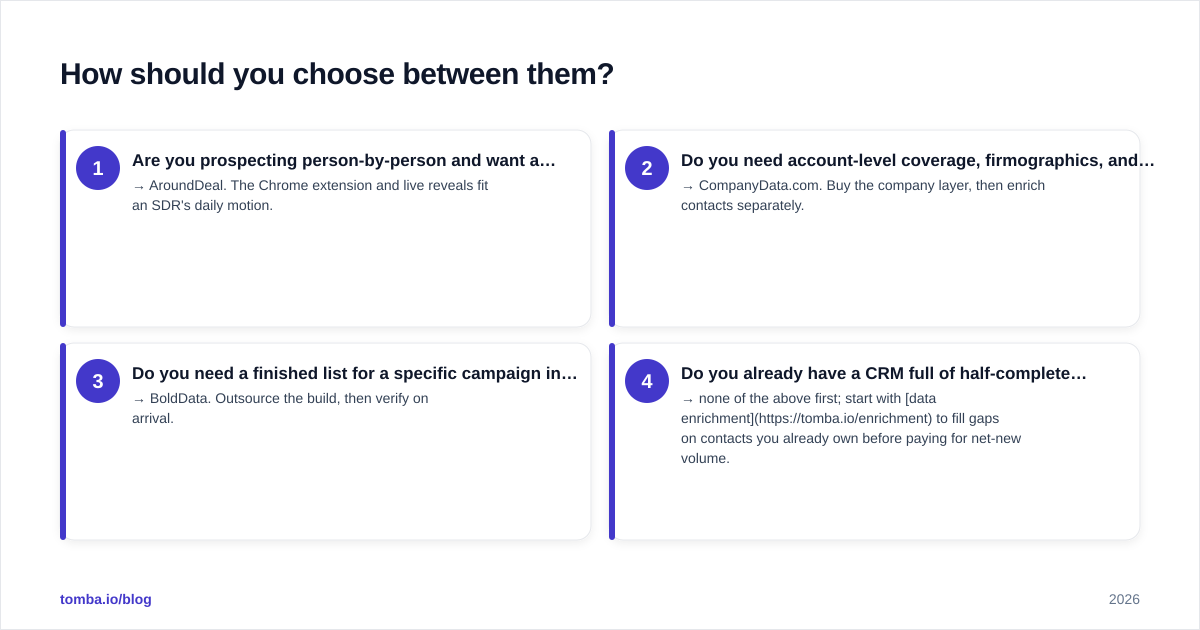
How should you choose between them?#
Match the tool to your bottleneck, not to the longest feature list. Use this decision framework:
- Are you prospecting person-by-person and want a self-serve UI? → AroundDeal. The Chrome extension and live reveals fit an SDR's daily motion.
- Do you need account-level coverage, firmographics, and segmentation at scale? → CompanyData.com. Buy the company layer, then enrich contacts separately.
- Do you need a finished list for a specific campaign in a niche or non-US market? → BoldData. Outsource the build, then verify on arrival.
- Do you already have a CRM full of half-complete records? → none of the above first; start with data enrichment to fill gaps on contacts you already own before paying for net-new volume.
A practical hybrid most teams land on: use a company database (CompanyData.com) or a list provider (BoldData) to define the account universe, then use a contact-level tool to find and verify the people — and always finish with verification.
What about pricing?#
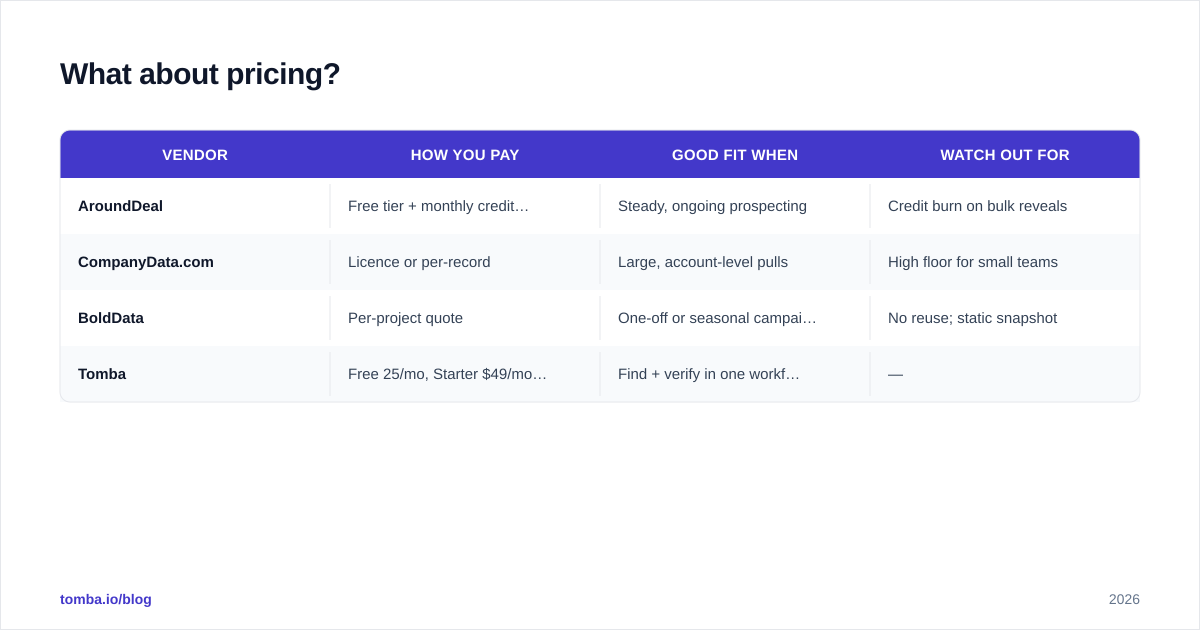
Pricing models differ enough that a flat "X is cheaper" comparison misleads. Here is the shape of each:
| Vendor | How you pay | Good fit when | Watch out for |
|---|---|---|---|
| AroundDeal | Free tier + monthly credit plans | Steady, ongoing prospecting | Credit burn on bulk reveals |
| CompanyData.com | Licence or per-record | Large, account-level pulls | High floor for small teams |
| BoldData | Per-project quote | One-off or seasonal campaigns | No reuse; static snapshot |
| Tomba | Free 25/mo, Starter $49/mo, Growth $99/mo | Find + verify in one workflow | — |
For comparison, transparent self-serve Tomba pricing starts free (25 searches/month), with Starter at $49/mo and Growth at $99/mo — useful as a baseline when a list vendor quotes you a four-figure project fee and you want to know what build-it-yourself would cost.
Where does an email finder fit alongside these tools?#
Conclusion: a dedicated email finder + verifier is the connective tissue between any of these data sources and your actual outbound. The data providers above give you who to contact and which company; you still need confirmed, deliverable addresses.
That is the gap Tomba's Email Finder fills. Drop in a name and company domain and it returns the verified professional email with a confidence score and source attribution — and it documents where the data comes from so you are not flying blind on provenance. Run a BoldData file or a CompanyData.com export through bulk find-and-verify, and you turn a decaying snapshot back into a clean, send-ready list.
Concretely, a resilient stack looks like:
- Define accounts with a firmographic source (CompanyData.com) or a built list (BoldData).
- Find decision-makers with a contact tool (AroundDeal) or by domain search on the companies you've targeted.
- Verify everything before sending, so list age never becomes a deliverability problem.
Frequently asked questions#
Is AroundDeal better than CompanyData.com? Neither is "better" — they sell different things. AroundDeal is for revealing individual contacts in a live UI; CompanyData.com is for licensing company-level firmographic data at scale. If you need emails for specific people, AroundDeal; if you need account coverage and segmentation, CompanyData.com.
Is BoldData accurate? BoldData lists are accurate at the moment of delivery, but every B2B file decays after that. Re-verify the file before each campaign rather than trusting the original accuracy claim weeks later.
Can I use all three together? Yes, and many teams do — company database for TAM, a list service or contact tool for sourcing, and a verifier to keep it clean. The key is not skipping the verification step between sourcing and sending.
Which is cheapest? It depends on volume and cadence. List providers can be cost-effective for a single campaign but expensive to repeat; credit-based SaaS is cheaper for ongoing, lower-volume prospecting. Compare against a transparent self-serve baseline before committing to a project quote.
The bottom line#
AroundDeal, CompanyData.com, and BoldData are not really competitors — they occupy three corners of the B2B data map: live contacts, company firmographics, and custom lists. Pick by bottleneck, assume any sourced data is decaying from the day you get it, and never let it touch your domain unverified.
Want the find-and-verify layer that sits on top of whichever source you choose? Start free with the Tomba Email Finder — 25 searches a month at no cost, verified emails with confidence scores and source attribution, and bulk tools to clean any list before you press send.
// get started
Find, verify and enrich your first contacts today
Start on the free plan with 25 searches a month, then scale when your team is ready.
Free plan · No credit card required · GDPR & CCPA
// about the author