AroundDeal vs CUFINDER 2026: Full B2B Data Comparison
AroundDeal vs CUFINDER, compared on data accuracy, coverage, pricing, and workflow fit so you can pick the right B2B contact tool in 2026 without burning credits.
Choosing between AroundDeal and CUFINDER usually comes down to one question you can't answer from a pricing page: when you actually run your list, how many emails bounce and how many phone numbers connect? Both platforms promise large B2B databases and AI enrichment. Both sell credits. But they're built for different buyers, and picking wrong means paying for records you can't use.
This breakdown compares the two on the things that move pipeline — data accuracy, coverage, enrichment depth, pricing structure, and how they fit a real outbound workflow — then tells you which one earns the slot in your stack.
TL;DR — AroundDeal vs CUFINDER at a glance#
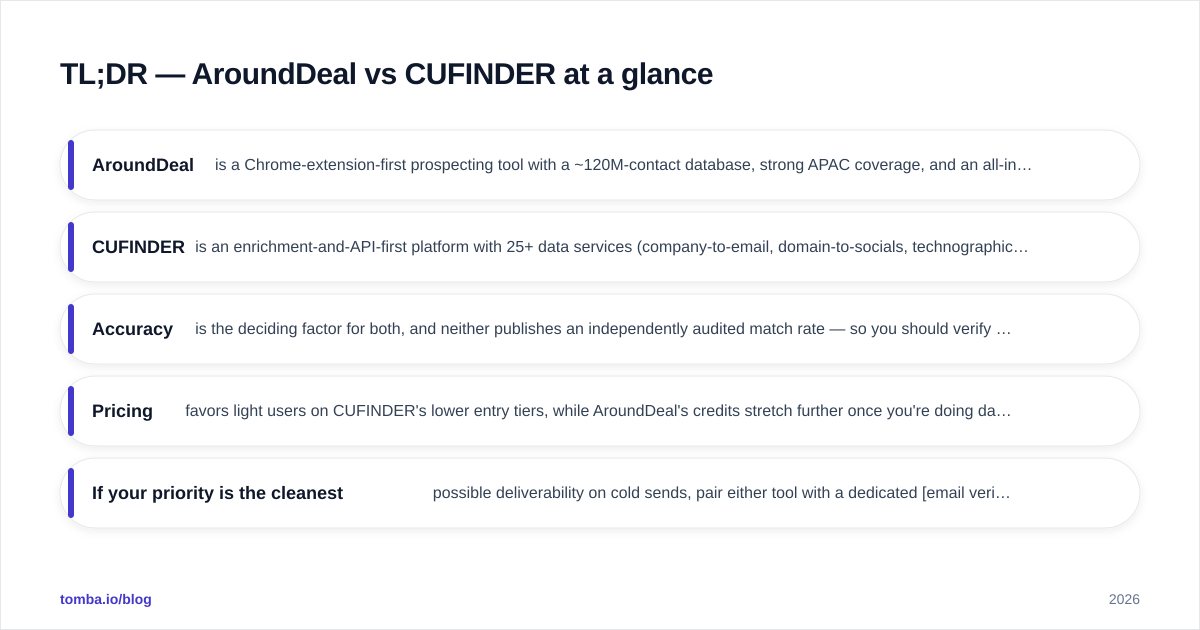
- AroundDeal is a Chrome-extension-first prospecting tool with a ~120M-contact database, strong APAC coverage, and an all-in-one "find + engage" layout aimed at individual SDRs and small teams.
- CUFINDER is an enrichment-and-API-first platform with 25+ data services (company-to-email, domain-to-socials, technographics), built for marketers and ops people who want to enrich lists at scale.
- Accuracy is the deciding factor for both, and neither publishes an independently audited match rate — so you should verify any list before sending, regardless of vendor.
- Pricing favors light users on CUFINDER's lower entry tiers, while AroundDeal's credits stretch further once you're doing daily LinkedIn prospecting.
- If your priority is the cleanest possible deliverability on cold sends, pair either tool with a dedicated email verifier rather than trusting raw exports.
What is AroundDeal?#
AroundDeal is a B2B contact and company intelligence platform best known for its browser extension. You install it, open a LinkedIn profile or company site, and it surfaces work emails, phone numbers, and firmographic data in a side panel. Its database hovers around 120 million contacts with notably deeper coverage across Asia-Pacific markets than most US-centric competitors.
The product splits into three pieces: Prospector (search the database by filters), Engagement (basic sequencing and outreach), and Enrichment (fill gaps in an existing CRM list). That bundling is the pitch — one login instead of a finder plus a separate sequencer.
In practice, AroundDeal sits closest to tools like Apollo or Lusha: extension-driven, SDR-friendly, credit-metered. If you live inside LinkedIn Sales Navigator all day, that workflow feels natural.
What is CUFINDER?#
CUFINDER is an AI-powered lead generation and enrichment engine. Instead of leading with a Chrome extension, it leads with services and an API: company name to email, company to phone, domain to social profiles, email to company, technographic lookups, and bulk enrichment uploads. It advertises 25+ distinct enrichment endpoints and a very large company database.
The mental model is different. AroundDeal answers "who works here and what's their email?" one profile at a time. CUFINDER answers "I have 5,000 company names in a spreadsheet — enrich all of them with the data points I need." That makes it a favorite of growth marketers, RevOps teams, and anyone wiring enrichment into data enrichment pipelines or internal tooling.

AroundDeal vs CUFINDER: the head-to-head comparison#
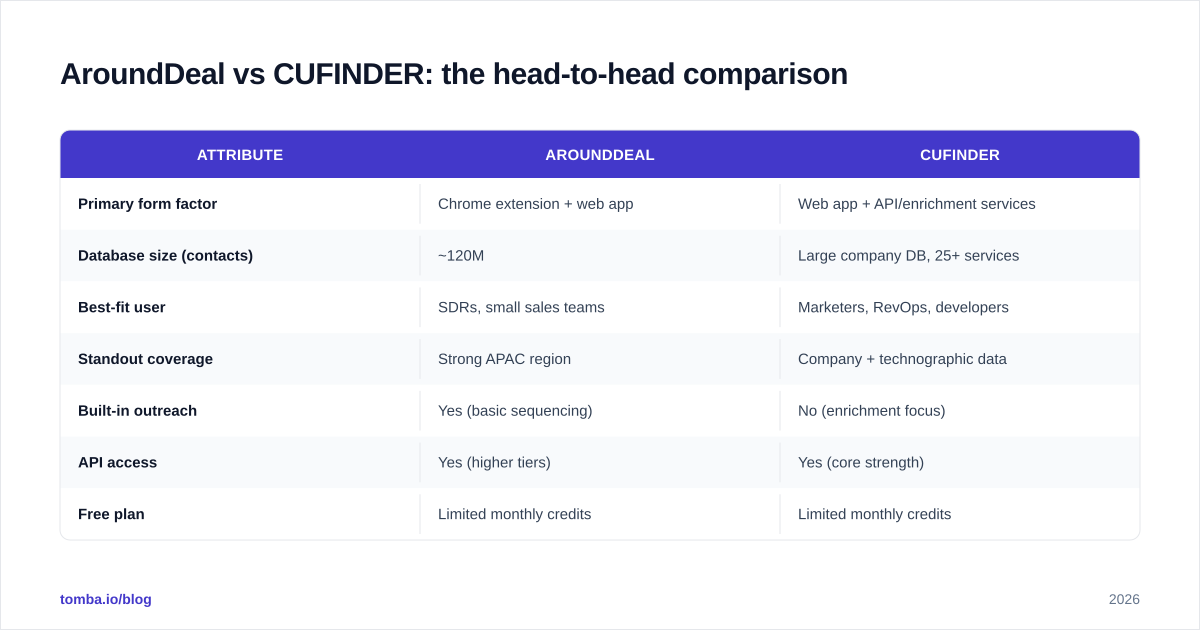
Here's how the two stack up on the attributes that actually affect your results.
| Attribute | AroundDeal | CUFINDER |
|---|---|---|
| Primary form factor | Chrome extension + web app | Web app + API/enrichment services |
| Database size (contacts) | ~120M | Large company DB, 25+ services |
| Best-fit user | SDRs, small sales teams | Marketers, RevOps, developers |
| Standout coverage | Strong APAC region | Company + technographic data |
| Built-in outreach | Yes (basic sequencing) | No (enrichment focus) |
| API access | Yes (higher tiers) | Yes (core strength) |
| Free plan | Limited monthly credits | Limited monthly credits |
| Entry paid tier | ~$59/mo range | ~$49/mo range |
| Phone numbers | Yes | Yes |
| Bulk enrichment | Yes | Yes (a core feature) |
Two takeaways. First, these aren't really the same product — AroundDeal is a prospecting suite, CUFINDER is an enrichment platform that happens to find contacts. Second, the pricing tiers are close enough that cost shouldn't be your deciding factor; fit and accuracy should.
Which tool has more accurate B2B data?#
Neither vendor publishes a third-party-audited accuracy figure, so treat any "98% accurate" marketing claim with skepticism — including from their competitors. What you can rely on is structural reasoning.
AroundDeal's accuracy is strongest where its database is densest: APAC contacts and mid-market companies in those regions. CUFINDER's strength is company-level and technographic data, plus its enrichment-by-API model, which tends to return fresher results for the specific fields you request rather than a whole stale profile.

The honest answer: both will return a meaningful share of catch-all, outdated, or role-based addresses, because every database provider does. The bounce rate you experience depends less on the vendor's headline number and more on whether you verify before sending. Running exports through an email verification step catches the dead addresses that any provider — AroundDeal, CUFINDER, or otherwise — will inevitably include. For catch-all domains specifically, a dedicated catch-all verifier resolves the addresses that simple syntax checks pass but mailboxes reject.
How do AroundDeal and CUFINDER price their credits?#
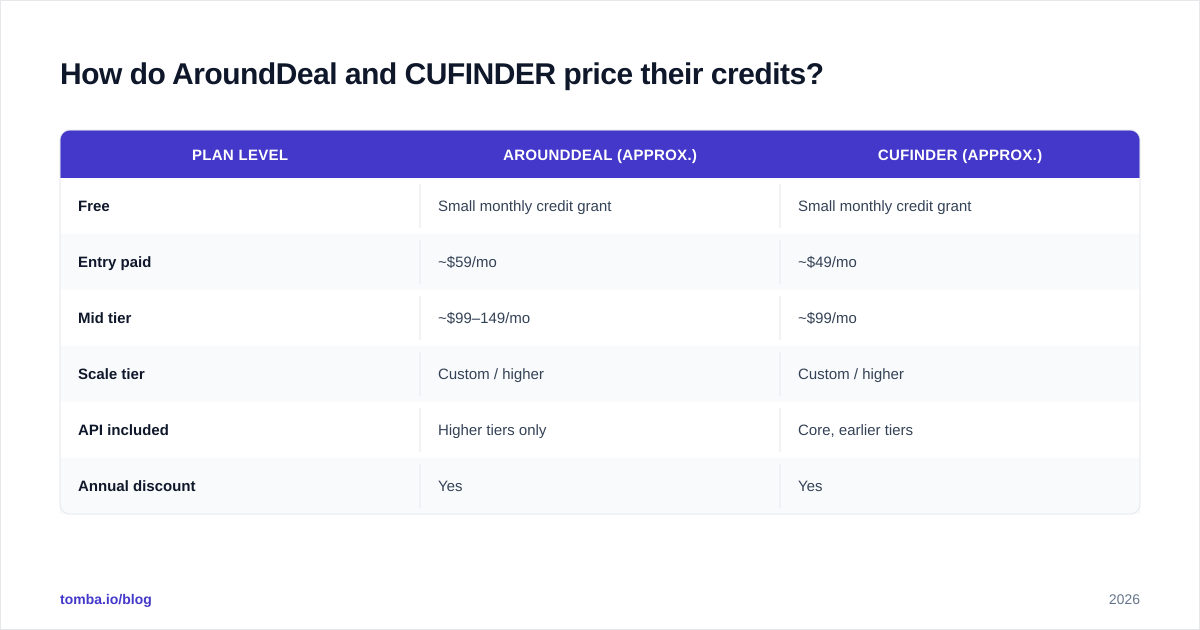
Both use a credit model, and both gate API access and bulk volume behind higher tiers. The trap with credit pricing is "reveals" — some plans charge a credit even when the lookup returns nothing usable, so the effective cost per valid contact is higher than the sticker.
| Plan level | AroundDeal (approx.) | CUFINDER (approx.) |
|---|---|---|
| Free | Small monthly credit grant | Small monthly credit grant |
| Entry paid | ~$59/mo | ~$49/mo |
| Mid tier | ~$99–149/mo | ~$99/mo |
| Scale tier | Custom / higher | Custom / higher |
| API included | Higher tiers only | Core, earlier tiers |
| Annual discount | Yes | Yes |
If you're a solo SDR doing daily LinkedIn prospecting, AroundDeal's extension workflow tends to convert credits into usable contacts efficiently. If you're enriching large static lists or building enrichment into an app, CUFINDER's API-forward pricing is the better economic fit. Always model your cost per verified contact, not your cost per credit — that's the number that shows up in your CAC.
When should you pick AroundDeal?#
Choose AroundDeal if:
- Your reps work inside LinkedIn and a browser extension matches their day.
- You sell into APAC and need depth there, not just US/EU coverage.
- You want find-and-sequence in one tool instead of stitching two together.
- You're a small team that values a single bundled subscription.
AroundDeal is the more natural pick for a sales-led motion where individual reps need contacts on demand and a lightweight place to send the first touch.
When should you pick CUFINDER?#
Choose CUFINDER if:
- You enrich lists in bulk rather than prospect one profile at a time.
- You need company-level and technographic data, not just person emails.
- You're a developer or ops person wiring enrichment into a pipeline via API.
- You run a marketing-led motion where data feeds scoring, routing, or ABM segmentation.
CUFINDER shines as infrastructure. Its 25+ services mean you can request exactly the field you need — domain to socials, company to phone, email to company — without paying for a full profile you'll never use.
How do both compare to a dedicated email finder?#
Here's the part the vendor pages won't tell you: an all-in-one prospecting suite and an enrichment API are both generalists. When your single most important metric is deliverability on cold outbound, a specialist email finder and verifier often beats either on the one job that matters.
That's where pairing matters. You can use AroundDeal or CUFINDER to source contacts and a focused tool to guarantee the emails are real before they hit your sequence. Tomba's email finder resolves professional addresses by name and domain, its domain search pulls every reachable address at a company, and verification runs on the same platform so you never export a list you haven't validated.

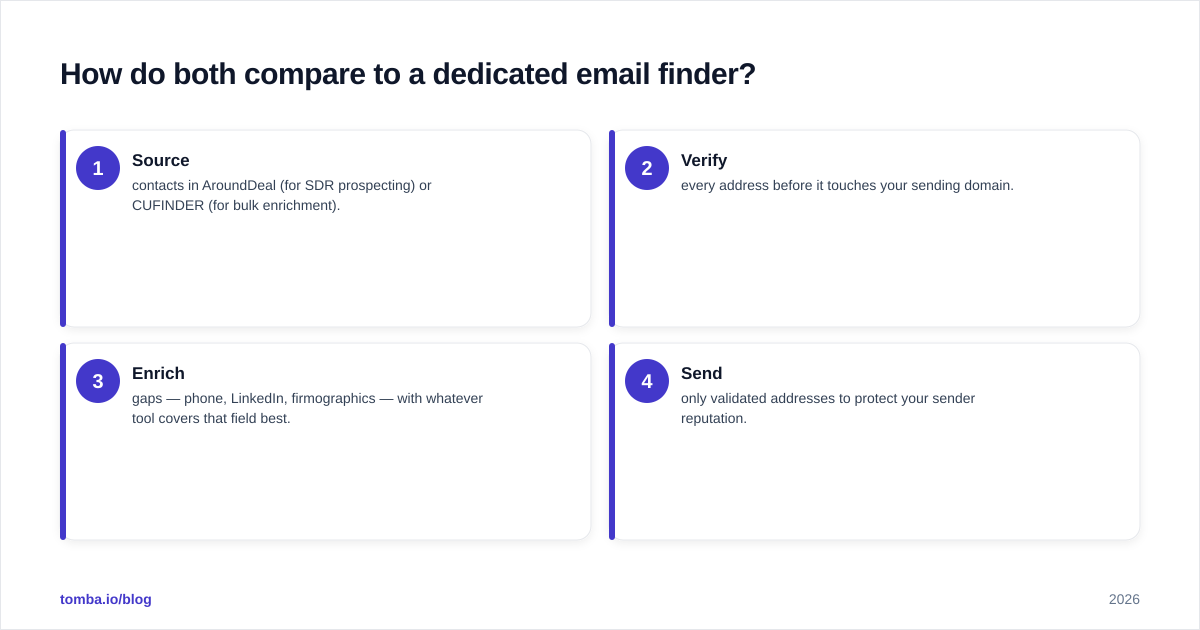
A practical 2026 stack looks like this:
- Source contacts in AroundDeal (for SDR prospecting) or CUFINDER (for bulk enrichment).
- Verify every address before it touches your sending domain.
- Enrich gaps — phone, LinkedIn, firmographics — with whatever tool covers that field best.
- Send only validated addresses to protect your sender reputation.
Skipping step two is the single most common reason cold campaigns tank, no matter which database you bought from. For independent user reviews while you evaluate, AroundDeal on G2 and the official CUFINDER site are the most useful starting points, alongside each vendor's own AroundDeal homepage for current feature lists.
What about coverage gaps and catch-all domains?#
Every B2B database has holes. AroundDeal is thinner on long-tail SMBs outside its strong regions; CUFINDER, being enrichment-first, can return "not found" on obscure person-level lookups even when company data is rich. Neither is a flaw — it's the nature of database coverage.
The bigger operational issue is catch-all domains, which accept every address at the SMTP level and then silently drop invalid ones. Both tools will hand you catch-all addresses marked as "valid." If a large share of your target accounts use catch-all setups, build a catch-all verification step into your process, because a raw export will overstate how many of those addresses actually deliver.
The verdict: which should you buy?#
There's no universal winner — there's a winner for your motion.
- Sales-led, reps in LinkedIn, APAC focus → AroundDeal.
- Marketing/RevOps, bulk enrichment, API-driven → CUFINDER.
- Either way → don't trust raw exports; verify before you send.
The mistake is treating this as a binary when the real lever is data hygiene. The best-performing teams source from whichever database fits their workflow and then run a hard verification gate so deliverability stays high. Compare the entry tiers, model cost-per-verified-contact instead of cost-per-credit, and start on the free plans before committing.
Get accurate emails without the guesswork#
Whichever database you choose, your results live or die on email accuracy. Tomba's Email Finder finds verified professional emails by name, company, or domain — with verification built into the same platform so you're never exporting addresses you haven't validated. Start free with 25 searches a month, then scale on a plan that fits, from Starter at $49/mo to Growth at $99/mo. Pair it with AroundDeal or CUFINDER as your sourcing layer, and let Tomba be the accuracy layer that keeps your sender reputation clean and your bounce rate near zero.
// get started
Find, verify and enrich your first contacts today
Start on the free plan with 25 searches a month, then scale when your team is ready.
Free plan · No credit card required · GDPR & CCPA
// about the author