AroundDeal vs DiscoverOrg: Which B2B Data Wins in 2026?
AroundDeal vs DiscoverOrg, head to head on coverage, accuracy, pricing, and compliance — plus a cheaper, pay-as-you-grow alternative most teams overlook.
AroundDeal vs DiscoverOrg: Which B2B Data Wins in 2026?
Picking a B2B contact data provider is like choosing between a wholesale warehouse and a specialty grocer. One sells everything in bulk on an annual contract; the other gets you in and out fast for a fraction of the price. AroundDeal and DiscoverOrg sit on opposite ends of that aisle, and the right pick depends less on brand names than on how your team actually buys data.
TL;DR#
- **DiscoverOrg is now part of
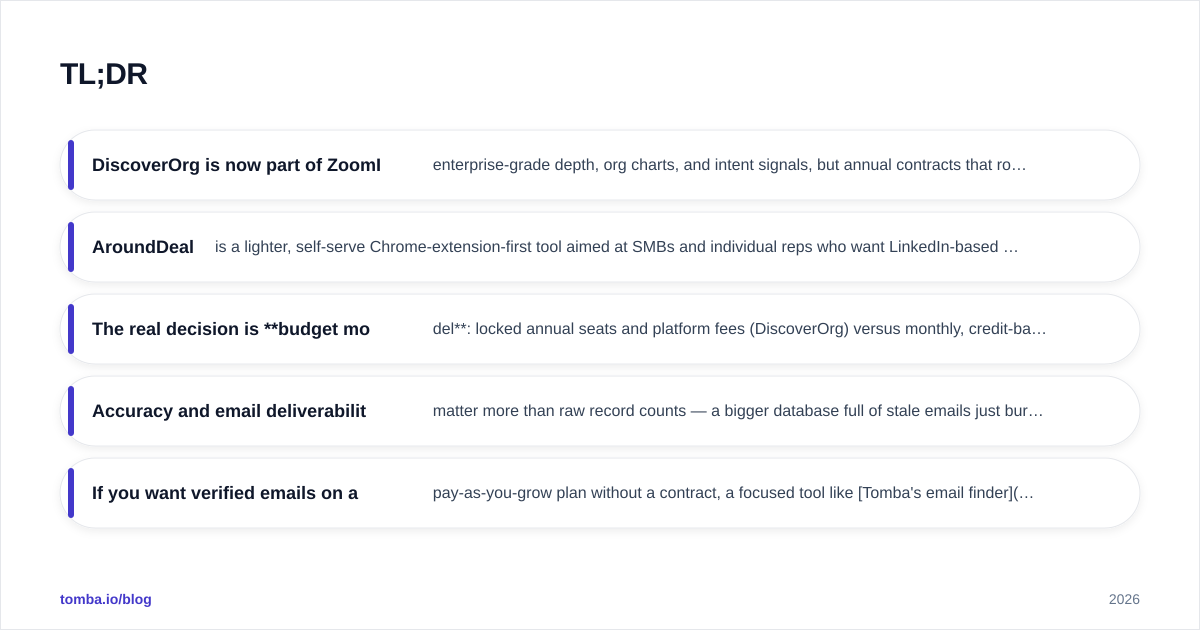
ZoomInfo** — enterprise-grade depth, org charts, and intent signals, but annual contracts that routinely start in the five figures.
- AroundDeal is a lighter, self-serve Chrome-extension-first tool aimed at SMBs and individual reps who want LinkedIn-based prospecting without a sales call.
- The real decision is budget model: locked annual seats and platform fees (DiscoverOrg) versus monthly, credit-based access (AroundDeal).
- Accuracy and email deliverability matter more than raw record counts — a bigger database full of stale emails just burns your sender reputation.
- If you want verified emails on a pay-as-you-grow plan without a contract, a focused tool like Tomba's email finder often beats both on cost-per-valid-contact.
What is AroundDeal?#
AroundDeal is a B2B prospecting and data platform built around a browser extension. You install it, open a LinkedIn profile or company page, and it surfaces the contact's business email and phone number on the spot. It also offers list building, a contact database you can search by title and industry, and basic enrichment.
Its core audience is small teams, founders, and SDRs who prospect one profile at a time and want a low-friction, monthly tool. Pricing is self-serve and credit-based — you buy a tier, get a credit allowance, and spend credits to reveal contacts. There's no mandatory demo, no procurement cycle, and no annual lock-in to start.
The tradeoff is depth. AroundDeal does not pretend to be a full revenue-intelligence suite. You won't find granular org charts, scoop-style sales triggers, or the same breadth of firmographic and technographic filters that an enterprise platform ships with.
What is DiscoverOrg?#
DiscoverOrg was one of the original enterprise sales-intelligence platforms, known for human-verified data, detailed org charts, and "scoops" — early signals about hiring, budget, and projects inside target accounts. In 2019 it merged with ZoomInfo, and today DiscoverOrg's data and capabilities live inside the broader ZoomInfo platform.
That heritage shows. The platform is built for outbound and ABM teams that need to map a buying committee, layer intent data over a territory, and push enriched records straight into Salesforce or HubSpot. Coverage of departmental structure and direct-dial phone numbers is a long-standing strength.
The catch is the commercial model. Access is sold through annual contracts with platform fees, per-seat licensing, and credit caps negotiated by a sales rep. Public pricing doesn't exist, and most reported deals land in the four-to-five-figure range per year. It's powerful, but it's a committed purchase, not an impulse buy.
How do AroundDeal and DiscoverOrg compare on features and pricing?#
Here's the head-to-head on the attributes that actually change a buying decision. (DiscoverOrg figures reflect typical
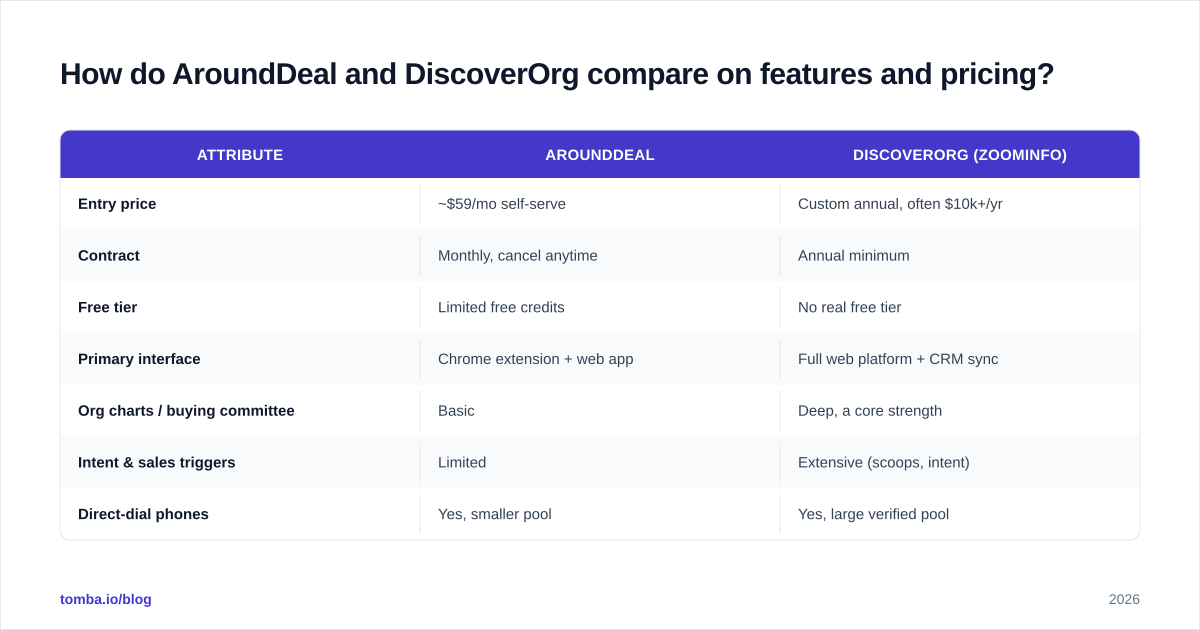
ZoomInfo-platform terms, since pricing is quote-only.)
| Attribute | AroundDeal | DiscoverOrg (ZoomInfo) |
|---|---|---|
| Entry price | ~$59/mo self-serve | Custom annual, often $10k+/yr |
| Contract | Monthly, cancel anytime | Annual minimum |
| Free tier | Limited free credits | No real free tier |
| Primary interface | Chrome extension + web app | Full web platform + CRM sync |
| Org charts / buying committee | Basic | Deep, a core strength |
| Intent & sales triggers | Limited | Extensive (scoops, intent) |
| Direct-dial phones | Yes, smaller pool | Yes, large verified pool |
| Best for | SMBs, solo reps, SDRs | Enterprise outbound & ABM |
| Procurement friction | None — sign up and go | Demo, quote, contract |
The pattern is clear. AroundDeal optimizes for speed and low commitment; DiscoverOrg optimizes for depth and integration at enterprise scale. Neither is "better" in a vacuum — a 5-person agency and a 200-rep outbound org are solving different problems.

Is AroundDeal or DiscoverOrg more accurate?#
Accuracy is where reputations are won and lost, and it's also where buyers get misled. A database advertising "150 million contacts" tells you nothing about how many of those emails will actually deliver today. People change jobs every few years, so any static record decays fast — studies of B2B data routinely cite 20–30% annual decay.
DiscoverOrg historically leaned on human verification and re-verification cycles, which is why its data carries a premium. For org charts and direct dials inside mid-market and enterprise accounts, that depth is genuinely hard to replicate. AroundDeal pulls heavily from LinkedIn-adjacent sourcing, which is excellent for finding a contact quickly but more variable on freshness for any single email.
The lesson for either tool: verify before you send. Whatever provider hands you an address, run it through an email verifier before it touches your sequence. Bounces above 2–3% drag down your sender reputation and push otherwise-good emails into spam. A smaller verified list out-performs a giant unverified one every time.

Pay attention to one more thing: catch-all domains. Many corporate mail servers accept every address at the domain, so a "valid" result can still be a dead inbox. A dedicated catch-all verifier resolves what a basic syntax check cannot, which matters more the further upmarket you sell.
Which one fits your team and budget?#
Match the tool to how you buy and how you sell.
Choose DiscoverOrg / ZoomInfo if:
- You run structured outbound or ABM and need to map full buying committees.
- Intent data and real-time sales triggers drive your territory planning.
- You have budget for an annual platform fee and a procurement process to approve it.
- Native, high-volume CRM enrichment into Salesforce is non-negotiable.
Choose AroundDeal if:
- You're an SMB, agency, or solo rep who prospects profile-by-profile.
- You want a monthly tool with no contract and no sales call.
- A Chrome extension over LinkedIn covers most of your workflow.
- Budget predictability matters more than maximum depth.
Look past both if your real need is simply accurate emails at a fair price. Enterprise platforms bundle a lot you may never touch, and lighter tools can run thin on verification. That gap is exactly where a focused finder-and-verifier stack earns its place.
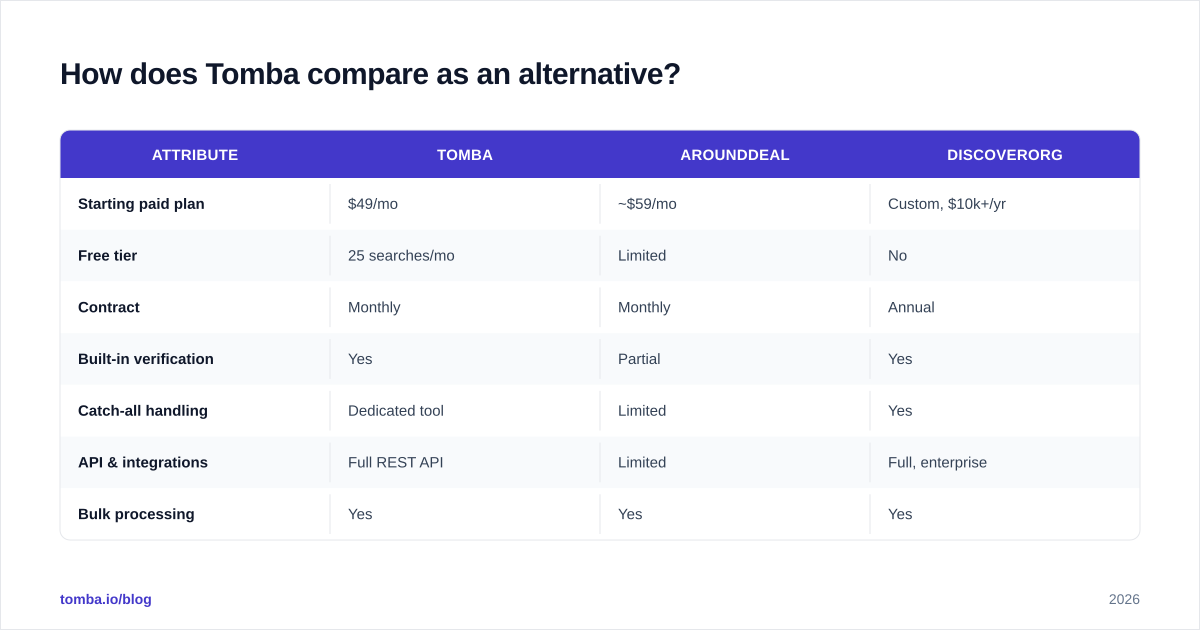
How does Tomba compare as an alternative?#
If the comparison above left you wanting enterprise-grade accuracy without enterprise pricing, that's the niche Tomba fills. Instead of bundling intent data, org charts, and a platform fee into one annual contract, Tomba focuses on the part nearly every team actually needs daily: finding and verifying business emails, with phones and enrichment alongside.
| Attribute | Tomba | AroundDeal | DiscoverOrg |
|---|---|---|---|
| Starting paid plan | $49/mo | ~$59/mo | Custom, $10k+/yr |
| Free tier | 25 searches/mo | Limited | No |
| Contract | Monthly | Monthly | Annual |
| Built-in verification | Yes | Partial | Yes |
| Catch-all handling | Dedicated tool | Limited | Yes |
| API & integrations | Full REST API | Limited | Full, enterprise |
| Bulk processing | Yes | Yes | Yes |
A few practical points. Tomba's domain search returns every public email pattern for a company in one query, which is faster than revealing contacts one profile at a time. Verification is built in rather than a separate purchase, so the address you find is the address you can confirm. And the Tomba API lets you wire finding and verification directly into your own enrichment flow — useful if you're stitching tools together rather than buying one monolith.
The honest framing: Tomba won't hand you a buying-committee org chart or live intent scoops the way
ZoomInfo's platform does. If those signals are central to your motion, pay for the enterprise suite. But if you mostly need verified contacts to fuel outbound, you'll spend a fraction of the cost and skip the annual commitment. See the full Tomba pricing to compare tiers directly.

What about data compliance and privacy?#
Compliance is not optional in 2026, and it varies by provider. B2B data platforms operate under GDPR (legitimate-interest provisions for business contacts), CCPA, and similar regimes. Enterprise vendors like ZoomInfo publish detailed privacy and notice-and-opt-out processes because their customers' legal teams demand it. Lighter tools differ in how transparently they document sourcing.
Three questions to ask any provider before you sign:
- Where does the data come from? Public sources, partnerships, and contributory networks each carry different obligations. Tomba documents its data sources openly.
- How is opt-out handled? A compliant provider honors deletion and suppression requests promptly across its database.
- Is the data re-verified? Freshness is both an accuracy and a compliance concern — stale records on people who've left a company create risk, not just bounces.
Don't outsource this entirely to the vendor. Maintain your own suppression list, honor unsubscribes immediately, and keep records of your lawful basis for outreach. A clean process protects deliverability and your brand at the same time.
The verdict: AroundDeal vs DiscoverOrg#
Conclusion first: DiscoverOrg (ZoomInfo) wins on depth; AroundDeal wins on accessibility; and many teams are better served by neither.
If you're an enterprise outbound or ABM team with budget and a need for org charts plus intent signals, DiscoverOrg's lineage inside ZoomInfo is hard to beat — just go in expecting an annual contract and a procurement cycle. If you're an SMB or individual rep who prospects on LinkedIn and wants a no-commitment monthly tool, AroundDeal is the lighter, friendlier pick.
But if your actual job is putting verified emails in front of the right people without overpaying for features you'll never open, start with a focused stack. Tomba's email finder and built-in email verification cover the 80% of the workflow that drives pipeline — at $49/mo with a free tier to test first, and no annual lock-in. Run a few searches against your current provider's data and compare valid-contact rates before you renew anything. The numbers usually make the decision for you.
Sources and further reading: ZoomInfo, G2 sales intelligence category, and the HubSpot blog for outbound and data-hygiene best practices.
// get started
Find, verify and enrich your first contacts today
Start on the free plan with 25 searches a month, then scale when your team is ready.
Free plan · No credit card required · GDPR & CCPA
// about the author