Arounddeal vs Easyleadz 2026: B2B Contact Data Compared
AroundDeal leans on a broad B2B contact database while EasyLeadz wins on direct-dial phone numbers. Here's how the two stack up on coverage, accuracy, pricing, and which fits your outbound motion in 2026.
Choosing between AroundDeal and EasyLeadz usually comes down to one question: do you need a wide B2B contact database, or do you need a phone to ring? Both tools promise verified prospect data, but they were built for different jobs. This breakdown shows where each one is genuinely strong, where the marketing oversells, and how to pick without burning a quarter's budget on the wrong subscription.
TL;DR — AroundDeal vs EasyLeadz at a glance#
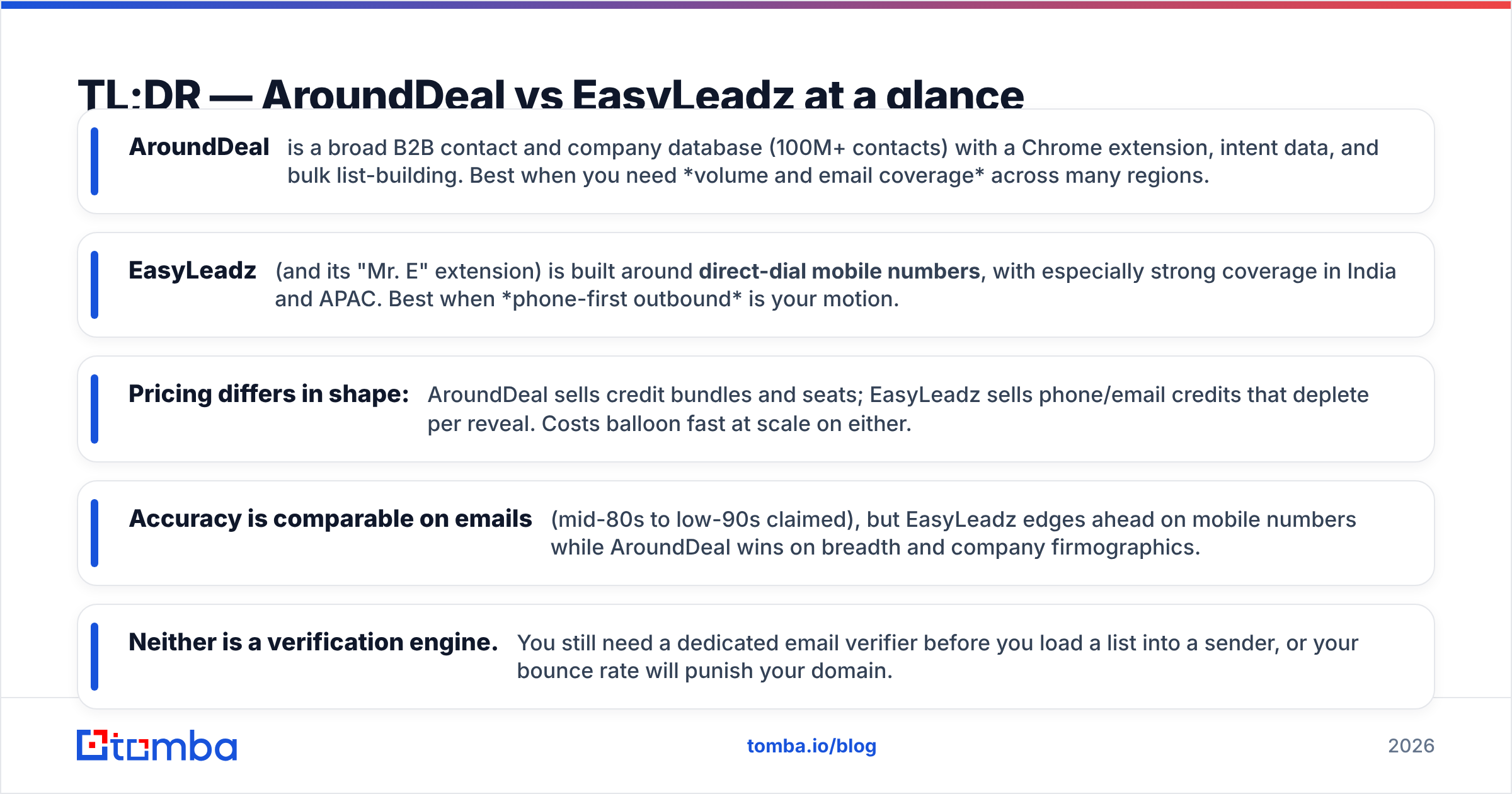
- AroundDeal is a broad B2B contact and company database (100M+ contacts) with a Chrome extension, intent data, and bulk list-building. Best when you need volume and email coverage across many regions.
- EasyLeadz (and its "Mr. E" extension) is built around direct-dial mobile numbers, with especially strong coverage in India and APAC. Best when phone-first outbound is your motion.
- Pricing differs in shape: AroundDeal sells credit bundles and seats; EasyLeadz sells phone/email credits that deplete per reveal. Costs balloon fast at scale on either.
- Accuracy is comparable on emails (mid-80s to low-90s claimed), but EasyLeadz edges ahead on mobile numbers while AroundDeal wins on breadth and company firmographics.
- Neither is a verification engine. You still need a dedicated email verifier before you load a list into a sender, or your bounce rate will punish your domain.
What are AroundDeal and EasyLeadz?#
AroundDeal is a B2B data platform positioned as a sales-intelligence "all-in-one." You get a searchable contact database, a browser extension that pulls contact details off LinkedIn and company sites, intent signals, and enrichment APIs. Its pitch is coverage: filter by title, industry, geography, and headcount, then export lists in bulk. You can read more on its official site.
EasyLeadz takes a narrower, sharper angle. Its flagship is Mr. E, a Chrome extension that surfaces a prospect's direct mobile number from a LinkedIn profile in one click. The company built its reputation on phone data — particularly hard-to-find APAC and Indian mobile numbers that most US-centric databases miss. See their homepage for the current feature set.
The everyday analogy: AroundDeal is the big-box wholesaler — aisles of contacts, decent prices, you grab what you need in bulk. EasyLeadz is the specialty shop that stocks the one part the wholesaler never has in stock: a working cell number.
How do AroundDeal and EasyLeadz compare on core features?#
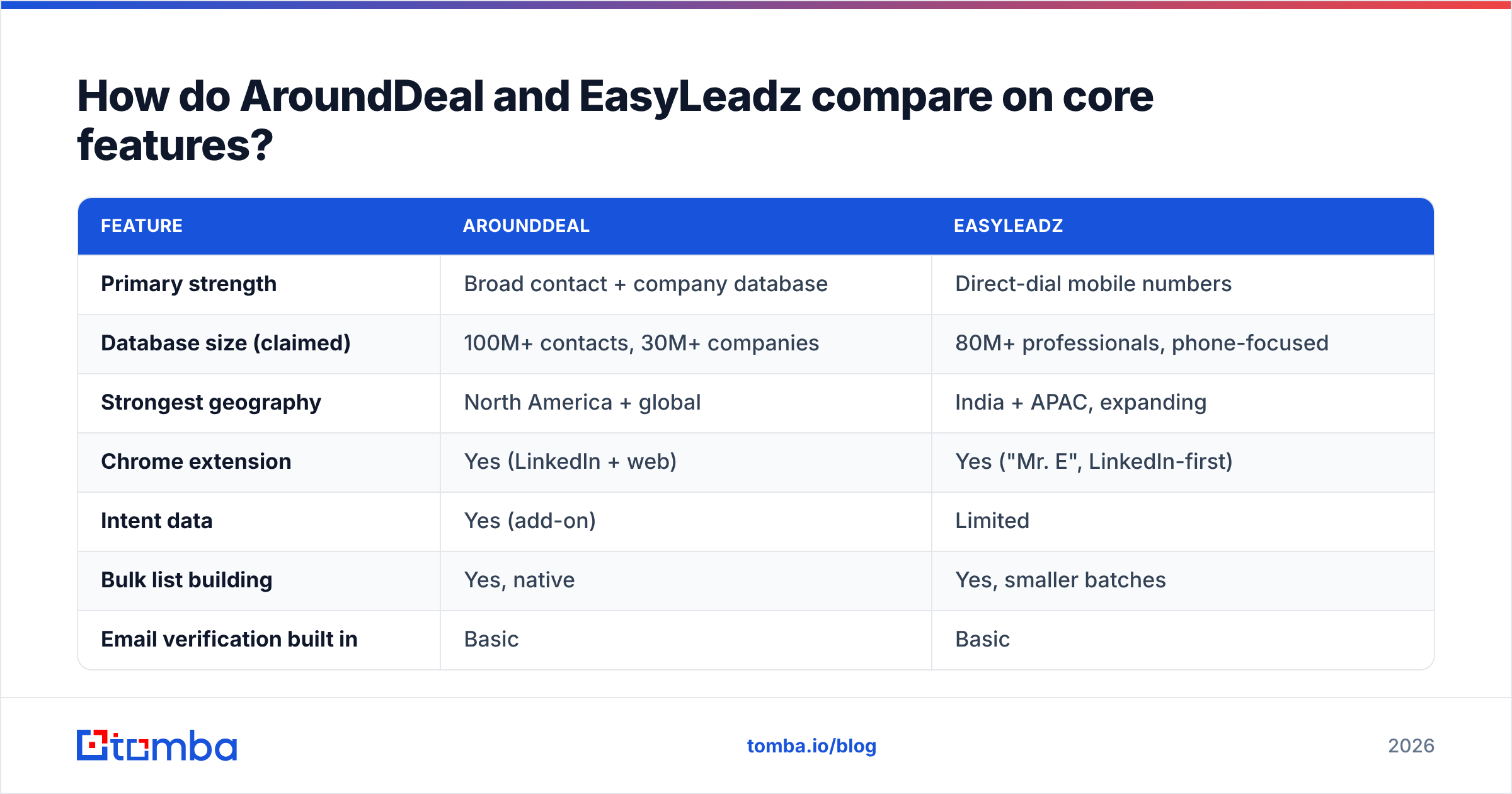
The two overlap on the basics — both find emails, both have extensions, both export to CSV — but their depth is lopsided. AroundDeal is wide; EasyLeadz is deep on a single axis.
| Feature | AroundDeal | EasyLeadz |
|---|---|---|
| Primary strength | Broad contact + company database | Direct-dial mobile numbers |
| Database size (claimed) | 100M+ contacts, 30M+ companies | 80M+ professionals, phone-focused |
| Strongest geography | North America + global | India + APAC, expanding |
| Chrome extension | Yes (LinkedIn + web) | Yes ("Mr. E", LinkedIn-first) |
| Intent data | Yes (add-on) | Limited |
| Bulk list building | Yes, native | Yes, smaller batches |
| Email verification built in | Basic | Basic |
| Enrichment API | Yes | Yes |
| Free tier | Limited monthly credits | Limited monthly credits |
The pattern is clear. If your SDRs live in LinkedIn Sales Navigator and need a phone to dial today, EasyLeadz removes friction better. If your motion is list-build-then-email across many segments, AroundDeal's filters and volume do more work per seat.
Which has better data accuracy and coverage?#
Conclusion first: it depends on the data type. AroundDeal wins on email and firmographic breadth; EasyLeadz wins on mobile-number hit rate, especially outside North America.
Both vendors publish accuracy claims in the mid-80s to low-90s percent range, and both — like every provider in this category — measure that on their own terms. Treat marketing accuracy numbers as a ceiling, not a guarantee. Independent reviews on G2 tell a more grounded story: AroundDeal users praise coverage but flag stale records in smaller markets, while EasyLeadz users rave about phone accuracy in India and APAC but note thinner data for US mid-market roles.
The variable that wrecks every accuracy claim is the catch-all domain. When a company's mail server accepts every address, no finder can confirm a specific inbox exists by SMTP alone. Both tools will hand you a "valid" catch-all address that may bounce. This is exactly why a dedicated catch-all verifier belongs in your workflow regardless of which database you buy from.
A practical accuracy test before you commit to either: pull 100 contacts you already know to be correct (your own customers), run them through each tool's reveal, and measure the real match rate against ground truth. Vendor benchmarks are averages; your segment is what you actually pay for.
)
How does pricing compare between AroundDeal and EasyLeadz?#
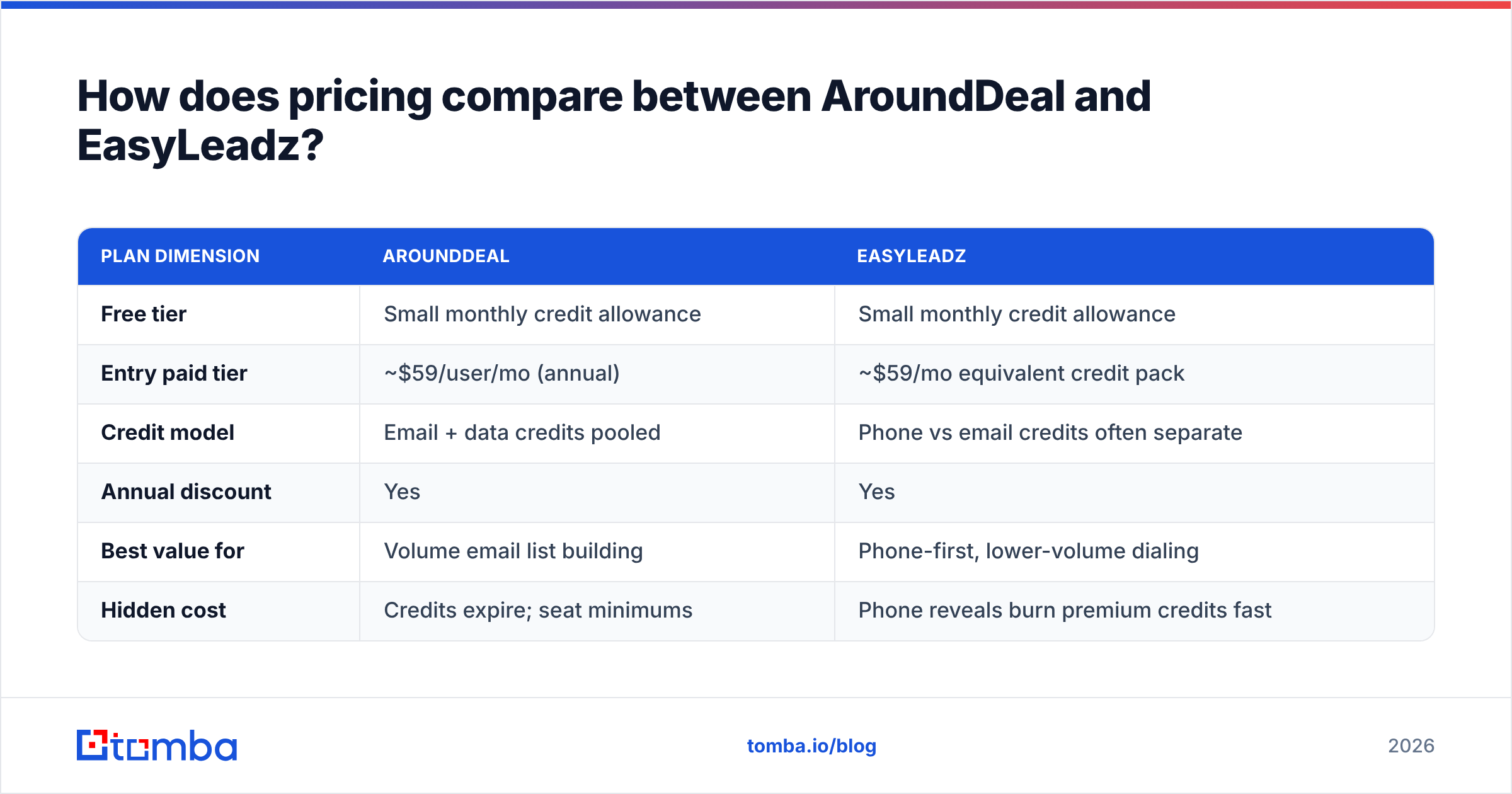
Both price on a credit model, and both get expensive once a full team is revealing data daily. The headline difference: EasyLeadz often charges separately (and more) for phone reveals, while AroundDeal bundles email and basic data into broader credit packs.
| Plan dimension | AroundDeal | EasyLeadz |
|---|---|---|
| Free tier | Small monthly credit allowance | Small monthly credit allowance |
| Entry paid tier | ~$59/user/mo (annual) | ~$59/mo equivalent credit pack |
| Credit model | Email + data credits pooled | Phone vs email credits often separate |
| Annual discount | Yes | Yes |
| Best value for | Volume email list building | Phone-first, lower-volume dialing |
| Hidden cost | Credits expire; seat minimums | Phone reveals burn premium credits fast |
Note: vendor pricing changes often and varies by contract — verify current numbers directly before budgeting. The structural takeaway holds regardless of the exact figure: per-credit data pricing punishes high-volume teams. If three SDRs each reveal 50 contacts a day, you will blow through a "generous" monthly allowance inside two weeks and end up negotiating an enterprise contract you didn't plan for.
That cost curve is why many teams split the stack: a flat-rate finder for the high-volume email work, and a specialist phone tool only for accounts that warrant a call. A flat plan like Tomba's pricing — Starter at $49/mo, Growth at $99/mo — makes the email half of that math predictable instead of metered.
)
Which is better for finding emails vs phone numbers?#
Split the decision by the channel you actually use:
For email-led outbound, AroundDeal is the stronger default. Its database depth, bulk export, and intent layer let you build a 2,000-line segmented list in an afternoon. But — and this matters — a found email is not a deliverable email. Run every export through verification and consider data enrichment to fill gaps before the list touches your sequencer.
For phone-led outbound, EasyLeadz is the clear pick, particularly if you sell into India, Southeast Asia, or the Middle East where its mobile coverage is genuinely hard to beat. If you need to pair those numbers with a validation step, a phone validator confirms the line is active before your dialer wastes a slot.
The honest answer for most teams in 2026 is neither tool alone covers both channels well. AroundDeal's phone data is thin compared to EasyLeadz; EasyLeadz's email breadth is thin compared to AroundDeal. You're choosing a primary, not a complete solution.
What are the main weaknesses of each tool?#
No comparison is useful without the downsides stated plainly.
AroundDeal weaknesses:
- Data freshness dips in smaller and non-English markets — expect more bounces there.
- Phone coverage is secondary; don't buy it as a dialing tool.
- Credit expiry and seat minimums make small-team economics awkward.
- Built-in verification is light; you'll want a real verifier downstream.
EasyLeadz weaknesses:
- Email and firmographic breadth lag the broad-database players.
- Phone credits deplete quickly and are the premium-priced unit.
- Strongest in APAC/India; US mid-market coverage is patchier.
- Narrow feature surface — fewer workflow integrations than the all-in-one crowd.
The shared weakness is the one buyers underestimate: both sell discovery, not deliverability. Finding a contact and reliably landing in their inbox are different problems. If your sender reputation tanks because half a bought list bounces, the data was worthless no matter how "accurate" the vendor claimed it was. Pair either tool with verification and basic sender reputation hygiene.
Which should you choose — AroundDeal or EasyLeadz?#
Use this quick decision logic:
- Choose AroundDeal if email is your primary channel, you build large segmented lists, you sell across multiple geographies, and you value intent signals plus company firmographics.
- Choose EasyLeadz if calling is core to your motion, you sell into India/APAC, and a working mobile number is worth more to you than email volume.
- Choose both (or a split stack) if you run true multi-channel outbound and can justify two data subscriptions — but watch the combined credit burn.
For teams whose real bottleneck is email — finding it, verifying it, and not torching their domain — the smarter move is often to skip the all-in-one premium and pair a focused, flat-rate email finder with a specialist phone tool only where calls matter.
Where does Tomba fit in this comparison?#
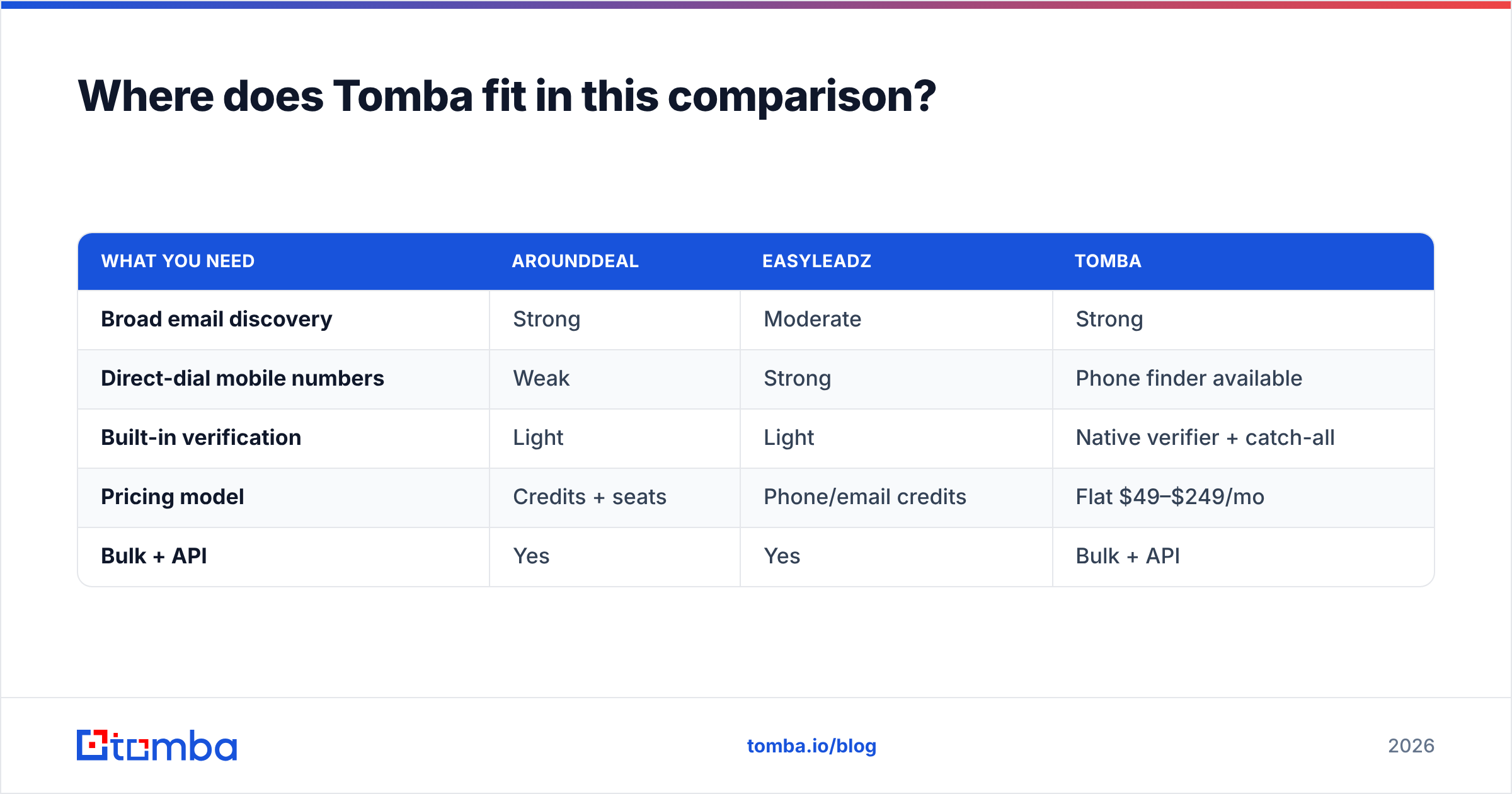
Tomba isn't trying to be an all-in-one sales-intelligence suite — it's a focused, accurate engine for the email half of the job, priced flat instead of per-lead. If your pain is "I need verified work emails at scale without metered credit anxiety," that focus is the point.
| What you need | AroundDeal | EasyLeadz | Tomba |
|---|---|---|---|
| Broad email discovery | Strong | Moderate | Strong |
| Direct-dial mobile numbers | Weak | Strong | Phone finder available |
| Built-in verification | Light | Light | Native verifier + catch-all |
| Pricing model | Credits + seats | Phone/email credits | Flat $49–$249/mo |
| Bulk + API | Yes | Yes | Bulk + API |
The realistic 2026 stack for an email-first team: use Tomba's email finder and domain search for discovery and verification, and bolt on EasyLeadz only for the accounts where you genuinely need a phone. That keeps your highest-volume cost predictable and your lowest-volume specialist spend contained.
Frequently asked questions#
Is AroundDeal or EasyLeadz more accurate? For emails and firmographics, AroundDeal's breadth wins. For direct-dial mobile numbers — especially in India and APAC — EasyLeadz is more accurate. Always verify against your own known-good contacts before committing.
Are AroundDeal and EasyLeadz GDPR compliant? Both publish compliance statements and honor opt-out/removal requests, but compliance is your responsibility too — document lawful basis for outreach and respect suppression lists. Review each vendor's current data-processing terms directly.
Do I still need an email verifier if I use these tools? Yes. Both provide only light verification and will return catch-all addresses as "valid." Run exports through a dedicated verifier to protect your bounce rate and sender reputation.
Which is cheaper at scale? Neither is cheap once a team reveals data daily — credit models scale linearly with usage. A flat-rate finder is usually more predictable for high-volume email work.
The bottom line#
AroundDeal and EasyLeadz solve adjacent but different problems: breadth of contact data versus depth of phone data. Pick by channel, test on your own segment, and never confuse "found" with "deliverable." If email is your engine, start with a focused, flat-priced finder and verifier rather than paying all-in-one premiums for coverage you won't use.
Ready to make the email half reliable and predictable? Try Tomba's Email Finder free for 25 searches a month — find professional emails by name, domain, or company, verify them on the spot, and keep your costs flat as you scale instead of watching credits evaporate. Spend your phone budget where it counts and stop overpaying for emails.
// get started
Find, verify and enrich your first contacts today
Start on the free plan with 25 searches a month, then scale when your team is ready.
Free plan · No credit card required · GDPR & CCPA
Get the Tomba newsletter
Product and data updates
// about the author