AroundDeal vs EmailListVerify: 2026 Data & Verify Showdown
AroundDeal finds B2B contacts; EmailListVerify cleans your lists. Here's how the two compare on data, accuracy, pricing, and where each wins in 2026.
AroundDeal and EmailListVerify do two different jobs, and confusing them costs you money. One sources B2B contacts; the other scrubs the list you already have. This guide shows where each one fits in a 2026 outbound stack, what each gets wrong, and why most teams end up needing a third option.
TL;DR#
- AroundDeal is a contact data platform — it finds emails, phone numbers, and company data so you can build prospect lists. EmailListVerify is a standalone verification tool — it tells you whether emails you already have are deliverable.
- They are not direct competitors. Comparing them is like comparing a well to a water filter: you need both functions, but they sit at different points in the pipeline.
- AroundDeal's weakness is accuracy and bounce rates on the data it sources. EmailListVerify's weakness is that it does nothing to find contacts — it only validates.
- If you want one tool that finds and verifies emails in a single workflow, a dedicated email-finder with built-in verification (like Tomba) covers both jobs without paying two vendors.
- Pricing models differ sharply: AroundDeal sells credits for revealing contacts; EmailListVerify sells verification credits priced per email checked.
What is AroundDeal?#
AroundDeal is a B2B contact and company database, positioned as a prospecting platform with a Chrome extension that pulls contact details off LinkedIn and company websites. Its core promise is sourcing: you search by title, company, industry, or location, and it returns work emails and direct-dial numbers you can push into your CRM or sequencer.
Think of AroundDeal as a phone book for B2B — it hands you the contact, but it does not guarantee the line still works. The platform also bundles light enrichment and intent signals on higher tiers, putting it in the same broad bucket as Apollo, Lusha, and RocketReach. You can see how buyers rate it on its G2 listing, where the recurring theme in reviews is solid coverage paired with inconsistent data freshness.
The catch with any sourcing platform is staleness. People change jobs, companies migrate domains, and a database snapshot from six months ago will quietly feed you addresses that bounce. That is exactly the gap a verifier is built to close.
What is EmailListVerify?#
EmailListVerify is a dedicated email verification service. You upload a list — or hit the API — and it runs each address through syntax checks, MX record lookups, SMTP handshakes, and spam-trap and disposable-domain filters, then returns a deliverability verdict.
It does not find anyone. It assumes you already have addresses from a sourcing tool, a webform, a trade show, or a scraped list, and its only job is to keep the dead and risky ones out of your sends. The company has been in the verification niche for years and competes with ZeroBounce, Bouncer, and Debounce. You can review its feature set on the EmailListVerify homepage.
The value is narrow but real: cleaning a list before a campaign protects your sender reputation and keeps your bounce rate under the thresholds that mailbox providers punish. If you want to understand why that matters, the mechanics live in our breakdown of email deliverability and sender reputation.
AroundDeal vs EmailListVerify: how do they actually compare?#
Because they solve different problems, the honest comparison is about job-to-be-done, not a feature-for-feature face-off. Here is the head-to-head.
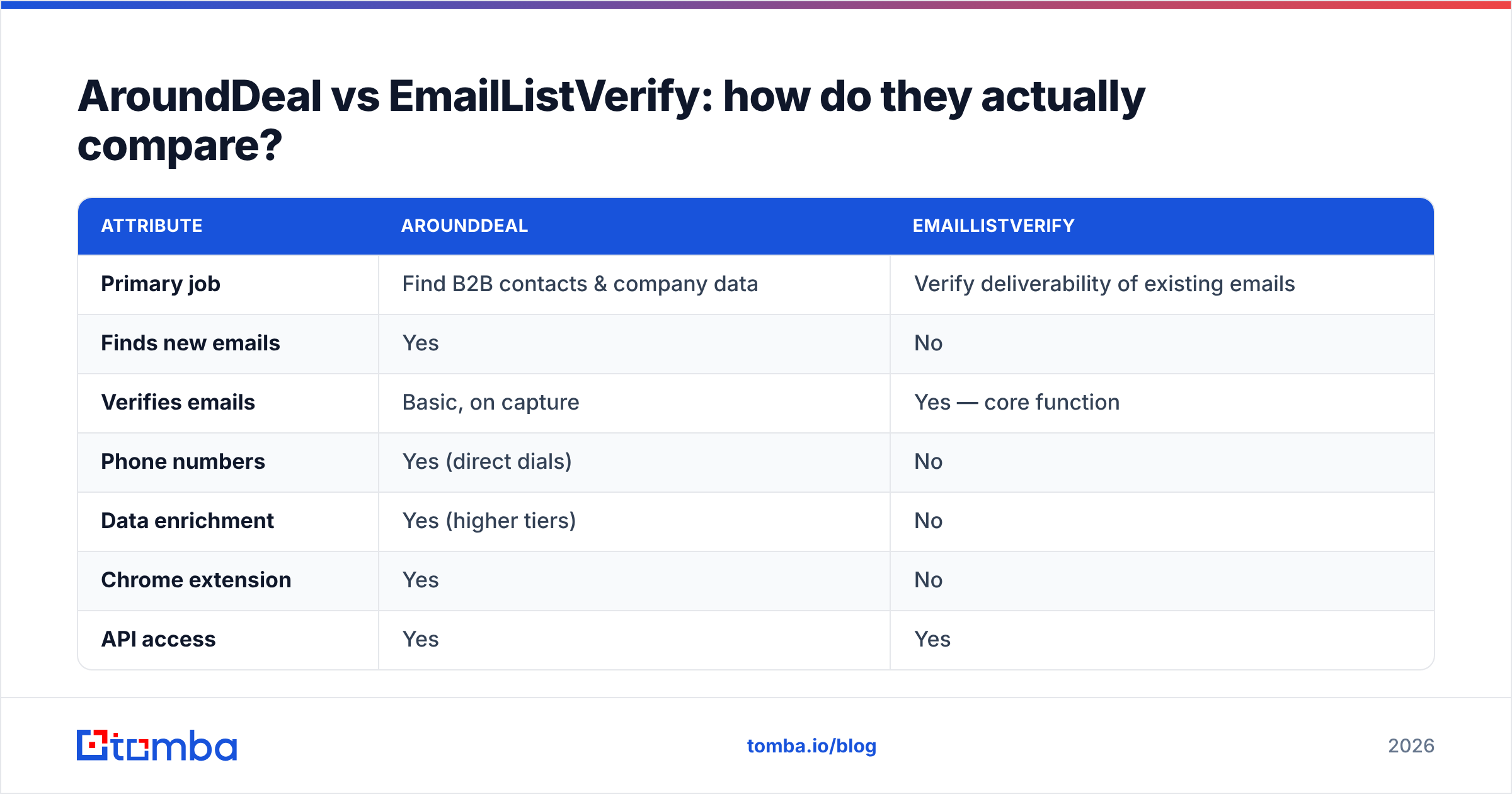
| Attribute | AroundDeal | EmailListVerify |
|---|---|---|
| Primary job | Find B2B contacts & company data | Verify deliverability of existing emails |
| Finds new emails | Yes | No |
| Verifies emails | Basic, on capture | Yes — core function |
| Phone numbers | Yes (direct dials) | No |
| Data enrichment | Yes (higher tiers) | No |
| Chrome extension | Yes | No |
| API access | Yes | Yes |
| Bulk processing | Yes (list building) | Yes (list cleaning) |
| Pricing model | Credits per contact revealed | Credits per email verified |
| Free tier | Limited monthly credits | Small one-time free check |
| Best for | Building prospect lists | Cleaning lists before send |
The pattern is clear: AroundDeal sits at the top of the funnel (acquire contacts) and EmailListVerify sits in the middle (clean before send). A complete outbound motion needs both functions. The real question is whether you buy them as two tools or get them from one.

Which one is more accurate?#
Accuracy means different things for each tool, so judge them on their own job.
For AroundDeal, accuracy is about whether the email it surfaces is correct and current. Sourcing databases live and die on freshness, and no provider is immune to drift — a contact accurate in Q1 can be wrong by Q3 after a job change. Independent benchmarks across the email-finder category show wide spreads in match rate and bounce rate between vendors.

For EmailListVerify, accuracy is about catching dead and risky addresses without false-flagging good ones. Most established verifiers, EmailListVerify included, land in the high-90s for catching hard bounces. The harder problem is catch-all domains, where the server accepts everything and a simple SMTP probe can't confirm a real inbox. That is where many verifiers return an ambiguous "unknown," and you need a dedicated catch-all verifier to push past the guesswork.
The uncomfortable truth: even if EmailListVerify scores a list perfectly, it can only verify what AroundDeal — or any source — gave you. Garbage sourcing in, verified-garbage out. Verification reduces bounces; it does not improve the quality of who you're targeting.
How does pricing compare?#
Two different units of measure make direct price comparison messy. AroundDeal charges for revealing a contact; EmailListVerify charges for checking an email. You can burn credits on AroundDeal pulling a contact, then spend again on EmailListVerify to confirm it's valid — paying twice to land one usable address.
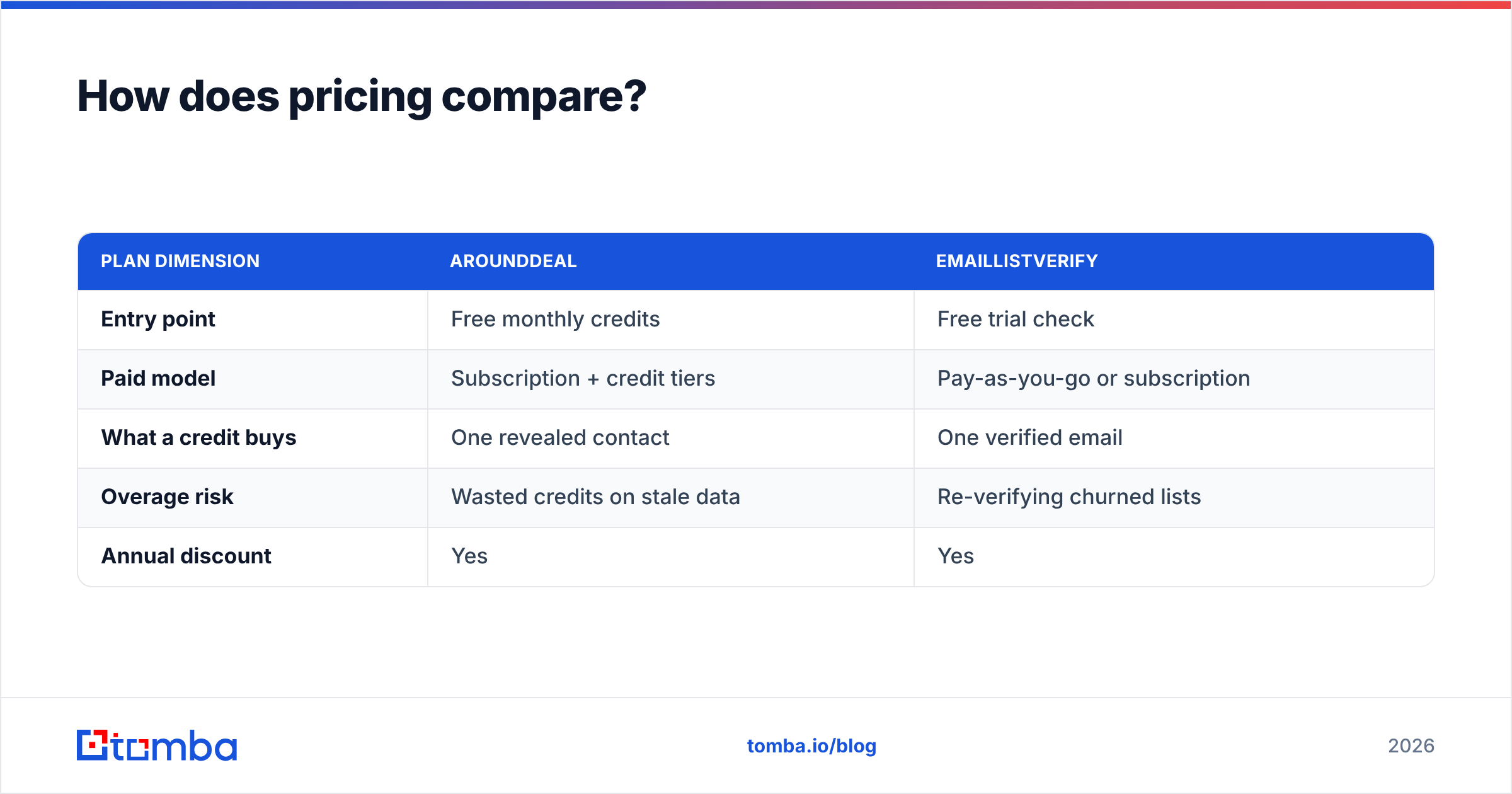
| Plan dimension | AroundDeal | EmailListVerify |
|---|---|---|
| Entry point | Free monthly credits | Free trial check |
| Paid model | Subscription + credit tiers | Pay-as-you-go or subscription |
| What a credit buys | One revealed contact | One verified email |
| Overage risk | Wasted credits on stale data | Re-verifying churned lists |
| Annual discount | Yes | Yes |
For exact current numbers, check each vendor directly — pricing pages change often and any figure quoted here will age. The strategic point stands: a two-vendor stack means two bills, two dashboards, two APIs, and a credit-spend math problem where you can pay for a contact that turns out to be undeliverable. Consolidating into one platform with transparent pricing removes that double-charge.
When should you use each tool?#
Match the tool to the stage of your pipeline.
Use AroundDeal when:
- You're starting from zero and need to build a list by persona, title, or company.
- Direct-dial phone numbers matter to your motion (it bundles them).
- You live in LinkedIn and want a capture extension for ad-hoc prospecting.
Use EmailListVerify when:
- You already have a list — from a form, an event, a CSV handoff, or a scrape — and need it clean before a campaign.
- You're seeing bounce rates creep above 2–3% and need to protect domain reputation.
- You run periodic hygiene passes on a CRM that accumulates stale contacts.
Use neither — pick a combined finder + verifier when:
- You want one workflow that finds an address and validates it in the same step.
- You're tired of paying for a contact and then paying again to confirm it works.
- You need bulk operations, enrichment, and an API under one roof.
Is there a better all-in-one option?#
For most B2B teams, yes — a platform that finds and verifies in a single pass beats stitching a sourcing tool to a separate verifier.
This is where Tomba fits the comparison. Instead of paying AroundDeal to reveal a contact and EmailListVerify to check it, the email finder returns an address with a confidence score, and the built-in email verifier confirms deliverability in the same flow. Need to clean an existing list the way EmailListVerify does? The bulk verify tool handles that job directly. Want the company-data and enrichment angle AroundDeal sells? Data enrichment covers it.

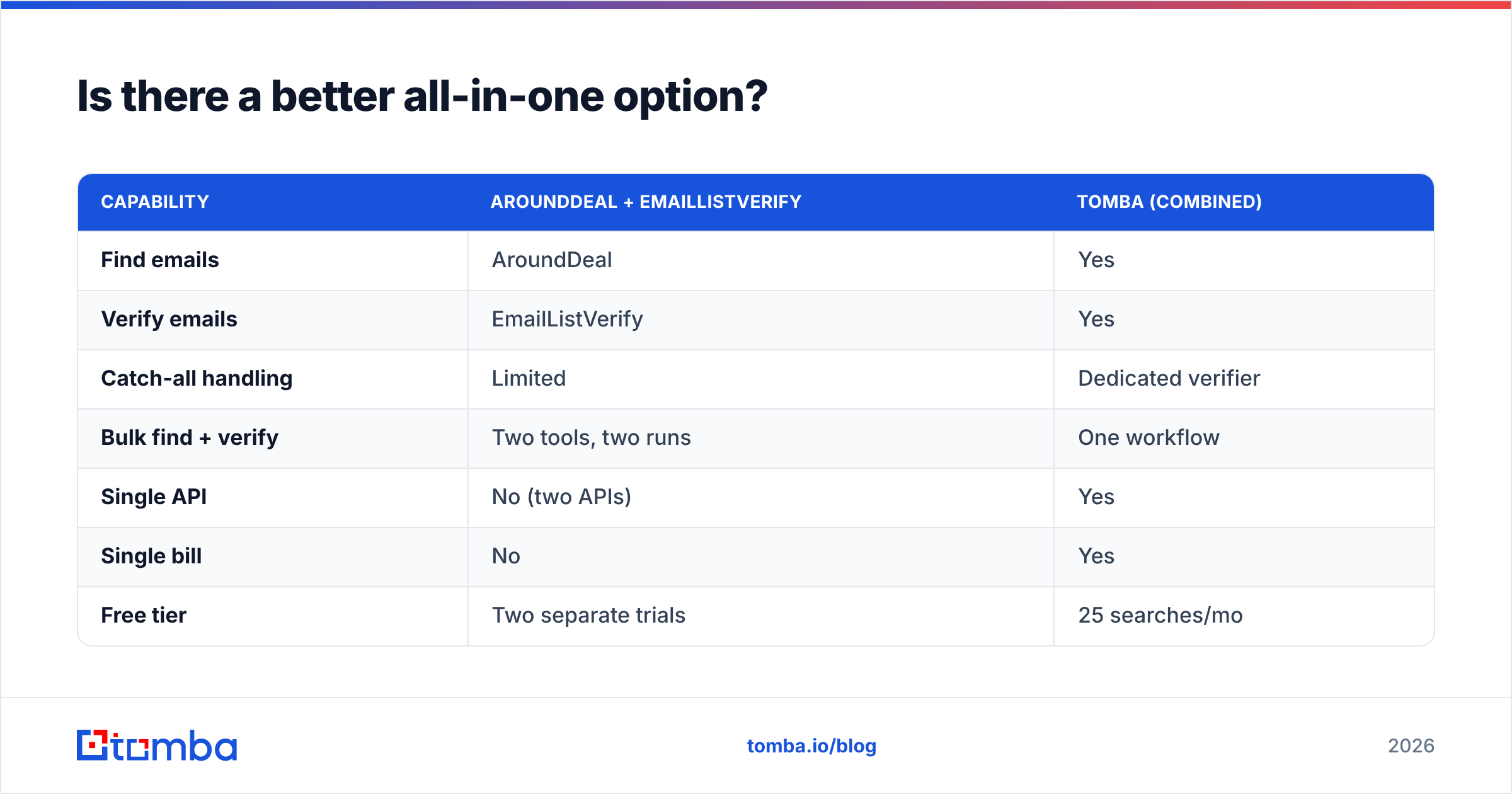
Here's how the all-in-one model stacks against running the two specialist tools side by side.
| Capability | AroundDeal + EmailListVerify | Tomba (combined) |
|---|---|---|
| Find emails | AroundDeal | Yes |
| Verify emails | EmailListVerify | Yes |
| Catch-all handling | Limited | Dedicated verifier |
| Bulk find + verify | Two tools, two runs | One workflow |
| Single API | No (two APIs) | Yes |
| Single bill | No | Yes |
| Free tier | Two separate trials | 25 searches/mo |
The consolidation argument isn't just convenience. Every handoff between two vendors is a place data gets dropped, re-formatted, or double-charged. Verification works best when it's wired into discovery, not bolted on after.
What do the trade-offs really come down to?#
Strip away the marketing and three decisions drive the choice.
Coverage vs. hygiene. AroundDeal optimizes for how many contacts it can hand you. EmailListVerify optimizes for how clean your list is. Neither optimizes for both, because that's not what they were built to do. If you only buy one, you're solving half the problem.
Credits you control vs. credits you waste. A two-tool stack creates a failure mode where you spend a reveal credit on a contact, then a verify credit confirms it's dead. You paid twice for nothing. A combined tool that verifies at discovery time stops you from spending on contacts that were never reachable.
One throat to choke. When deliverability tanks, debugging across two vendors — was the address wrong, or was the verification wrong? — wastes hours. One platform means one place to look. Pair that with disciplined sending habits, and your sender reputation stays intact.
None of this means AroundDeal or EmailListVerify is a bad tool. Each is competent at its narrow job. The point is that buying them as a pair is rarely the most efficient way to get find-and-verify done in 2026.
Frequently asked questions#
Is AroundDeal a competitor to EmailListVerify? Not really. AroundDeal finds contacts; EmailListVerify verifies them. They occupy different stages of the same pipeline, which is why teams often run both — or replace both with one combined tool.
Can EmailListVerify find email addresses? No. It only validates addresses you already have. To find new contacts you need a sourcing tool like AroundDeal or an email finder.
Does AroundDeal verify the emails it finds? It applies basic checks at capture, but it's not a dedicated verification engine. For high-volume sends, a purpose-built verifier catches risks AroundDeal's lighter checks miss.
What's the cheapest way to both find and verify emails? Usually a single platform that does both, because you avoid paying two vendors and avoid spending verify credits on contacts that turn out to be undeliverable.
The bottom line#
AroundDeal and EmailListVerify are not rivals — they're two halves of a workflow you'd otherwise buy separately. AroundDeal builds the list; EmailListVerify cleans it. If your stack already runs both well and the budget works, keep it.
But if you're choosing fresh, the simpler path is one tool that finds and verifies in a single pass. Start free with the Tomba Email Finder — 25 searches a month, work emails returned with a confidence score and deliverability check built in, no second vendor required. Find the contact, verify the contact, send with confidence, all in one place.
Ready to find emails that actually work?
Join 150,000+ professionals who stopped guessing and started sending. Free credits on signup — no credit card required.
Get the Tomba newsletter
Practical outbound tactics and product updates — once every two weeks.
About the author