Arounddeal vs Enrichley 2026: B2B Data Tools Compared
Arounddeal vs Enrichley compared on data accuracy, coverage, pricing, and workflow fit—plus where each one wins and a faster, cheaper alternative.
Choosing between Arounddeal and Enrichley comes down to one question: do you need a broad contact database to find prospects, or an enrichment layer to complete records you already have? They sit on opposite ends of the B2B data stack, and picking the wrong one means paying for capabilities you'll never touch.
This guide breaks down both tools on accuracy, coverage, pricing, and workflow fit—then shows where a verification-first alternative beats either on cost-per-valid-contact.
TL;DR#
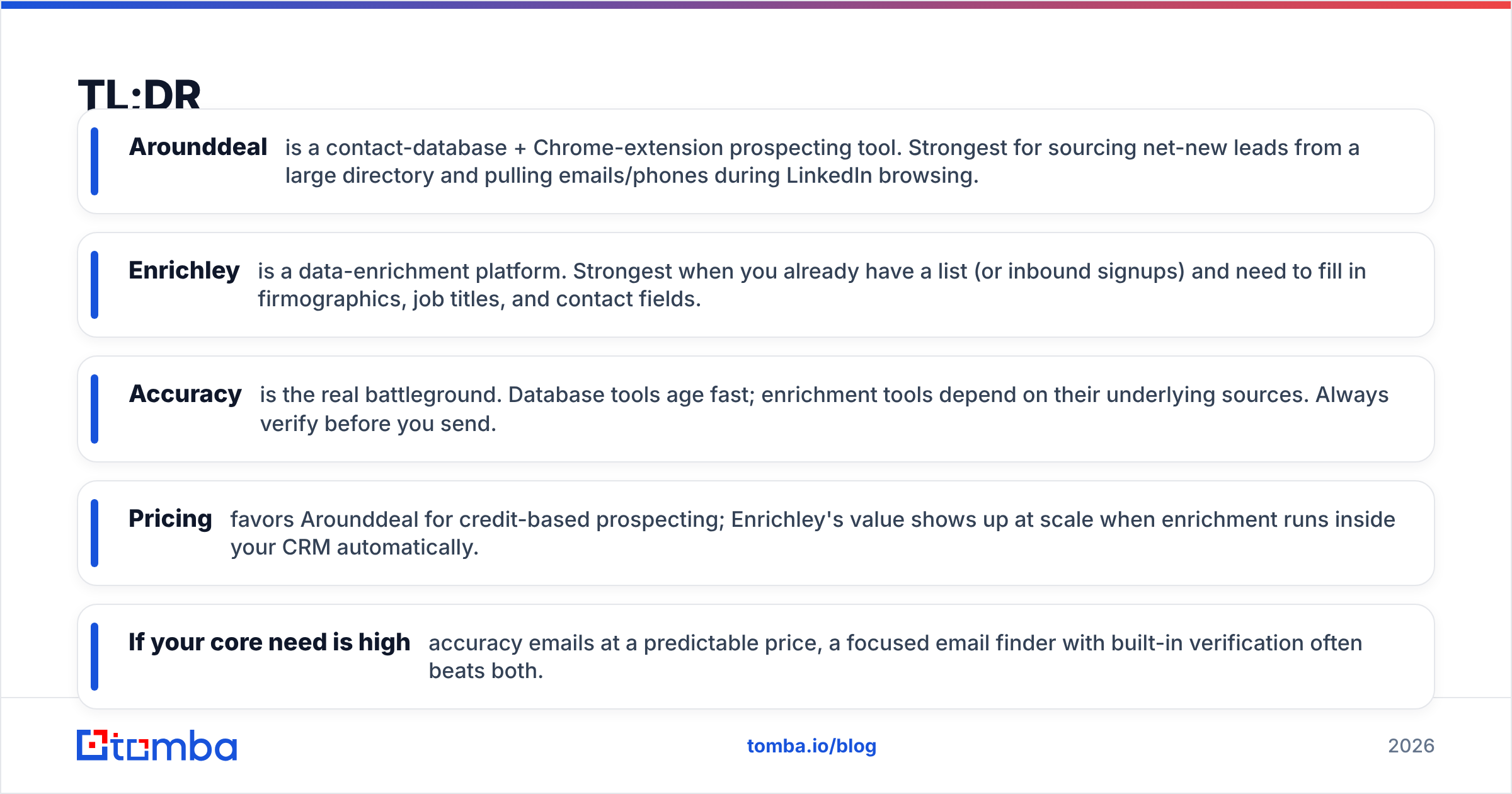
- Arounddeal is a contact-database + Chrome-extension prospecting tool. Strongest for sourcing net-new leads from a large directory and pulling emails/phones during LinkedIn browsing.
- Enrichley is a data-enrichment platform. Strongest when you already have a list (or inbound signups) and need to fill in firmographics, job titles, and contact fields.
- Accuracy is the real battleground. Database tools age fast; enrichment tools depend on their underlying sources. Always verify before you send.
- Pricing favors Arounddeal for credit-based prospecting; Enrichley's value shows up at scale when enrichment runs inside your CRM automatically.
- If your core need is high-accuracy emails at a predictable price, a focused email finder with built-in verification often beats both.
What is Arounddeal?#
Arounddeal is a B2B prospecting platform built around a large contact directory and a browser extension. You search the database by company, role, industry, or location, or you trigger the extension while viewing a LinkedIn profile to reveal a person's work email and phone number. It positions itself as an all-in-one sourcing tool: find a lead, grab the contact details, and export to your CRM or outreach sequence.
The appeal is breadth. When you don't yet have a list, a database tool gives you somewhere to start. You define an ideal customer profile, filter the directory, and walk away with hundreds of contacts in a few clicks. You can read real user feedback on platforms like G2 and Capterra to gauge how that breadth holds up in practice.
The tradeoff is freshness. Directory records are snapshots. People change jobs, companies rebrand, and email formats shift—so a contact that was valid last quarter may bounce today. That's why pairing any database tool with an email verifier is non-negotiable.
What is Enrichley?#
Enrichley is a data-enrichment tool. Instead of helping you discover new people, it takes records you already have—a CSV of signups, a CRM segment, a list of domains—and fills in the gaps: company size, industry, revenue band, job title, seniority, social profiles, and sometimes a contact email or phone.
The mental model is a librarian, not a hunter. You hand it incomplete index cards, and it returns them with the missing fields written in. This makes Enrichley most valuable for teams with an existing inbound motion or a partially-populated CRM, where the bottleneck isn't finding people but understanding and routing them.
Enrichment quality is only as good as the sources behind it. A tool that enriches from stale or thin data will confidently hand back wrong titles and dead emails. So the same rule applies: treat enriched contact fields as candidates to verify, not facts to trust.
Arounddeal vs Enrichley: how do they compare?#
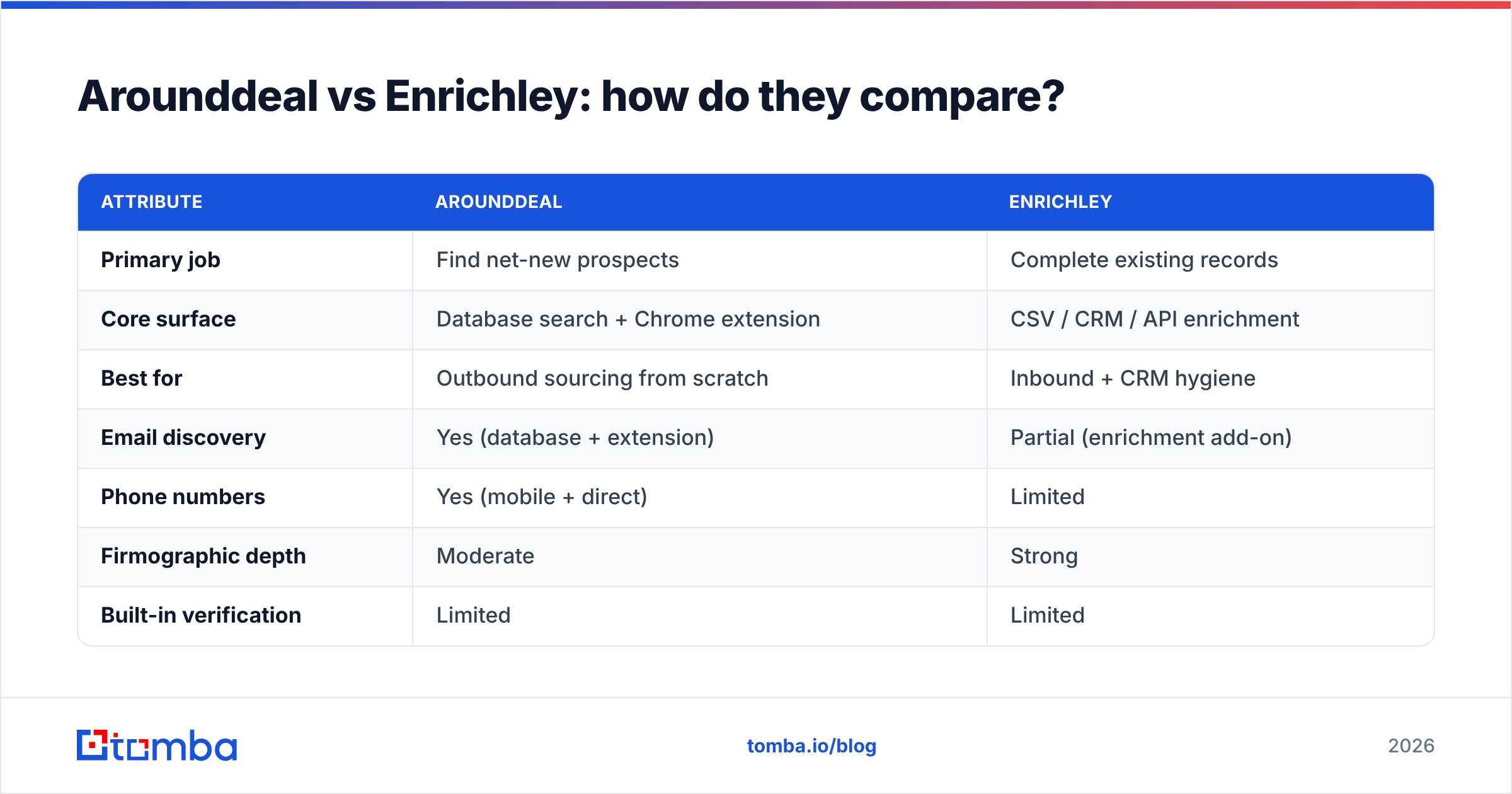
Here's the head-to-head on the attributes that actually change your results.
| Attribute | Arounddeal | Enrichley |
|---|---|---|
| Primary job | Find net-new prospects | Complete existing records |
| Core surface | Database search + Chrome extension | CSV / CRM / API enrichment |
| Best for | Outbound sourcing from scratch | Inbound + CRM hygiene |
| Email discovery | Yes (database + extension) | Partial (enrichment add-on) |
| Phone numbers | Yes (mobile + direct) | Limited |
| Firmographic depth | Moderate | Strong |
| Built-in verification | Limited | Limited |
| Pricing model | Credit-based plans | Enrichment volume / seats |
| Free option | Limited free credits | Limited trial |
| Workflow fit | SDR / outbound | RevOps / marketing ops |
The pattern is clear: these aren't really competitors so much as neighbors. Arounddeal answers "who should I contact?" Enrichley answers "what do I know about the contacts I have?" The overlap is the contact email itself—and that's exactly where accuracy decides which tool earns its budget.

Which has better data accuracy?#
Accuracy is the deciding factor, and neither tool wins by default—because both depend on how recently their data was confirmed.
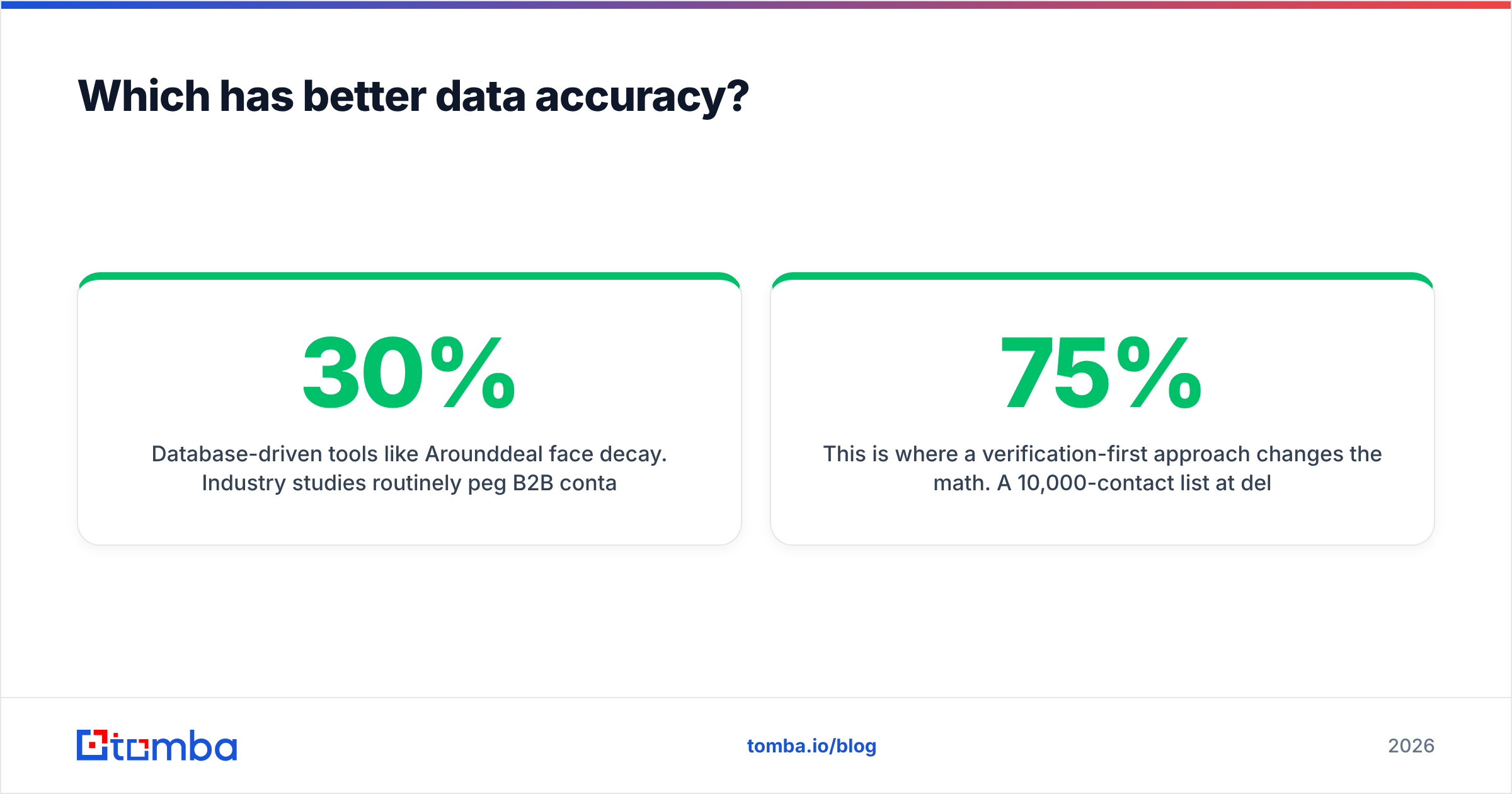
Database-driven tools like Arounddeal face decay. Industry studies routinely peg B2B contact data decay at roughly 20–30% per year as people switch roles. A directory that isn't continuously re-validated will quietly accumulate dead addresses, and you only discover them when your bounce rate spikes and your sender reputation takes the hit.
Enrichment tools like Enrichley face a different risk: confident-but-wrong fields. Because enrichment fills blanks automatically and at scale, a bad source propagates errors across thousands of records before anyone notices. The output looks complete, which makes the errors harder to catch than an obvious blank.
The fix for both is the same discipline: never trust a contact email until it's been verified against the mail server in real time. Whatever tool sources the address, run it through a verification step before it enters a sending tool.

This is where a verification-first approach changes the math. A 10,000-contact list at 75% deliverability gives you 7,500 usable contacts; at 95% it gives you 9,500—and protects your domain from the bounces the other 2,000 would have caused.
How do they price?#
Pricing models reflect the different jobs each tool does.
Arounddeal uses credit-based plans: you spend credits to reveal contacts, so cost scales with how many net-new prospects you pull. That's predictable for outbound teams who know their monthly sourcing volume, but credits for unverified contacts can be wasteful if a chunk of them bounce.
Enrichley prices around enrichment volume and seats. The value lands when enrichment runs automatically—every new CRM record gets completed without manual effort—so heavier CRM throughput justifies the spend. For a small list enriched once, it can feel like paying for a pipeline you don't run.
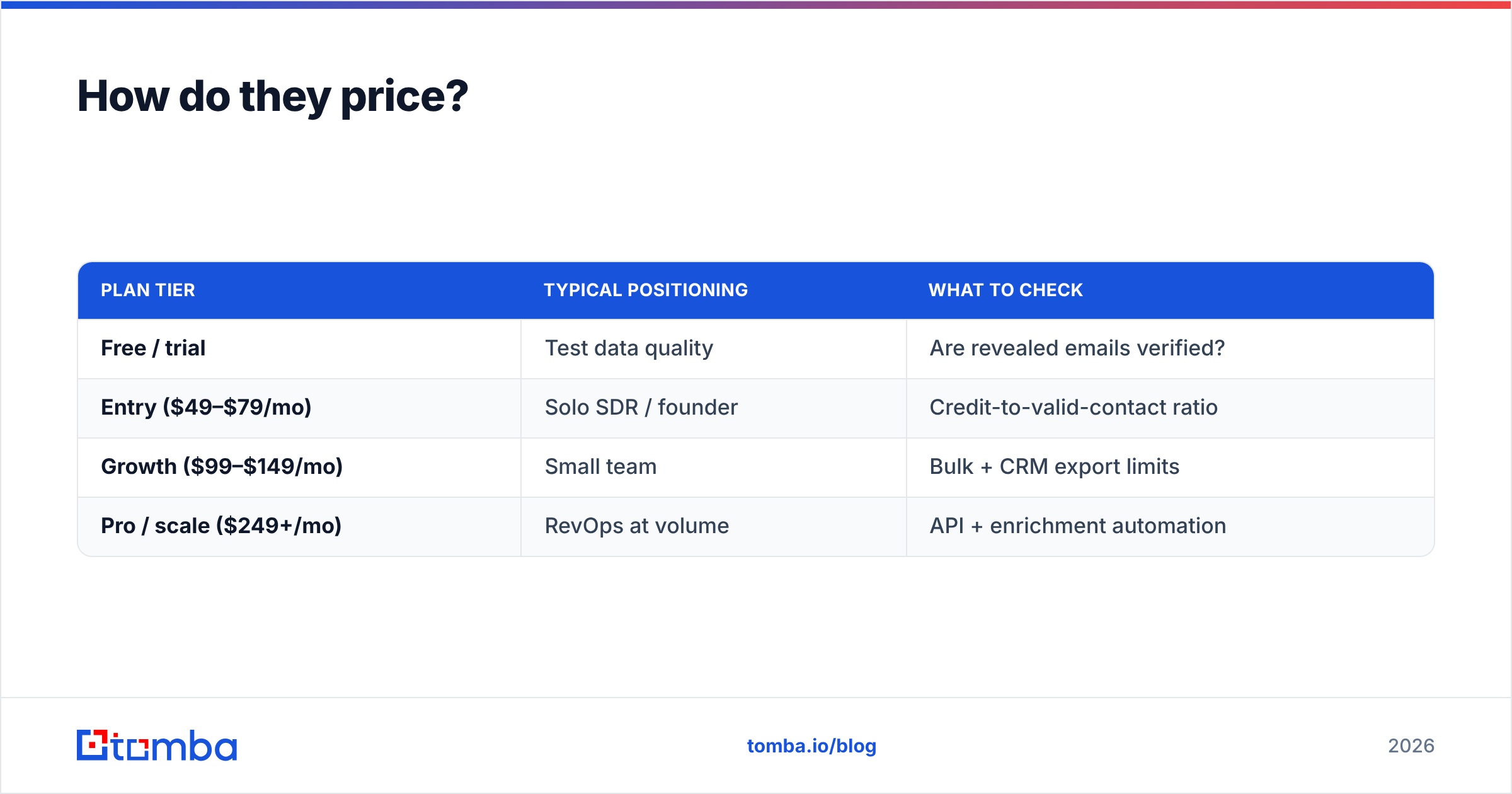
When you compare either against a focused finder, look at cost per verified contact, not cost per credit. A cheap credit that yields a dead email costs more than a slightly pricier one that's confirmed valid. For reference, Tomba pricing starts with a free tier of 25 searches/month, then $49/mo (Starter), $99/mo (Growth), and $249/mo (Pro)—with verification built into the same workflow rather than bolted on.
| Plan tier | Typical positioning | What to check |
|---|---|---|
| Free / trial | Test data quality | Are revealed emails verified? |
| Entry ($49–$79/mo) | Solo SDR / founder | Credit-to-valid-contact ratio |
| Growth ($99–$149/mo) | Small team | Bulk + CRM export limits |
| Pro / scale ($249+/mo) | RevOps at volume | API + enrichment automation |

When should you choose each tool?#
Match the tool to the bottleneck, not the buzzwords.
Choose Arounddeal if your pipeline starts empty. You're an SDR or founder doing outbound, you live in LinkedIn, and you need a directory plus an extension to turn browsing into a contact list. The Chrome workflow is the draw—reveal, export, sequence.
Choose Enrichley if your pipeline starts full but shallow. You have inbound signups or a CRM full of half-complete records, and your problem is routing, scoring, and personalization rather than discovery. Automated data enrichment that completes records on entry is the draw.
Choose neither if your real need is simple: accurate emails for a known set of people or companies, at a predictable price, already verified. That's a finder problem, and a dedicated finder solves it with less overhead than a broad database or an enrichment suite.
Is there a better alternative for accurate emails?#
If email accuracy is your priority, a verification-first finder is worth a hard look alongside both tools.
Tomba combines discovery and verification in one flow. You can search by domain with domain search to pull every public address at a company, find an individual with the email finder, and confirm deliverability with the email verifier—without exporting between tools. For teams running large lists, bulk email finder handles thousands of lookups, and the Tomba API drops the same checks into your own pipeline.

The difference isn't a single feature—it's that verification is part of the same step as discovery, so the contacts you export are the contacts you can actually reach. That keeps bounce rates low and protects the sender reputation you spent months building.
A practical setup many teams land on: use a database tool when you genuinely need net-new sourcing, use enrichment when CRM completeness is the gap, and run everything through a verifier before it touches your outreach tool. The verifier is the cheap insurance that makes the expensive tools pay off.
What about integrations and workflow?#
Both tools aim to fit existing stacks, and integration depth matters more than feature counts.
Arounddeal's center of gravity is the browser, with CSV and CRM export for getting contacts into your sequence. Enrichley's center of gravity is the CRM and API, with automated enrichment as records flow in. Before committing, confirm the specific connectors you need—HubSpot, Salesforce, Pipedrive, or a spreadsheet workflow—rather than assuming "has integrations" covers it.
If your stack is spreadsheet-first, also weigh how cleanly contacts land in tools like Google Sheets, since a clumsy export step quietly taxes every campaign. The official sites—arounddeal.com and the respective vendor docs—are the source of truth for current connector lists, which change often.
Final verdict: Arounddeal vs Enrichley#
There's no universal winner, because they solve different problems. Arounddeal wins for net-new outbound sourcing; Enrichley wins for completing and routing records you already own. The constant across both is that contact accuracy depends on verification you'll need to add yourself.
If your single biggest pain is reaching the right person at the right email, skip the either/or and start with a finder that verifies as it discovers. Try the Tomba Email Finder—search by name, company, or domain, confirm deliverability in the same flow, and start free with 25 searches a month before you scale. You'll spend less time cleaning bounces and more time in real conversations.
// get started
Find, verify and enrich your first contacts today
Start on the free plan with 25 searches a month, then scale when your team is ready.
Free plan · No credit card required · GDPR & CCPA
// about the author