AroundDeal vs Enrow 2026: Which B2B Email Tool Wins?
AroundDeal is a contact database; Enrow is a waterfall email finder. We compare accuracy, pricing, data depth, and use cases to show which one fits your 2026 outbound stack.
You are choosing between two very different products that get lumped into the same shortlist. AroundDeal is a B2B contact database with a Chrome extension and prospecting workflows. Enrow is a waterfall email-finding and verification engine built to squeeze the highest-quality email out of a name and a domain. Picking the wrong one means either paying for a database you don't need or bolting a finder onto a workflow that already has data.
This breakdown shows exactly where each tool wins, what they cost, and how they compare to a finder-plus-verifier stack like Tomba.
TL;DR — AroundDeal vs Enrow at a glance#
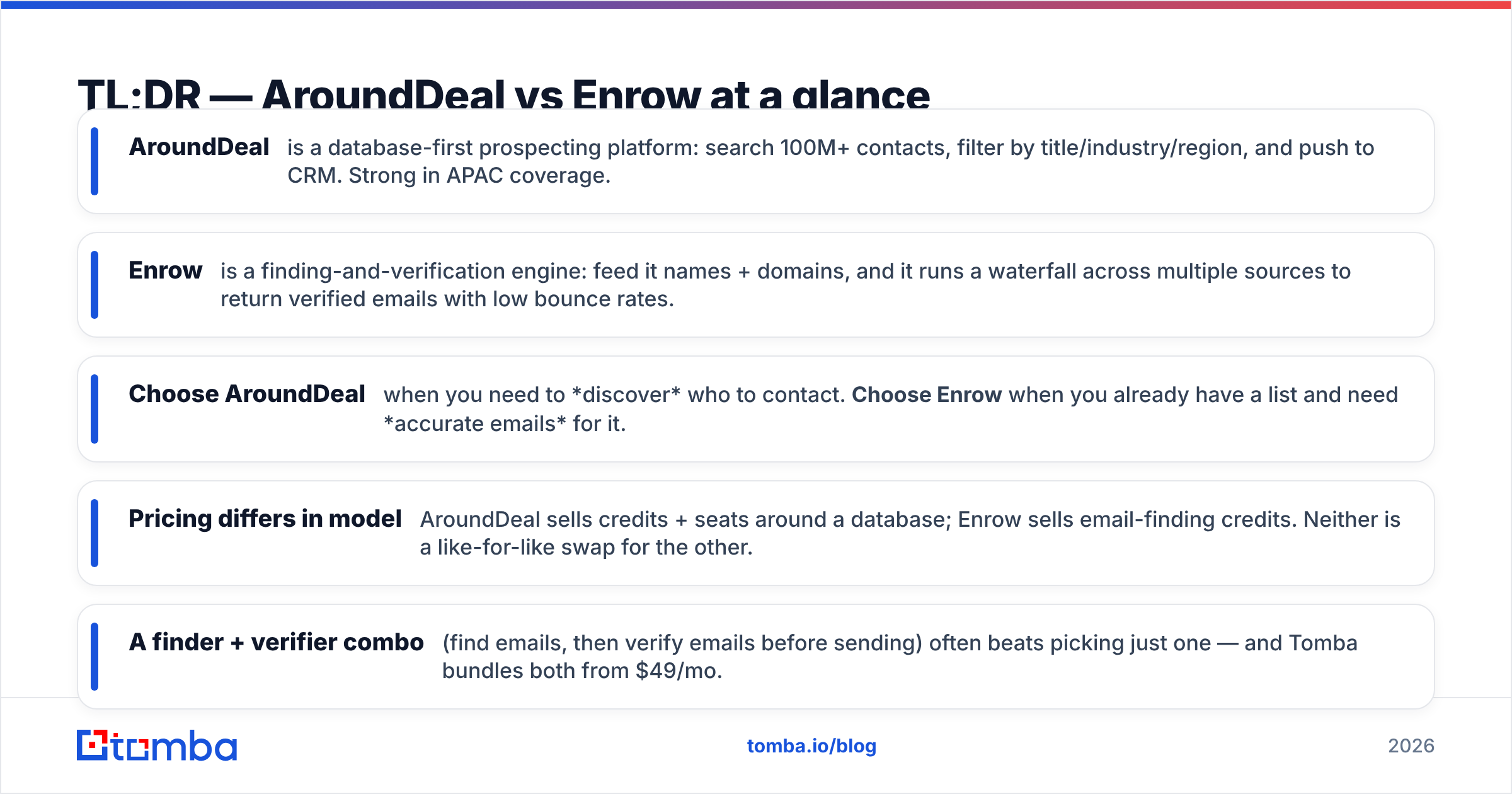
- AroundDeal is a database-first prospecting platform: search 100M+ contacts, filter by title/industry/region, and push to CRM. Strong in APAC coverage.
- Enrow is a finding-and-verification engine: feed it names + domains, and it runs a waterfall across multiple sources to return verified emails with low bounce rates.
- Choose AroundDeal when you need to discover who to contact. Choose Enrow when you already have a list and need accurate emails for it.
- Pricing differs in model: AroundDeal sells credits + seats around a database; Enrow sells email-finding credits. Neither is a like-for-like swap for the other.
- A finder + verifier combo (find emails, then verify emails before sending) often beats picking just one — and Tomba bundles both from $49/mo.

What is AroundDeal?#
AroundDeal is a B2B sales-intelligence platform. At its core sits a contact database the company markets at over 100 million business profiles, with company firmographics, direct dials, and email addresses. You search it the way you'd search a CRM you didn't have to build: filter by job title, seniority, industry, headcount, location, and technology, then export or sync the matching contacts.
Its standout is geographic. AroundDeal leans heavily into Asia-Pacific coverage, a region where ZoomInfo and Apollo historically run thin. If you sell into Singapore, India, or Southeast Asia, that depth matters more than another million US records.
The product surface includes a Chrome extension for pulling contacts off LinkedIn and company sites, an enrichment endpoint, and a basic intent/engagement layer. In other words, AroundDeal answers the question "who should I contact, and how do I reach them?"
You can read independent user reviews on G2 and check current plans on the AroundDeal site before committing.
What is Enrow?#
Enrow is an email-finding and verification specialist. It does not try to be a database you browse. Instead, you bring the input — a first name, last name, and company domain (or a CSV of them) — and Enrow returns the best deliverable email it can confirm.
The mechanism is a waterfall enrichment approach. Rather than relying on a single data source, Enrow queries multiple providers in sequence, picks the best candidate email, and runs verification to filter out catch-alls and risky addresses. The pitch is straightforward: higher hit rate and lower bounce rate than any single-source finder, because no one provider covers every contact.
Enrow's whole reason for existing is accuracy on a list you already have. It sits after the "who do I target" decision and before the "hit send" moment. You can see its positioning on the Enrow homepage.
AroundDeal vs Enrow: full comparison table#
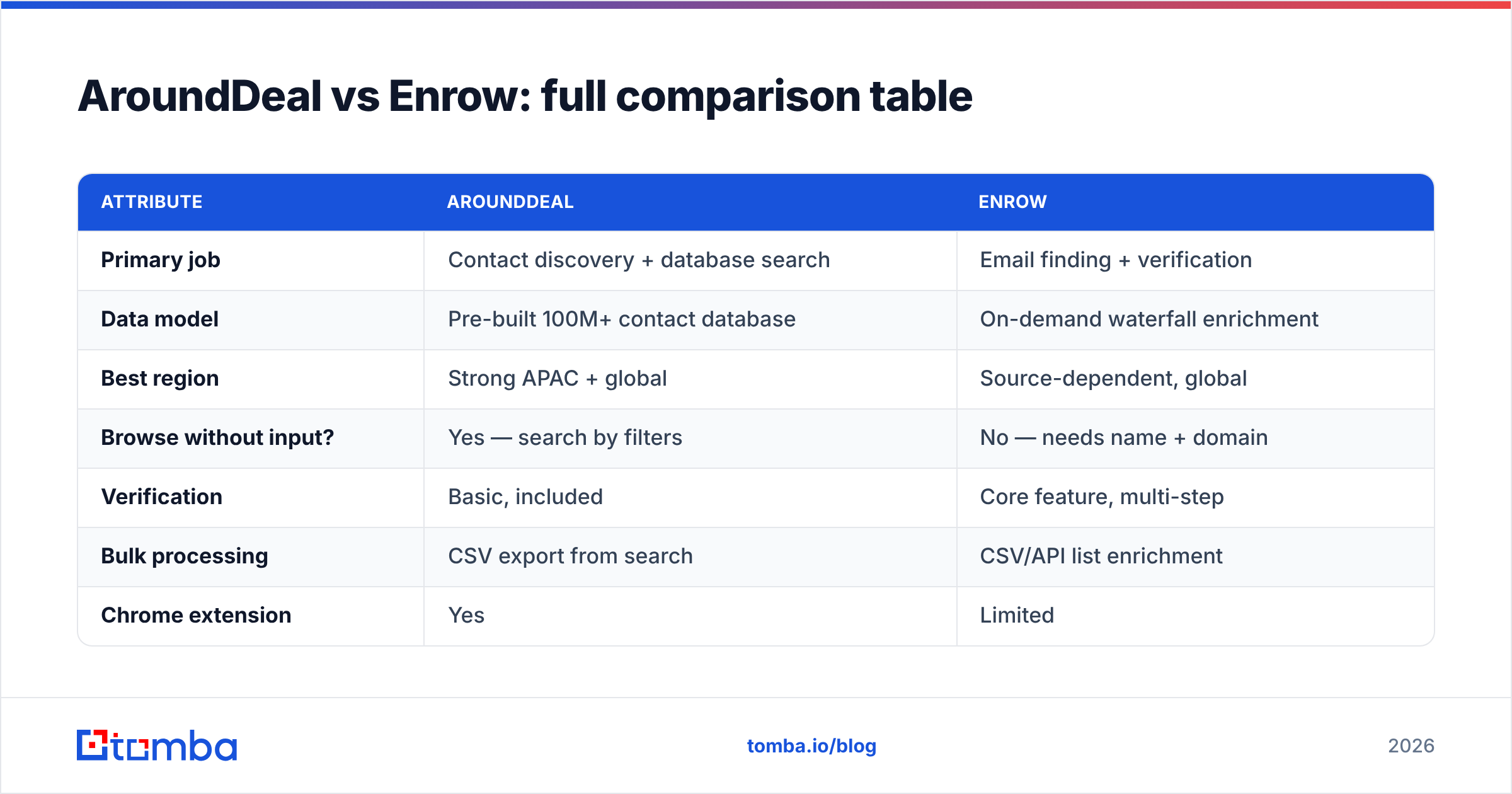
The two tools overlap only at the edges. Here is the honest side-by-side.
| Attribute | AroundDeal | Enrow |
|---|---|---|
| Primary job | Contact discovery + database search | Email finding + verification |
| Data model | Pre-built 100M+ contact database | On-demand waterfall enrichment |
| Best region | Strong APAC + global | Source-dependent, global |
| Browse without input? | Yes — search by filters | No — needs name + domain |
| Verification | Basic, included | Core feature, multi-step |
| Bulk processing | CSV export from search | CSV/API list enrichment |
| Chrome extension | Yes | Limited |
| CRM sync | Native (HubSpot, Salesforce, Pipedrive) | Via integrations/API |
| Pricing model | Credits + seats | Email-finding credits |
| Free tier | Yes, limited credits | Trial credits |
| Ideal user | SDRs building target lists | RevOps cleaning/enriching lists |
A note on pricing: both vendors revise plans often, and credit definitions differ (a "credit" in a database tool is not the same as a finding credit). Treat the numbers on each vendor's pricing page as the source of truth, and compare cost per verified, usable email rather than headline credit counts. For a transparent reference point, Tomba pricing runs Free (25 searches/mo), Starter $49/mo, Growth $99/mo, and Pro $249/mo.
Is AroundDeal better than Enrow for accuracy?#
It depends on what "accuracy" means to you, and the two tools optimize for different definitions.
AroundDeal's accuracy is a function of database freshness. Pre-built databases decay — people change jobs at roughly 25-30% per year — so any record you pull is a snapshot that may be stale. AroundDeal mitigates this with periodic refreshes, but the structural reality of a static database is that some percentage is always out of date the day you export it.
Enrow's accuracy is a function of real-time verification. Because it finds and checks the email at request time, you're less exposed to decay. The waterfall design also means a contact missed by one source can still be found by another, lifting the overall hit rate. The trade-off: Enrow can only verify what its sources can find, and it can't tell you who to look up.

In practice, the highest accuracy comes from separating the two jobs. Use a database to build the target list, then run every address through a dedicated verification step before it touches your sequencer. A standalone email verifier — or a catch-all verifier for those tricky accept-all domains — catches the stale and risky addresses that a database export quietly includes.
Which tool fits your workflow?#
Map the tool to the job you're actually doing.
You're an SDR with no list yet. You need discovery. AroundDeal (or any database) wins, because Enrow has nothing to chew on without names and domains. Search by ICP filters, build the list, export.
You're in RevOps cleaning a messy CRM or enriching an event list. You need finding + verification at volume. Enrow's waterfall is purpose-built for this — feed it the rows, get back deliverable emails. A pure database adds little here because you already know who the people are.
You're a founder doing targeted outbound to named accounts. You usually know the companies and roles. A domain search plus an email finder gets you the patterns and addresses for specific companies without paying for a 100M-record database you'll never browse.
You're running cold email at scale. Bounce rate is your enemy. Whatever finds the emails, a verification gate is non-negotiable — and bulk tooling matters. A bulk email finder that finds and verifies in one pass removes a step.

How do AroundDeal and Enrow compare on pricing model?#
This is where buyers get tripped up, so let's be precise about the model, not just the price.
AroundDeal charges around a database subscription: you pay for seats and a monthly credit pool that you spend revealing contacts. The value is access to the database itself. If you stop paying, you lose the search.
Enrow charges per email-finding credit: you pay for the work of finding and verifying. There's no database to lose access to — you're buying an operation, not a library.
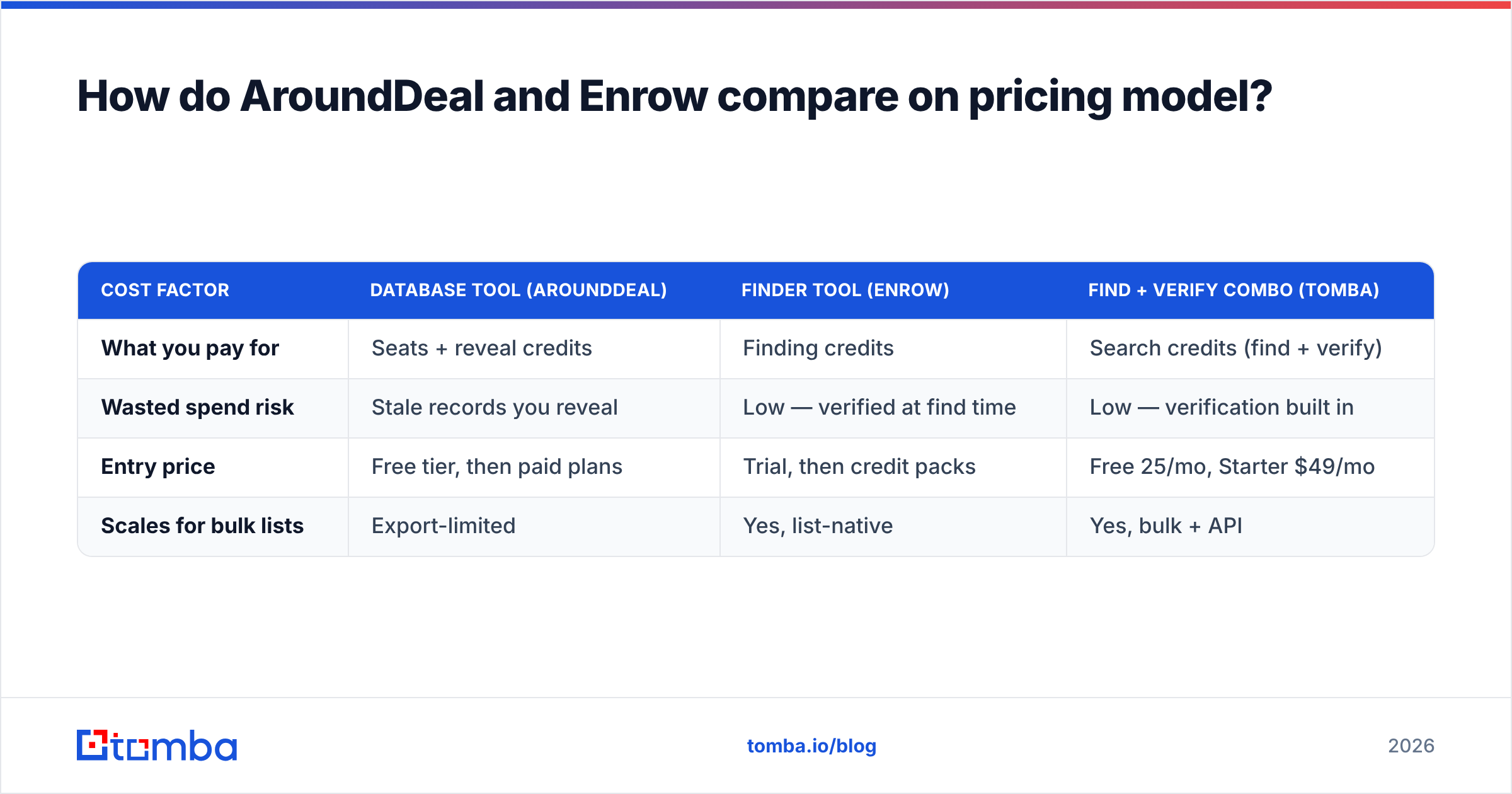
Neither is "cheaper" in the abstract. The right question is cost per verified, usable email delivered into your sequencer:
| Cost factor | Database tool (AroundDeal) | Finder tool (Enrow) | Find + verify combo (Tomba) |
|---|---|---|---|
| What you pay for | Seats + reveal credits | Finding credits | Search credits (find + verify) |
| Wasted spend risk | Stale records you reveal | Low — verified at find time | Low — verification built in |
| Entry price | Free tier, then paid plans | Trial, then credit packs | Free 25/mo, Starter $49/mo |
| Scales for bulk lists | Export-limited | Yes, list-native | Yes, bulk + API |
If your spend is dominated by discovery, a database amortizes well. If it's dominated by enriching lists you already own, a finder is more efficient. If you do both, paying for two tools is common — or you consolidate into one platform that finds, verifies, and enriches.
Where does Tomba fit between them?#
Tomba sits in the overlap and removes the false choice. It is a finder and a verifier and a domain-search tool under one roof, which means you don't have to decide between "discover contacts" and "verify emails" — you get both in one credit.
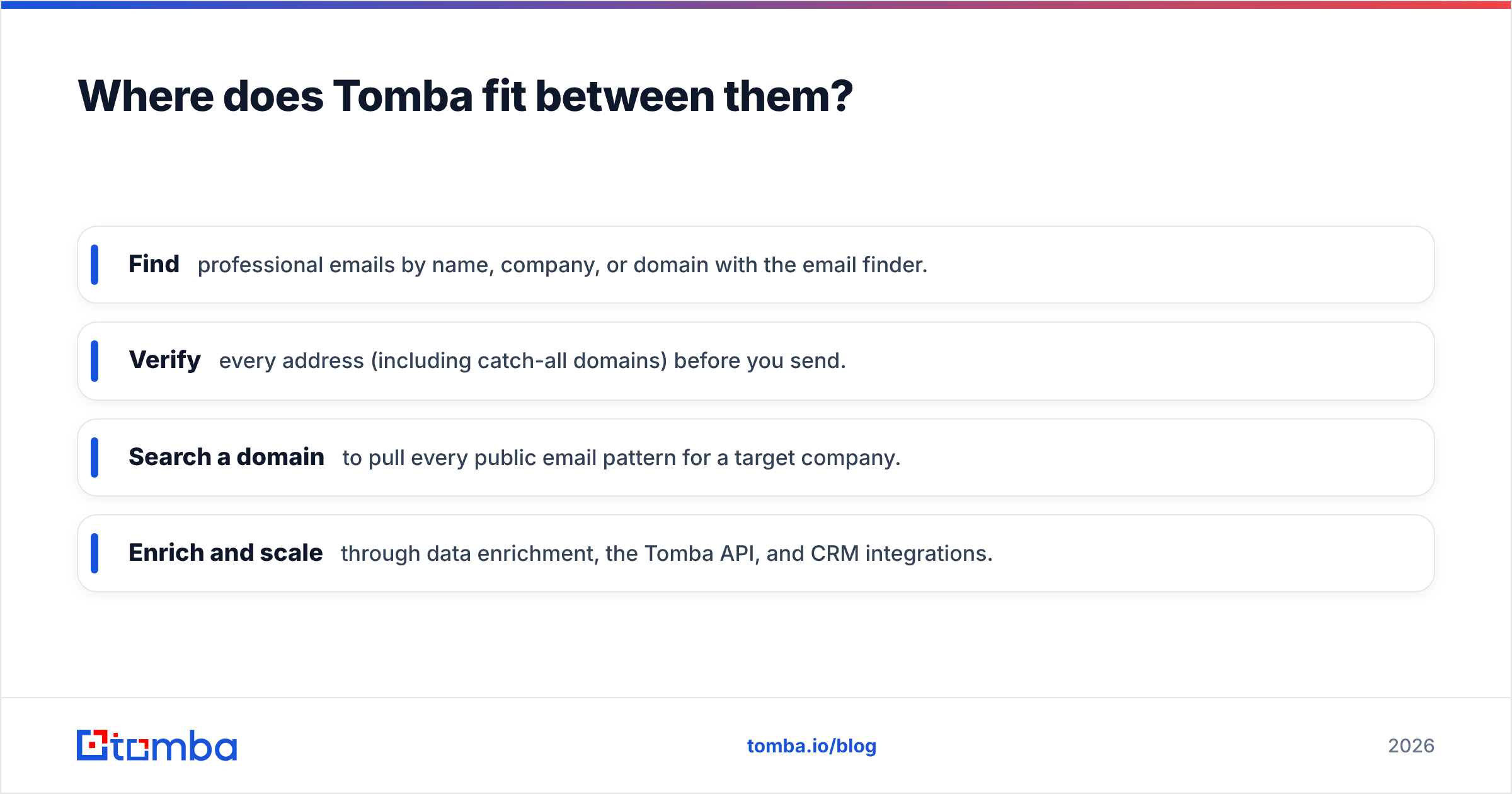
- Find professional emails by name, company, or domain with the email finder.
- Verify every address (including catch-all domains) before you send.
- Search a domain to pull every public email pattern for a target company.
- Enrich and scale through data enrichment, the Tomba API, and CRM integrations.
Against AroundDeal, Tomba won't replace a giant browse-anything APAC database — if pure discovery in that region is your need, AroundDeal's depth is real. Against Enrow, Tomba matches the find-and-verify job while also letting you discover emails by domain when you don't have a pre-built list. The practical win is one bill, one credit type, and transparent pricing from $49/mo instead of stitching a database tool to a separate verifier.
Common questions about AroundDeal vs Enrow#
Can Enrow replace AroundDeal? Only if you already have target names and companies. Enrow finds and verifies emails — it does not let you browse a database to discover who to contact. If discovery is your bottleneck, Enrow alone won't solve it.
Can AroundDeal replace Enrow? Partially. AroundDeal includes emails and basic verification, but it isn't built around the multi-source waterfall and bounce-minimizing verification that Enrow specializes in. For large list-cleaning jobs, a dedicated finder/verifier is stronger.
Which has better data privacy and compliance? Both publish compliance positions; verify current GDPR/CCPA handling on each vendor's site before purchase, especially for EU contacts. Database tools carry more standing-data obligations than on-demand finders by nature.
What about deliverability? Neither tool guarantees inbox placement — that depends on your sending setup. Whatever you use to source emails, pair it with verification and good sending hygiene. Tomba's email verifier exists precisely to protect your bounce rate.
The bottom line#
AroundDeal and Enrow are not really competitors — they're complements pretending to be a choice. AroundDeal answers who to contact with a deep, APAC-strong database. Enrow answers what's their verified email with a waterfall finder built to cut bounces. If you only do one of those jobs, buy the matching tool. If you do both — and most outbound teams do — paying for two specialized tools is the expensive default.
That's the case for consolidating. Try the Tomba Email Finder to find and verify professional emails in one workflow, with a free tier of 25 searches a month and paid plans from $49/mo. Build the list, confirm the addresses, and skip the bounce — without juggling a database subscription and a separate verifier.
Ready to find emails that actually work?
Join 150,000+ professionals who stopped guessing and started sending. Free credits on signup — no credit card required.
Get the Tomba newsletter
Practical outbound tactics and product updates — once every two weeks.
About the author