Arounddeal vs Findthatlead 2026: Which Tool Wins?
AroundDeal and FindThatLead both promise verified B2B contacts, but they win on very different jobs. Here is the honest 2026 breakdown of data, pricing, and accuracy.
TL;DR
- AroundDeal is a LinkedIn-centric B2B database (~120M contacts) built for prospecting, enrichment, and intent signals — strongest when you live inside LinkedIn Sales Navigator.
- FindThatLead is an email-first lead generator with a built-in cold-email sender — strongest when you want to find, verify, and send in one place.
- On raw email accuracy, both hover in the 80–90% range on common domains but degrade on catch-all and niche domains; neither publishes an independently audited rate.
- Pricing: FindThatLead starts cheaper for solo senders; AroundDeal scales better for teams that need enrichment and CRM sync.
- If your real bottleneck is verified deliverable emails rather than a second sending tool, a dedicated finder like the Tomba Email Finder often beats both on cost-per-valid-contact.
What are AroundDeal and FindThatLead?#
Short version: they solve overlapping problems from opposite ends.
AroundDeal is a B2B intelligence platform. Think of it as a giant contact directory bolted onto a Chrome extension that reads LinkedIn profiles. You browse a prospect, click the extension, and it returns work emails, direct dials, and company firmographics. It leans into enrichment and intent data — the "who should I contact and why now" layer.
FindThatLead comes at the same goal from the email side. Its core is a finder that takes a name plus a domain (or a whole domain) and returns email addresses, plus a "Scrab.in" LinkedIn automation arm and a cold-email campaign sender called the Email Sender. It's the "find them, then email them today" tool.
Here's the analogy: AroundDeal is the well-stocked warehouse you walk through with a shopping cart; FindThatLead is the vending machine that also mails the snack to your prospect. Different shapes, same hunger.
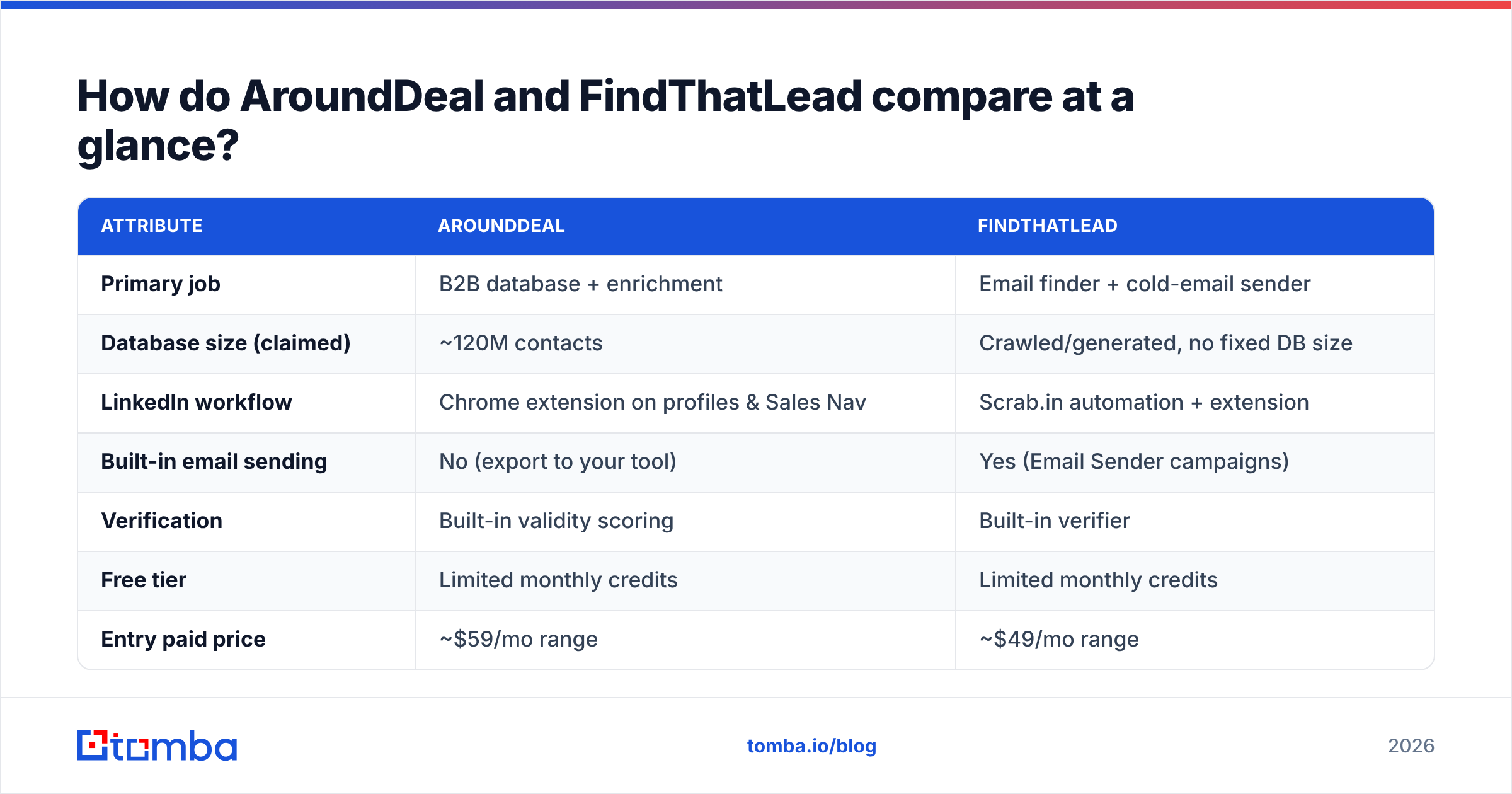
How do AroundDeal and FindThatLead compare at a glance?#
| Attribute | AroundDeal | FindThatLead |
|---|---|---|
| Primary job | B2B database + enrichment | Email finder + cold-email sender |
| Database size (claimed) | ~120M contacts | Crawled/generated, no fixed DB size |
| LinkedIn workflow | Chrome extension on profiles & Sales Nav | Scrab.in automation + extension |
| Built-in email sending | No (export to your tool) | Yes (Email Sender campaigns) |
| Verification | Built-in validity scoring | Built-in verifier |
| Free tier | Limited monthly credits | Limited monthly credits |
| Entry paid price | ~$59/mo range | ~$49/mo range |
| Best for | SDR teams, enrichment, CRM sync | Solo founders, agencies, all-in-one outbound |
| Data export | CSV + CRM integrations | CSV + |
Zapier |
Two honest caveats before you read that table as gospel. First, both vendors change packaging often, so treat prices as ballpark and confirm on their own sites. Second, "database size" is a vanity metric — a 120M-row database with 30% stale emails is worse than a 40M-row database that's been verified this quarter. What matters is cost per deliverable contact, which we'll get to.
Which tool has more accurate email data?#
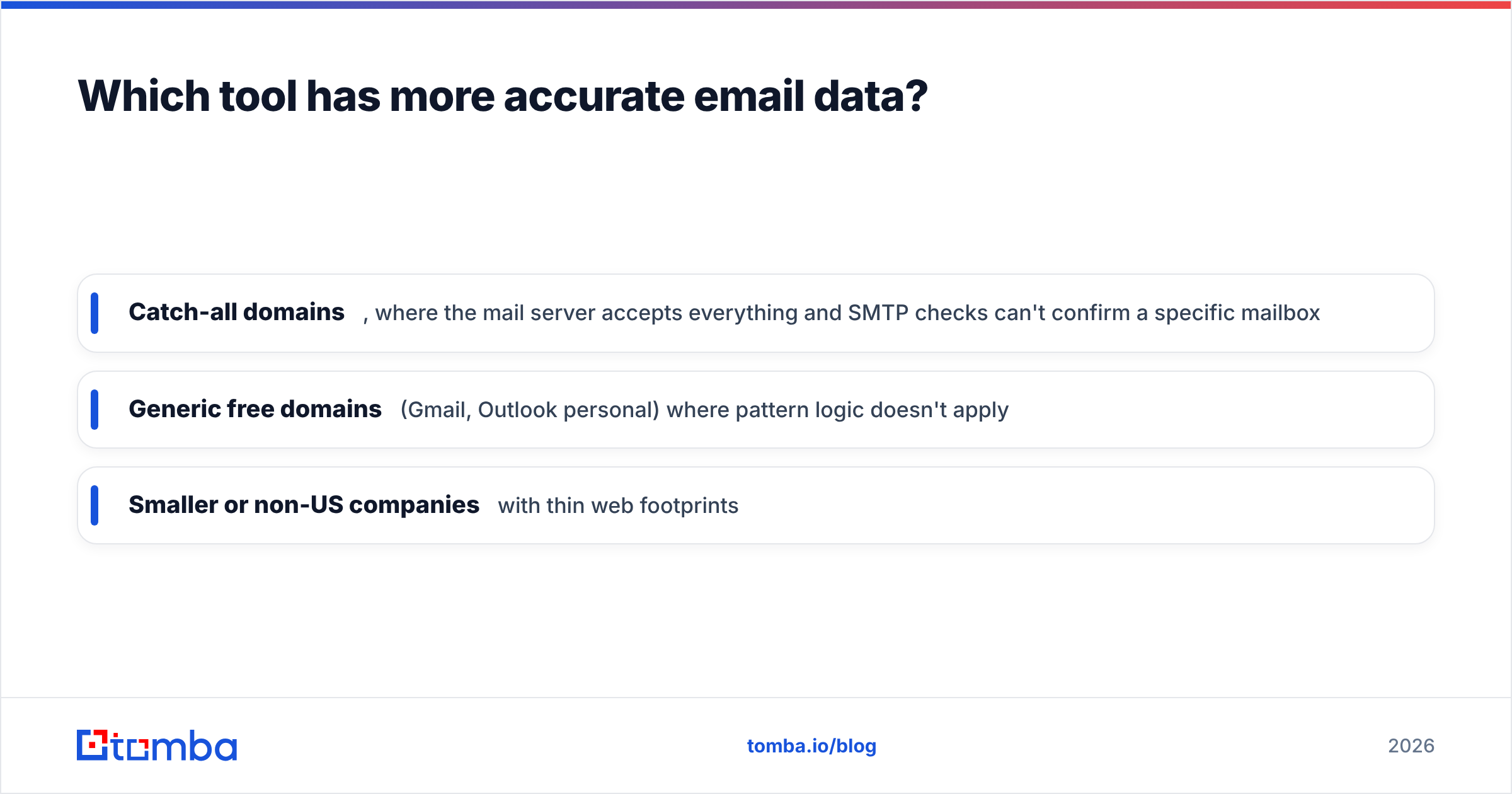
Neither company publishes an independent, third-party-audited accuracy figure, so anyone quoting you "98% accurate" is repeating marketing. From hands-on testing patterns and public user reports, both land in roughly the 80–90% valid range on standard corporate domains (think @company.com with a clear first.last pattern) and both fall off a cliff on:
- Catch-all domains, where the mail server accepts everything and SMTP checks can't confirm a specific mailbox
- Generic free domains (Gmail, Outlook personal) where pattern logic doesn't apply
- Smaller or non-US companies with thin web footprints
AroundDeal's edge is that it pulls from a maintained database, so popular companies resolve fast. FindThatLead's edge is that its finder will generate and test permutations on demand, which sometimes surfaces an email AroundDeal's static row is missing — at the cost of more guesses that need verifying.

The practical takeaway: whichever you pick, run the output through a dedicated email verifier before you send. A finder telling you an address "looks valid" and a verifier confirming the mailbox accepts mail are two different guarantees. Catch-all domains especially need a catch-all verifier to avoid torching your sender reputation on addresses that may not exist.

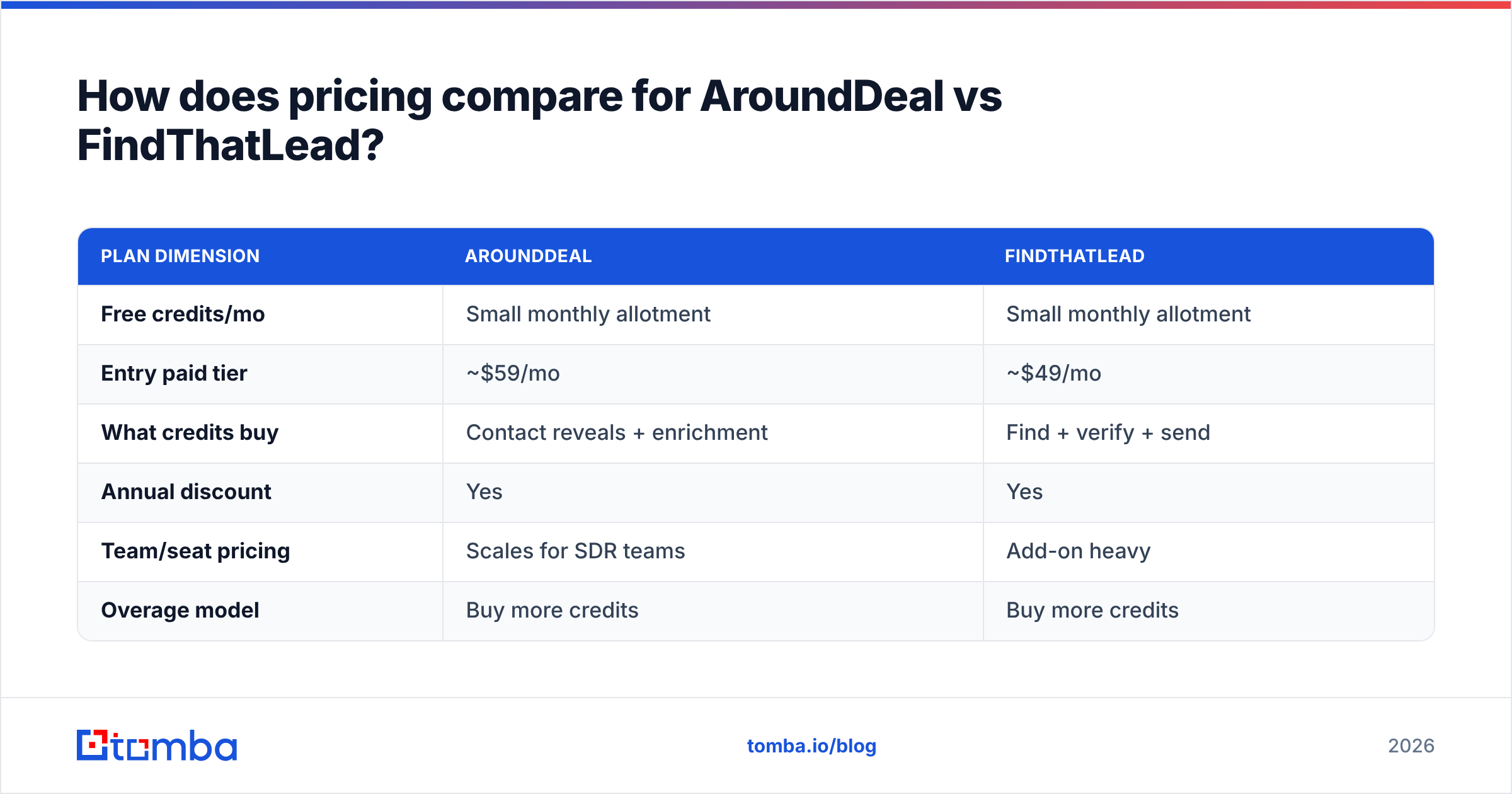
How does pricing compare for AroundDeal vs FindThatLead?#
Pricing is where the two tools' personalities show.
FindThatLead prices for the solo operator. Its lower tiers bundle finder credits and sending volume, which is attractive if you want one bill instead of stitching a finder to a separate sequencer. The trade-off: credits get consumed by both finding and validation, so heavy senders burn through them faster than the headline number suggests.
AroundDeal prices per-credit for data, and assumes you'll plug exports into your own CRM and sequencer (HubSpot, Salesforce, Outreach). For a team that already pays for a sending stack, that's the right separation of concerns. For a one-person shop, it's a second subscription.
| Plan dimension | AroundDeal | FindThatLead |
|---|---|---|
| Free credits/mo | Small monthly allotment | Small monthly allotment |
| Entry paid tier | ~$59/mo | ~$49/mo |
| What credits buy | Contact reveals + enrichment | Find + verify + send |
| Annual discount | Yes | Yes |
| Team/seat pricing | Scales for SDR teams | Add-on heavy |
| Overage model | Buy more credits | Buy more credits |
If you're comparing total cost of ownership, don't stop at the sticker price. Add the cost of the sending tool AroundDeal assumes you have, and subtract the value of FindThatLead's sender if you already own Instantly, Smartlead, or similar. For reference on how a transparent finder structures this, the Tomba pricing page splits search and verification credits explicitly — Free (25 searches/mo), Starter $49/mo, Growth $99/mo, and Pro $249/mo — which makes cost-per-contact easy to model.
When should you choose AroundDeal?#
Pick AroundDeal when:
- You prospect inside LinkedIn Sales Navigator. The extension is the workflow. Reveal a contact, enrich, push to CRM, repeat.
- You're an SDR team, not a solo sender. Enrichment and intent signals pay off when multiple reps share a pipeline and a CRM.
- You already own your sending stack. You want clean data into Outreach/Salesloft, not a new sender to learn.
- Firmographic filtering matters. Building lists by headcount, industry, tech stack, and geography is AroundDeal's home turf.
AroundDeal is the better "fill the top of the funnel with enriched records" engine. It's the warehouse. For a deeper look at building lists this way, our guide to domain search covers the company-wide discovery angle that complements profile-by-profile reveals.
When should you choose FindThatLead?#
Pick FindThatLead when:
- You want find-verify-send in one tab. Solo founders and small agencies love not juggling three tools.
- You run campaign-style outbound. The Email Sender plus Scrab.in covers a basic end-to-end motion without extra subscriptions.
- Your targets are domain-led. "Give me everyone at these 200 companies" is a natural fit for its domain finder.
- Budget is tight and volume is moderate. The bundled credits stretch furthest for low-to-mid senders.
The risk with all-in-one tools is that each component is "good enough" rather than best-in-class. FindThatLead's sender won't match a dedicated deliverability platform, and its finder won't match a dedicated data vendor. For many small teams, "good enough in one place" genuinely wins — just go in clear-eyed.
What do AroundDeal and FindThatLead both get wrong?#
Both tools share the same structural weakness: the finder and the verifier are the same vendor. That's a mild conflict of interest. A tool that profits from "found a result" has a gentle incentive to mark borderline addresses as valid. It's not malicious — it's just that an independent verification step catches things a bundled one rationalizes away.
The second shared gap is catch-all handling. Roughly a third of corporate domains are catch-all configured. Both tools will hand you addresses on those domains with a confidence score, but a score is not a confirmation. If you send to unconfirmed catch-all addresses at volume, your bounce rate climbs and your sender reputation suffers — which quietly tanks deliverability for the good addresses too.
Third: export friction and credit anxiety. Both meter aggressively. Bulk jobs eat credits fast, and re-running a list you already paid for usually costs again.

This is the gap a dedicated, accuracy-first finder is built to close. Decoupling discovery from verification, and pricing them as separate credits, removes the conflict of interest and lets you verify aggressively without burning your finding budget.
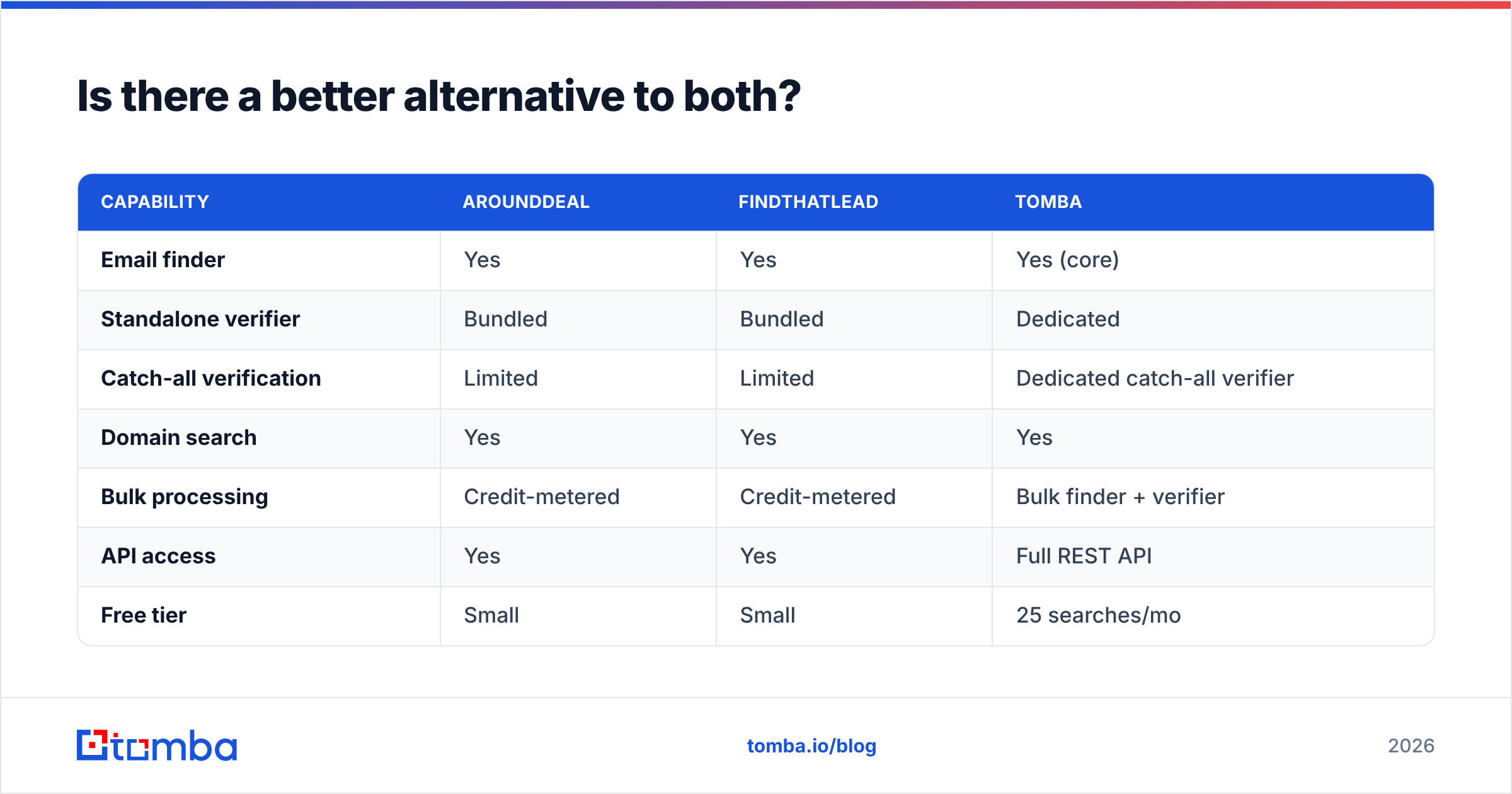
Is there a better alternative to both?#
If your actual problem is "I need verified, deliverable B2B emails at a predictable cost," a specialist finder is worth a look alongside these two. Tomba focuses on the finding-and-verifying layer rather than trying to also be your sender or your CRM.
| Capability | AroundDeal | FindThatLead | Tomba |
|---|---|---|---|
| Email finder | Yes | Yes | Yes (core) |
| Standalone verifier | Bundled | Bundled | Dedicated |
| Catch-all verification | Limited | Limited | Dedicated catch-all verifier |
| Domain search | Yes | Yes | Yes |
| Bulk processing | Credit-metered | Credit-metered | Bulk finder + verifier |
| API access | Yes | Yes | Full REST API |
| Free tier | Small | Small | 25 searches/mo |
| Entry price | ~$59/mo | ~$49/mo | $49/mo |
Where Tomba fits: it's the verification-first option. You can run bulk lead generation jobs, confirm deliverability with a real email verifier, and pull everything through the Tomba API into whatever sender or CRM you already use. It deliberately does not try to be your cold-email platform — which means it doesn't have a reason to inflate "valid" scores to keep you sending inside its walls.
For teams that want context on where contact data originates and how it's kept fresh, the data sources breakdown is more transparent than most vendors offer.
You can compare the broader landscape on independent review sites too — G2 and Capterra both carry side-by-side user ratings for AroundDeal, FindThatLead, and their alternatives, and FindThatLead's own findthatlead.com documents its current credit model.
Final verdict: AroundDeal vs FindThatLead#
There's no universal winner — there's a winner for your job.
- Choose AroundDeal if you're an SDR team that prospects in LinkedIn, needs enrichment and intent, and already owns a sending stack.
- Choose FindThatLead if you're a solo founder or small agency who wants find-verify-send bundled into one affordable subscription.
- Choose a dedicated finder if your bottleneck is deliverable emails and predictable cost-per-valid-contact, and you'd rather verify aggressively without paying for a second sender you don't need.
Most teams discover their real problem isn't "I can't find emails" — it's "too many of the emails I find bounce." That's a verification problem, not a discovery problem, and it's the one that costs you domain reputation when ignored.
Ready to stop guessing? Start with the Tomba Email Finder on the free tier — 25 searches a month, no card required — and run a sample of your AroundDeal or FindThatLead exports through its verifier. If your cost-per-valid-contact drops, you'll have your answer. Find the email, verify the mailbox, then send. In that order, every time.
// get started
Find, verify and enrich your first contacts today
Start on the free plan with 25 searches a month, then scale when your team is ready.
Free plan · No credit card required · GDPR & CCPA
// about the author