Arounddeal vs Findymail: Which B2B Email Tool Wins 2026?
Arounddeal vs Findymail compared on accuracy, pricing, data coverage, and verification. See which email finder fits your outbound stack in 2026 — and where a third option beats both.
You have a prospect list to build, two tools open in two browser tabs, and a card you do not want to waste. Arounddeal and Findymail both promise accurate B2B emails, but they solve slightly different problems and charge for them in very different ways. This guide breaks down where each one actually wins so you can pick without burning a free trial to find out.
TL;DR — Arounddeal vs Findymail in 30 seconds#
- Findymail is a focused email finder built for outbound senders. It leads with verification, low bounce rates, and tight integrations to sequencers like Lemlist and Smartlead.
- Arounddeal is a broader B2B database and Chrome extension. You get emails plus phone numbers, company data, intent signals, and a searchable contact database — closer to an Apollo-style platform.
- Pick Findymail if your only job is clean, send-ready emails for cold campaigns. Pick Arounddeal if you want an all-in-one prospecting database with phones and firmographics.
- Pricing differs in shape: Findymail sells email-finder credits; Arounddeal bundles credits into broader plans with extra data types.
- If accuracy-per-dollar and a verification-first workflow matter most, a third option like Tomba often beats both — more on that below.
What is Arounddeal?#
Arounddeal is a B2B contact and company database with a popular Chrome extension. You install it, browse LinkedIn or a company website, and it surfaces emails, direct dials, and firmographic details for the people on the page. Beyond the extension, it offers a searchable database where you filter by title, industry, location, headcount, and technology to build lists from scratch.
In practice, Arounddeal competes with platforms like Apollo, Lusha, and RocketReach rather than with single-purpose email finders. Its pitch is breadth: one login for emails, phone numbers, intent data, and bulk list-building. If you have ever wanted a contact database you can slice by attribute and export, that is the lane Arounddeal plays in.
The trade-off with breadth is depth. Database-style tools carry large volumes of records, and freshness varies. A title that was accurate eighteen months ago may now point to someone who changed jobs, which is why verification still matters even when a tool hands you a "found" email.
What is Findymail?#
Findymail is a purpose-built email finder aimed squarely at cold outreach teams. Its core promise is simple: find the email, verify it, and only charge you for valid results. That verification-first stance is the reason it built a following among agencies running high-volume cold email — bounces hurt sender reputation, and Findymail markets itself as the tool that keeps your bounce rate low.
Findymail also leans into list-building from LinkedIn Sales Navigator and integrates cleanly with sending tools. You scrape a Sales Nav search, Findymail enriches and verifies, and the clean list flows into your sequencer. For a team whose entire workflow is "list in, campaign out," that focus is the appeal.
What you do not get is the wider data platform. Findymail is not trying to be your CRM-grade database with intent scoring and org charts. It does one job and tries to do it without giving you junk.

Arounddeal vs Findymail: how do they actually differ?#
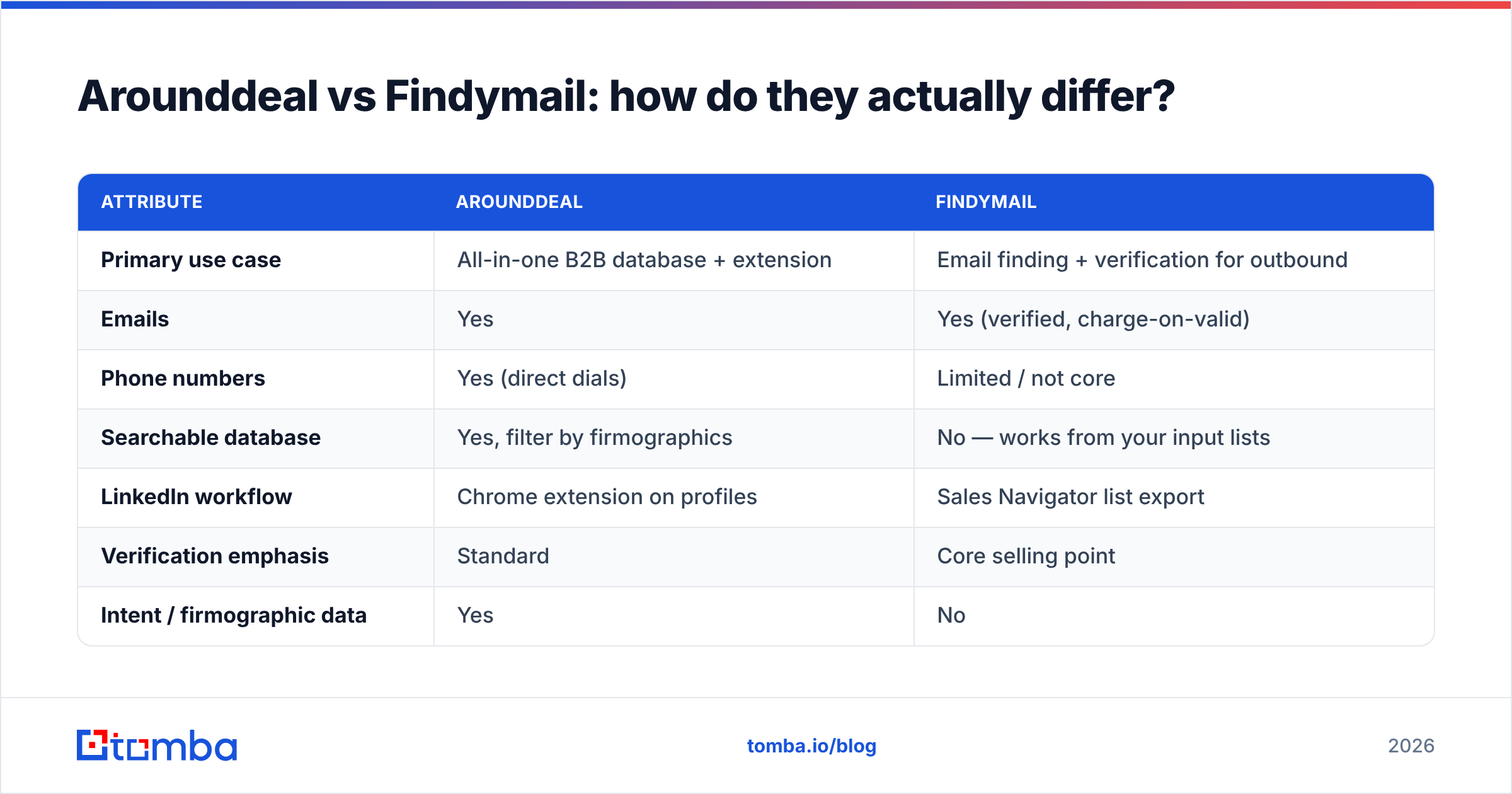
The cleanest way to see the gap is to line up what each tool is built around. One is a database platform; the other is a verification-first finder.
| Attribute | Arounddeal | Findymail |
|---|---|---|
| Primary use case | All-in-one B2B database + extension | Email finding + verification for outbound |
| Emails | Yes | Yes (verified, charge-on-valid) |
| Phone numbers | Yes (direct dials) | Limited / not core |
| Searchable database | Yes, filter by firmographics | No — works from your input lists |
| LinkedIn workflow | Chrome extension on profiles | Sales Navigator list export |
| Verification emphasis | Standard | Core selling point |
| Intent / firmographic data | Yes | No |
| Best for | Full-funnel prospecting teams | Cold email senders, agencies |
| Free option | Limited free credits | Limited free trial |
Read that table as a fork in the road. If you need phone numbers and a database you can mine, Arounddeal does more. If you need send-ready emails and want bounce protection baked in, Findymail is more focused on exactly that outcome.
Which one is more accurate?#
Accuracy is the question that decides every email-finder comparison, so be precise about what it means. There are two numbers that matter: hit rate (how often the tool returns any email for a given contact) and valid rate (how many of those returned emails actually deliver). A tool can have a high hit rate and still hurt you if half of those emails bounce.
Findymail optimizes for the second number. By verifying before it bills you, it pushes the valid rate up and keeps your bounce rate down, which is the metric cold senders live and die by. The downside is that a strict verification pass can lower your apparent hit rate — Findymail would rather return nothing than return a risky guess.
Arounddeal optimizes more for coverage. A large database means a higher chance it has something on your target, but database records age, and not every returned email is freshly verified. The practical move with any database tool is to run results through a dedicated email verifier before you load them into a sequence, especially for catch-all domains where standard checks return "unknown."
No single vendor wins accuracy across every region and industry. Coverage for a SaaS founder in San Francisco looks nothing like coverage for a manufacturing buyer in Germany. Test both on your ICP with a sample of 50 known-good contacts before committing budget — that is the only benchmark that reflects your reality.

How does pricing compare?#
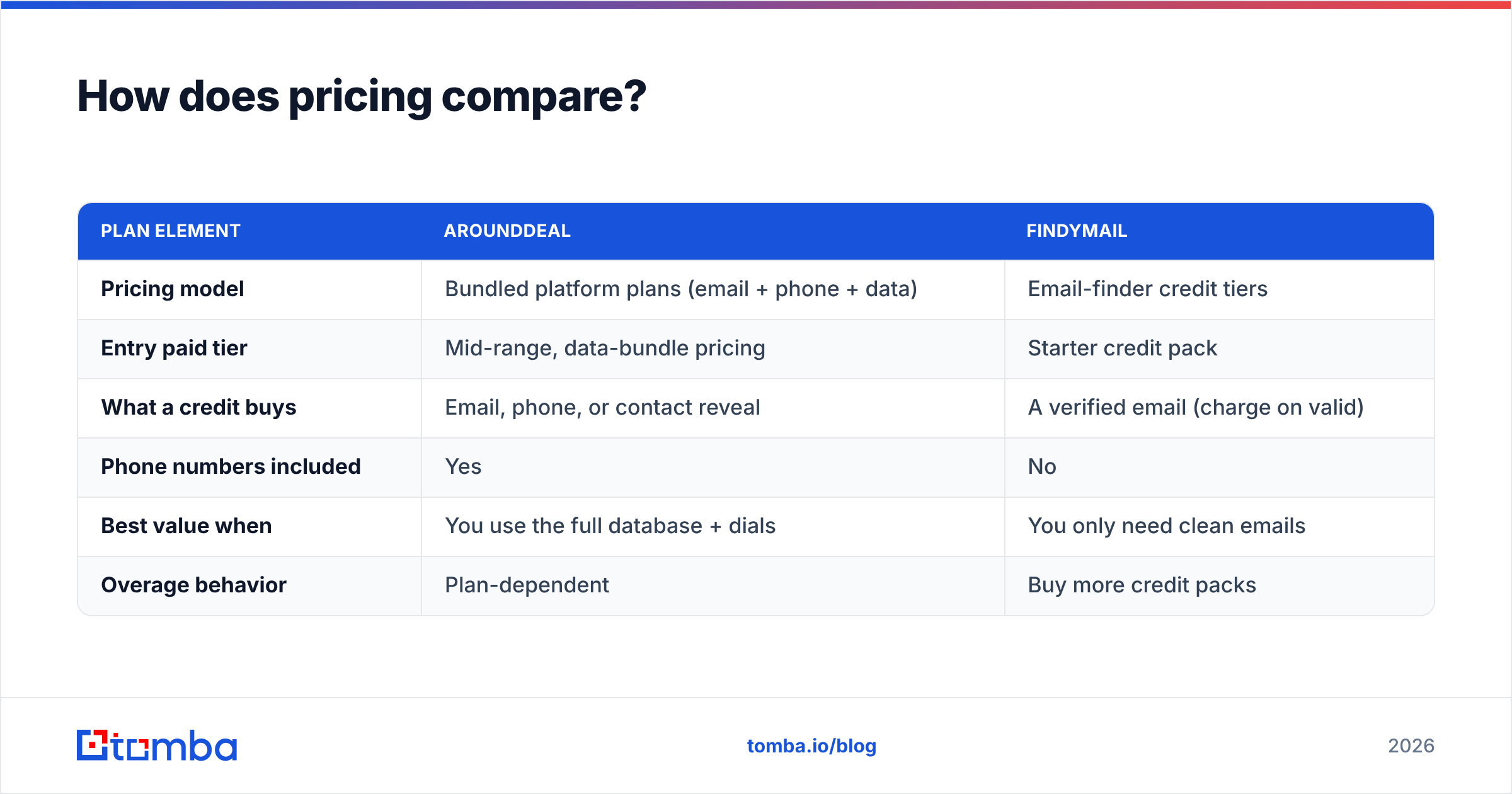
Pricing is where the two tools feel most different, because they are selling different things. Findymail sells email-finder credits in tiers built for senders. Arounddeal bundles email credits with phone credits, database access, and other data inside broader plans, so a like-for-like comparison depends on how much non-email data you actually use.
| Plan element | Arounddeal | Findymail |
|---|---|---|
| Pricing model | Bundled platform plans (email + phone + data) | Email-finder credit tiers |
| Entry paid tier | Mid-range, data-bundle pricing | Starter credit pack |
| What a credit buys | Email, phone, or contact reveal | A verified email (charge on valid) |
| Phone numbers included | Yes | No |
| Best value when | You use the full database + dials | You only need clean emails |
| Overage behavior | Plan-dependent | Buy more credit packs |
The honest takeaway: if you only need emails, paying for Arounddeal's bundled data you never touch is wasteful, and Findymail's pay-for-valid model is cleaner. If you genuinely use phones, firmographics, and intent, Arounddeal's bundle can be cheaper than buying three separate tools. Map your actual usage before you decide — and always check the current rates on each vendor's pricing page, since credit costs shift.
For context on how a verification-first finder prices a single, focused job, compare both against Tomba pricing, where a free tier covers 25 searches a month and paid plans start at $49/mo.
Is there a better alternative to both?#
Yes, depending on what you optimize for. Both Arounddeal and Findymail are good at their respective jobs, but if your priority is high-accuracy emails with verification built into the same flow — and an API and integrations to match — Tomba is a strong third option that often beats both on accuracy-per-dollar.
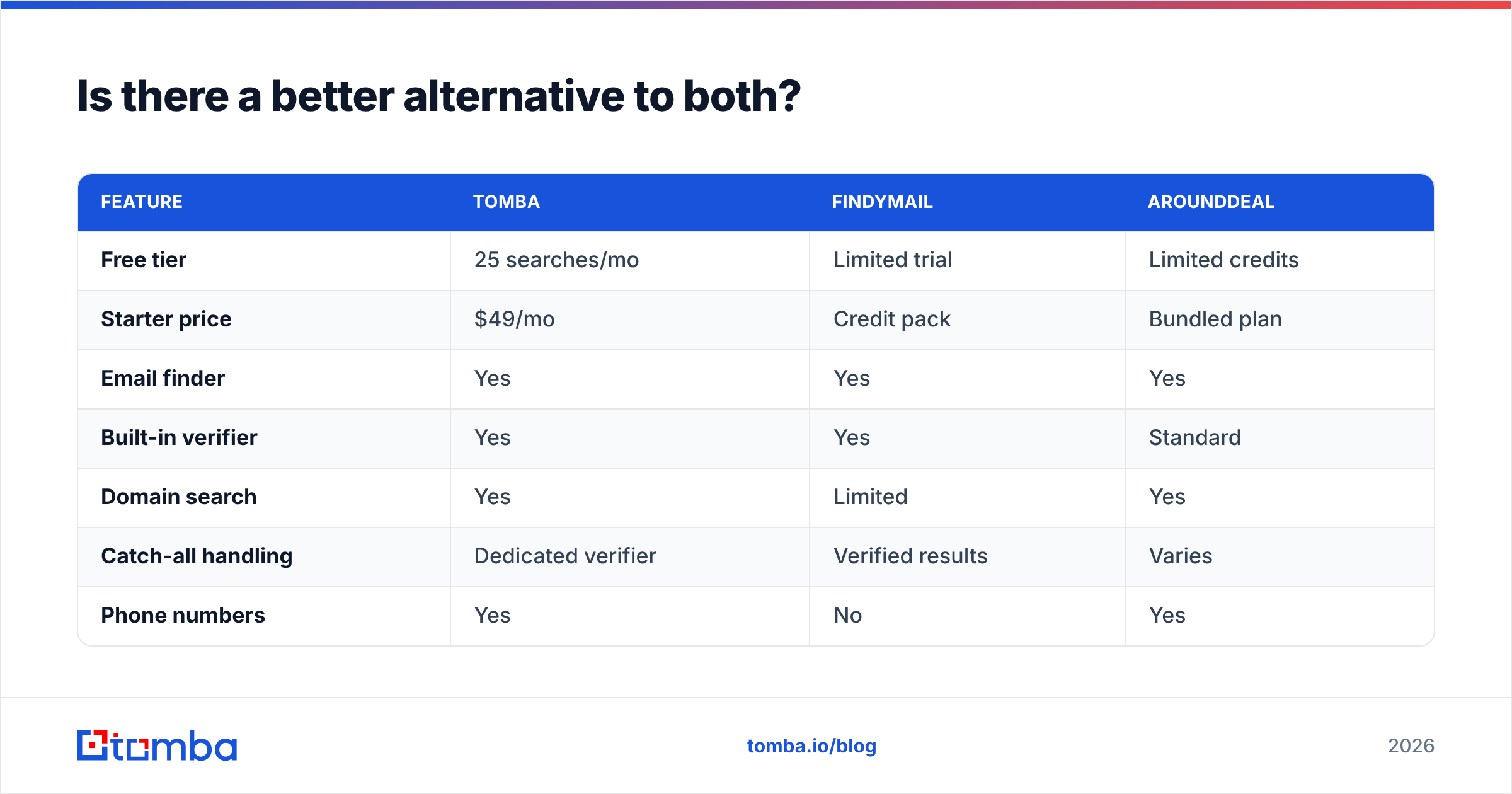
Here is how the three stack up on the dimensions that matter for outbound.
| Feature | Tomba | Findymail | Arounddeal |
|---|---|---|---|
| Free tier | 25 searches/mo | Limited trial | Limited credits |
| Starter price | $49/mo | Credit pack | Bundled plan |
| Email finder | Yes | Yes | Yes |
| Built-in verifier | Yes | Yes | Standard |
| Domain search | Yes | Limited | Yes |
| Catch-all handling | Dedicated verifier | Verified results | Varies |
| Phone numbers | Yes | No | Yes |
| Public API | Yes | Yes | Yes |
| Bulk processing | Yes | Yes | Yes |
Tomba's core is the email finder, backed by a verifier, domain search, a catch-all verifier, and data enrichment — so a single workflow takes you from a company name to a verified, send-ready contact without exporting to a second tool. If you arrived here specifically weighing a Findymail alternative, that end-to-end coverage is the main reason teams switch.
The point is not that Tomba wins every comparison — it is that "Arounddeal vs Findymail" is the wrong frame if you have not also priced the option that does both jobs in one pass. Run all three on your sample list.

Which tool should you choose?#
Match the tool to the job rather than to the hype. Here is the decision in plain terms.
Choose Findymail if:
- Your workflow is cold email, and your KPI is a low bounce rate.
- You build lists from LinkedIn Sales Navigator and push them straight into a sequencer.
- You want to pay only for valid, verified emails.
- You do not need phone numbers or a searchable database.
Choose Arounddeal if:
- You want one platform for emails, direct dials, and company data.
- Your reps live in a Chrome extension while browsing LinkedIn.
- You build lists by filtering a database on firmographics and intent.
- You are consolidating away from a stack of single-purpose tools.
Choose Tomba if:
- Accuracy-per-dollar on emails is your top priority.
- You want finding plus email verification in one flow, including catch-all handling.
- You need a clean email finder API or bulk processing to wire into your own systems.
- You want a real free tier to test before paying.
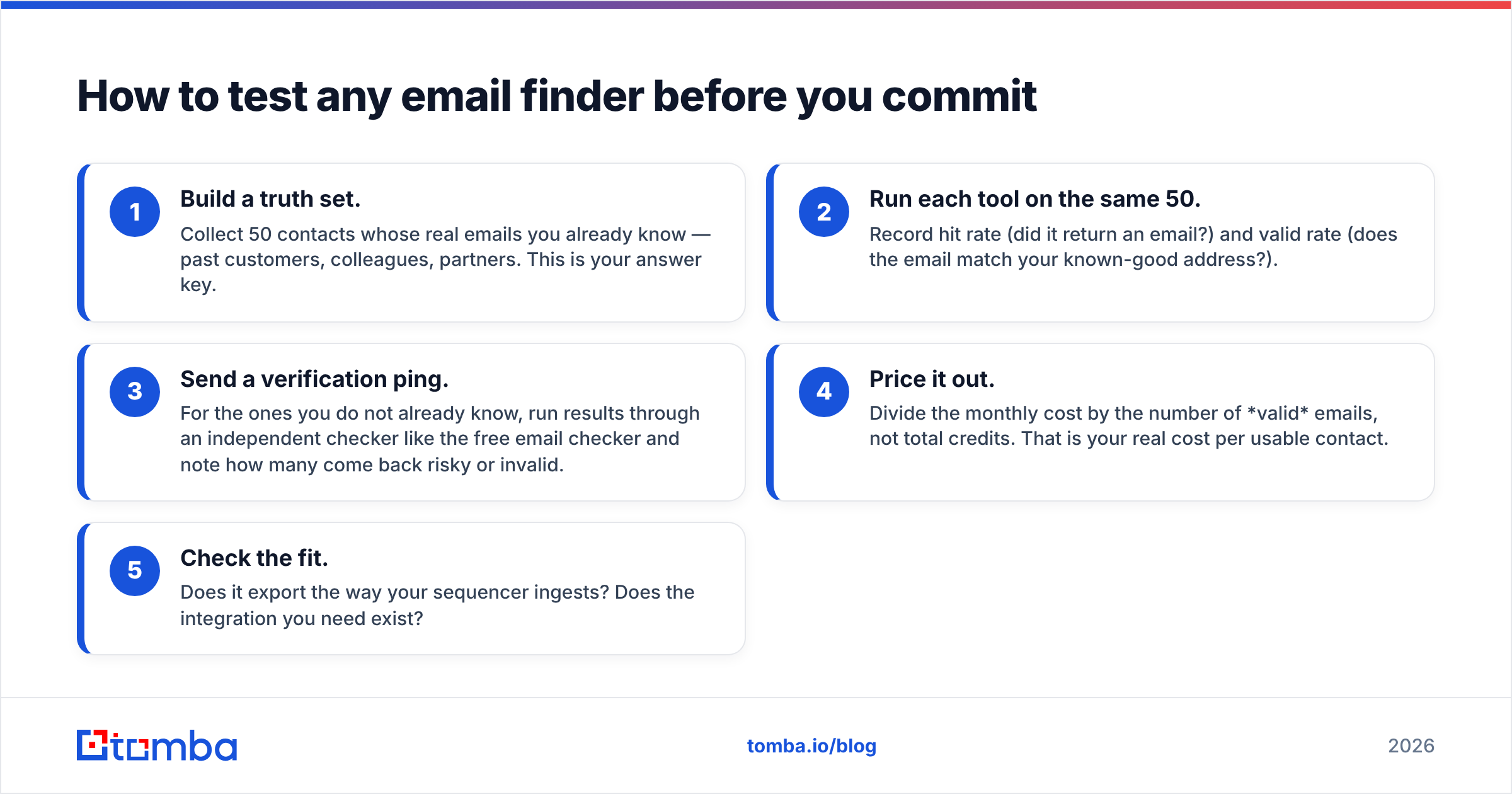
How to test any email finder before you commit#
Do not trust marketing accuracy claims, including the ones in this article. Run a controlled test instead. It takes twenty minutes and saves you months on the wrong tool.
- Build a truth set. Collect 50 contacts whose real emails you already know — past customers, colleagues, partners. This is your answer key.
- Run each tool on the same 50. Record hit rate (did it return an email?) and valid rate (does the email match your known-good address?).
- Send a verification ping. For the ones you do not already know, run results through an independent checker like the free email checker and note how many come back risky or invalid.
- Price it out. Divide the monthly cost by the number of valid emails, not total credits. That is your real cost per usable contact.
- Check the fit. Does it export the way your sequencer ingests? Does the integration you need exist?
Whatever wins that test for your ICP is your tool, regardless of which logo has the bigger marketing budget. For deeper background on the metric that ties all of this together, see external resources on email deliverability and browse verified user reviews on G2 before you sign anything. You can also compare each vendor's own claims on the Findymail and Arounddeal homepages.
The bottom line#
Arounddeal and Findymail are not really competitors so much as tools for two different jobs. Findymail is the sharper choice for verification-first cold email; Arounddeal is the broader platform for teams that want phones and a database alongside emails. Decide based on whether you need a focused finder or a full prospecting suite — and price each against your actual usage, not the sticker.
If what you want is the best of both — high-accuracy emails, built-in verification, catch-all handling, phone lookup, and an API — start with the Tomba Email Finder. The free tier gives you 25 searches a month to run the 50-contact test above, so you can see the valid rate on your own list before spending a dollar. Build your truth set, run all three, and let the numbers pick the winner.
// get started
Find, verify and enrich your first contacts today
Start on the free plan with 25 searches a month, then scale when your team is ready.
Free plan · No credit card required · GDPR & CCPA
// about the author