Arounddeal vs Forager 2026: Which B2B Email Finder Wins?
A hands-on 2026 breakdown of Arounddeal vs Forager — accuracy, pricing, data coverage, and which B2B email finder actually fits your outbound stack.
Arounddeal vs Forager: The Honest 2026 Comparison
Picking a B2B email finder usually comes down to one quiet question: when you hand the tool a name and a company, how often does it give you an address that actually lands? Arounddeal and Forager both promise that, but they go about it differently — and the difference shows up in your bounce rate, your budget, and how much manual cleanup your SDRs do every week.
TL;DR — Arounddeal vs Forager at a glance#
- Arounddeal is a broad contact-data platform (emails, phones, Chrome extension, intent signals) with a large APAC-leaning database and a credit-based model. Good coverage, variable verification.
- Forager is a leaner, accuracy-first email finder that emphasizes real-time verification and "only pay for valid emails" pricing — narrower feature set, tighter data.
- Accuracy is the real battleground: Forager leans on live verification, Arounddeal leans on database scale. Neither is bulletproof, so you still want a verification pass.
- Pricing models differ fundamentally — Arounddeal sells credits/seats, Forager sells valid-email volume. Your cost-per-good-lead depends entirely on your hit rate.
- If you want both scale and verified accuracy without juggling two tools, a finder-plus-verifier platform like Tomba is worth a look before you commit.
What is Arounddeal?#
Arounddeal is a B2B sales-intelligence platform. Its core is a contact database you query by person, company, or domain, surfaced through a web app and a Chrome extension that overlays contact data on LinkedIn profiles. Beyond email, it offers direct-dial phone numbers, company firmographics, and basic buyer-intent signals.
Its strength is breadth. Arounddeal has historically had strong coverage in Asia-Pacific markets where many Western tools are thin, which makes it a popular pick for teams selling into APAC. You can read user reports on G2 to see how that coverage holds up by region.
The trade-off: like most database-first tools, accuracy varies by how recently a record was refreshed. A contact who changed jobs eight months ago may still show a stale address. That's not unique to Arounddeal — it's the nature of static databases — but it means verification matters.
What is Forager?#
Forager (forager.ai) takes the opposite stance: instead of leading with a giant static database, it emphasizes finding and verifying emails in real time, and it built its pricing around that. The headline promise is that you primarily pay for emails that pass verification, which aligns the vendor's incentives with your bounce rate.
That focus makes Forager narrower. You won't find the same sprawl of intent data, phone enrichment, and APAC-heavy coverage. What you get is a more disciplined email-finding engine for teams whose top priority is protecting sender reputation and keeping bounce rates low.

How do Arounddeal and Forager find email addresses?#
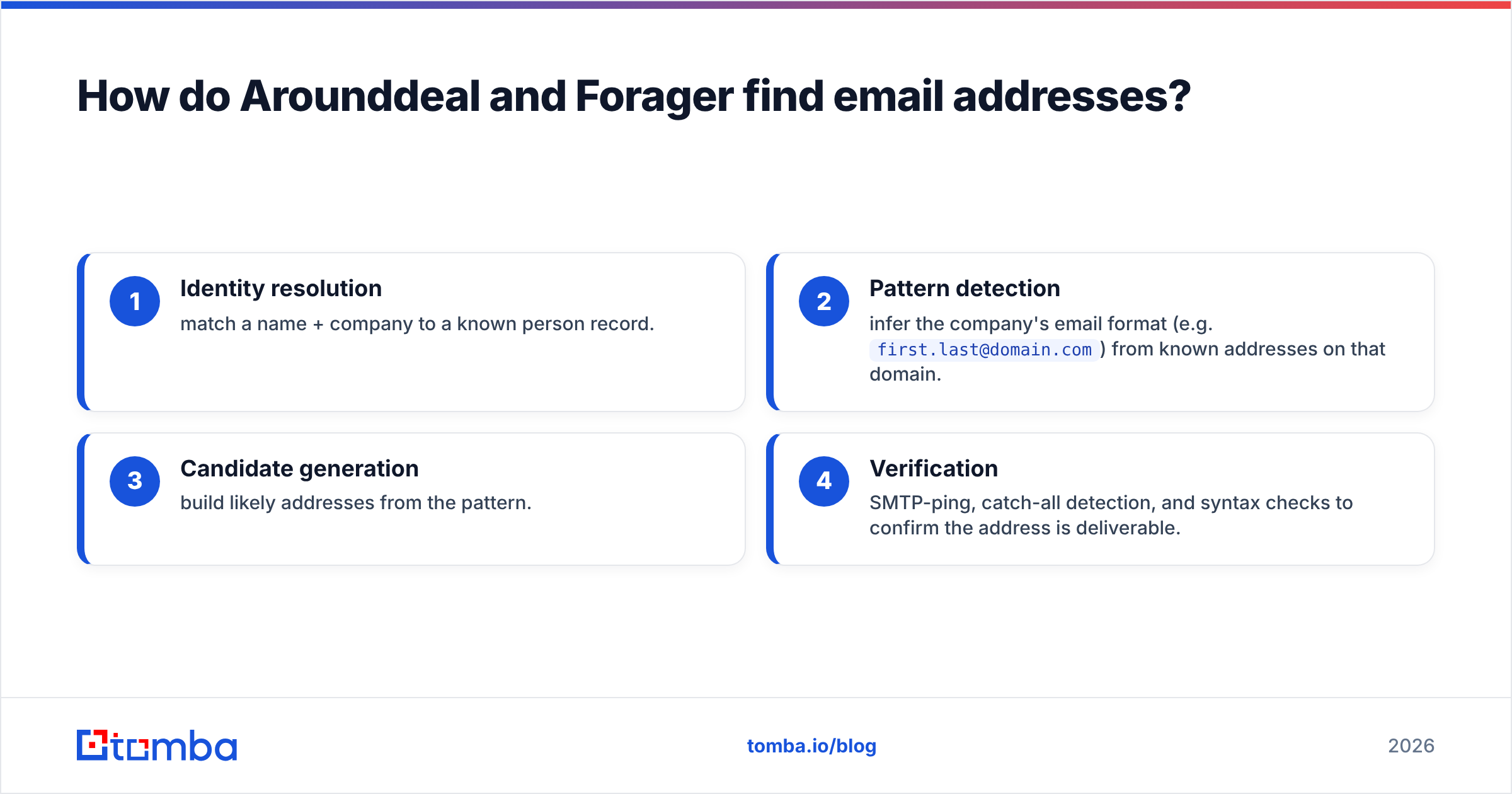
Both tools rely on the same family of techniques every email finder uses — the difference is emphasis.
The pipeline looks like this:
- Identity resolution — match a name + company to a known person record.
- Pattern detection — infer the company's email format (e.g.
first.last@domain.com) from known addresses on that domain. - Candidate generation — build likely addresses from the pattern.
- Verification — SMTP-ping, catch-all detection, and syntax checks to confirm the address is deliverable.
Arounddeal leans on steps 1–3 backed by its large stored database, then verifies. Forager pushes weight onto step 4, verifying aggressively at query time before it charges you. If you want to understand the mechanics in depth, our breakdown of how an email finder works walks through each stage.
The practical upshot: database-first tools win on recall (they'll return an answer more often), verification-first tools win on precision (the answers they return bounce less). The accuracy benchmark below shows why that distinction matters for your deliverability.

Arounddeal vs Forager: full feature comparison#
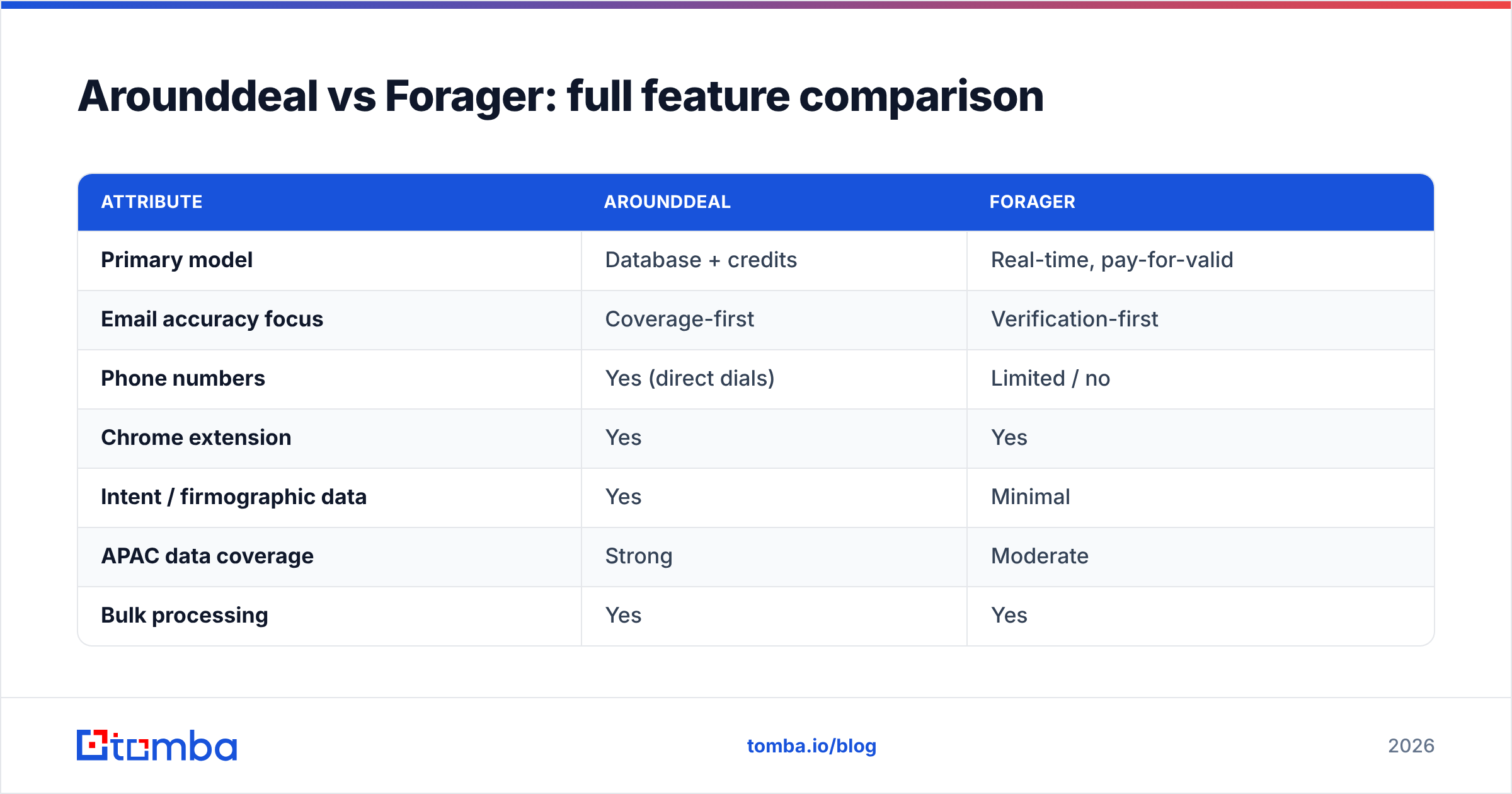
Here's the head-to-head on the attributes that actually change your workflow.
| Attribute | Arounddeal | Forager |
|---|---|---|
| Primary model | Database + credits | Real-time, pay-for-valid |
| Email accuracy focus | Coverage-first | Verification-first |
| Phone numbers | Yes (direct dials) | Limited / no |
| Chrome extension | Yes | Yes |
| Intent / firmographic data | Yes | Minimal |
| APAC data coverage | Strong | Moderate |
| Bulk processing | Yes | Yes |
| Best-fit team | Multi-channel SDR teams | Deliverability-focused senders |
| Pricing logic | Per credit / per seat | Per valid email |
Neither column is a knockout. Arounddeal is the more complete platform; Forager is the more focused tool. The right answer depends on whether you need a multi-channel data hub or a clean email pipe.
Which one is more accurate?#
Conclusion first: verification-first tools like Forager usually post lower bounce rates, while coverage-first tools like Arounddeal usually return more results — and the "winner" depends on which metric hurts you more.
If you're running cold email at volume, bounce rate is existential. A few percentage points of invalid addresses can drag your domain into spam folders and undo months of warmup. In that world, Forager's verify-before-you-charge model is genuinely valuable.
But if you're an SDR working a target account list by hand, recall matters more — you'd rather get an address to verify yourself than a blank result. Arounddeal's larger database returns more non-empty answers.
The honest reality: no single vendor is the accuracy champion across every region and seniority level. That's why experienced teams treat finding and verifying as two steps, not one. Run discovery in your finder of choice, then push everything through a dedicated email verifier and a catch-all verifier before send. The comparison table below shows how much spread there is across tools on this exact axis.

How does pricing compare?#
This is where the two tools diverge most, and where buyers get tripped up.
Arounddeal uses a credit/seat model. You buy a plan with a monthly allotment of credits; each revealed email or phone consumes credits. Predictable if your volume is steady, but you pay for results whether or not they're deliverable — invalid emails still cost you.
Forager ties cost to valid emails. On paper that's better alignment: you're not burning budget on bounces. The catch is that "valid" volume can be harder to forecast, and the per-unit price reflects the verification work baked in.
To compare fairly, ignore sticker price and compute cost per good lead:
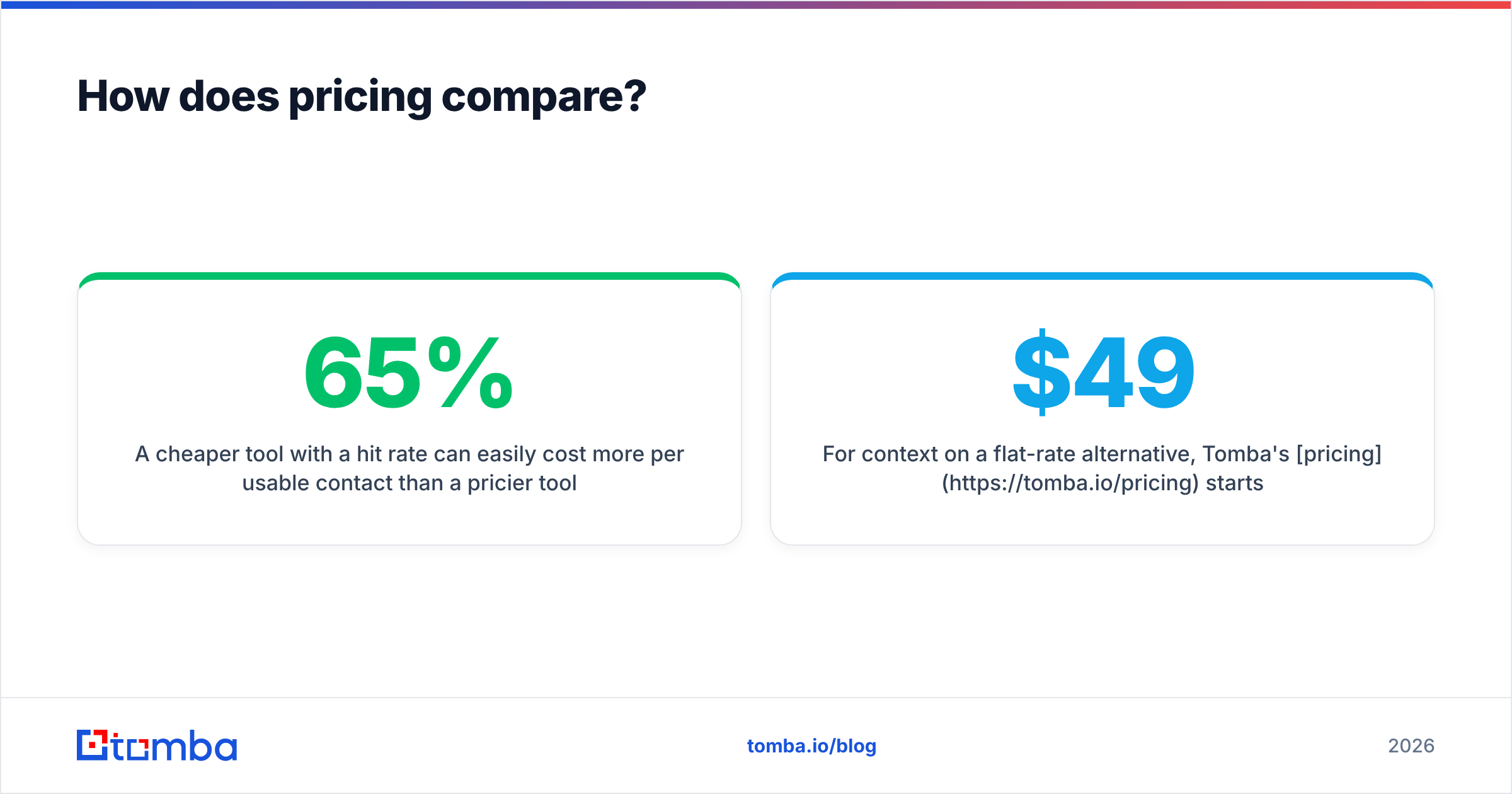
cost per good lead = total spend / (results returned × deliverability rate)A cheaper tool with a 65% hit rate can easily cost more per usable contact than a pricier tool at 92%. Run that math on a sample of 200 contacts before you sign anything.
For context on a flat-rate alternative, Tomba's pricing starts with a free tier (25 searches/month), then Starter at $49/mo, Growth at $99/mo, and Pro at $249/mo — finder and verifier included, so you're not paying two vendors to cover one workflow.
Where does each tool fit best?#
Choose Arounddeal if:
- You sell into APAC and need regional coverage Western tools miss.
- You want phones, intent data, and emails in one platform.
- Your team works LinkedIn heavily and lives in the Chrome extension.
- You're comfortable adding your own verification step.
Choose Forager if:
- Bounce rate is your top KPI and you run high-volume cold email.
- You want pricing that punishes the vendor, not you, for bad data.
- You don't need phones or intent — just clean, deliverable emails.
- You prefer a focused tool over a sprawling platform.
Is there a better alternative to both?#
For a lot of teams, the real frustration with the Arounddeal vs Forager decision is that it forces a trade between coverage and verification — and then often a second purchase to cover the gap. You buy a finder, then bolt on a verifier; or you buy a verifier-first tool, then add a database for recall.
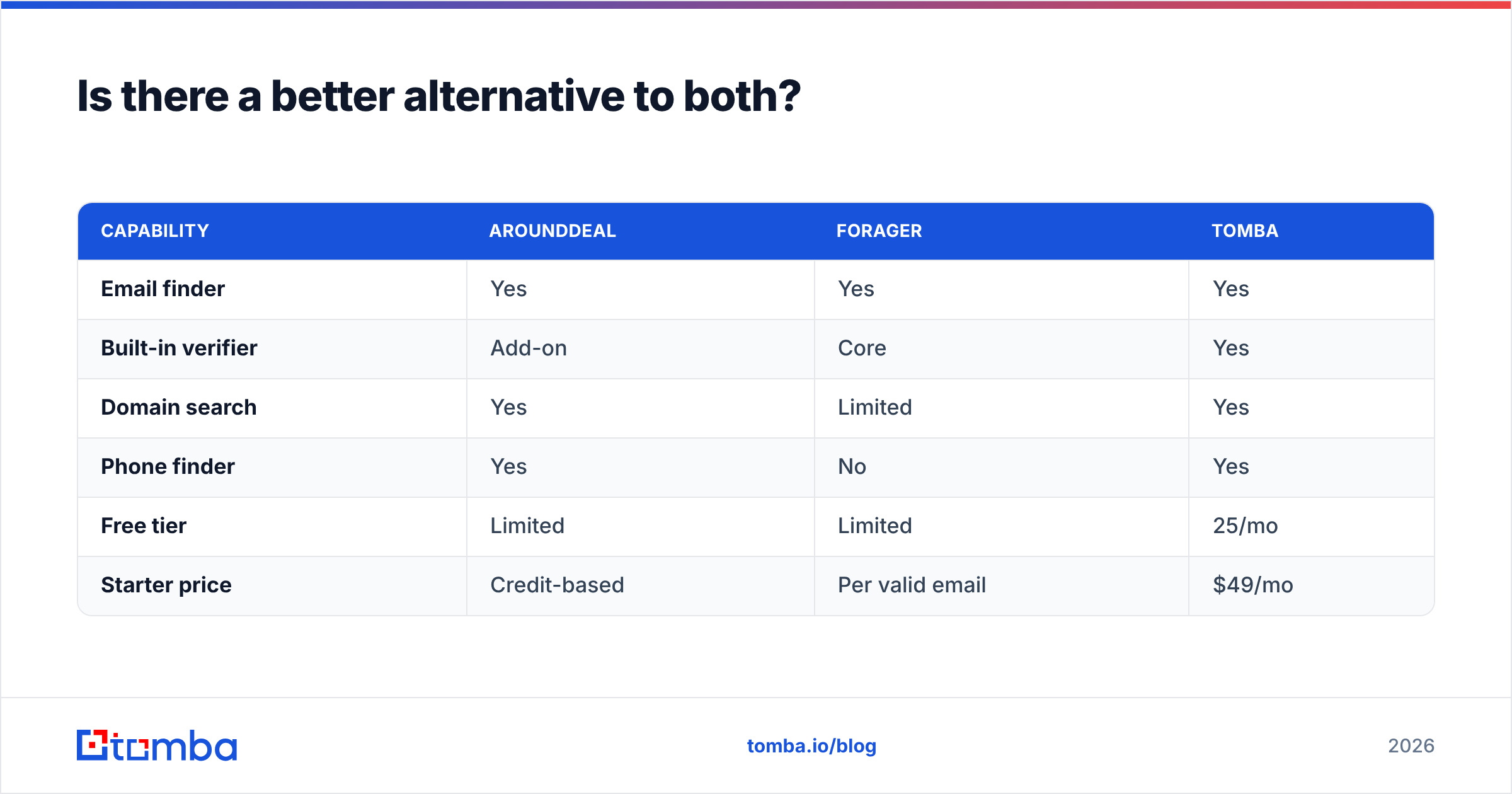
A consolidated platform sidesteps that. Tomba pairs a high-recall email finder with built-in verification, domain search for mapping every address at a company, and bulk processing for list-scale work — so discovery and validation happen in one pass instead of two tools and two invoices.
| Capability | Arounddeal | Forager | Tomba |
|---|---|---|---|
| Email finder | Yes | Yes | Yes |
| Built-in verifier | Add-on | Core | Yes |
| Domain search | Yes | Limited | Yes |
| Phone finder | Yes | No | Yes |
| Free tier | Limited | Limited | 25/mo |
| Starter price | Credit-based | Per valid email | $49/mo |
This isn't to say Tomba beats both on every axis — Arounddeal's APAC depth and Forager's verify-first pricing are real strengths for specific teams. It's that if you want coverage and verification without managing two contracts, a unified tool is usually the cheaper, simpler path. You can dig into where the data comes from on Tomba's data sources page and judge for yourself.
How should you actually test these tools?#
Don't trust any vendor's marketing accuracy number, including the ones above. Run your own bake-off:
- Build a truth set. Take 100–200 contacts where you already know the correct, deliverable email.
- Run all candidates blind. Feed the same list to Arounddeal, Forager, and any alternative.
- Measure three things: hit rate (non-empty results), accuracy (matches your truth set), and bounce rate on a real send.
- Compute cost per good lead using the formula above.
- Check coverage by segment — accuracy often varies sharply by region and seniority, so slice the results.
Free tiers exist precisely so you can do this. Use the free credits, run the numbers, and let your own data pick the winner. Anyone selling you on a benchmark without offering a trial is selling you the benchmark, not the tool.
Final verdict: Arounddeal vs Forager in 2026#
There's no universal winner — there's a winner for your motion. Arounddeal is the broader platform: more data types, stronger APAC coverage, better for multi-channel SDR teams who'll add their own verification. Forager is the disciplined specialist: verification-first, deliverability-first, with pricing that aligns to outcomes — ideal if cold-email bounce rate is what keeps you up at night.
But if the whole reason you're comparing them is that you want accurate emails without stitching together two products, evaluate a consolidated finder-and-verifier before you decide. The best stack is the one that gets a verified, deliverable address into your sequence with the fewest tools and the lowest cost per good lead.
Ready to benchmark for yourself? Spin up the free tier of the Tomba Email Finder — 25 searches a month, finder and verifier in one pass — run your truth set against it alongside Arounddeal and Forager, and let cost-per-good-lead make the call. It's the fastest way to turn this comparison into a decision you can defend.
// get started
Find, verify and enrich your first contacts today
Start on the free plan with 25 searches a month, then scale when your team is ready.
Free plan · No credit card required · GDPR & CCPA
// about the author