Arounddeal vs Kaspr 2026: B2B Contact Data Compared
Arounddeal and Kaspr both promise LinkedIn emails and phone numbers, but they win on different fronts. Here is the honest 2026 breakdown of pricing, accuracy, and fit.
Choosing between Arounddeal and Kaspr usually comes down to one question: do you need a broad B2B database to research accounts, or a fast LinkedIn extension that hands you a mobile number mid-prospecting? Both tools answer "yes" to email and phone enrichment, but they are built around different center of gravity, and that difference decides which one is worth your budget.
This breakdown compares the two on data accuracy, pricing, coverage, compliance, and workflow fit for 2026 — and shows where a dedicated email-finding stack like Tomba changes the math entirely.
TL;DR: Arounddeal vs Kaspr at a glance#
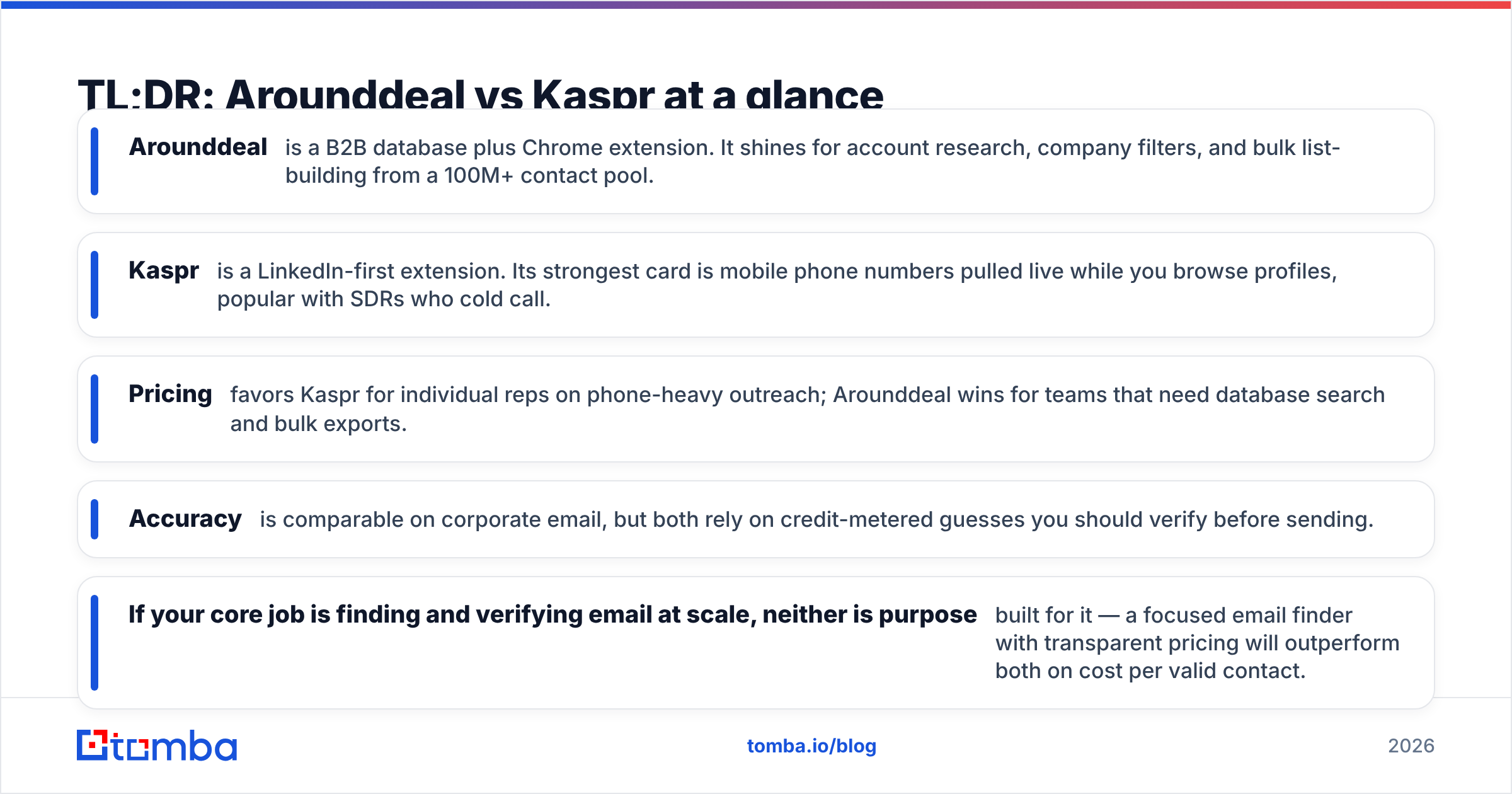
- Arounddeal is a B2B database plus Chrome extension. It shines for account research, company filters, and bulk list-building from a 100M+ contact pool.
- Kaspr is a LinkedIn-first extension. Its strongest card is mobile phone numbers pulled live while you browse profiles, popular with SDRs who cold call.
- Pricing favors Kaspr for individual reps on phone-heavy outreach; Arounddeal wins for teams that need database search and bulk exports.
- Accuracy is comparable on corporate email, but both rely on credit-metered guesses you should verify before sending.
- If your core job is finding and verifying email at scale, neither is purpose-built for it — a focused email finder with transparent pricing will outperform both on cost per valid contact.
What is Arounddeal and who is it for?#
Arounddeal is a B2B contact-intelligence platform built around a searchable database and a browser extension. You filter by title, industry, headcount, location, and technology, then export contacts or pull them one-by-one from LinkedIn. It positions itself against tools like ZoomInfo and Apollo but at a lower entry price, and it leans on a large international contact pool that is reasonably strong in EMEA and APAC.
The typical Arounddeal user is a marketer or sales ops person building a targeted list: "give me 500 marketing directors at 50–200 person SaaS companies in Germany." That is a database job, and Arounddeal handles it without forcing you to scrape profiles one at a time.
What is Kaspr and who is it for?#
Kaspr is a LinkedIn prospecting extension owned by Cognism. Open a LinkedIn profile, click the Kaspr widget, and it surfaces email addresses and — its signature feature — mobile phone numbers. It is designed for the rep who lives inside LinkedIn Sales Navigator and wants a number to dial before the prospect forgets the connection request.
Kaspr's center of gravity is the individual SDR workflow: enrich, sequence, and call. It includes lightweight outreach automation (LinkedIn message and email sequences) so a solo rep can run a small motion without a separate sales-engagement platform. Where Arounddeal thinks in lists, Kaspr thinks in profiles.
Arounddeal vs Kaspr: the head-to-head comparison#
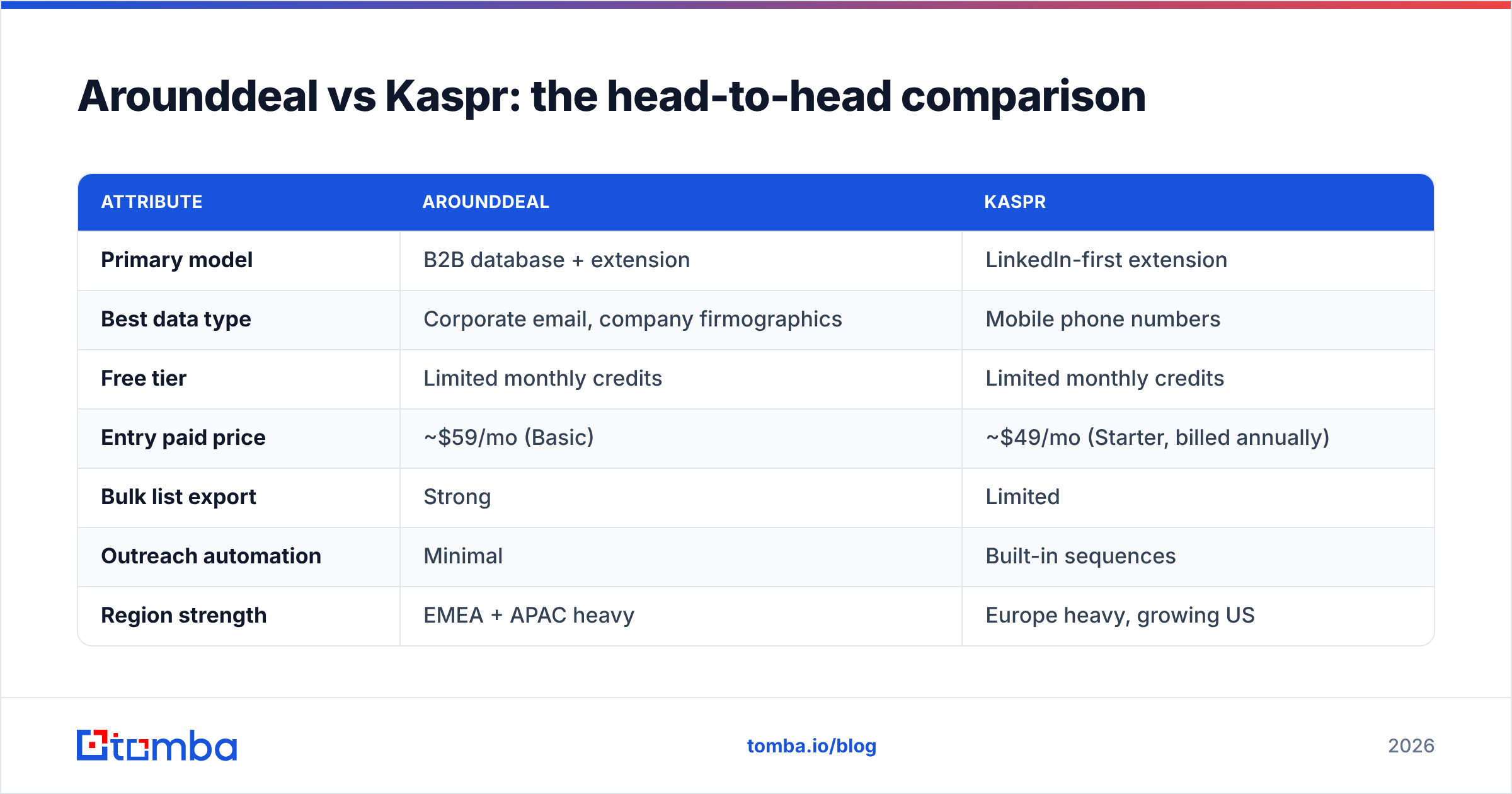
Here is how the two stack up on the attributes that actually affect cost per meeting.
| Attribute | Arounddeal | Kaspr |
|---|---|---|
| Primary model | B2B database + extension | LinkedIn-first extension |
| Best data type | Corporate email, company firmographics | Mobile phone numbers |
| Free tier | Limited monthly credits | Limited monthly credits |
| Entry paid price | ~$59/mo (Basic) | ~$49/mo (Starter, billed annually) |
| Bulk list export | Strong | Limited |
| Outreach automation | Minimal | Built-in sequences |
| Region strength | EMEA + APAC heavy | Europe heavy, growing US |
| Verification | Basic, credit-gated | Basic, credit-gated |
| Best for | List-building, account research | SDR phone-first prospecting |
The pattern is clear: Arounddeal is the research and list tool, Kaspr is the dial-the-number tool. Neither is wrong — they solve adjacent problems, and plenty of teams could justify both. But running two credit-metered tools to cover one prospecting workflow gets expensive fast.

Which has better data accuracy?#
Accuracy is the question that matters most, because a cheap contact that bounces costs you sender reputation, not just a credit.
On corporate email, Arounddeal and Kaspr are roughly comparable for mainstream roles at mid-to-large companies. Both pull from a mix of crowdsourced contributions, partnerships, and pattern inference, and both meter every reveal as a credit whether or not the result is correct. That is the structural weakness of the credit model: you pay for guesses.
On phone numbers, Kaspr has the edge. Its mobile coverage in Europe is genuinely useful for cold callers, and that is the single best reason to pick it. Arounddeal includes phone data but it is not the product's strength.
The catch with both: neither bundles rigorous verification by default. A revealed email is a candidate, not a confirmed deliverable. If you send to unverified addresses, your bounce rate climbs and your domain reputation suffers. This is why a separate verification step — or a provider that builds verification into the find step — matters more than a marginal accuracy difference between the two.

This is where transparency about data sources becomes a real buying criterion. A tool that tells you how a contact was sourced and scored lets you trust the output; a black-box credit reveal does not.
Which is cheaper: Arounddeal or Kaspr?#
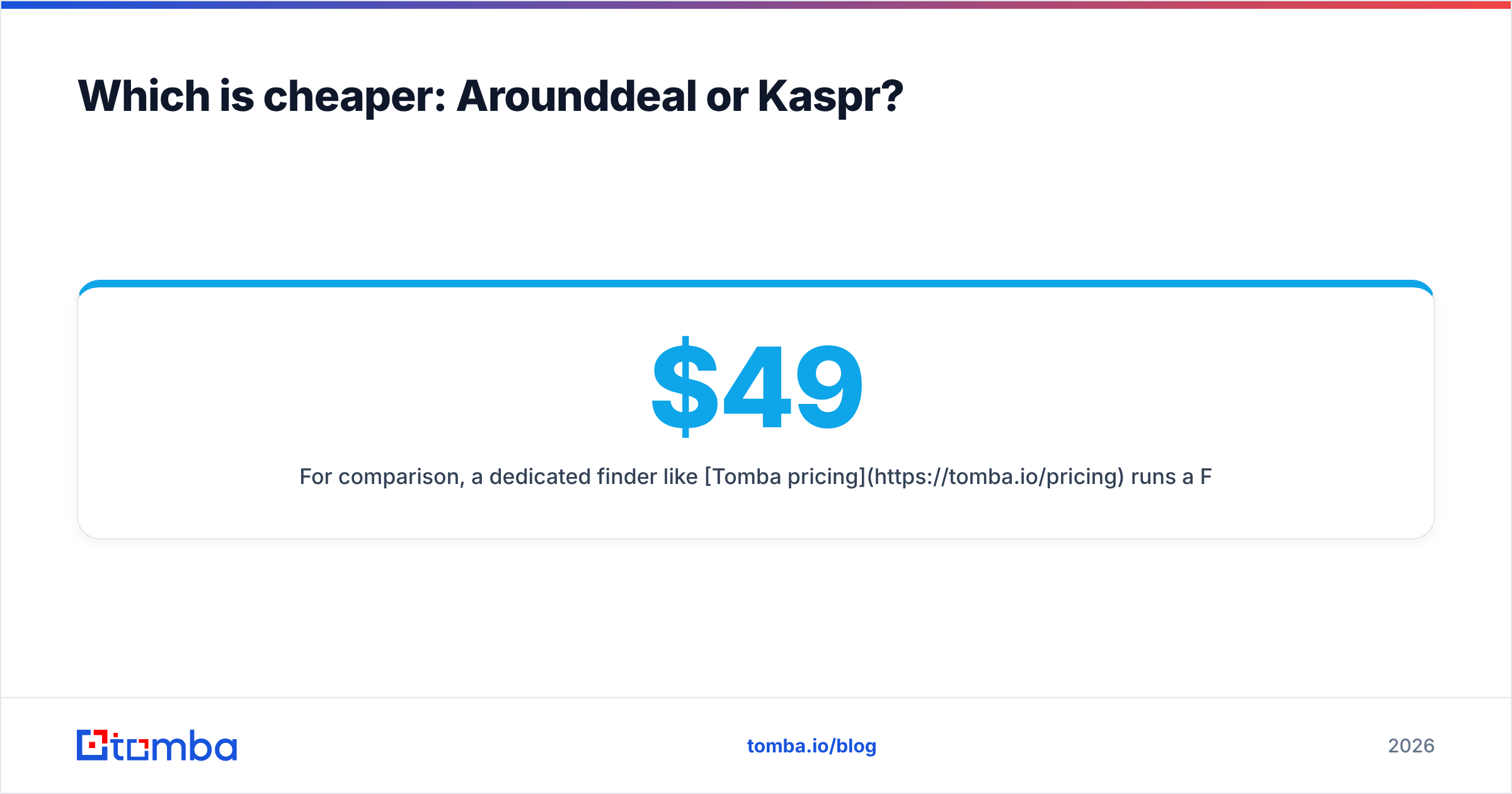
It depends on what you are buying. For a single SDR who cold calls, Kaspr's entry plan is competitive and the phone numbers justify the spend. For a team that needs to export thousands of contacts a month, Arounddeal's database access is the cheaper route per record because bulk list-building is what it is designed for.
Both share the same hidden cost, though: credits are consumed on reveal, including on results you would never send to. When you model true cost, the number that matters is not the sticker price — it is the cost per valid, verified contact. A plan that looks cheap but burns credits on catch-all domains and dead inboxes is not cheap.
For comparison, a dedicated finder like Tomba pricing runs a Free tier (25 searches/mo), Starter at $49/mo, Growth at $99/mo, and Pro at $249/mo, with verification included in the workflow rather than sold as a separate consumable. When the find and the verify happen together, your effective cost per usable email drops even if the headline price looks similar.

How do they handle GDPR and compliance?#
Both tools operate in Europe and publish GDPR positions, which matters because contact data — especially personal mobile numbers — is regulated. Kaspr, as part of the Cognism group, leans on its parent's compliance posture and notification processes. Arounddeal provides opt-out mechanisms and data-subject request handling.
Practically, compliance is not a feature you can fully outsource to a vendor. If you prospect into the EU you still owe legitimate-interest assessments, suppression of opt-outs, and clean record-keeping. Pick whichever vendor's documentation you can actually understand and audit — and keep your own suppression list regardless of which tool feeds it.
When should you use a dedicated email finder instead?#
Choose a focused finder when your bottleneck is getting valid email at scale, not researching accounts or dialing phones. That is a different job than either Arounddeal or Kaspr optimizes for.
A purpose-built stack gives you three things the all-in-one extensions tend to under-deliver:
- Find by domain, not just by profile. When you already know the target company, domain search returns every reachable contact and the email pattern in one pass — far faster than enriching profiles individually.
- Verification baked into the find. Instead of revealing a credit-priced guess and hoping, you get a deliverability check before the address ever enters your sequence.
- Phone coverage when you need it. If you also cold call, a dedicated phone finder covers the dial without forcing you into a separate per-seat extension.
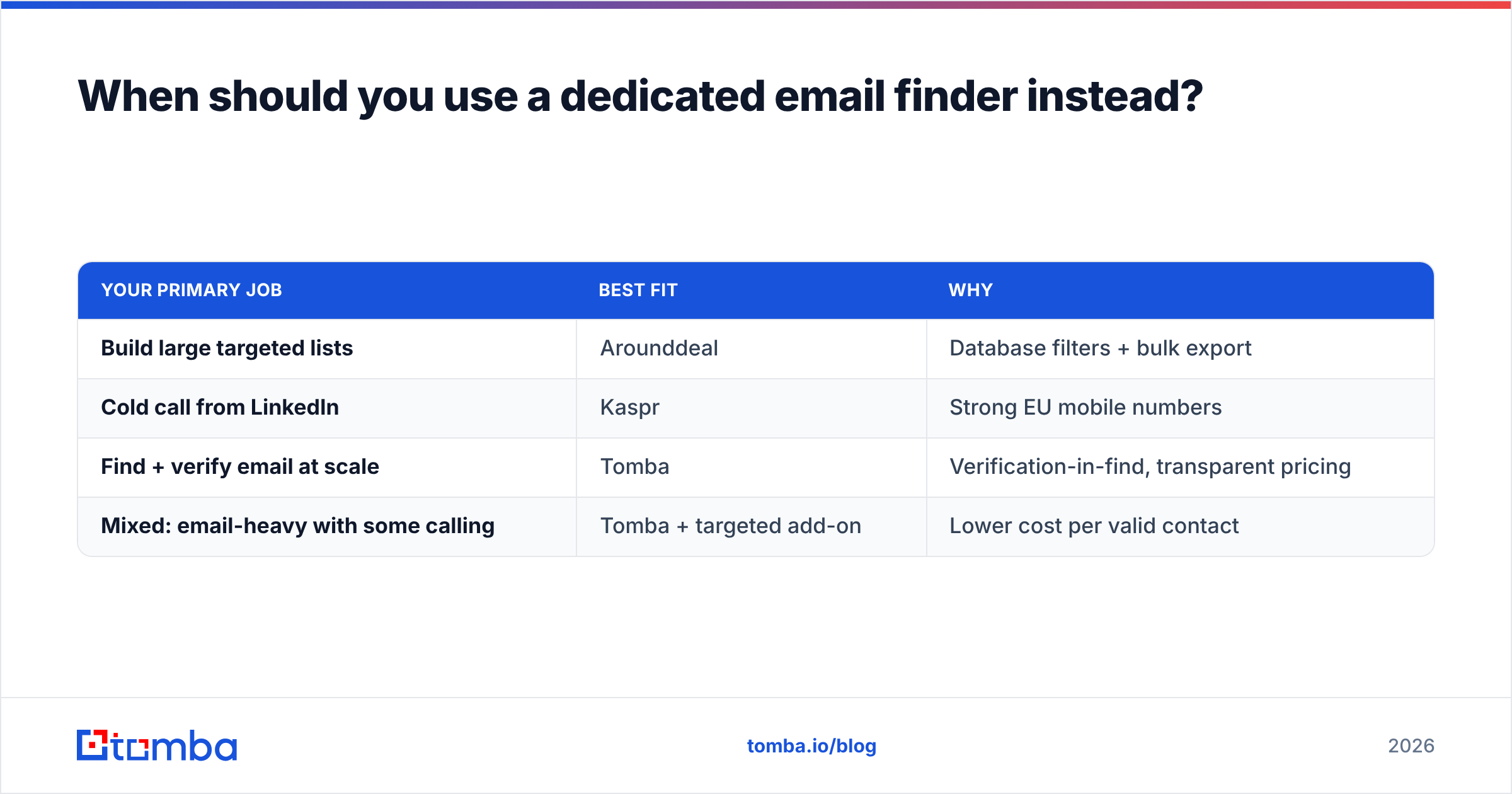
Here is a simple way to decide between the three approaches.
| Your primary job | Best fit | Why |
|---|---|---|
| Build large targeted lists | Arounddeal | Database filters + bulk export |
| Cold call from LinkedIn | Kaspr | Strong EU mobile numbers |
| Find + verify email at scale | Tomba | Verification-in-find, transparent pricing |
| Mixed: email-heavy with some calling | Tomba + targeted add-on | Lower cost per valid contact |
The honest read: if you picked up this comparison because you need reliable email volume, you are evaluating the wrong category. Arounddeal and Kaspr are excellent at list research and phone prospecting respectively, but email finding is a specialty, and specialists win on cost per valid contact.

Arounddeal vs Kaspr: which should you pick?#
Strip away the marketing and it comes down to two clean rules:
- Pick Arounddeal if you build lists. You want firmographic filters, bulk export, and a database you can query like a research tool. It is the better account-based and marketing-led choice.
- Pick Kaspr if you cold call. The mobile numbers are the product, the LinkedIn workflow is fast, and the built-in sequences let a solo rep run a small motion without a separate platform.
Both are legitimate, both have real users who love them, and both share the same friction: a credit model that charges you for unverified reveals. For teams whose entire engine runs on deliverable email, that friction compounds month after month.
You can sanity-check any of these claims yourself on a peer-review site like G2 before you commit, and read each vendor's own positioning at arounddeal.com and kaspr.io. Don't take a single blog's word for fit — including this one.
The bottom line#
Arounddeal and Kaspr are not really competitors so much as two answers to two different questions. If you need a database, Arounddeal. If you need phone numbers off LinkedIn, Kaspr. But if your prospecting lives or dies on getting verified email into a sequence without burning credits on bad guesses, you want a tool built for exactly that.
That is what the Tomba Email Finder is for: find professional email addresses by domain, name, or company, with verification folded into the search and pricing that starts free and tops out predictably. Run your next 25 searches on the free tier, compare the cost per valid contact against your current Arounddeal or Kaspr spend, and let the bounce rate decide. The data will tell you which category you actually needed.
// get started
Find, verify and enrich your first contacts today
Start on the free plan with 25 searches a month, then scale when your team is ready.
Free plan · No credit card required · GDPR & CCPA
// about the author