AroundDeal vs LeadGenius: B2B Data Tools Compared (2026)
AroundDeal vs LeadGenius: one is a self-serve contact database, the other is managed custom data. Here's which B2B data tool fits your GTM motion in 2026.
TL;DR
- AroundDeal is a self-serve B2B contact database with a Chrome extension, strongest in APAC and mid-market prospecting. You search, you export, you pay per credit.
- LeadGenius is a managed, human-in-the-loop data provider. You brief a team, they build custom lists and enrichment to spec. Enterprise pricing, slower turnaround, deeper custom attributes.
- They are not really the same product. AroundDeal sells access to a database; LeadGenius sells a data service.
- Pick AroundDeal if you want fast, cheap, self-serve contacts. Pick LeadGenius if you need bespoke firmographics or hard-to-source signals at scale.
- If your real bottleneck is verified email accuracy at a fair price, a focused tool like the Tomba Email Finder often beats both on cost per usable contact.
What are AroundDeal and LeadGenius?#
Conclusion first: AroundDeal and LeadGenius solve the same problem — "get me accurate B2B contacts" — but through opposite delivery models.
AroundDeal is a self-serve sales intelligence platform. It gives you a searchable database of company and contact records, a browser extension that pulls emails and phone numbers off LinkedIn, and bulk export. It rose on the back of strong Asia-Pacific coverage, where most US-built databases are thin. You operate it yourself, in minutes.
LeadGenius is a managed data company. Instead of handing you a search bar, it pairs software with a global team of researchers who assemble lists, verify records, and enrich them with custom attributes you define — things no off-the-shelf database tracks, like "uses Shopify Plus and has a head of sustainability." You brief them; they deliver.
That distinction drives every other difference: price, speed, accuracy, and who on your team actually uses it.
How do their data models differ?#
AroundDeal is a product. LeadGenius is a service wrapped in a product.
With AroundDeal you query an existing index. Coverage and freshness are whatever the database holds the moment you search. That makes it fast and cheap, but you inherit the database's blind spots — if a contact isn't in there, you won't find them, and stale records get exported alongside fresh ones.
With LeadGenius, the data is built to your brief. Need decision-makers at companies that just opened a second warehouse in Vietnam? A human-in-the-loop pipeline can source that. The trade-off is turnaround measured in days or weeks, plus an enterprise contract.
Here's the practical split:
- AroundDeal = breadth-on-demand. Good for volume prospecting where "close enough" coverage works.
- LeadGenius = depth-on-request. Good for narrow, high-value segments where a generic database fails.
Neither model is automatically better. They map to different go-to-market motions, which is the part most comparison posts skip.

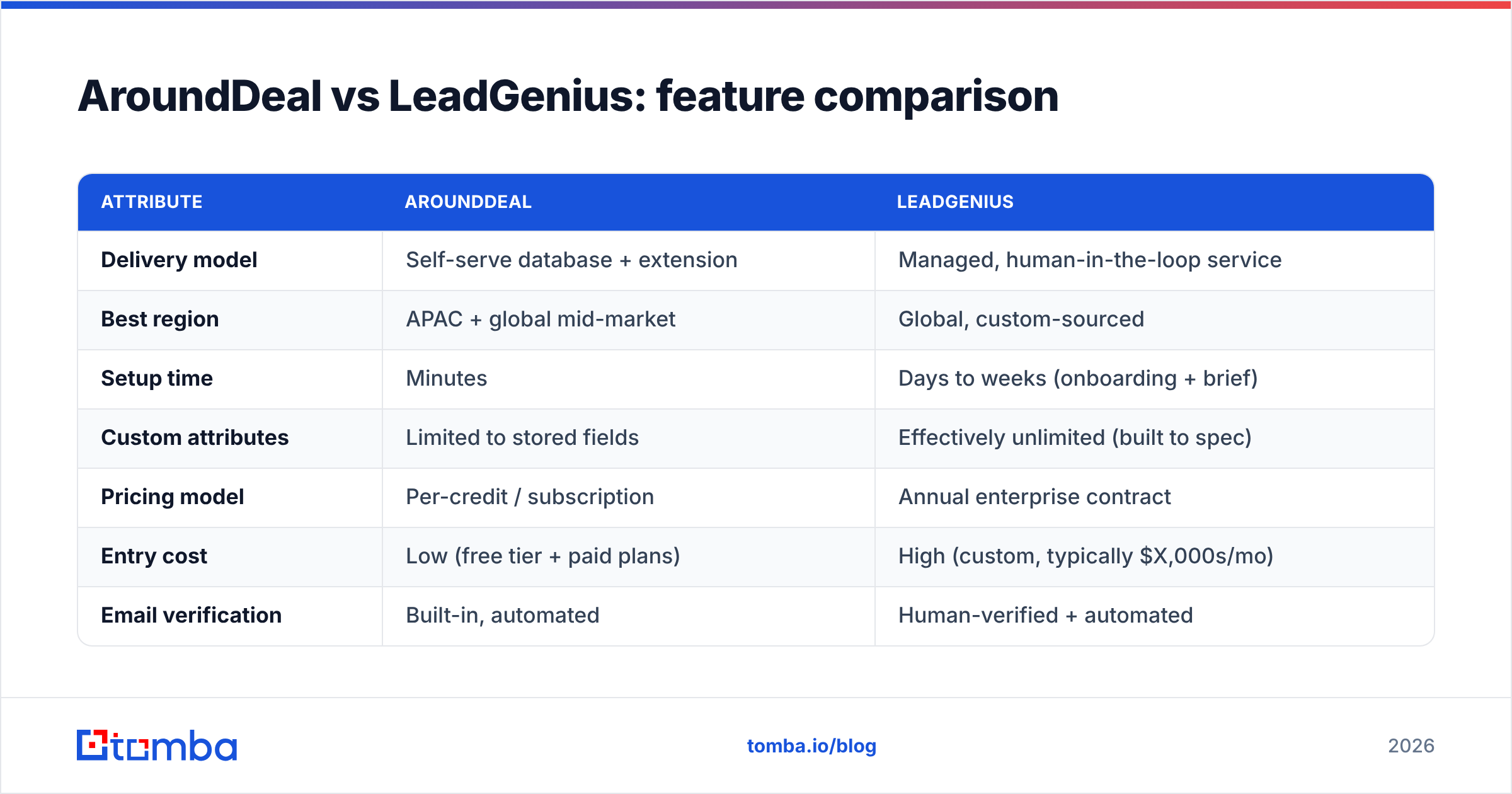
AroundDeal vs LeadGenius: feature comparison#
| Attribute | AroundDeal | LeadGenius |
|---|---|---|
| Delivery model | Self-serve database + extension | Managed, human-in-the-loop service |
| Best region | APAC + global mid-market | Global, custom-sourced |
| Setup time | Minutes | Days to weeks (onboarding + brief) |
| Custom attributes | Limited to stored fields | Effectively unlimited (built to spec) |
| Pricing model | Per-credit / subscription | Annual enterprise contract |
| Entry cost | Low (free tier + paid plans) | High (custom, typically $X,000s/mo) |
| Email verification | Built-in, automated | Human-verified + automated |
| Phone numbers | Yes (direct + mobile, varies) | Yes, sourced on request |
| Who operates it | SDRs / individual reps | RevOps / data ops teams |
| Turnaround for net-new list | Instant | Scoped project |
The headline: AroundDeal optimizes for speed and cost per record; LeadGenius optimizes for specificity and coverage of the un-googleable. If you can find your prospects in any standard database, paying LeadGenius rates is overkill. If you can't, AroundDeal's self-serve index won't save you.
For more on how managed data fits a modern stack, G2's B2B data category and Capterra's lead-gen listings are useful neutral reference points before you commit to either contract.
Which is more accurate?#
Accuracy is the wrong single question — you need accuracy at what cost and freshness.
LeadGenius generally wins raw accuracy on hard segments because a human checks the record. That's its whole pitch. But "human-verified last quarter" can still decay; people change jobs roughly every 2–3 years, so even a perfect record ages.
AroundDeal's accuracy is database-dependent. APAC records tend to be strong; some Western SMB records are thinner and you'll hit bounces if you export without a verification pass.
This is where a dedicated verification step matters regardless of which platform you choose. Running exported lists through an email verifier before a send protects your sender reputation and keeps bounce rates under the 2–3% threshold that mailbox providers watch. Even great source data benefits from a fresh real-time check at send time, because the source verified the address on their schedule, not yours.
A pragmatic accuracy workflow:
- Source contacts (AroundDeal for volume, LeadGenius for bespoke).
- Verify every address at export with email verification.
- Enrich gaps with data enrichment so reps have title, company, and phone before the first touch.

How does pricing compare?#
Conclusion: AroundDeal is priced for individuals and small teams; LeadGenius is priced for enterprises with a data budget.
AroundDeal offers a free tier and credit-based paid plans, so a single SDR can start for the price of a couple of SaaS subscriptions. You pay roughly in proportion to how many contacts you pull.
LeadGenius does not publish self-serve pricing. It's a custom annual contract scoped to the project — typically a meaningful commitment that only pencils out when the data you need can't be bought off the shelf and the deals it unlocks are large.
The hidden cost on both sides is waste: credits or contract spend burned on records that bounce, duplicate, or were never a fit. That's why cost-per-usable-contact beats cost-per-record as a metric. A cheap export full of dead addresses isn't cheap once you count rep hours and domain reputation damage.
If budget is the deciding factor and your prospects live in standard databases, compare both against transparent, published pricing from a focused finder before signing anything. The math frequently favors a per-search tool you can actually forecast.
Which workflow fits your team?#
Match the tool to who's actually doing the work.
Choose AroundDeal if:
- Individual reps need to self-serve contacts during prospecting.
- You sell into APAC or global mid-market and need broad coverage now.
- You want low commitment and a free tier to test.
- Speed matters more than bespoke attributes.
Choose LeadGenius if:
- You have a RevOps or data-ops function to manage a vendor relationship.
- Your ICP depends on signals no standard database tracks.
- You're running account-based plays into a finite, high-value list.
- You can absorb project turnaround time and enterprise pricing.
Choose a focused email finder if:
- Your bottleneck is simply getting verified emails by name and domain.
- You want predictable per-search cost and an API.
- You'd rather assemble lists with a Chrome extension or domain search and skip both a heavy database subscription and a managed contract.
Most teams discover their actual constraint is narrower than "we need a data platform." Often it's "we have company names but no reliable emails" — a job a bulk email finder does for a fraction of either platform's cost.
Are there better alternatives to both?#
Yes, depending on the gap you're filling.
If you mostly need verified emails at scale, neither a regional database nor a managed-data shop is the cheapest path — a specialized finder is. If you need custom firmographic research, LeadGenius-style services are hard to replace, but you should price several before committing. And if you need APAC breadth specifically, AroundDeal is genuinely strong, though you'll still want to verify exports.
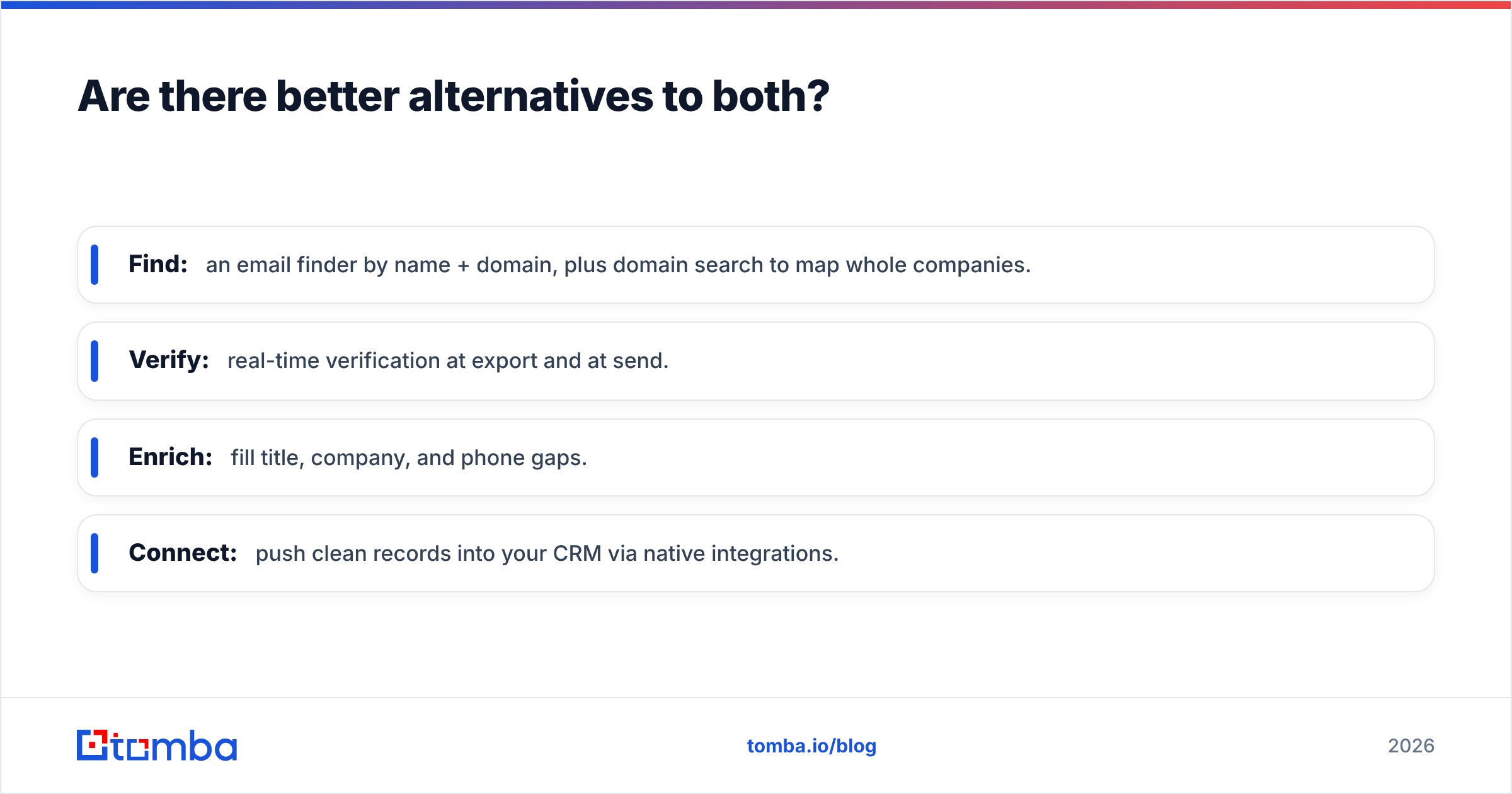
A common, cost-effective stack looks like this:
- Find: an email finder by name + domain, plus domain search to map whole companies.
- Verify: real-time verification at export and at send.
- Enrich: fill title, company, and phone gaps.
- Connect: push clean records into your CRM via native integrations.
This modular approach lets you swap any piece without re-platforming, and it usually lands well under an enterprise data contract while staying more current than a static database export.
AroundDeal vs LeadGenius: the verdict#
There's no universal winner because they're built for different buyers.
- AroundDeal wins on speed, price, self-serve simplicity, and APAC coverage. It's the better default for SDRs and small teams who need contacts today.
- LeadGenius wins on bespoke, hard-to-source data and human-verified accuracy for narrow, high-value segments — at enterprise cost and pace.
- Choose by motion, not brand: high-volume self-serve prospecting points to AroundDeal; custom, signal-driven ABM points to LeadGenius.
But interrogate the assumption that you need either. If your real problem is turning a list of companies and names into deliverable, verified emails — the most common bottleneck in outbound — a dedicated finder solves it faster and cheaper than a full database subscription or a managed-data contract.
Get verified B2B contacts without the enterprise contract#
If your goal is accurate emails you can act on this week, start with the Tomba Email Finder. Search by name, company, or domain; verify every address before it hits your sequence; and export clean records straight into your CRM. There's a free tier to test (25 searches/month), Starter at $49/mo, and an API when you're ready to automate — transparent pricing, no annual commitment, and no waiting on a managed-data queue. Find the contacts, skip the overhead, and keep your sender reputation intact.
// get started
Find, verify and enrich your first contacts today
Start on the free plan with 25 searches a month, then scale when your team is ready.
Free plan · No credit card required · GDPR & CCPA
// about the author