Arounddeal vs Leadsforge: B2B Data Tools Compared (2026)
A neutral, hands-on breakdown of Arounddeal vs Leadsforge for 2026 — data coverage, accuracy, pricing, and which B2B contact tool fits your outbound stack.
Picking between Arounddeal and Leadsforge usually comes down to one practical question: which one puts more correct contact records in front of your reps with less wasted spend? Both promise B2B emails, direct dials, and enrichment. They get there very differently.
This is a neutral teardown — where each tool is genuinely strong, where it falls short, and where a dedicated finder like Tomba slots in if your real bottleneck is email accuracy rather than database size.
TL;DR#
- Arounddeal is a broad B2B contact database with a Chrome extension, strong APAC coverage, and intent-style signals — best when you want to browse and build lists from a prospecting platform.
- Leadsforge leans on AI-assisted list building and conversational lead sourcing — best when you want to describe an ICP in plain language and get a starter list fast.
- Neither is purpose-built for verification depth; bounce rates climb on stale or catch-all domains regardless of which you choose.
- If your KPI is deliverability and verified emails, pairing either with a focused email verifier — or replacing both with Tomba's email finder — usually beats buying a bigger database.
- For most outbound teams in 2026, the winner is the tool whose accuracy on your target geography is highest. Test before you commit annually.
What is Arounddeal?#
Arounddeal is a B2B sales-intelligence platform built around a contact and company database. You search by company, title, industry, or geography, then export verified-looking records or push them into your CRM. Its browser extension surfaces contact details while you're on a LinkedIn profile or company site, which makes it feel native to the way most SDRs already prospect.
Its standout trait is geographic depth in Asia-Pacific markets, where many Western databases thin out. If you sell into Singapore, India, or Australia, that coverage difference is not marketing fluff — it shows up in fill rates.
The trade-off is the usual database trade-off: coverage is wide but freshness varies. A record that was accurate eighteen months ago may now point to someone who changed jobs, and the platform's internal verification doesn't always catch a domain that quietly went catch-all.
What is Leadsforge?#
Leadsforge takes the newer, AI-first angle. Instead of building a Boolean filter stack, you describe your ideal customer in natural language — "Series A fintech companies in the UK with a VP of Engineering" — and it assembles a candidate list. For founders and small teams who don't live in advanced filters all day, that lowers the barrier to a first list considerably.
The conversational layer is the differentiator. It's genuinely faster for a non-specialist to get something usable. The risk is that natural-language targeting can be fuzzy: you trade the precision of explicit filters for speed, and you have to sanity-check that the AI interpreted your ICP the way you meant it.
Like Arounddeal, Leadsforge is a sourcing tool first. Verification is a feature, not the product, so the emails it returns still benefit from an independent accuracy pass before you load them into a sequence.

Arounddeal vs Leadsforge: how do they compare?#
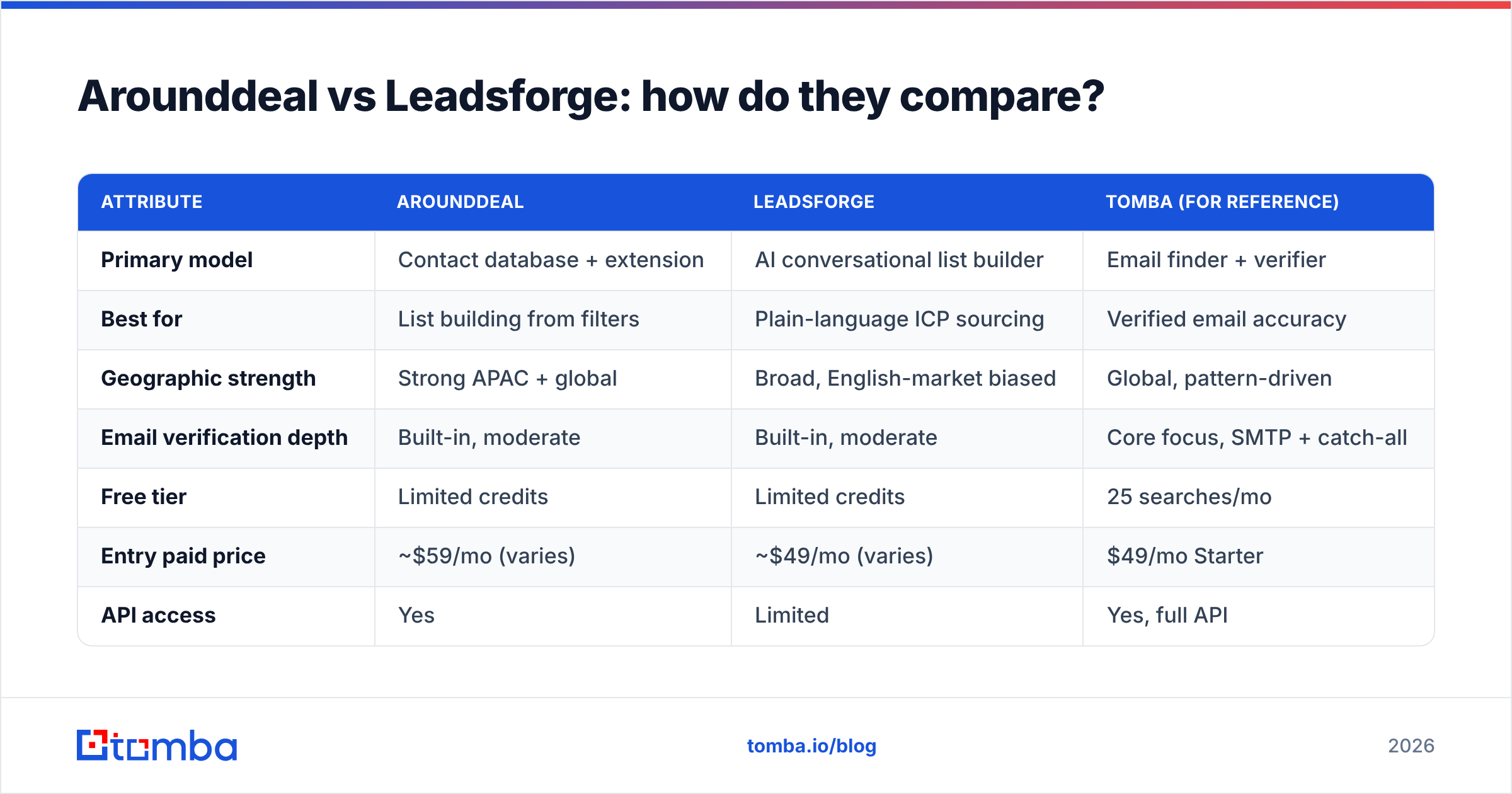
Here's the side-by-side on the attributes that actually change outcomes for an outbound team. Treat specific pricing as directional — both vendors adjust tiers, and you should confirm current numbers on their own sites.
| Attribute | Arounddeal | Leadsforge | Tomba (for reference) |
|---|---|---|---|
| Primary model | Contact database + extension | AI conversational list builder | Email finder + verifier |
| Best for | List building from filters | Plain-language ICP sourcing | Verified email accuracy |
| Geographic strength | Strong APAC + global | Broad, English-market biased | Global, pattern-driven |
| Email verification depth | Built-in, moderate | Built-in, moderate | Core focus, SMTP + catch-all |
| Free tier | Limited credits | Limited credits | 25 searches/mo |
| Entry paid price | ~$59/mo (varies) | ~$49/mo (varies) | $49/mo Starter |
| API access | Yes | Limited | Yes, full API |
| Catch-all handling | Basic | Basic | Dedicated verifier |
The pattern is clear: Arounddeal and Leadsforge compete on how you build the list. They are not primarily competing on how clean the list is. That distinction matters more than most comparison posts admit, because a 2,000-record list with a 22% bounce rate is worse than a 900-record list at 2%.

Which has better data accuracy?#
Accuracy is not a single number — it's accuracy on your segment. Run a controlled test before you trust either platform's headline claims.
A fair test looks like this:
- Pull the same 200 target accounts through both tools.
- Export every email each returns.
- Run all of them through a neutral, third-party email verification pass — not the source tool's own checker.
- Compare valid-rate, catch-all rate, and unknown rate per geography.
In our experience reviewing tools in this category, the database-first players are competitive on well-known mid-market and enterprise domains and weaker on small businesses, recent job-changers, and catch-all-heavy domains. That last bucket is where most "verified" emails silently fail. A domain configured to accept all addresses will pass a naive check and still bounce, which is exactly why a dedicated catch-all finder exists as a separate discipline.
If your outbound lives or dies on deliverability, the smartest move is to decouple sourcing from verification. Use Arounddeal or Leadsforge to find candidates, then verify with a tool whose entire reputation rests on getting that step right.
How does pricing compare?#
Both tools sit in the same broad range for small teams, with the usual jump once you need higher export volumes, more seats, or API access. The honest takeaway: list price is rarely the real cost. The real cost is wasted sends — burned domain reputation, lower reply rates, and reps chasing dead contacts.
A rough way to think about true cost per usable contact:
- Start with the monthly price divided by usable (verified, in-segment) contacts.
- A cheaper tool with a higher bounce rate often loses on this metric.
- Factor in the time reps spend cleaning lists the tool should have cleaned.
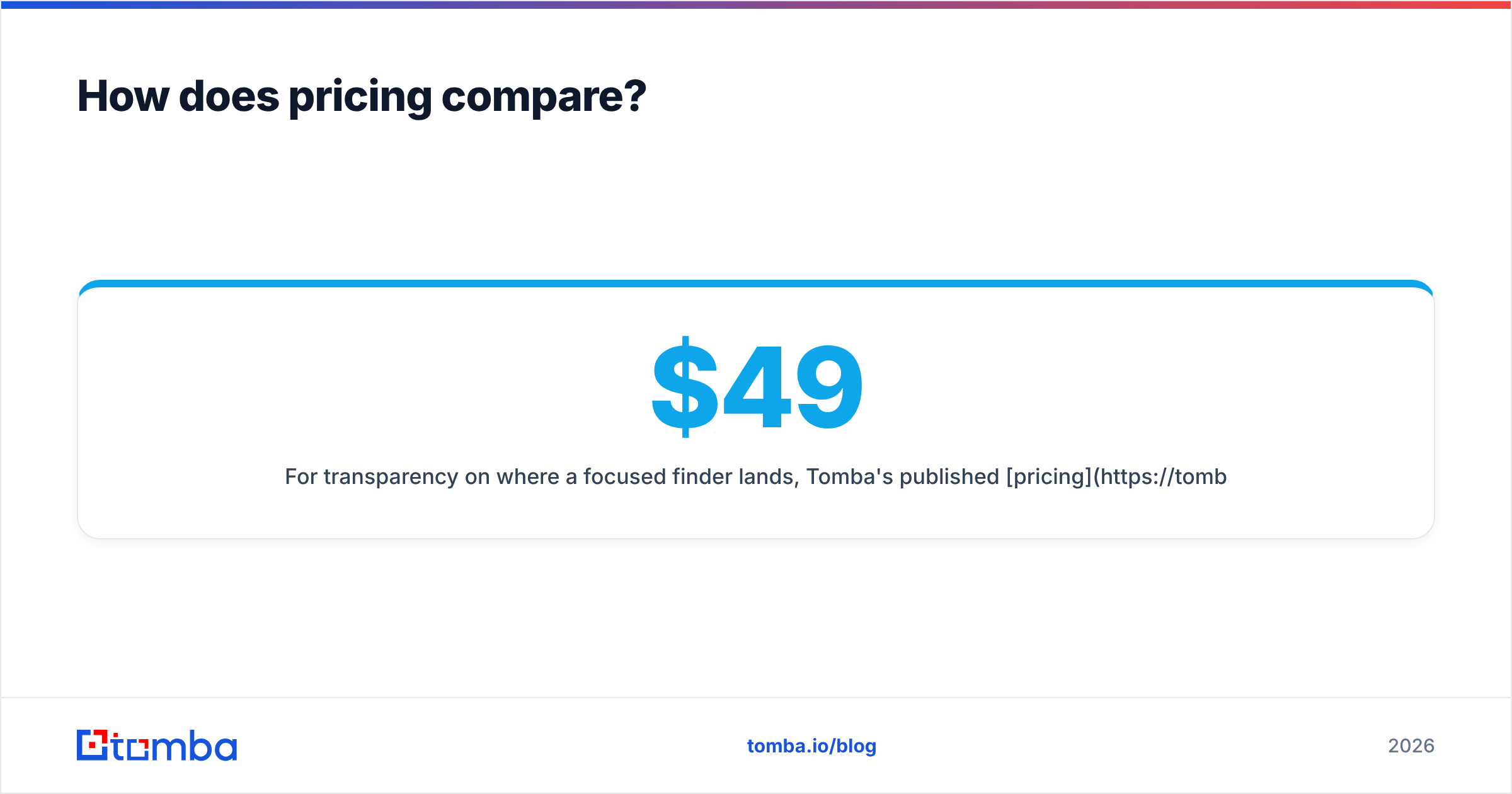
For transparency on where a focused finder lands, Tomba's published pricing runs a Free tier (25 searches/mo), Starter at $49/mo, Growth at $99/mo, and Pro at $249/mo, with Enterprise custom. The point isn't that one number beats another — it's that you should compare cost per verified contact, not cost per seat. Independent reviews on G2 and Capterra are useful for sanity-checking how each vendor's billing behaves at renewal.
What about integrations and workflow?#
Workflow fit decides whether a tool actually gets used after week two.
- Arounddeal integrates cleanly with the common CRMs and offers a usable API, so it fits teams that want records flowing into HubSpot or Salesforce automatically.
- Leadsforge is lighter on deep integrations but faster for ad-hoc list generation; it suits founders running outbound from a spreadsheet more than a 12-rep team with a strict RevOps process.
- If your stack is spreadsheet-centric, note that a finder with native Google Sheets and bulk support can replace a lot of manual export-import churn.
For teams scaling beyond a few hundred contacts a month, the deciding factor is usually how painless it is to enrich and de-dupe at volume. Data enrichment and clean bulk processing matter more than any single UI nicety once you're past the early stage.
Which should you choose?#
Match the tool to your actual constraint:
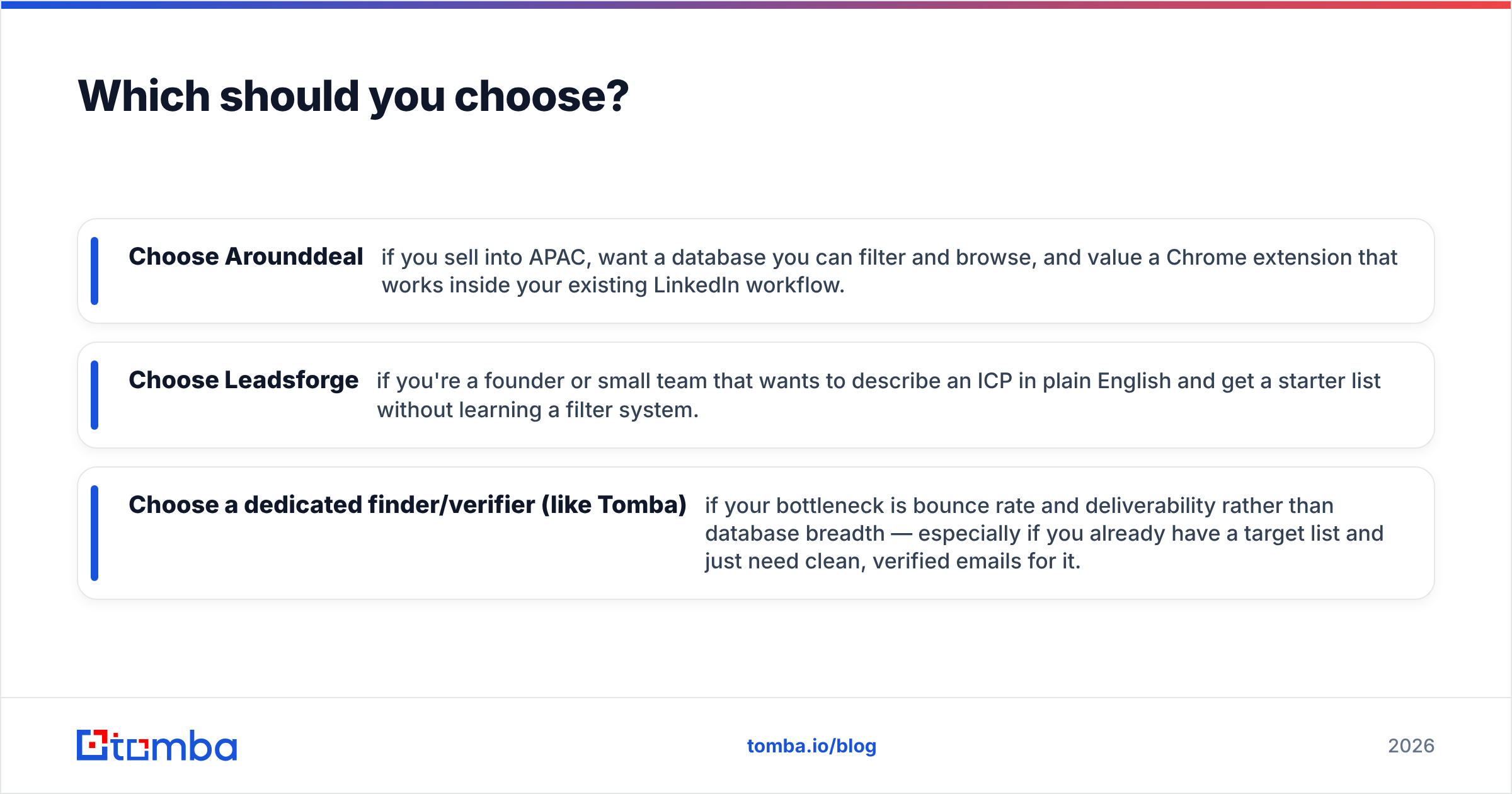
- Choose Arounddeal if you sell into APAC, want a database you can filter and browse, and value a Chrome extension that works inside your existing LinkedIn workflow.
- Choose Leadsforge if you're a founder or small team that wants to describe an ICP in plain English and get a starter list without learning a filter system.
- Choose a dedicated finder/verifier (like Tomba) if your bottleneck is bounce rate and deliverability rather than database breadth — especially if you already have a target list and just need clean, verified emails for it.
Many teams end up running a hybrid: source with a database tool, then verify and fill gaps with a finder. That's not a cop-out — it's the configuration that produces the lowest bounce rate per dollar.
Frequently asked questions#
Is Arounddeal or Leadsforge more accurate? Neither is universally more accurate; it depends on your target geography and company size. Database-first tools like Arounddeal tend to win on established domains and APAC coverage, while AI-sourcing tools like Leadsforge win on speed-to-list. Always run your own verification pass on a sample before committing.
Do I still need a separate email verifier? Usually, yes. Both tools verify internally, but independent verification catches catch-all and recently-changed addresses their native checks miss. A dedicated email verifier is cheap insurance against domain-reputation damage.
Can I use these alongside Tomba? Yes. A common setup is sourcing lists in Arounddeal or Leadsforge, then running them through Tomba's bulk verify before any cold sequence. You keep the database breadth and add finder-grade accuracy.
Which is cheaper? Entry tiers are close. The meaningful comparison is cost per verified, in-segment contact, not sticker price — a cheaper tool with higher bounce rates often costs more in practice.
The bottom line#
Arounddeal and Leadsforge are both solid sourcing tools that solve the "how do I build a list" problem from opposite ends — structured filters versus natural language. Neither is designed to be your last line of defense on accuracy.
If your outbound numbers hinge on emails that actually land, start with the step that controls deliverability. Tomba's Email Finder is built for exactly that — verified, pattern-validated professional emails with SMTP and catch-all checks baked in, on a Free tier you can test today before you commit a cent. Source wherever you like; verify where it counts.
// get started
Find, verify and enrich your first contacts today
Start on the free plan with 25 searches a month, then scale when your team is ready.
Free plan · No credit card required · GDPR & CCPA
// about the author