AroundDeal vs Leadzenai 2026: B2B Data Tools Compared
AroundDeal vs Leadzenai for 2026: pricing, data accuracy, coverage, and workflow fit compared side by side — plus where a dedicated email finder like Tomba beats both.
Choosing a B2B contact-data platform usually comes down to two questions: how accurate is the data, and how much does it cost to get at scale? AroundDeal and Leadzen.ai both promise verified emails, direct dials, and enriched company records — but they take different routes to get there, and they price those routes very differently.
This guide breaks down AroundDeal vs Leadzenai on the things that actually move pipeline: data accuracy, coverage depth, pricing structure, workflow integrations, and compliance. By the end you will know which one fits your motion — and where a focused tool beats a do-everything suite.
TL;DR — AroundDeal vs Leadzenai at a glance#
- AroundDeal leans into APAC and global coverage with a Chrome extension, intent data, and a generous-feeling free tier that gets metered fast.
- Leadzen.ai is strongest for India-centric and number-heavy prospecting, with real-time search and a credit model that rewards bulk buyers.
- Accuracy is comparable on paper, but both degrade on catch-all domains and senior titles — the same weak spot most all-in-one suites share.
- Pricing favors Leadzen.ai for high-volume phone-led teams; AroundDeal is simpler for small SDR pods.
- If your core need is finding and verifying work emails reliably, a dedicated tool like the Tomba Email Finder typically lands more valid addresses per dollar than either suite.
What is AroundDeal?#
AroundDeal is a B2B intelligence platform built around a contact database of roughly hundreds of millions of business profiles. Its pitch is "prospecting + intelligence in one place": you search by company, title, industry, or location, pull verified emails and phone numbers, and layer on intent signals and org charts. A Chrome extension scrapes profiles directly from LinkedIn, and an enrichment API backfills your CRM.
The platform is notably strong in Asia-Pacific markets, where many North-America-first databases thin out. For teams selling into Singapore, Australia, or Southeast Asia, that regional depth is the headline reason to look at it. You can see the full feature set on the AroundDeal site.
What is Leadzen.ai?#
Leadzen.ai is a real-time lead-intelligence tool with deep roots in the Indian market. Instead of leaning only on a static database, it emphasizes live search — pulling and validating contact details on demand — which can surface fresher records for fast-moving segments. It is particularly phone-forward: mobile numbers and direct dials are a core selling point, which matters in markets where cold calling still outperforms email.
Leadzen.ai packages search, bulk extraction, and enrichment together, and prices around a credit system. You can review its current capabilities on the Leadzen.ai homepage.
AroundDeal vs Leadzenai: the core comparison#
Here is the side-by-side that most buyers actually care about. Treat vendor-published accuracy numbers as directional — independent tests almost always come in lower than marketing claims.
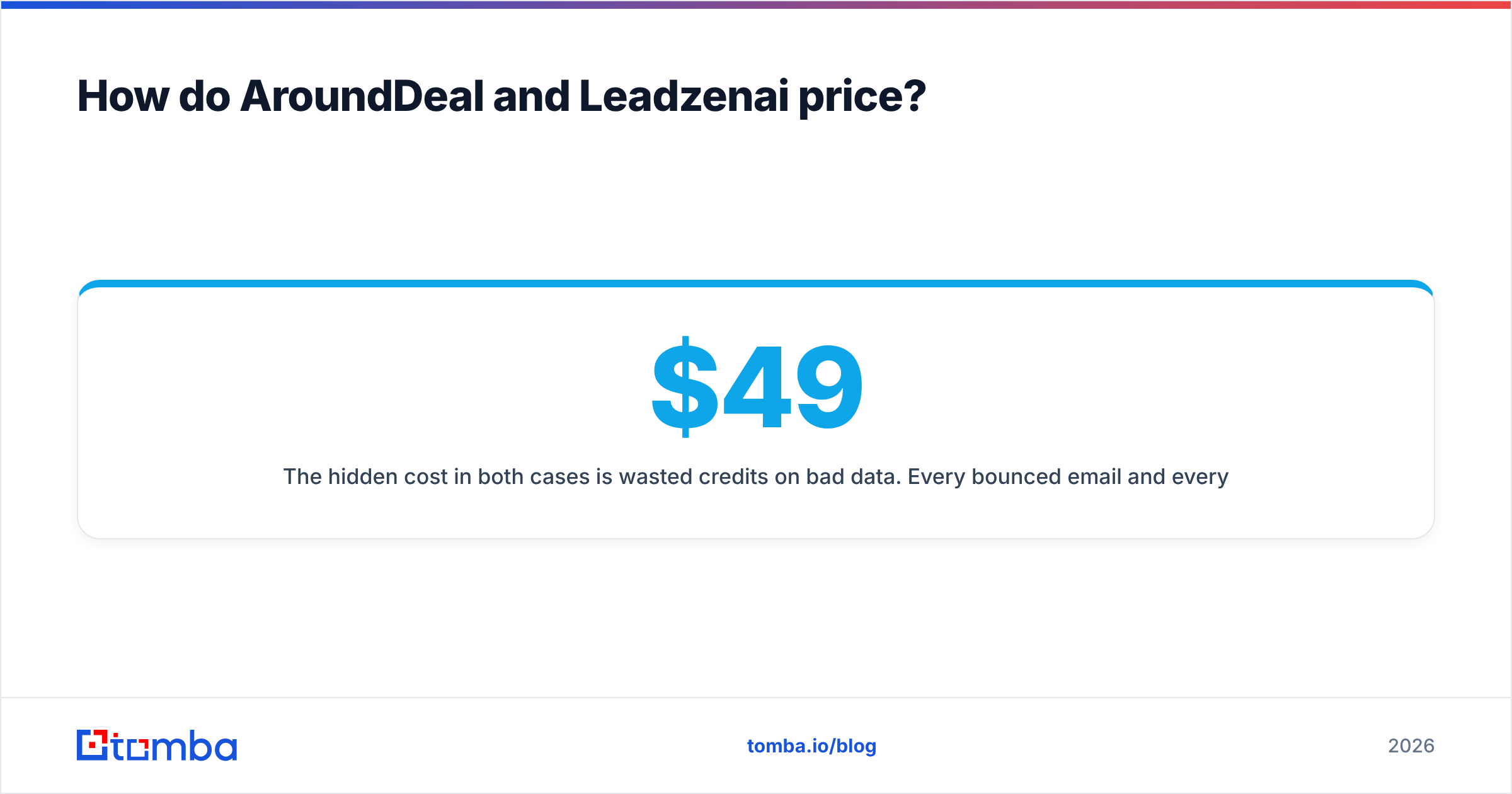
| Attribute | AroundDeal | Leadzen.ai |
|---|---|---|
| Primary strength | Global + APAC database, intent data | Real-time search, India coverage, phone numbers |
| Data approach | Large static database + enrichment | Live/real-time lookup + database hybrid |
| Email accuracy (claimed) | ~90%+ on verified emails | ~85–90% on validated records |
| Phone / direct dials | Yes, varies by region | Strong — core differentiator |
| Free / trial | Free credits, metered monthly | Limited trial credits |
| Chrome extension | Yes (LinkedIn scraping) | Yes |
| API & enrichment | Yes | Yes |
| Best-fit buyer | SMB SDR teams, APAC sellers | Phone-led teams, India-focused GTM |
The pattern: AroundDeal is the steadier "database-first" option with broader Western coverage, while Leadzen.ai wins when you need fresh numbers and you are selling into India or similar markets. Neither is a clear knockout on raw email quality.

Which has more accurate data?#
Accuracy is where the marketing gloss meets reality, and the honest answer is: both are good on easy contacts and both stumble on the hard ones. Easy contacts are mid-level employees at mid-size companies with standard email patterns (first.last@). Hard contacts are executives, people at companies on catch-all domains, and recently-moved employees.
A few things to keep in mind when you evaluate AroundDeal vs Leadzenai on data quality:
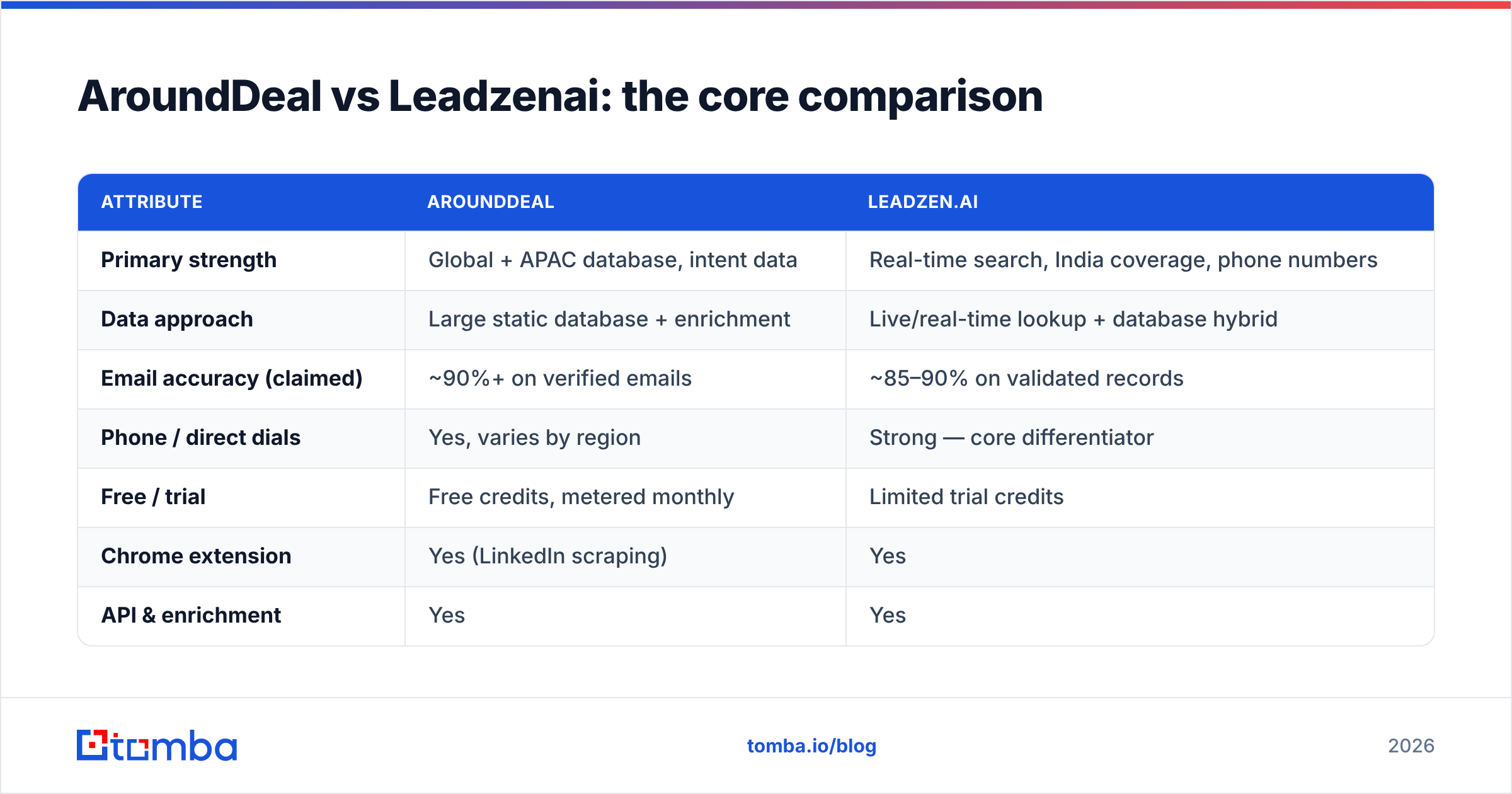
- Catch-all domains break simple verification. When a domain accepts every address, an SMTP check can't confirm a specific mailbox. Suites often mark these "valid" optimistically, inflating their accuracy numbers. A dedicated catch-all verifier handles this far more honestly.
- Real-time beats stale — until it doesn't. Leadzen.ai's live-search model can surface fresher data, but live lookups also fail more often on obscure or locked-down targets, returning nothing rather than a stale-but-usable record.
- Regional skew is real. AroundDeal is denser in APAC and decent in the US/EU; Leadzen.ai is densest in India. Run your own seed list against both before committing.
The practical move: build a 50-contact test list from your actual ICP, run it through each tool, then independently re-check the results with a third-party email verifier. The tool that produces the most addresses that survive independent verification wins — not the one with the prettiest dashboard percentage.

How do AroundDeal and Leadzenai price?#
Pricing is where these two diverge most, and where buyers most often overpay.
AroundDeal uses a tiered subscription with monthly credit allotments. The free tier feels generous at signup but meters quickly once you start pulling emails and phone numbers in volume. Paid tiers unlock more credits, bulk export, and API access. It is simple to reason about for a small SDR pod.
Leadzen.ai centers on a credit-and-plan model that rewards bulk commitment. If you are running high-volume, phone-led campaigns into India, the per-contact economics can work out favorably. If you only need a few hundred emails a month, you may pay for headroom you never use.
The hidden cost in both cases is wasted credits on bad data. Every bounced email and every dead phone number is a credit you already spent. That is why cost-per-valid-contact matters more than sticker price. A platform with transparent, usage-aligned Tomba pricing — Free (25 searches/mo), Starter $49/mo, Growth $99/mo, Pro $249/mo — lets you model that math directly instead of guessing how many credits a "lead" really costs.
Which integrates better with your stack?#
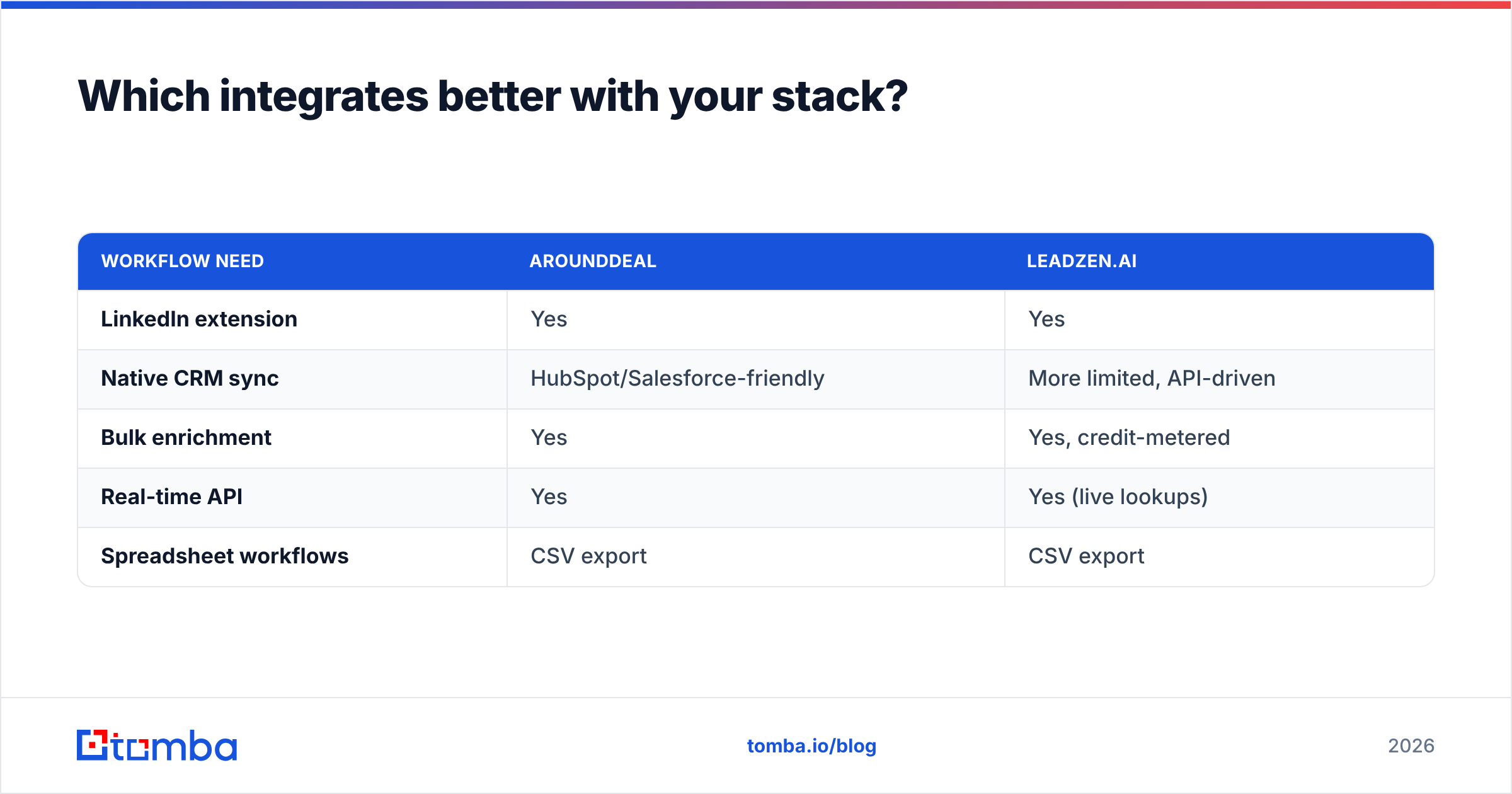
Both tools cover the table stakes: a Chrome extension for LinkedIn prospecting, CSV import/export, an enrichment API, and CRM hooks. The differences are at the edges.
| Workflow need | AroundDeal | Leadzen.ai |
|---|---|---|
| LinkedIn extension | Yes | Yes |
| Native CRM sync | HubSpot/Salesforce-friendly | More limited, API-driven |
| Bulk enrichment | Yes | Yes, credit-metered |
| Real-time API | Yes | Yes (live lookups) |
| Spreadsheet workflows | CSV export | CSV export |
If your team lives in HubSpot or Salesforce, AroundDeal's native paths tend to be smoother out of the box. If you are an engineering-led team comfortable wiring up an API, either works — though you should test rate limits and response shapes before you build on them.
One gap shared by both: spreadsheet-native prospecting. If your analysts work in Google Sheets or Excel, a tool with a first-class Google Sheets add-on or a dedicated bulk email finder removes a lot of copy-paste friction that the suites still leave on the table.
When should you pick a dedicated email finder instead?#
Here is the uncomfortable truth about all-in-one platforms: you pay for breadth you may not use, and the breadth often comes at the expense of depth on the one thing you need most — accurate, verified work emails.
Pick a focused tool over a suite when:
- Email is your primary channel. If 80% of your outreach is email, you want a tool engineered around deliverability, not a phone-and-intent suite where email is one feature among ten.
- You care about cost-per-valid-contact. Dedicated finders typically run a verification step inline, so you spend credits on addresses that actually land.
- You need catch-all and verification depth. Generic "valid/invalid" flags aren't enough; you want confidence scoring and real catch-all handling.
- You want clean, auditable data sources. Knowing where the data comes from matters for compliance and for trust.
This is the buff-vs-cheems split in practice: a sharp, single-purpose finder will often out-find a sprawling suite on the exact task you bought it for.

What about compliance and data sourcing?#
Any tool that scrapes LinkedIn and sells contact data sits in a regulated space — GDPR in the EU, CCPA in California, and equivalents elsewhere. Both AroundDeal and Leadzen.ai publish compliance statements, but the burden of lawful use ultimately sits with you, the sender.
Two things to verify before buying either:
- Opt-out and suppression handling. Can you honor deletion and do-not-contact requests cleanly? Check whether the vendor supports suppression lists and removal workflows.
- Source transparency. Vague "publicly available data" claims are a yellow flag. Compare against vendor review breakdowns on G2 and read how each platform documents its sourcing.
When in doubt, prioritize tools that are explicit about provenance and that pair finding with verification so you are not blasting unverified, scraped records into cold inboxes — the fastest way to torch your sender reputation.
AroundDeal vs Leadzenai: the verdict#
There is no universal winner — there is a winner for your motion:
- Choose AroundDeal if you sell into APAC or global markets, want intent data baked in, and prefer a database-first tool with clean HubSpot/Salesforce paths.
- Choose Leadzen.ai if you are phone-led, selling into India, and you value real-time search and bulk-friendly credit economics.
- Choose a dedicated finder if email is your main channel and cost-per-valid-contact is the metric you are graded on.
Run the 50-contact bake-off described above before you sign anything. The tool that wins on independently-verified results — not on dashboard claims — is the one that deserves your budget.
Find and verify emails that actually land#
If your goal is simple — get accurate, verified work emails into your sequences without burning credits on bounces — start with the Tomba Email Finder. It finds professional addresses by name, domain, or company, runs verification inline so you spend credits on contacts that land, and handles the catch-all and bulk cases that trip up broader suites. The free tier gives you 25 searches a month to test it against your own ICP, and paid plans start at $49/mo with transparent, usage-aligned pricing. Pair it with the email verifier and you have a finding-plus-verification stack that beats most all-in-one suites on the one metric that matters: valid contacts per dollar.
// get started
Find, verify and enrich your first contacts today
Start on the free plan with 25 searches a month, then scale when your team is ready.
Free plan · No credit card required · GDPR & CCPA
// about the author