Arounddeal vs Letsextract: 2026 B2B Data Tool Comparison
Arounddeal is a live B2B contact database; Letsextract is a desktop scraper. We compare accuracy, pricing, compliance, and the best fit for 2026 prospecting.
Arounddeal vs Letsextract: Which B2B Data Tool Wins in 2026?
Picking between Arounddeal vs Letsextract comes down to one question: do you want a live, maintained B2B contact database, or a desktop tool that scrapes and extracts emails on your own machine? They sound similar on a feature list, but they solve different problems and carry very different compliance risk.
TL;DR#
- Arounddeal is a cloud B2B database and prospecting platform (contact records, email finder, enrichment, Chrome extension). Best for sales teams that want maintained, queryable data.
- Letsextract is desktop email-extraction and email-marketing software that harvests addresses from web pages, search engines, and files. Best for cheap, high-volume scraping — with higher deliverability and compliance risk.
- On data accuracy, a maintained database (Arounddeal) beats raw scraped lists (Letsextract) almost every time.
- Neither is the cleanest fit if you mainly need verified, role-based emails by domain — an API-first finder like Tomba usually delivers better accuracy per dollar.
- This guide breaks down pricing, accuracy, compliance, and the workflow each one actually fits.
What is Arounddeal?#
Arounddeal is a cloud-based B2B data and sales-intelligence platform. You search a database of company and contact records, pull work emails and direct dials, and push them into your CRM. Its Chrome extension surfaces contact details while you browse LinkedIn, which is how most reps actually use it day to day.
The core promise is maintained data: records are refreshed, enriched with firmographics (industry, headcount, location), and intended to stay current. You are renting access to a database, not building one from scratch.
Typical use cases:
- Building targeted prospect lists by title, industry, and geography
- Enriching inbound leads with company and contact fields
- Grabbing a verified work email mid-LinkedIn-session
What is Letsextract?#
Letsextract is desktop software (Windows-first) for email extraction and bulk email marketing. It crawls websites, search-engine results, and local files to harvest email addresses, then offers a verifier and a built-in sender to email those lists. You can read more on the official Letsextract site.
The model is the opposite of Arounddeal. There is no maintained contact database. You point the tool at sources, it scrapes whatever addresses it finds, and you own the output. That makes it cheap and flexible, but the quality of your list is only as good as the pages you scraped — and scraped, unconsented addresses are a deliverability and legal minefield.
Typical use cases:
- Harvesting emails from niche directories or your own page set
- One-time list building without a subscription
- Users who want extraction, verification, and sending in one desktop app
Arounddeal vs Letsextract: how do they compare at a glance?#
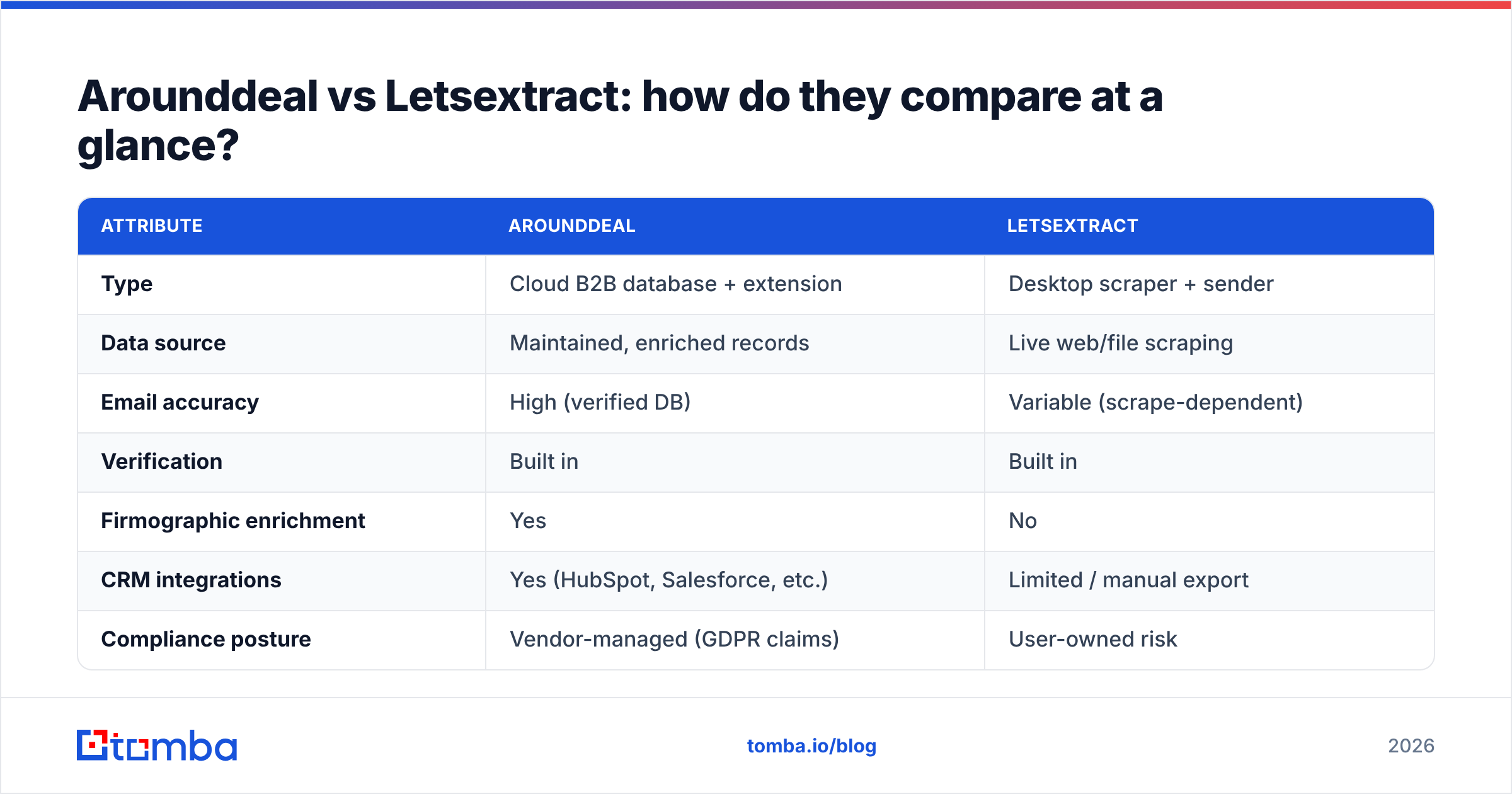
| Attribute | Arounddeal | Letsextract |
|---|---|---|
| Type | Cloud B2B database + extension | Desktop scraper + sender |
| Data source | Maintained, enriched records | Live web/file scraping |
| Email accuracy | High (verified DB) | Variable (scrape-dependent) |
| Verification | Built in | Built in |
| Firmographic enrichment | Yes | No |
| CRM integrations | Yes (HubSpot, Salesforce, etc.) | Limited / manual export |
| Compliance posture | Vendor-managed (GDPR claims) | User-owned risk |
| Platform | Web + Chrome | Windows desktop |
| Pricing model | Credit-based SaaS subscription | One-time / tiered license |
| Best for | Sales teams needing fresh data | Cheap bulk extraction |
)
How do Arounddeal vs Letsextract compare on data accuracy?#
Accuracy is where the two philosophies split hardest. Arounddeal sells you the result of continuous data work — collection, validation, and refresh. Letsextract sells you the tools to do that work yourself, which means accuracy depends entirely on the sources you point it at and the verification you run afterward.
A maintained database wins on accuracy for most teams because:
- Records are re-verified on a cycle, so bounce rates stay lower
- Catch-all and role-based addresses are flagged, not silently included
- Firmographic context lets you filter out obviously stale rows
Scraped lists, by contrast, mix valid mailboxes with spam traps, abandoned aliases, and addresses that were never meant to be contacted. Even a strong verifier can only catch syntactically dead addresses — it cannot tell you whether the human behind a valid mailbox wants your cold email.

If accuracy is your top priority, the smarter move is to separate finding from verifying. Use a finder that returns confidence-scored work emails, then run them through a dedicated email verifier before any send. That two-step flow beats trusting a single scraped-and-verified pile, regardless of which vendor you choose.
How do they compare on pricing?#
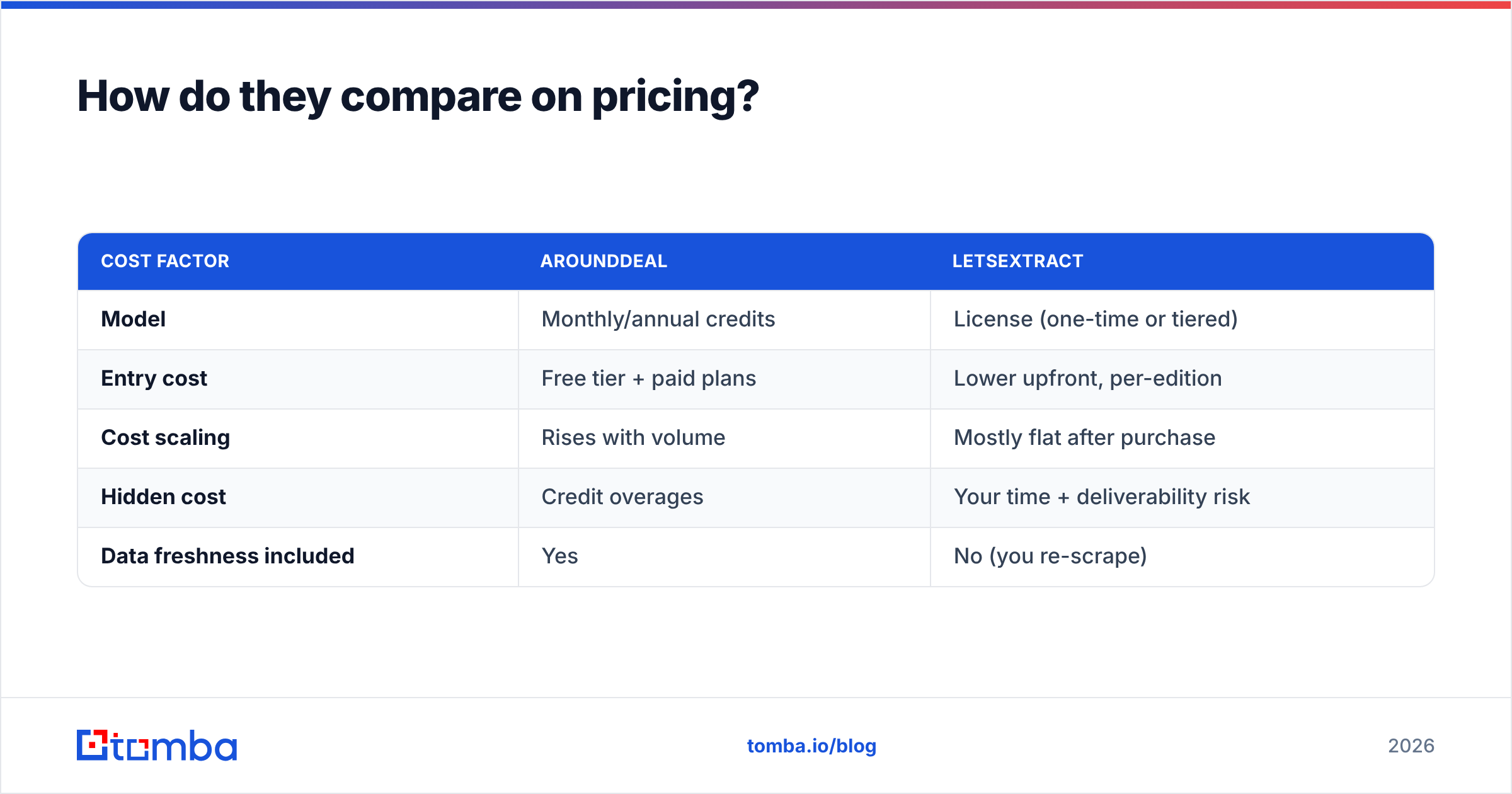
Pricing is the clearest reason buyers consider Letsextract: a desktop license is a near-fixed cost with no per-record metering. Arounddeal uses a credit-based SaaS model, so cost scales with how much data you pull.
| Cost factor | Arounddeal | Letsextract |
|---|---|---|
| Model | Monthly/annual credits | License (one-time or tiered) |
| Entry cost | Free tier + paid plans | Lower upfront, per-edition |
| Cost scaling | Rises with volume | Mostly flat after purchase |
| Hidden cost | Credit overages | Your time + deliverability risk |
| Data freshness included | Yes | No (you re-scrape) |
The honest read: Letsextract looks cheaper on the invoice, but the real cost shows up in deliverability damage, manual cleanup time, and the maintenance you now own. Arounddeal costs more per month but offloads the data-keeping. Neither is "cheap" once you price in your own hours.
What about compliance and deliverability?#
This is the part teams underestimate. Scraping addresses from the open web and emailing them at volume runs straight into GDPR, CAN-SPAM, and CASL exposure — and into spam filters that punish unsolicited sends. With Letsextract, that risk is yours, because you operated the scraper and pressed send.
Arounddeal carries vendor-managed compliance claims (opt-out handling, GDPR processes), which shifts some — not all — of that burden to the provider. You still need a lawful basis to contact B2B prospects, but you are not the one harvesting raw addresses.
Either way, protect your sending domain:
- Warm up new domains before volume sends
- Verify every address and remove catch-alls and role accounts
- Monitor sender reputation and bounce rates weekly
- Keep lists fresh; stale data drives complaints
Independent reviews on platforms like G2 are worth scanning before you commit — pay attention to comments about bounce rates and support responsiveness, not just star ratings.
)
Which one should you choose?#
Choose based on the job, not the feature list.
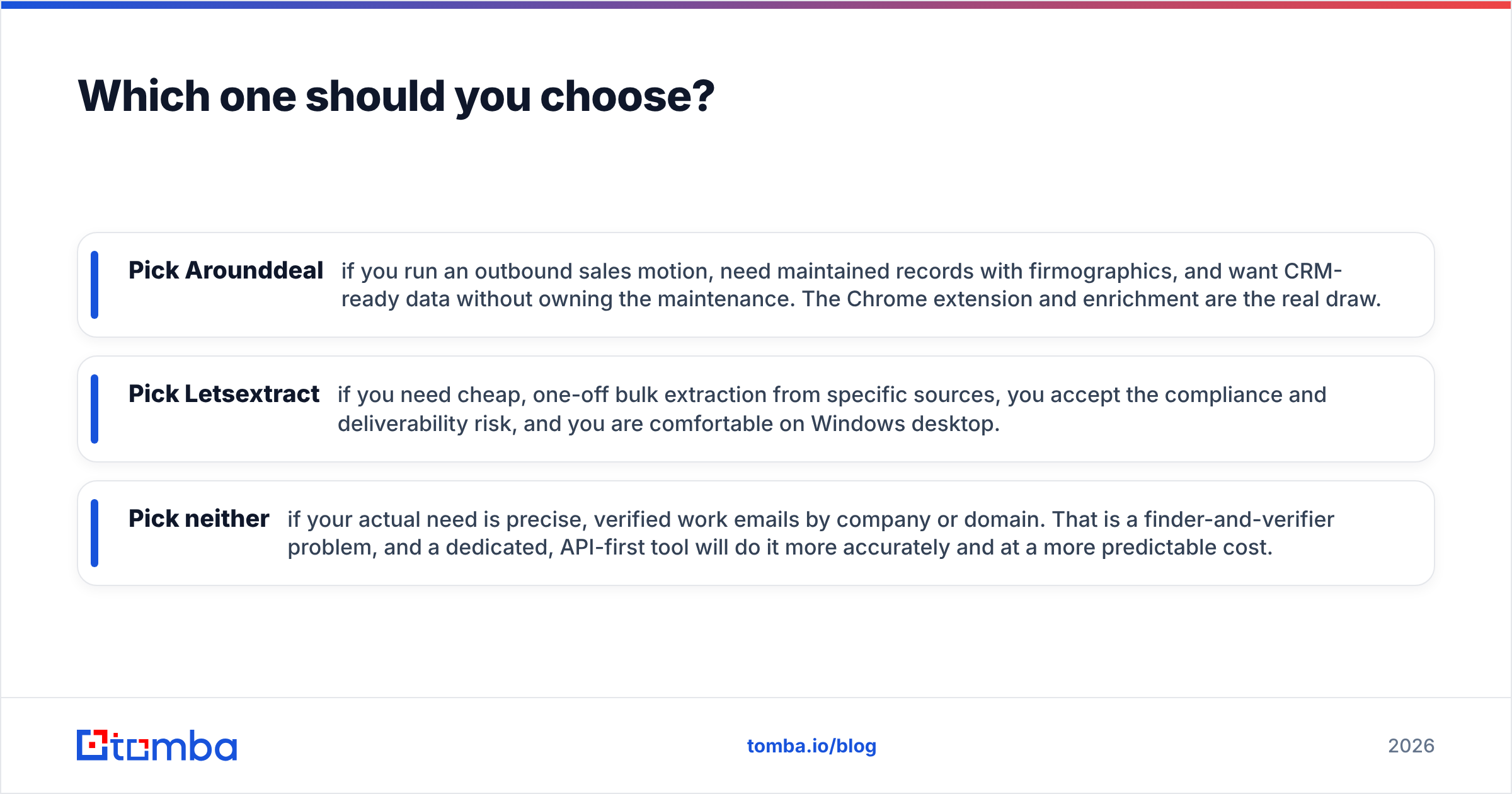
- Pick Arounddeal if you run an outbound sales motion, need maintained records with firmographics, and want CRM-ready data without owning the maintenance. The Chrome extension and enrichment are the real draw.
- Pick Letsextract if you need cheap, one-off bulk extraction from specific sources, you accept the compliance and deliverability risk, and you are comfortable on Windows desktop.
- Pick neither if your actual need is precise, verified work emails by company or domain. That is a finder-and-verifier problem, and a dedicated, API-first tool will do it more accurately and at a more predictable cost.

Where does Tomba fit in this comparison?#
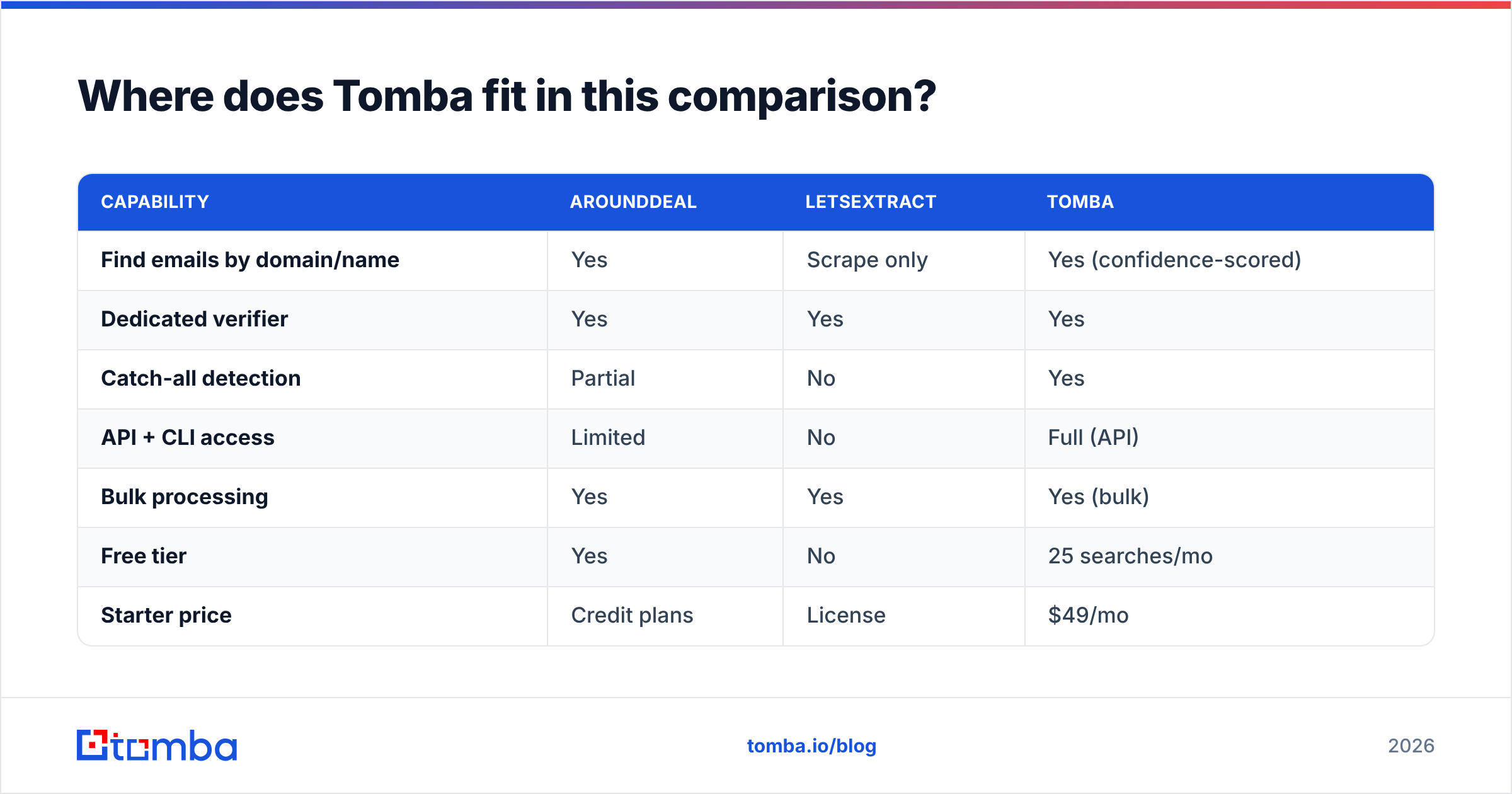
Tomba sits in the gap both tools leave open: high-accuracy email finding plus first-class verification, delivered through an API and integrations rather than a desktop scraper or a generalist database.
| Capability | Arounddeal | Letsextract | Tomba |
|---|---|---|---|
| Find emails by domain/name | Yes | Scrape only | Yes (confidence-scored) |
| Dedicated verifier | Yes | Yes | Yes |
| Catch-all detection | Partial | No | Yes |
| API + CLI access | Limited | No | Full (API) |
| Bulk processing | Yes | Yes | Yes (bulk) |
| Free tier | Yes | No | 25 searches/mo |
| Starter price | Credit plans | License | $49/mo |
The workflow that beats both legacy approaches:
- Run a domain search to pull every public address pattern for a target company.
- Use the email finder to resolve a specific person's work email.
- Verify with the email verifier and drop catch-alls.
- Enrich and sync via data enrichment into your CRM.
This is the pattern that keeps bounce rates low without the legal exposure of open-web scraping. You can see exact costs on the Tomba pricing page — the free tier is enough to test accuracy against your own known-good list before you pay.
Frequently asked questions#
Is Letsextract legal to use? The software itself is legal; how you use it determines your risk. Scraping and mass-emailing unconsented addresses can violate GDPR, CAN-SPAM, and CASL. You own that liability.
Is Arounddeal's data accurate? Generally more accurate than raw scraped lists because records are maintained and verified, but no database is perfect. Always re-verify before a campaign.
Can I use these together? You can, but it is rarely worth it. A maintained finder plus a dedicated verifier covers most needs without running a separate desktop scraper.
What is the cheapest accurate option? Predictable accuracy usually comes from a credit-based finder with a free tier to test, rather than a flat-license scraper whose output quality you cannot guarantee.
The bottom line#
In the Arounddeal vs Letsextract matchup, Arounddeal wins on data quality and compliance posture, while Letsextract wins only on raw upfront price — and that "win" evaporates once you price in deliverability damage and your own cleanup time. For most B2B teams in 2026, the right answer is a focused, verifiable finder rather than either a generalist database or a desktop harvester.
Want to test that accuracy claim yourself? Start with the Tomba Email Finder — find confidence-scored work emails by name, company, or domain, verify them in the same flow, and run 25 searches free before you spend a dollar. Compare the bounce rate against anything you scrape, and let the data decide.
// get started
Find, verify and enrich your first contacts today
Start on the free plan with 25 searches a month, then scale when your team is ready.
Free plan · No credit card required · GDPR & CCPA
// about the author