Arounddeal vs Limeleads: B2B Contact Data Compared (2026)
A neutral, hands-on breakdown of AroundDeal vs LimeLeads — coverage, accuracy, pricing, and compliance — so you can pick the right B2B data tool in 2026.
TL;DR
- AroundDeal leans on a large APAC-strong contact database with a Chrome extension and basic intent/engagement signals; LimeLeads is a lighter, US-centric list-builder with simple filters and credit-based exports.
- Pick AroundDeal if you prospect across Asia-Pacific and want a browser-first workflow; pick LimeLeads if you want a no-frills North American list builder on a tight budget.
- Both struggle with the same problem every database has: data decays, and neither replaces real-time email verification before you hit send.
- For accuracy-first prospecting, a dedicated email finder plus an email verifier usually beats either static database on bounce rate.
- This is a neutral comparison — no affiliation with either vendor. Tomba is referenced where it's honestly the better fit.
Who are AroundDeal and LimeLeads?#
AroundDeal and LimeLeads are both B2B contact-data providers, but they serve slightly different crowds. AroundDeal positions itself as a global sales-intelligence platform with a sizable database, a LinkedIn-friendly Chrome extension, and add-ons like engagement and basic intent data. Its data depth is notably stronger across Asia-Pacific markets than most Western-built tools.
LimeLeads takes the opposite approach: it's a streamlined, browser-based list builder focused on North American companies. You filter by industry, title, location, and company size, preview matching records, then spend credits to unlock verified emails. There's no heavy CRM-style layer — it's a lead list in, CSV out.
Think of it like buying produce. AroundDeal is the large international grocery with aisles for every region — more choice, more to navigate. LimeLeads is the corner stand: fewer options, faster checkout, and you know exactly what you're paying for.
The core question this post answers: in 2026, which one actually gets accurate, send-ready contacts into your pipeline — and where does a purpose-built email-finder beat both?
What does each tool actually do?#
Both tools answer the same job-to-be-done — "give me a list of people to contact" — but the feature surface differs.
AroundDeal bundles:
- A contact and company database with global coverage
- A Chrome extension that surfaces emails and phone numbers on LinkedIn and company sites
- Basic intent and engagement signals (who's showing buying behavior)
- List building, CRM exports, and an API on higher tiers
LimeLeads bundles:
- A searchable B2B database skewed to US/Canada
- Simple filter-and-preview list building in the browser
- Credit-based email reveals with claimed verification
- CSV export and basic integrations
Neither is a full outreach platform — you still need a sending tool, and you still need to verify before you send. That second point matters more than most vendor pages admit, which is why a standalone email verifier step earns its keep regardless of which database you choose.

AroundDeal vs LimeLeads: side-by-side comparison#
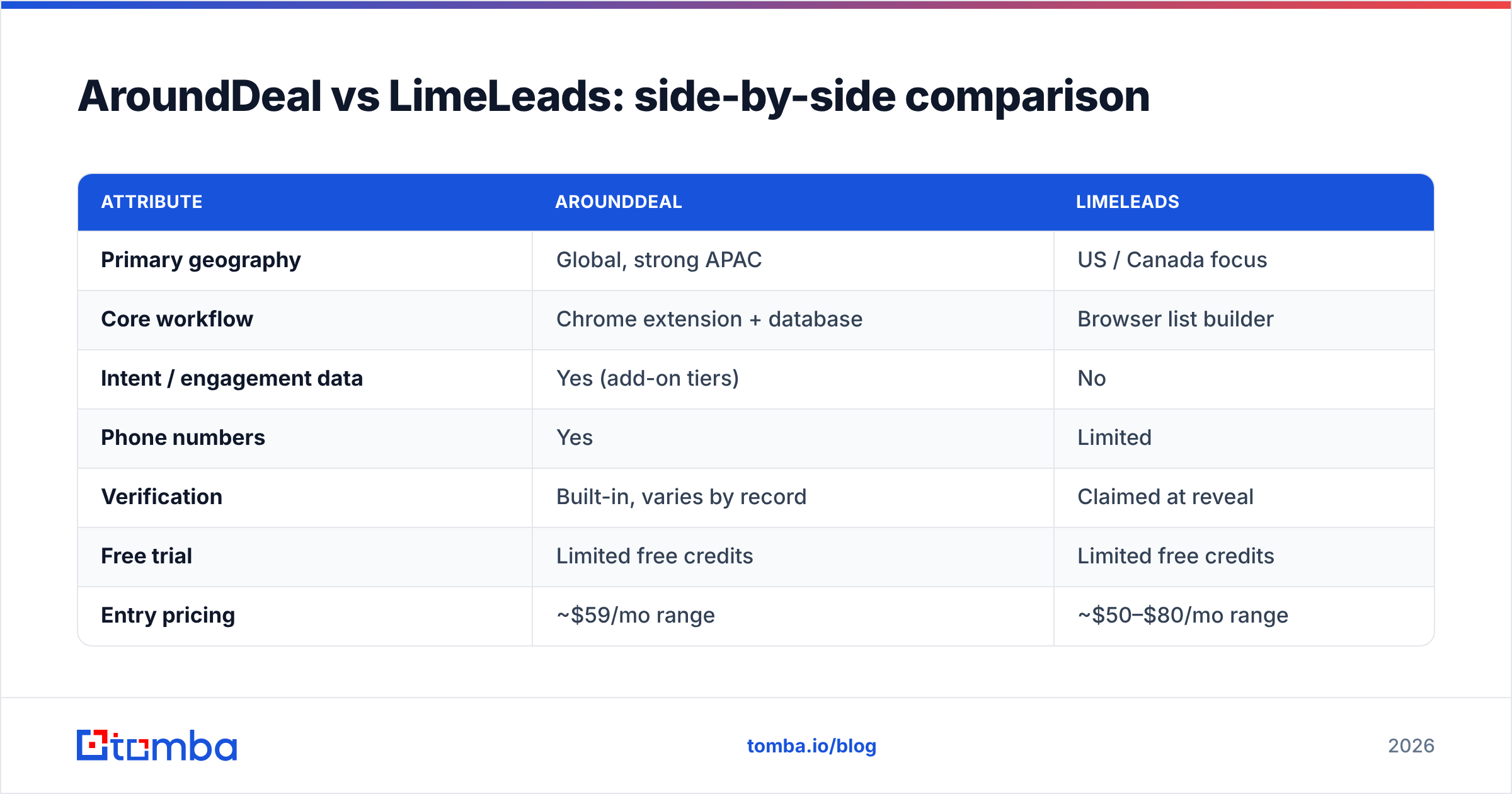
Here's the head-to-head on the attributes that actually change your results.
| Attribute | AroundDeal | LimeLeads |
|---|---|---|
| Primary geography | Global, strong APAC | US / Canada focus |
| Core workflow | Chrome extension + database | Browser list builder |
| Intent / engagement data | Yes (add-on tiers) | No |
| Phone numbers | Yes | Limited |
| Verification | Built-in, varies by record | Claimed at reveal |
| Free trial | Limited free credits | Limited free credits |
| Entry pricing | ~$59/mo range | ~$50–$80/mo range |
| API access | Higher tiers | Limited |
| Best for | APAC + browser-first reps | Lean US list building |
Pricing for both shifts frequently and is often gated behind a sales call or annual commitment, so treat the figures above as ballpark and confirm on each vendor's own page before buying. Always run a small paid test before committing to an annual plan.
Which has better data coverage?#
Conclusion first: AroundDeal wins on breadth, especially outside North America; LimeLeads is narrower but can feel "cleaner" inside its US niche.
Coverage is the single biggest reason to pick one over the other. If your ICP includes Singapore, India, Australia, Japan, or wider APAC accounts, AroundDeal's database will almost always return more matches than LimeLeads, which thins out quickly past US and Canadian companies.
But breadth isn't the same as accuracy. A database with 100 million contacts that's 30% stale is worse than a smaller one that's fresh. B2B data decays fast — people change jobs, companies rebrand, domains get retired. Industry estimates routinely put B2B contact decay at roughly 22–30% per year, and platforms like G2 are full of reviews on both tools citing outdated records as the top complaint.
That decay is why the smart move is not "trust the database" but "trust, then verify." Even the best provider should be treated as a strong starting hypothesis, not gospel.

Which is more accurate on email deliverability?#
This is where the comparison gets uncomfortable for both tools. AroundDeal and LimeLeads each claim verification, but "verified at the time we collected it" and "verified the moment before you send" are very different guarantees.
Here's the deliverability reality:
- A catch-all domain accepts every address, so a "valid" result can still bounce. You need a dedicated catch-all verifier to handle those safely.
- Role addresses (info@, sales@) inflate list size but tank engagement.
- Stale records that pre-date a job change sail through basic checks and then hard-bounce.
If you push an unverified export from either tool straight into a cold campaign, you risk spiking your bounce rate above the 2–3% danger zone — and that damages your sender reputation, which is far more expensive to repair than the cost of verification.
The honest takeaway: neither AroundDeal nor LimeLeads should be your last line of defense. Run every list through real-time verification. Tomba's email verifier and bulk verify exist precisely for this gap, and they're database-agnostic — you can verify a LimeLeads or AroundDeal export just as easily as a fresh find.
How do they compare on pricing and value?#
Conclusion first: LimeLeads is usually cheaper at the entry level; AroundDeal gives more per dollar if you actually use the intent and global data.
Both run a credit model. LimeLeads keeps it simple — pay for reveals, export, done. AroundDeal's tiers add intent data, more enrichment fields, and API access as you climb, which justifies the higher ceiling only if you use those features.
A few buying tips that apply to either:
- Don't pay for coverage you won't use. If 95% of your ICP is in the US, AroundDeal's APAC depth is wasted spend.
- Watch the per-credit math. Sticker price means little; cost-per-valid-contact is what matters after you strip bounces.
- Budget for a verification layer. Whatever you save on a cheap database, you'll lose on a damaged domain if you skip verification.
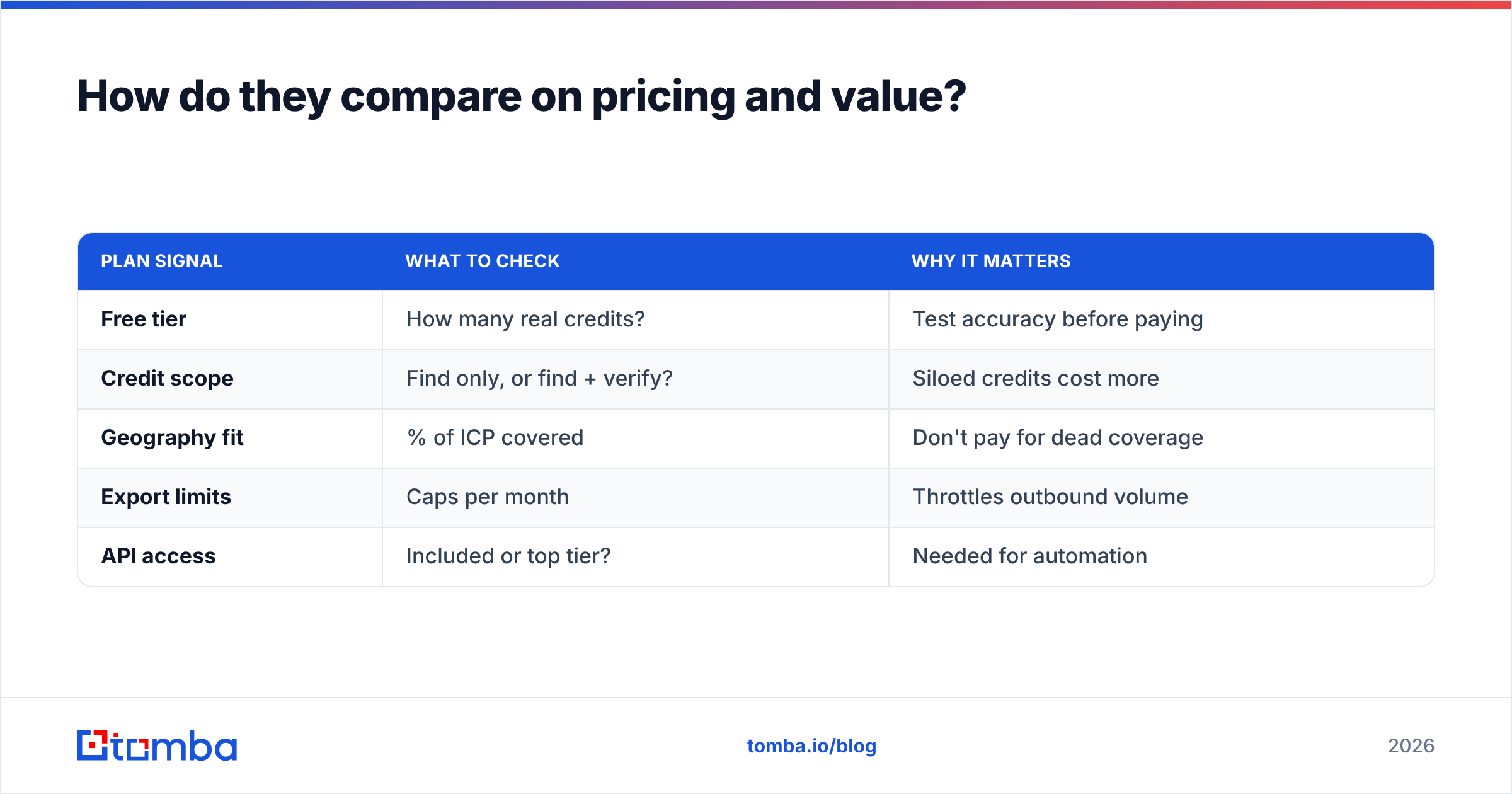
For context on how transparent, usage-based pricing can look, compare both vendors against published Tomba pricing: a free tier of 25 searches/month, Starter at $49/mo, Growth at $99/mo, and Pro at $249/mo, with the same credits spanning finding, verifying, and enrichment instead of being siloed per feature.
| Plan signal | What to check | Why it matters |
|---|---|---|
| Free tier | How many real credits? | Test accuracy before paying |
| Credit scope | Find only, or find + verify? | Siloed credits cost more |
| Geography fit | % of ICP covered | Don't pay for dead coverage |
| Export limits | Caps per month | Throttles outbound volume |
| API access | Included or top tier? | Needed for automation |
What about compliance and data sourcing?#
Both tools operate in the gray zone every B2B data provider lives in: scraped and aggregated business contact data, sold under GDPR/CCPA "legitimate interest" framing. That's legal in many cases, but it puts the compliance burden on you — the sender — to honor opt-outs, suppress EU consumer data, and document your lawful basis.
A few non-negotiables regardless of which you choose:
- Confirm the vendor offers documented opt-out and suppression handling.
- Keep EU outreach to genuine business addresses with a clear, relevant value proposition.
- Maintain your own suppression list; don't rely solely on the provider.
If data provenance matters to your legal team, ask each vendor directly how they source and refresh records. Transparency varies widely. Tomba documents its approach on its data sources page, which is the kind of disclosure you should expect — and push for — from any provider, AroundDeal and LimeLeads included. For a baseline on the regulation itself, the official GDPR text is the canonical reference.
When should you pick a dedicated email finder instead?#
There's a third path neither vendor will mention: you often don't need a giant static database at all.
If your workflow is "I have a name and a company, I need a reliable email," a focused tool is faster and more accurate than browsing a database. Domain-first prospecting — give a company, get the verified people — is exactly what domain search does, and it sidesteps the stale-list problem because the lookup happens in real time.
Choose a dedicated email finder over AroundDeal or LimeLeads when:
- You already know your target accounts and just need contacts at them.
- Bounce rate and sender reputation are mission-critical.
- You want finding, verification, and enrichment in one credit pool.
- You need an email finder API to wire prospecting into your own stack.
- You'd rather verify on the fly than clean a dump after the fact.
This isn't to say databases are useless — for broad, top-of-funnel discovery in a new market, AroundDeal's coverage is genuinely useful. But for accuracy-sensitive, account-based outbound, a find-and-verify motion typically wins on the metric that matters: emails that actually land.
How do I choose between them?#
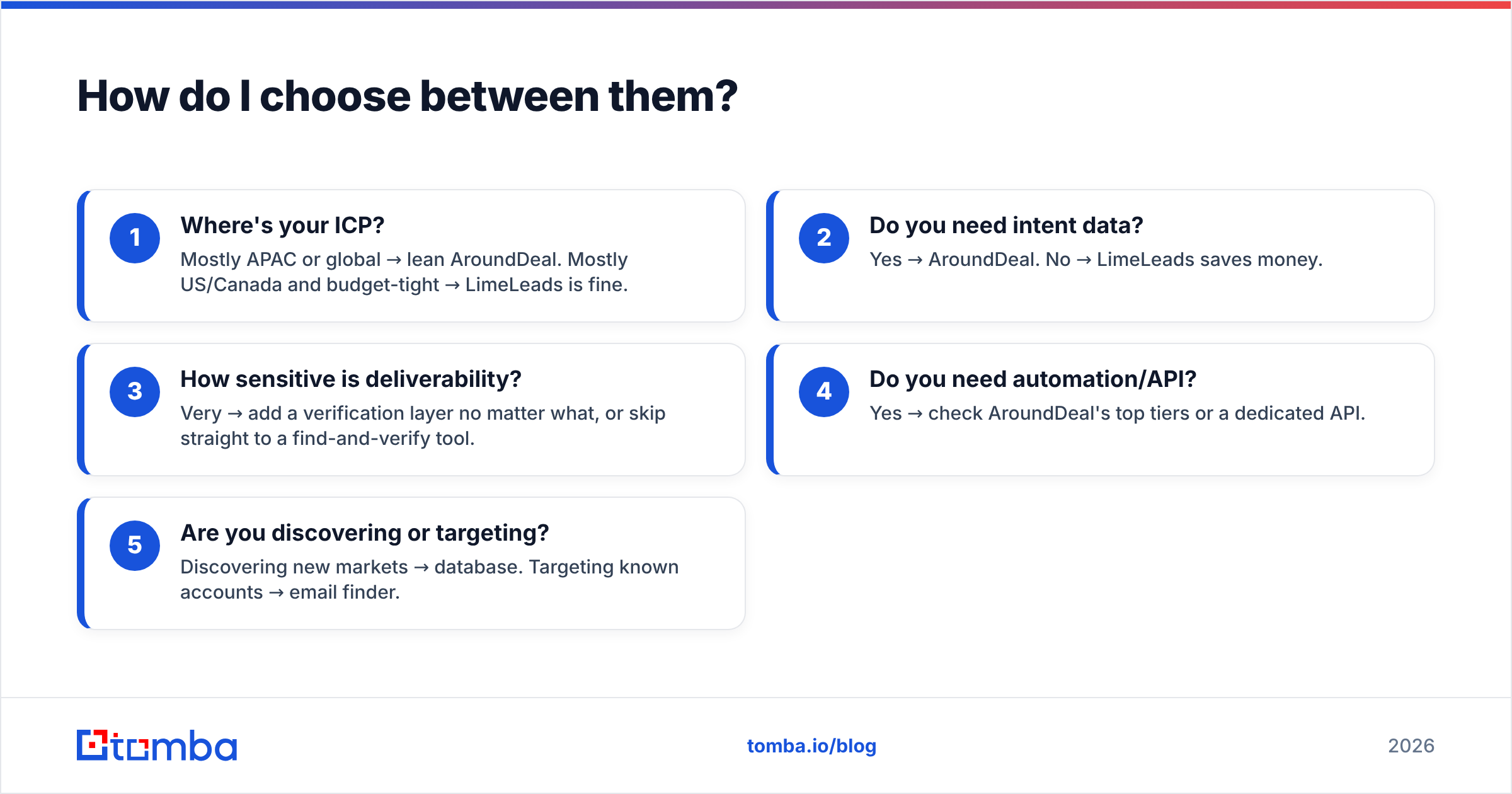
Run this quick decision filter:
- Where's your ICP? Mostly APAC or global → lean AroundDeal. Mostly US/Canada and budget-tight → LimeLeads is fine.
- Do you need intent data? Yes → AroundDeal. No → LimeLeads saves money.
- How sensitive is deliverability? Very → add a verification layer no matter what, or skip straight to a find-and-verify tool.
- Do you need automation/API? Yes → check AroundDeal's top tiers or a dedicated API.
- Are you discovering or targeting? Discovering new markets → database. Targeting known accounts → email finder.
Whatever you pick, test on a small paid batch, measure cost-per-valid-contact (not cost-per-credit), and verify before you send.
The bottom line#
AroundDeal and LimeLeads are reasonable tools for different jobs: AroundDeal for global, browser-first, intent-aware prospecting, and LimeLeads for lean, US-focused list building. Neither, on its own, guarantees the one thing outbound actually lives or dies on — emails that don't bounce.
If your priority is accuracy and protecting your sender reputation, build your stack around a find-and-verify core. Tomba's Email Finder lets you find professional emails by domain, name, or company, then verify them in the same workflow — with a free tier of 25 searches a month so you can benchmark it against your current AroundDeal or LimeLeads export before paying a cent. Start there, measure the bounce-rate difference, and let the numbers decide.
// get started
Find, verify and enrich your first contacts today
Start on the free plan with 25 searches a month, then scale when your team is ready.
Free plan · No credit card required · GDPR & CCPA
// about the author