Arounddeal vs Listmint 2026: B2B Lead Data Compared
Arounddeal and Listmint both promise B2B contact data, but they win on different fronts. Here's how their accuracy, pricing, and coverage stack up in 2026.
TL;DR
- Arounddeal is a broad B2B database and prospecting suite with a Chrome extension, intent data, and a large contact directory — strongest when you want an all-in-one platform.
- Listmint is a leaner, list-building-focused tool aimed at quickly assembling targeted prospect lists — strongest when speed and simplicity matter more than depth.
- On raw email accuracy and verification, neither one wins by default; both rely on database matches that decay over time, so verification is non-negotiable.
- Pricing favors Listmint at the entry level, but Arounddeal's credits stretch further once you need enrichment and intent signals.
- If your priority is verified, deliverable emails at a predictable price, a dedicated email finder like Tomba often beats a general database on the metric that actually matters: bounce rate.
What are Arounddeal and Listmint?#
Both Arounddeal and Listmint exist to solve the same core problem: you have a target account or persona, and you need contact details to reach them. Where they differ is scope.
Arounddeal positions itself as a global B2B information platform. It bundles a contact and company database, a browser extension that surfaces details on LinkedIn, basic intent data, and workflow features like list management and enrichment. You can read more about its positioning on the Arounddeal homepage. It competes in the same bracket as Apollo, Lusha, and RocketReach — a "data plus light engagement" suite.
Listmint is narrower by design. It is built around fast list construction: define a filter, pull a list of matching contacts, export, and move on. That focus makes it approachable, but it also means you lean on it for one job rather than as a system of record.
The honest framing: Arounddeal is a platform, Listmint is a tool. Neither label is an insult. The right choice depends on whether you want one dashboard for everything or a fast utility that does one thing.
How accurate is the data in Arounddeal vs Listmint?#
Accuracy is where most buyers get burned, because vendor-claimed accuracy and real-world deliverability rarely match.
Every B2B database — Arounddeal, Listmint, and their competitors — is a snapshot. Roughly 25-30% of B2B contact data decays each year as people change jobs, companies rebrand, and email formats shift. A database that was 95% accurate at collection time is materially worse twelve months later if it isn't continuously re-verified.
That is the core risk with a database-first approach: you are trusting a stored value, not a live check. Arounddeal's larger directory means more coverage (you'll find a record more often), but coverage is not the same as correctness. Listmint's smaller index may return fewer hits, but a smaller, fresher set can sometimes bounce less.

The practical rule: whatever tool you pick, run the exported list through an independent email verifier before you load it into a sequencer. Catching invalid and catch-all addresses before send is the single biggest lever on your sender reputation. If you skip this step, even the best database in the world will tank your email deliverability.

Arounddeal vs Listmint: feature and pricing comparison#
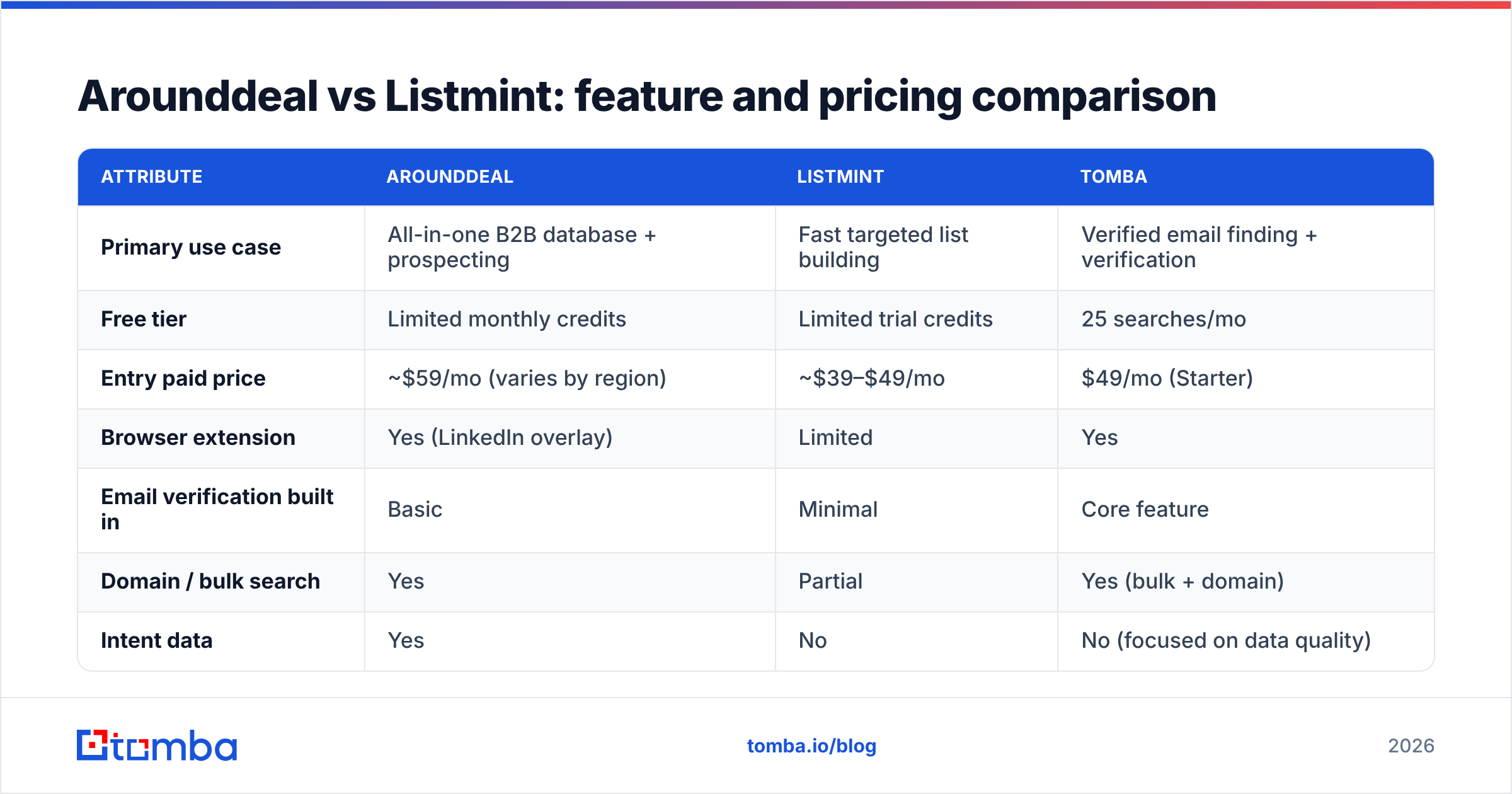
Here is the side-by-side. Treat pricing as directional — both vendors change tiers and credit definitions frequently, so confirm on their own pages before committing.
| Attribute | Arounddeal | Listmint | Tomba |
|---|---|---|---|
| Primary use case | All-in-one B2B database + prospecting | Fast targeted list building | Verified email finding + verification |
| Free tier | Limited monthly credits | Limited trial credits | 25 searches/mo |
| Entry paid price | ~$59/mo (varies by region) | ~$39–$49/mo | $49/mo (Starter) |
| Browser extension | Yes (LinkedIn overlay) | Limited | Yes |
| Email verification built in | Basic | Minimal | Core feature |
| Domain / bulk search | Yes | Partial | Yes (bulk + domain) |
| Intent data | Yes | No | No (focused on data quality) |
| Phone numbers | Yes | Limited | Yes (phone finder) |
| API access | Yes | Limited | Yes (full REST API) |
| Best for | Teams wanting one platform | Solo reps and small lists | Deliverability-first outbound |
A few notes on reading this table:
- Arounddeal wins on breadth. If you want intent signals, phone numbers, and enrichment in one login, it has the widest feature surface of the three.
- Listmint wins on simplicity and entry price. If you build a few focused lists per month and don't want to learn a platform, it gets out of your way.
- Tomba wins on the deliverability metric — verification is the product, not an afterthought — and its pricing is transparent with a usable free tier (25 searches/mo), Starter at $49/mo, Growth at $99/mo, and Pro at $249/mo.
For teams already invested in a CRM, also check how each tool pushes data downstream — a clean HubSpot integration or Salesforce integration saves more hours than a slightly larger database does.
Is Arounddeal better than Listmint for outbound?#
It depends on your motion, and the split is cleaner than most "it depends" answers.
Choose Arounddeal if you run account-based outbound, want intent data to prioritize accounts, and have a team that will actually use a platform. The breadth justifies the learning curve only at that scale. A solo SDR will pay for features they never open.
Choose Listmint if you build lists episodically — a campaign here, a territory there — and value time-to-list over depth. Its narrowness is a feature for that buyer.
But notice what neither question is really about: will the emails land? That is determined less by which database you query and more by whether you verify before you send. A 10,000-row export from any platform with a 12% bounce rate will damage your domain faster than a 3,000-row verified list will ever help it.
This is why a verification-first workflow matters regardless of your database choice. Use your database (Arounddeal, Listmint, or anything else) for discovery, then gate every address through verification and catch-all checks. Tomba's catch-all verifier handles the trickiest segment — domains that accept everything at the SMTP layer — which generic database "valid" flags routinely get wrong.

What does a verification-first workflow look like?#
The tool you start with matters less than the order of operations. Here is the sequence that keeps bounce rates low no matter which database you prospect from.
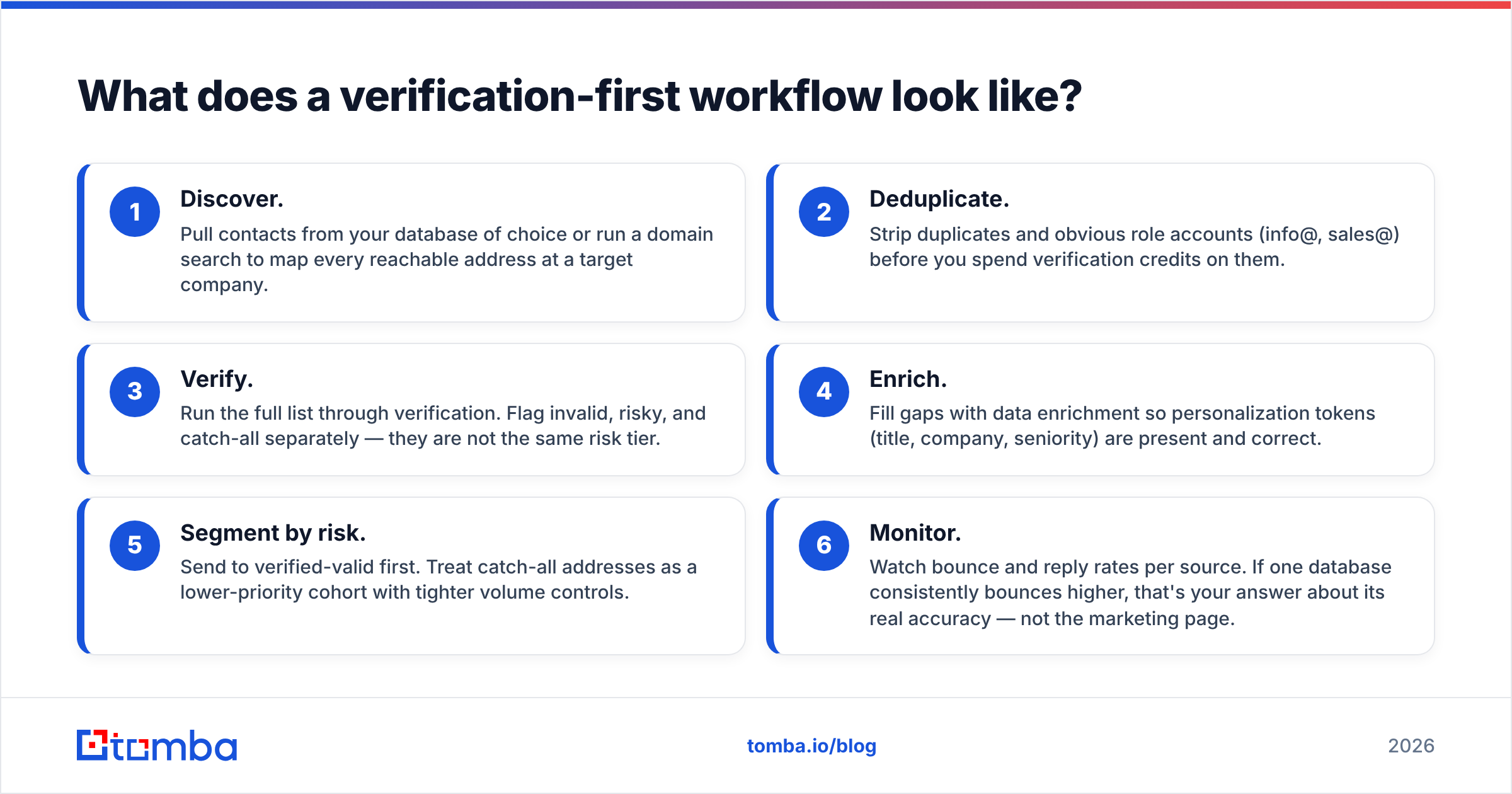
- Discover. Pull contacts from your database of choice or run a domain search to map every reachable address at a target company.
- Deduplicate. Strip duplicates and obvious role accounts (info@, sales@) before you spend verification credits on them.
- Verify. Run the full list through verification. Flag invalid, risky, and catch-all separately — they are not the same risk tier.
- Enrich. Fill gaps with data enrichment so personalization tokens (title, company, seniority) are present and correct.
- Segment by risk. Send to verified-valid first. Treat catch-all addresses as a lower-priority cohort with tighter volume controls.
- Monitor. Watch bounce and reply rates per source. If one database consistently bounces higher, that's your answer about its real accuracy — not the marketing page.
This workflow is database-agnostic on purpose. Arounddeal and Listmint both slot into step 1. The deliverability outcome is decided in steps 3 through 6.
How do Arounddeal and Listmint compare on price-per-verified-email?#
Sticker price is the wrong unit. The metric that controls your real cost is price per verified, deliverable email, not price per row exported.
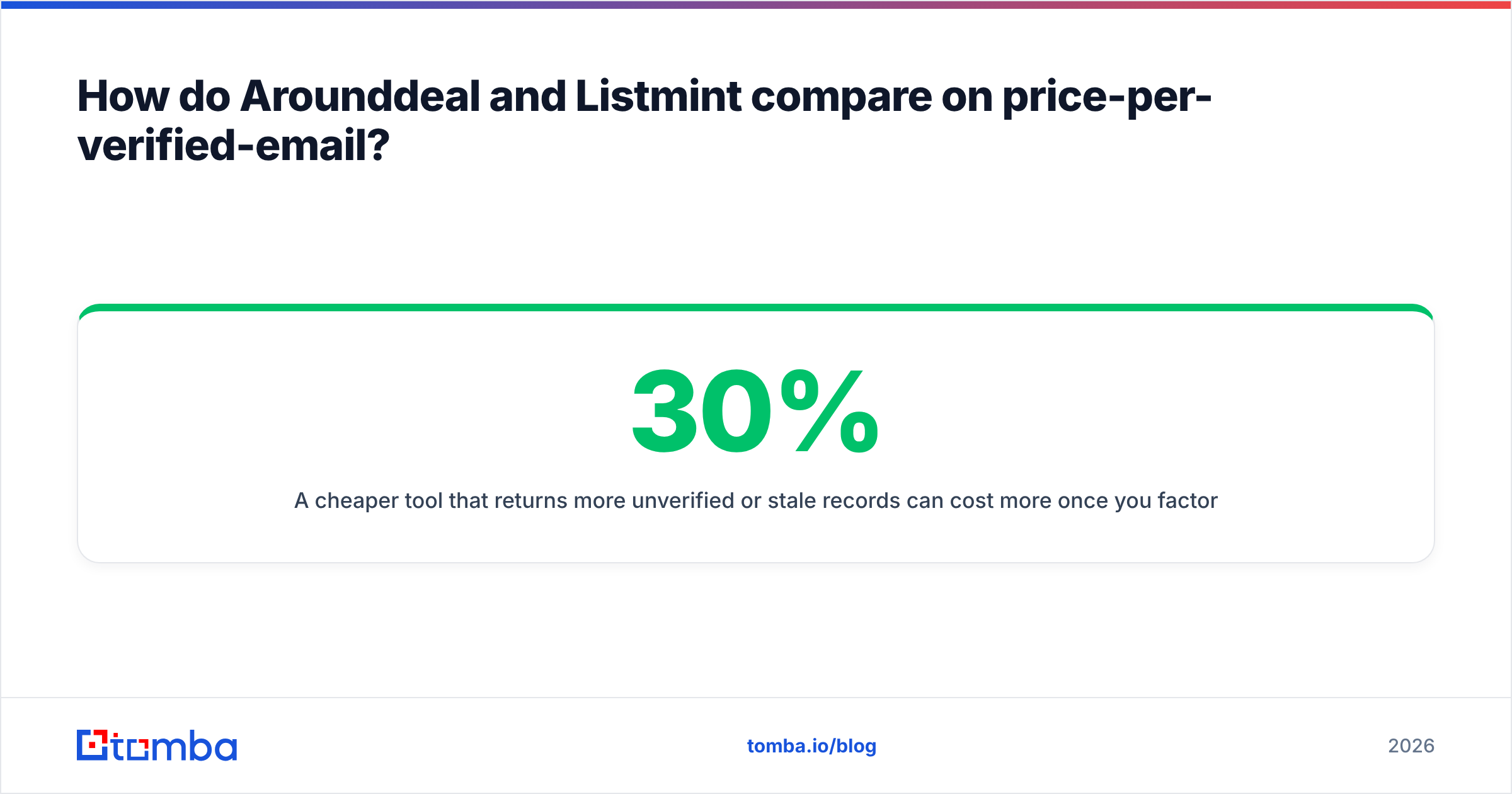
A cheaper tool that returns more unverified or stale records can cost more once you factor in wasted verification credits, damaged sender reputation, and the deals you never started because your domain got throttled. A list that looks 30% cheaper but bounces at 12% instead of 2% is not cheaper.

When you normalize on verified emails:
- Listmint's low entry price is attractive, but if its records skew older, your effective cost rises after verification culls the list.
- Arounddeal's credits cover more feature types (enrichment, intent), so the per-credit value is higher if you use those features — and lower if you don't.
- Tomba's model is built around the verified unit directly, which is why deliverability-focused teams often find the math simpler. You can sanity-check any list yourself with the free email checker before committing budget.
Run your own test before you sign an annual contract: take 200 contacts from each tool, verify them through a neutral third party, and compare the valid-rate. The winner on that 200-row sample is usually the winner at scale.
Which tool should you pick?#
Conclusion first: pick the database that matches your motion, then bolt on dedicated verification — don't expect any single platform to be both your discovery engine and your deliverability guarantee.
- Running account-based outbound with a team? Arounddeal gives you the widest surface.
- Building focused lists solo or in a small team? Listmint is the faster, cheaper utility.
- Optimizing for the lowest bounce rate and most predictable cost-per-verified-email? Lead with a dedicated finder-and-verifier.
That last path is where Tomba fits cleanly. Use the Tomba Email Finder to source professional addresses by name, company, or domain, verify them in the same workflow, and push clean records straight into your CRM — with a free tier to test accuracy on your own list before you pay. If deliverability is the number you're judged on, start with the tool that treats verification as the product, not a checkbox. Compare the full Tomba plans and run your own 200-contact accuracy test this week.
Ready to find emails that actually work?
Join 150,000+ professionals who stopped guessing and started sending. Free credits on signup — no credit card required.
Get the Tomba newsletter
Practical outbound tactics and product updates — once every two weeks.
About the author