Arounddeal vs Ninjapear: B2B Contact Data Compared (2026)
Arounddeal vs Ninjapear, broken down by data accuracy, pricing, coverage, and compliance — plus where a verification-first tool beats both for cold outreach in 2026.
Choosing between two B2B contact databases comes down to one boring question: how many of the emails actually land. That is the heart of any Arounddeal vs Ninjapear decision. Both tools promise prospect data. Both sell credits. Both look great on a pricing page. The real difference shows up only after you hit "send" on 500 cold emails and read the bounce report.
This is a neutral, hands-on comparison of Arounddeal vs Ninjapear — coverage, accuracy, pricing, compliance, and workflow — written for revenue teams who care about deliverability more than dashboards.
TL;DR#
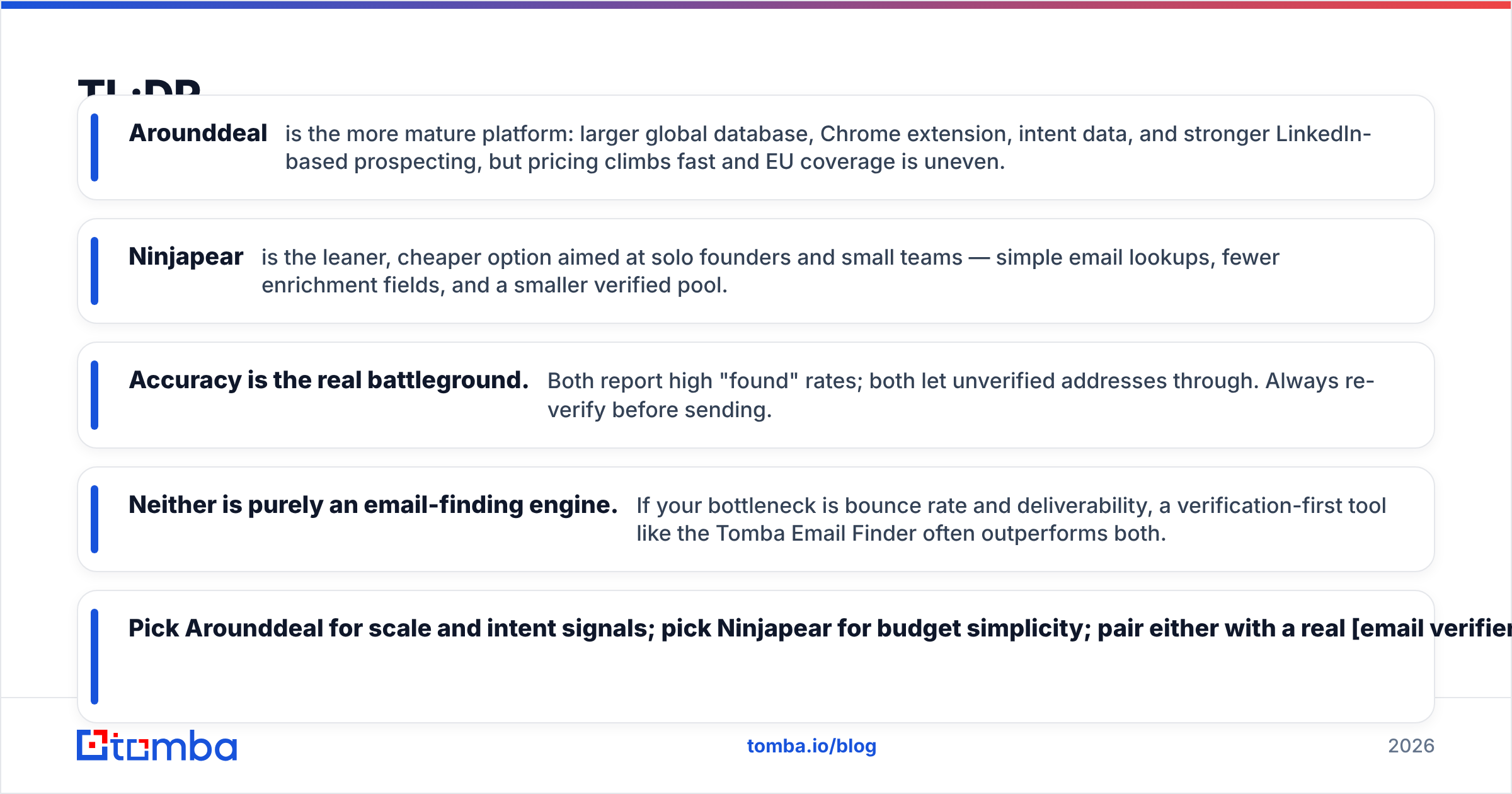
- Arounddeal is the more mature platform: larger global database, Chrome extension, intent data, and stronger LinkedIn-based prospecting, but pricing climbs fast and EU coverage is uneven.
- Ninjapear is the leaner, cheaper option aimed at solo founders and small teams — simple email lookups, fewer enrichment fields, and a smaller verified pool.
- Accuracy is the real battleground. Both report high "found" rates. Both let unverified addresses through. Always re-verify before sending.
- Neither is purely an email-finding engine. If your bottleneck is bounce rate and deliverability, a verification-first tool like the Tomba Email Finder often outperforms both.
- Pick Arounddeal for scale and intent signals; pick Ninjapear for budget simplicity; pair either with a real email verifier before launch.
What are Arounddeal and Ninjapear?#
Arounddeal is a B2B sales intelligence platform. It combines a few things. There is a contact and company database with hundreds of millions of profiles. There is a LinkedIn Chrome extension that surfaces emails and phone numbers. And there are lighter "GTM" features like intent data and job-change alerts. It competes more with Apollo and Lusha than with single-purpose lookup tools. You can read its own feature breakdown on the official arounddeal.com site.
Ninjapear is a smaller, newer email-finding and lead-generation tool. The pitch is speed and price: drop in a name and domain, get an email, export to CSV. It carries fewer enrichment fields and a smaller database. It also leans on pattern-matching plus light verification, not a deep multi-source data graph.
In short: Arounddeal is a platform, Ninjapear is a utility. That framing matters. You are often not comparing two equals — you are deciding how much database you actually need.
Arounddeal vs Ninjapear: how do they compare at a glance?#
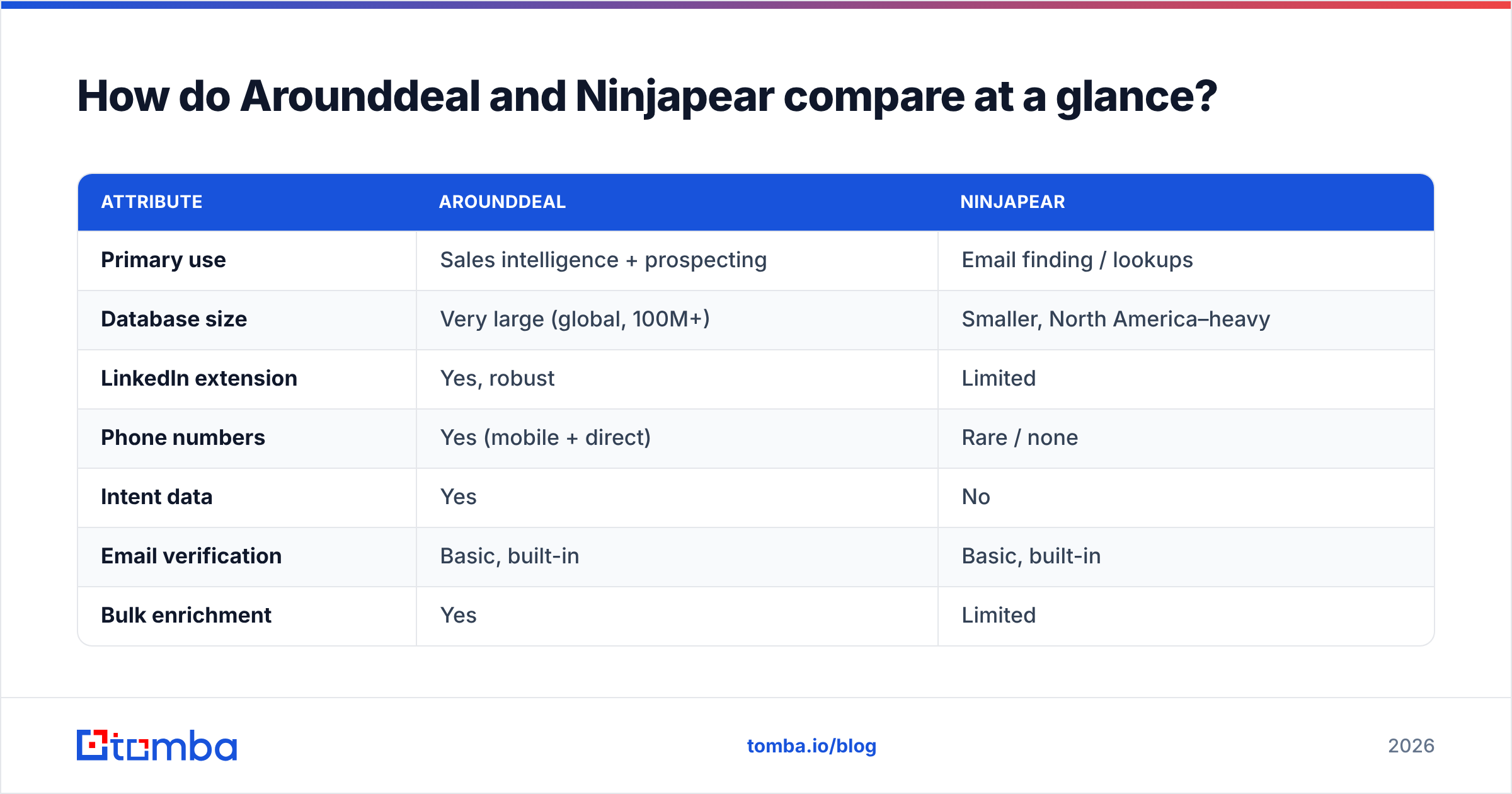
| Attribute | Arounddeal | Ninjapear |
|---|---|---|
| Primary use | Sales intelligence + prospecting | Email finding / lookups |
| Database size | Very large (global, 100M+) | Smaller, North America–heavy |
| LinkedIn extension | Yes, robust | Limited |
| Phone numbers | Yes (mobile + direct) | Rare / none |
| Intent data | Yes | No |
| Email verification | Basic, built-in | Basic, built-in |
| Bulk enrichment | Yes | Limited |
| Free tier | Yes (limited credits) | Yes (limited credits) |
| Entry paid price | ~$59/mo range | Lower / budget-tier |
| Best for | Mid-market SDR teams | Solo founders, small teams |
| Compliance posture | GDPR/CCPA stated | Less documented |
Treat the pricing column as directional. Both vendors change tiers often. Confirm current numbers on their sites and on a review aggregator like G2 or Capterra before you commit budget.
Which has better data accuracy?#
Accuracy is where "found rate" and "deliverable rate" quietly diverge. It is the metric that should drive your decision.
Arounddeal pulls from multiple sources and cross-references profiles. That generally yields higher coverage on senior and mid-market roles in the US and parts of APAC. Ninjapear relies more on pattern generation — guessing first.last@domain.com style formats — plus a lighter verification pass. Pattern generation is fast and cheap. But it produces plausible-looking addresses that were never confirmed to exist.
Here is the trap with both tools. A contact marked "found" is not the same as a contact marked "valid right now." People change jobs. Domains add catch-all rules. Mailboxes get deactivated. A database snapshot from last quarter can be 20–30% stale by the time you email it.

This is the single biggest reason to add a dedicated verification step, regardless of which platform you choose in the Arounddeal vs Ninjapear debate. Running your exported list through a catch-all verifier and an SMTP-level check catches the dead addresses that both tools will happily hand you. The cost of skipping it is not just wasted credits. It is sender reputation damage that suppresses every future campaign.

How does pricing compare?#
Both tools use a credit model, which makes apples-to-apples pricing harder than it looks. A "credit" might mean one email reveal on one tool and a full enrichment record on another.
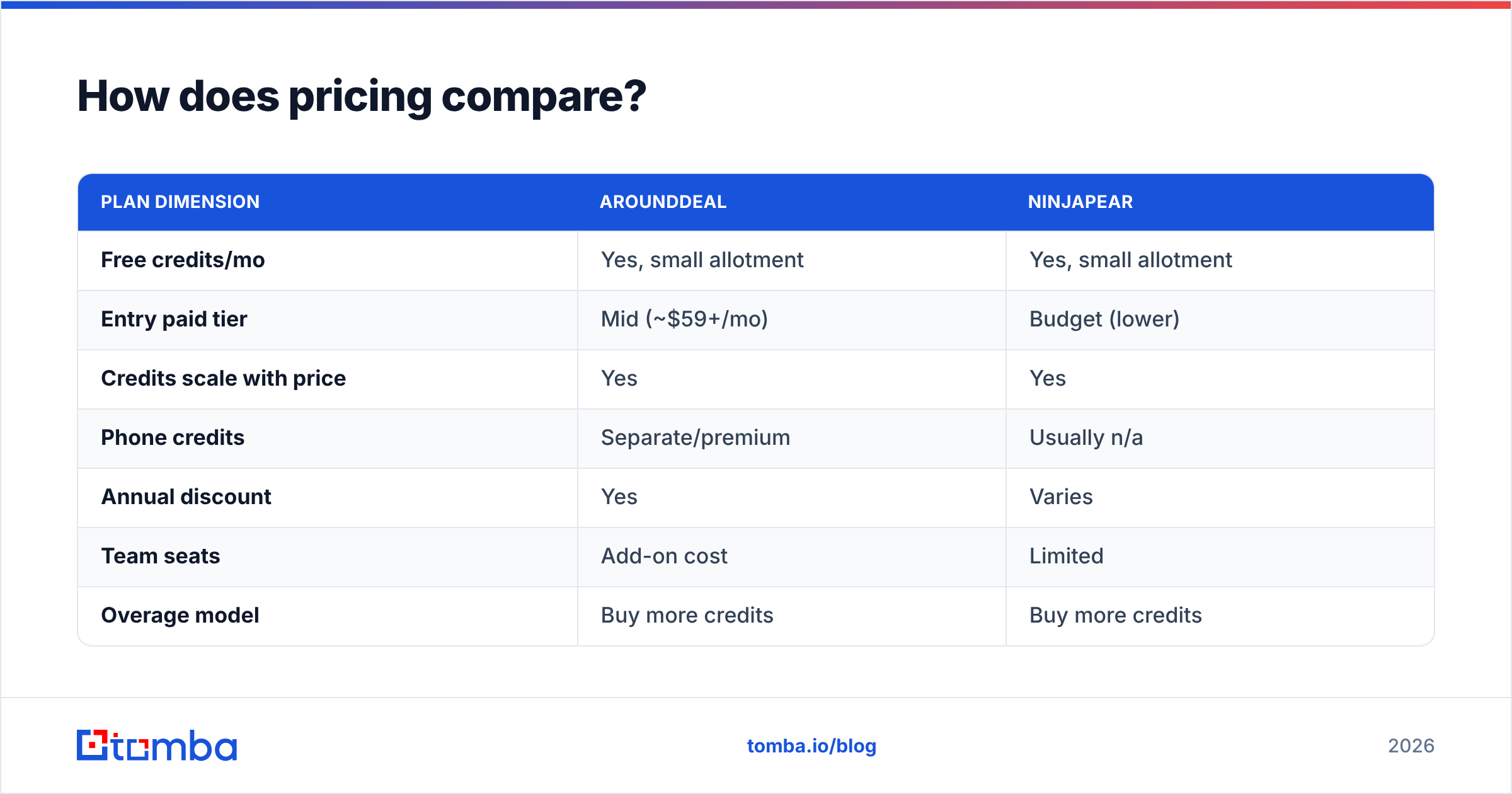
| Plan dimension | Arounddeal | Ninjapear |
|---|---|---|
| Free credits/mo | Yes, small allotment | Yes, small allotment |
| Entry paid tier | Mid (~$59+/mo) | Budget (lower) |
| Credits scale with price | Yes | Yes |
| Phone credits | Separate/premium | Usually n/a |
| Annual discount | Yes | Varies |
| Team seats | Add-on cost | Limited |
| Overage model | Buy more credits | Buy more credits |
Arounddeal costs more because you are paying for the database depth, the extension, and intent data. Ninjapear is cheaper because you get less. Neither is "expensive" or "cheap" in a vacuum. The real cost per usable lead depends on how many of those credits resolve to a deliverable address.
If you are price-sensitive, look closely at how each vendor treats unverified or catch-all results. Some tools charge a full credit for a guessed pattern that bounces. For context on how transparent, predictable lookup pricing can work, compare against Tomba pricing: a Free tier with 25 searches, Starter at $49/mo, Growth at $99/mo, and Pro at $249/mo, with verification built into the same workflow rather than billed as an afterthought.
Which is better for prospecting workflow?#
Workflow is where Arounddeal pulls clearly ahead. It is also where Ninjapear's simplicity is either a feature or a limit, depending on your team.
Arounddeal fits an SDR who lives inside LinkedIn Sales Navigator. The extension surfaces contact details on profile pages. You can build lists, push to your CRM, and layer in intent signals to prioritize accounts. It is a "research and reach out in one motion" tool.
Ninjapear fits someone who already has a list of names and companies and just needs the emails. Paste, find, export, done. There is less to learn and less to configure. That is genuinely valuable when you are a founder doing your own outbound between investor calls.
The deciding question is simple. Do you need to discover prospects, or do you already know who they are and just need to reach them? Discovery favors Arounddeal. Reaching favors a fast finder. If that is your case, a focused domain search that returns every known address pattern for a company often does the job for a fraction of a full platform license.
What about compliance and data sourcing?#
For any team emailing EU or UK contacts, compliance is not optional. Arounddeal publicly references GDPR and CCPA handling and offers opt-out mechanisms. That is the baseline you would expect from a platform selling into enterprise. Ninjapear documents this less thoroughly. That does not automatically mean it is non-compliant. But "less documented" is a real risk factor when your legal team asks where the data came from.
Two questions to put to either vendor before signing:
- What are your data sources, and do contacts have a lawful basis for processing? Vague answers are a red flag.
- How do you handle deletion and opt-out requests? You inherit their compliance posture the moment you import their data.
Transparency about sourcing is a feature, not a formality. It is worth reading how a provider documents its data sources and judging the others against that bar.
Is there a better alternative for cold outreach?#
Yes. If your core problem is bounce rate and deliverability rather than prospect discovery, a verification-first email finder will usually beat both Arounddeal and Ninjapear on the metric that matters.
The logic is simple. Arounddeal and Ninjapear optimize for coverage — how many contacts they can show you. A tool like Tomba optimizes for deliverability — how many of those addresses actually accept mail. Those are different goals. For cold email, deliverability wins, because a 10% bounce rate can get your whole domain throttled.

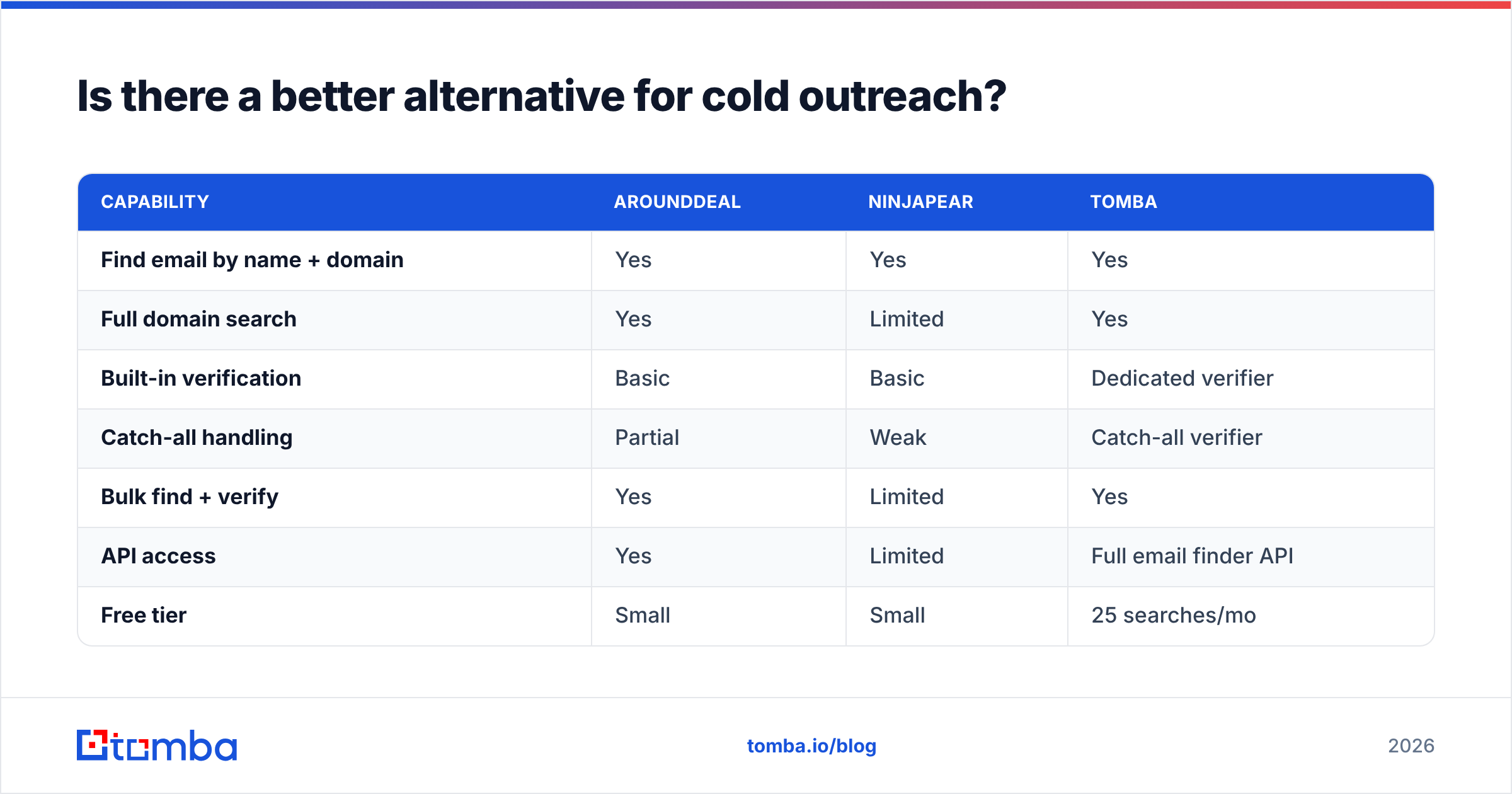
Here is how the three stack up for a cold-outreach use case specifically:
| Capability | Arounddeal | Ninjapear | Tomba |
|---|---|---|---|
| Find email by name + domain | Yes | Yes | Yes |
| Full domain search | Yes | Limited | Yes |
| Built-in verification | Basic | Basic | Dedicated verifier |
| Catch-all handling | Partial | Weak | Catch-all verifier |
| Bulk find + verify | Yes | Limited | Yes |
| API access | Yes | Limited | Full email finder API |
| Free tier | Small | Small | 25 searches/mo |
| Entry price | ~$59+/mo | Budget | $49/mo |
The point is not that Tomba replaces a full sales-intelligence platform. Arounddeal does things a finder does not, like intent data and deep firmographics. The point is narrower. For the specific job of turning a list of companies into a clean, sendable list of emails, a verification-native tool produces fewer bounces. Many teams run a hybrid: a database for discovery, then a finder-and-verifier to clean the export before it ever touches their sending domain.

How do you choose between Arounddeal and Ninjapear?#
Use this decision shortcut:
- Choose Arounddeal if you have a mid-market SDR team, you live in LinkedIn, and you want intent data plus phone numbers in one platform. You are buying breadth.
- Choose Ninjapear if you are a solo founder or tiny team on a tight budget who already knows your targets and just needs emails fast. You are buying simplicity.
- Choose a verification-first finder if your campaigns are bouncing, your sender reputation is fragile, or cold email is your primary channel. You are buying deliverability.
And regardless of which you pick: never send straight from a database export. The 15 minutes it takes to run a list through a bulk verify pass pays for itself the first time it saves your domain from a spam-trap hit.
Frequently asked questions#
Is Arounddeal more accurate than Ninjapear? Generally yes for coverage, especially on US mid-market and senior roles, because Arounddeal cross-references more sources. But "more found" is not "more deliverable." Both still require verification before you send.
Is Ninjapear good for beginners? It suits solo founders and small teams who want a no-frills paste-and-find experience without learning a full platform. The trade-off is a smaller database and fewer enrichment fields.
Can I use either tool without a separate verifier? You can, but you should not for cold email. Both include only basic verification. Pairing them with a dedicated email verification step is the difference between a 2% and a 12% bounce rate.
Which is cheaper, Arounddeal or Ninjapear? Ninjapear is typically the lower-priced option. But compare cost per deliverable lead, not cost per credit. A cheaper guessed address that bounces costs more than a verified one.
The bottom line#
In the Arounddeal vs Ninjapear matchup, Arounddeal is the stronger all-around platform and Ninjapear is the lean budget pick. But both optimize for coverage, and cold outreach is won or lost on deliverability. If your real goal is to turn a target list into clean, sendable contacts with the fewest bounces, start with the Tomba Email Finder — find emails by name, domain, or company, then verify them in the same flow before a single message goes out. Pair it with whichever database you choose, and your reply rate will reflect the difference. Spin up the free tier with 25 searches and run your next list through it before you hit send.
// get started
Find, verify and enrich your first contacts today
Start on the free plan with 25 searches a month, then scale when your team is ready.
Free plan · No credit card required · GDPR & CCPA
// about the author