Arounddeal vs Plusvibe (2026): Data vs Cold Email Tools
Arounddeal finds B2B contacts; Plusvibe sends cold email at scale. Here's which one your pipeline actually needs in 2026 — and where they overlap.
TL;DR
- Arounddeal and Plusvibe are not direct competitors. Arounddeal is a B2B contact-data platform (emails, phones, a Chrome extension). Plusvibe is a cold-email sending platform (sequences, inbox rotation, warmup). One fills your list; the other mails it.
- If you need accurate contact data, Arounddeal competes with email finders — but accuracy and pricing vary, and a dedicated finder/verifier often wins on cost per valid email.
- If you need to send cold email at scale, Plusvibe handles sequencing, deliverability tooling, and reply detection — Arounddeal does none of that.
- Most teams need both layers. The real decision is which data source feeds your sending tool, not "Arounddeal or Plusvibe."
- A finder-plus-verifier like Tomba Email Finder often slots in cheaper than Arounddeal's data tier while keeping bounce rates low for whatever sender you choose.
What are Arounddeal and Plusvibe?#
Quick conclusion first: these two tools sit at opposite ends of the outbound workflow, so comparing them feature-for-feature is a bit like comparing a grocery store to a kitchen. You need both to get dinner.
Arounddeal is a B2B intelligence and contact-data provider. Think of it as the part of the process where you build a list: you search a database of companies and people, pull work emails and direct-dial phone numbers, and push them into your CRM. Its best-known surface is a Chrome extension that reveals contact details on LinkedIn profiles, plus prospector and enrichment features.
Plusvibe is a cold-email engine. It's where you take a list you already have and actually run campaigns: multi-step sequences, AI-assisted copy, mailbox rotation across many sending accounts, built-in warmup, and a unified inbox to manage replies. Plusvibe assumes you already have verified contacts — it doesn't meaningfully source them for you.
So the honest framing of arounddeal vs plusvibe is: data acquisition versus message delivery. Let's break down each layer, then show where a focused tool beats a bundled one.
How do their core jobs differ?#
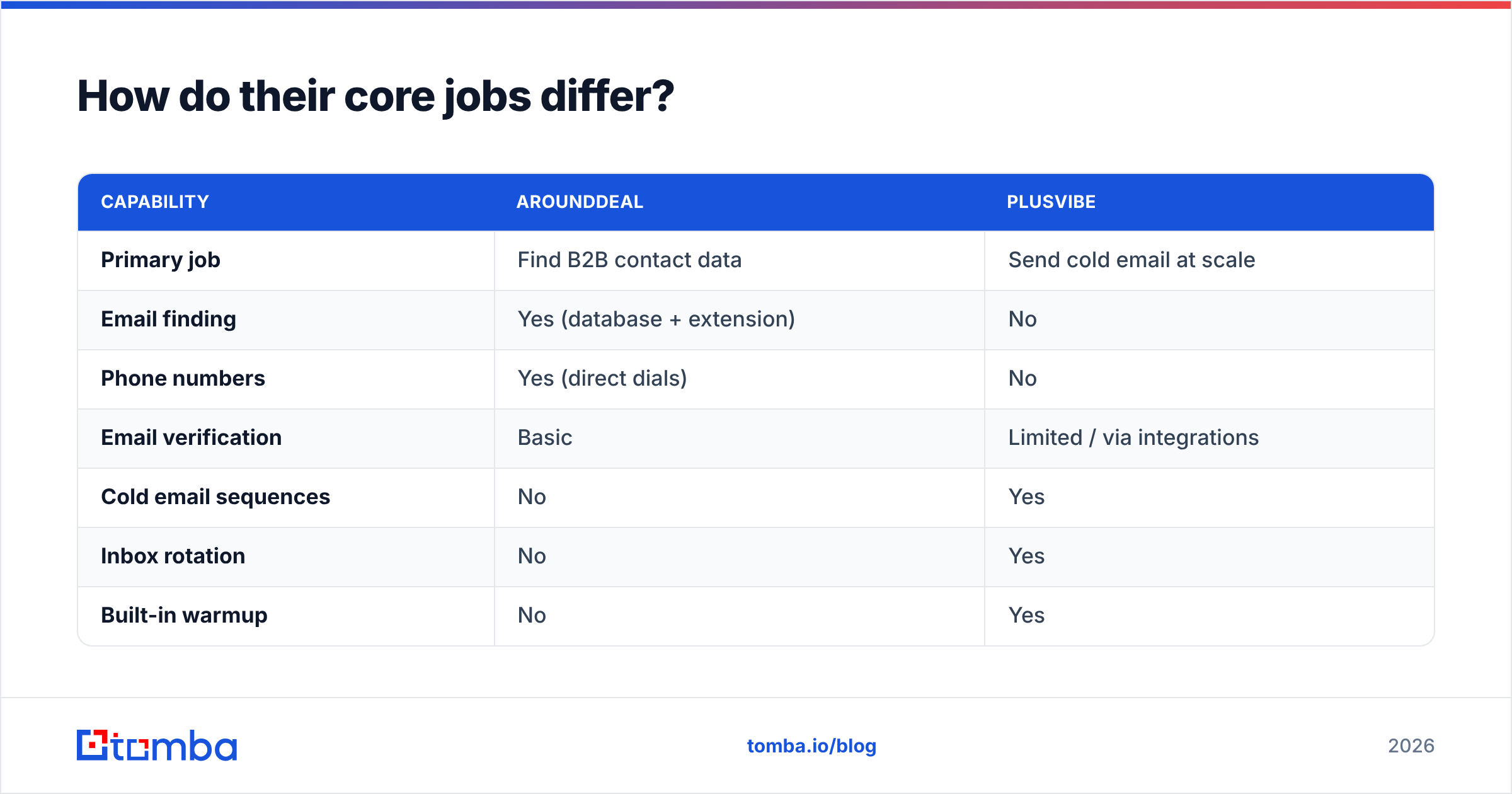
Here's the side-by-side. Notice that most rows are blank for one tool or the other — that's the whole point.
| Capability | Arounddeal | Plusvibe |
|---|---|---|
| Primary job | Find B2B contact data | Send cold email at scale |
| Email finding | Yes (database + extension) | No |
| Phone numbers | Yes (direct dials) | No |
| Email verification | Basic | Limited / via integrations |
| Cold email sequences | No | Yes |
| Inbox rotation | No | Yes |
| Built-in warmup | No | Yes |
| Unified reply inbox | No | Yes |
| AI copywriting | No | Yes |
| CRM enrichment | Yes | No |
| Best for | List building | Campaign execution |
Read that table and the question answers itself for most use cases. If your list is thin, you have an Arounddeal-shaped problem. If your list is solid but your open and reply rates are dying, you have a Plusvibe-shaped problem.
The trap teams fall into is buying one and assuming it covers the other. Arounddeal won't warm up your mailboxes or rotate sending domains. Plusvibe won't conjure accurate decision-maker emails out of thin air. Pretending otherwise is how you end up with a polished sequence blasting a list that's 30% invalid.

Which has better contact data — and how accurate is it?#
Conclusion: Arounddeal's data is usable but not category-leading, and accuracy is the single metric that should drive this part of your decision.
Cost per valid email matters more than cost per email. A provider that charges less but hands you a 12% bounce rate is more expensive in practice, because every bounce drags down your sender reputation and pushes future mail toward spam folders. Deliverability damage compounds; a bad list poisons even a great sequence.
Arounddeal pulls from crowd-sourced and public web data, which is fine for breadth but means freshness varies by region and seniority. For senior EU contacts or smaller markets, you'll see gaps and stale records. That's not unique to Arounddeal — it's the structural weakness of any single bundled database.
This is where a dedicated finder earns its keep. A tool whose entire business is finding and verifying emails — rather than treating data as one feature among many — can afford to run real-time SMTP checks and maintain tighter source hygiene. You can plug a verified email finder into the front of any sending tool, including Plusvibe, and decouple "where my data comes from" from "how I send."
If you mostly need company-wide coverage, domain search returns every public address pattern for a target company in one query, which is often faster than profile-by-profile extraction. And before anything hits a campaign, run it through an email verifier so your bounce rate stays under the 2–3% threshold that mailbox providers tolerate.
Which is better for sending cold email?#
Conclusion: Plusvibe wins this layer by default, because Arounddeal doesn't compete here at all.
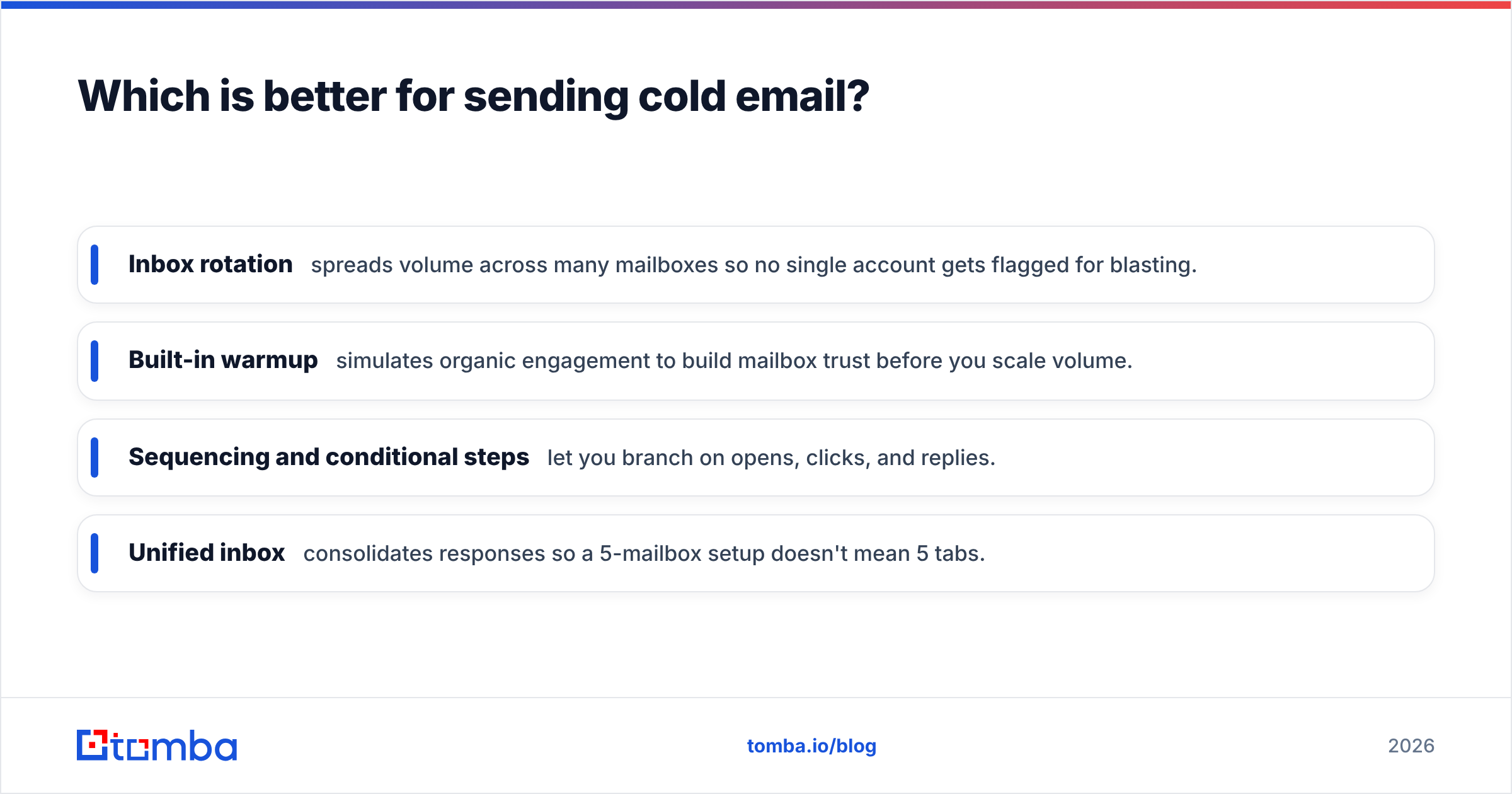
Plusvibe's sending stack covers the things that actually keep cold email out of spam in 2026:
- Inbox rotation spreads volume across many mailboxes so no single account gets flagged for blasting.
- Built-in warmup simulates organic engagement to build mailbox trust before you scale volume.
- Sequencing and conditional steps let you branch on opens, clicks, and replies.
- Unified inbox consolidates responses so a 5-mailbox setup doesn't mean 5 tabs.
These are table stakes for any modern cold-email platform, and Plusvibe positions itself as a budget-friendly entry in a field that includes Instantly, Smartlead, and Saleshandy. If sending is your bottleneck, Plusvibe is a reasonable pick — but evaluate it against those alternatives on G2, not against Arounddeal, which isn't playing the same sport.
What Plusvibe will not do is fix bad data. Warmup and rotation improve deliverability for valid addresses; they do nothing for invalid ones except let you bounce them faster across more domains. Which loops us right back to the data layer.
What does each one cost?#
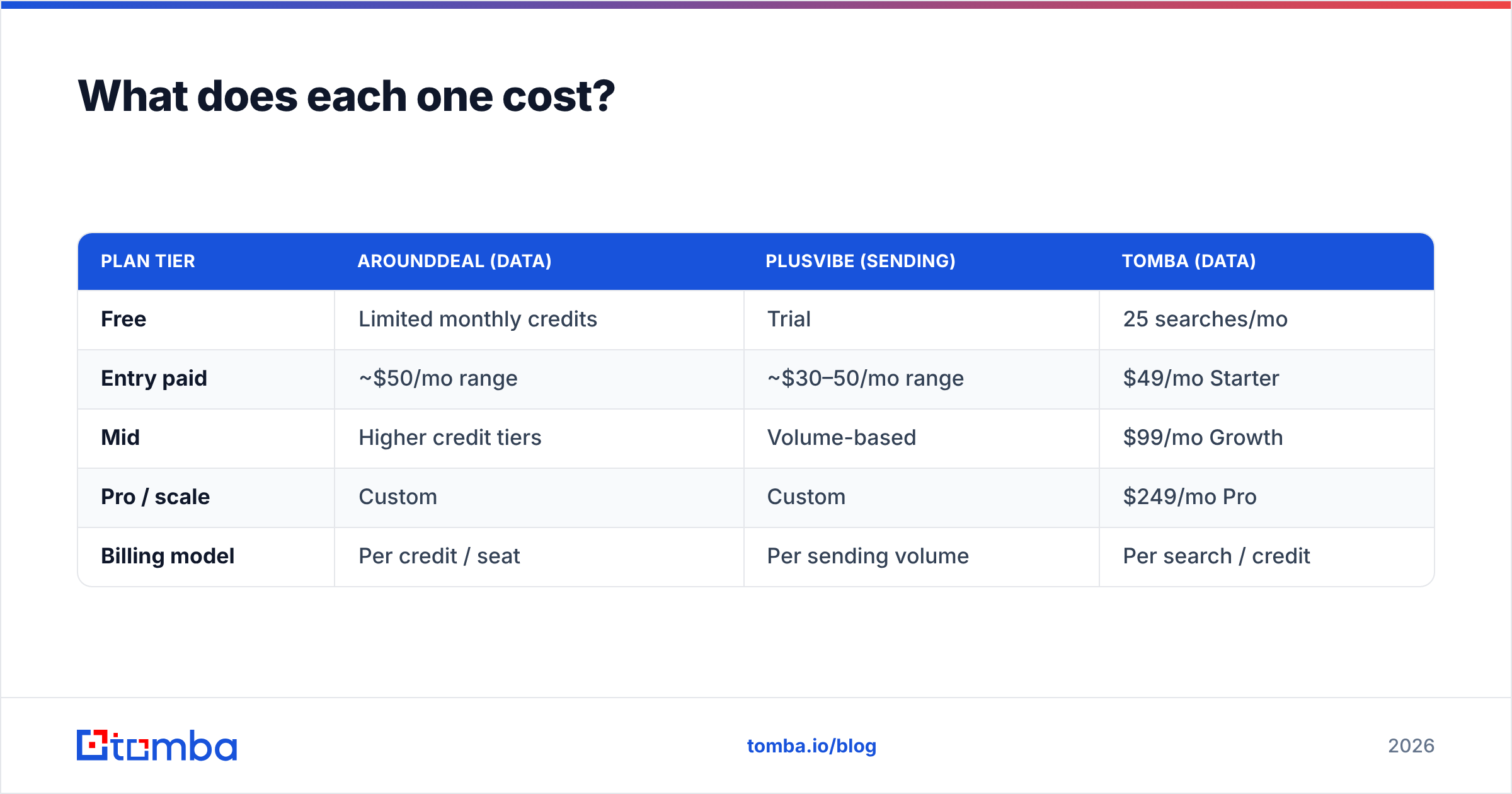
Pricing for both tools is credit- or seat-based and shifts often, so treat these as directional and confirm on each vendor's current page.
| Plan tier | Arounddeal (data) | Plusvibe (sending) | Tomba (data) |
|---|---|---|---|
| Free | Limited monthly credits | Trial | 25 searches/mo |
| Entry paid | ~$50/mo range | ~$30–50/mo range | $49/mo Starter |
| Mid | Higher credit tiers | Volume-based | $99/mo Growth |
| Pro / scale | Custom | Custom | $249/mo Pro |
| Billing model | Per credit / seat | Per sending volume | Per search / credit |
Two takeaways. First, you're often paying two separate bills anyway — a data tool and a sending tool — so "which is cheaper" is the wrong question. The right question is which combination gives you the lowest cost per booked meeting.
Second, on the data side specifically, a focused finder is frequently the better value. You can compare full Tomba pricing against Arounddeal's credit tiers; the Starter plan is $49/mo, and because verification is built in, you spend fewer credits chasing addresses that were never going to land. Pair that data layer with whatever sender you prefer — Plusvibe included.

When should you choose each one?#
Use this as a decision shortcut:
- Choose Arounddeal if your only gap is contact data, you live in the Chrome extension while prospecting on LinkedIn, and you want phone numbers alongside emails in one subscription. It's a competent all-in-one data grabber for reps who build lists manually.
- Choose Plusvibe if your lists are already solid and your problem is sending — you need sequences, mailbox rotation, and warmup without the price tag of the premium senders. Compare it to other Instantly alternatives before committing.
- Choose a dedicated finder + verifier + your sender of choice if you care about bounce rates, want to control data quality independently, and plan to scale. This is the setup most high-volume teams converge on.
For teams running real volume, that third path usually wins. You isolate each job — sourcing, verification, sending — so you can swap any one piece without re-architecting the stack. If Plusvibe's deliverability disappoints next quarter, you move the same verified list to a new sender. If Arounddeal's data goes stale in your territory, you change finders without touching campaigns.
How do you combine data and sending the right way?#
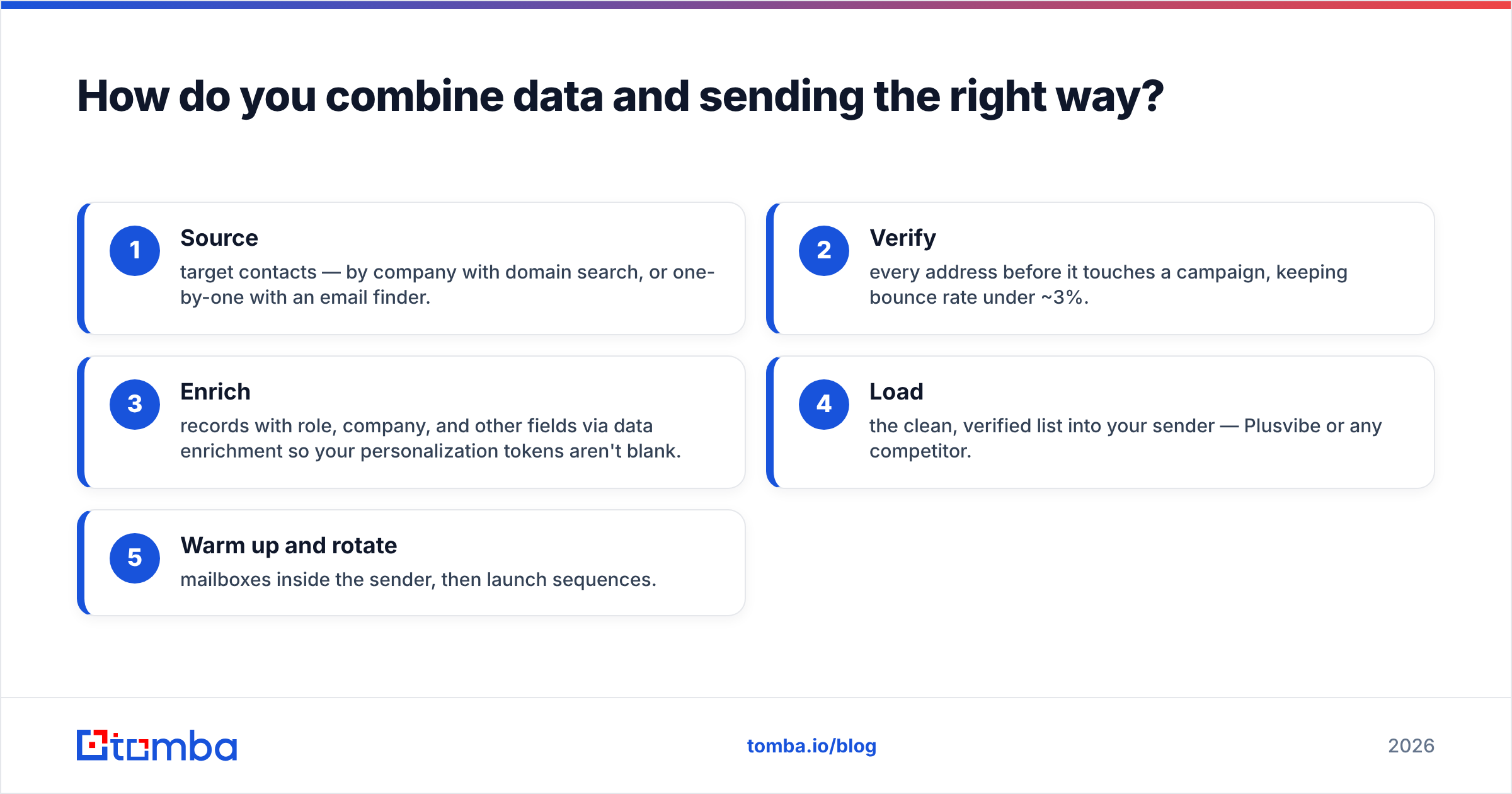
The clean workflow looks like this, regardless of which brand names you pick:
- Source target contacts — by company with domain search, or one-by-one with an email finder.
- Verify every address before it touches a campaign, keeping bounce rate under ~3%.
- Enrich records with role, company, and other fields via data enrichment so your personalization tokens aren't blank.
- Load the clean, verified list into your sender — Plusvibe or any competitor.
- Warm up and rotate mailboxes inside the sender, then launch sequences.
Notice steps 1–3 are the "Arounddeal layer" and steps 4–5 are the "Plusvibe layer." They're complementary stages, not rivals. The mistake is letting one vendor's weaker half drag down the other half. A bundled data tool with a weak sender, or a strong sender fed weak data, both underperform two focused tools wired together.
If you're standardizing this for a team, push data sourcing through an email finder API so list-building happens automatically inside your CRM or workflow tool, rather than reps hand-copying from a browser extension. Automation here is where cost per lead actually drops.
So, Arounddeal vs Plusvibe — who wins?#
Neither, because they're answering different questions. Arounddeal wins the data layer; Plusvibe wins the sending layer; and the smartest play is refusing to bundle a compromise.
If you're forced to buy just one today: buy the tool that fixes your actual bottleneck. Empty pipeline and no contacts? Start with data. Full list but tanking reply rates? Start with sending. Then add the other layer deliberately.
And on the data layer — the one that quietly decides whether your whole outbound motion works — don't settle for "good enough" accuracy bundled inside a broader tool. Start free with Tomba Email Finder: 25 searches a month at no cost, built-in verification, domain search for company-wide coverage, and an API to automate it all. Feed clean, verified contacts into Plusvibe or any sender you like, and let each layer do the one job it's actually good at.
// get started
Find, verify and enrich your first contacts today
Start on the free plan with 25 searches a month, then scale when your team is ready.
Free plan · No credit card required · GDPR & CCPA
// about the author