Arounddeal vs Revli: B2B Contact Data Compared (2026)
Arounddeal vs Revli: a neutral, data-first breakdown of coverage, accuracy, pricing, and compliance to help you pick the right B2B contact tool in 2026.
Arounddeal vs Revli: Which B2B Contact-Data Tool Should You Trust in 2026?
Choosing a contact-data vendor is less about logos and more about how many of the emails you export actually land. Arounddeal and Revli both promise B2B emails, phone numbers, and enrichment, but they come at the problem from opposite ends — one is a broad sales-intelligence database, the other a leaner, prospecting-first finder. This post compares them on the things that move pipeline: coverage, accuracy, pricing, compliance, and workflow fit.
TL;DR#
- Arounddeal is the heavier sales-intelligence play: a large global contact database, Chrome extension, intent signals, and team features aimed at SDR orgs.
- Revli is lighter and prospecting-focused — quick email lookups and list-building with a friendlier entry price, but a smaller verified dataset.
- Accuracy is the real decider. Both publish optimistic hit-rate claims; in practice you should verify every list before sending, regardless of vendor.
- Neither is a deliverability tool. They find contacts; keeping your domain healthy is on you.
- For teams that care most about verified emails and a clean API, a dedicated finder-plus-verifier stack (including Tomba Email Finder) often beats relying on a single database.
What is Arounddeal?#
Arounddeal is a B2B sales-intelligence platform built around a global contact and company database. Its pitch is breadth: hundreds of millions of contact records, a browser extension that surfaces emails and direct dials on LinkedIn and company sites, plus enrichment, intent data, and engagement tooling for outbound teams. It positions itself as an all-in-one prospecting layer rather than a single-purpose lookup utility.
The strengths are coverage and the LinkedIn workflow. If your reps live in LinkedIn Sales Navigator, an extension that reveals contact details inline removes a lot of copy-paste friction. The trade-off is the usual one for large aggregated databases: record freshness varies by region and seniority, and "available" does not always mean "deliverable."
What is Revli?#
Revli is a lighter-weight B2B email finder and lead-generation tool aimed at founders, small sales teams, and freelancers who want contacts without the cost or complexity of a full sales-intelligence suite. The emphasis is speed and simplicity: search by company or person, pull emails, build a list, export.
That focus is a genuine advantage for early-stage outbound. You are not paying for intent dashboards or team analytics you will never open. The flip side is depth — a smaller verified dataset and fewer enterprise controls mean Revli can leave gaps on harder-to-find roles, niche industries, or non-US geographies where data is thinner.
Arounddeal vs Revli: how do they compare at a glance?#
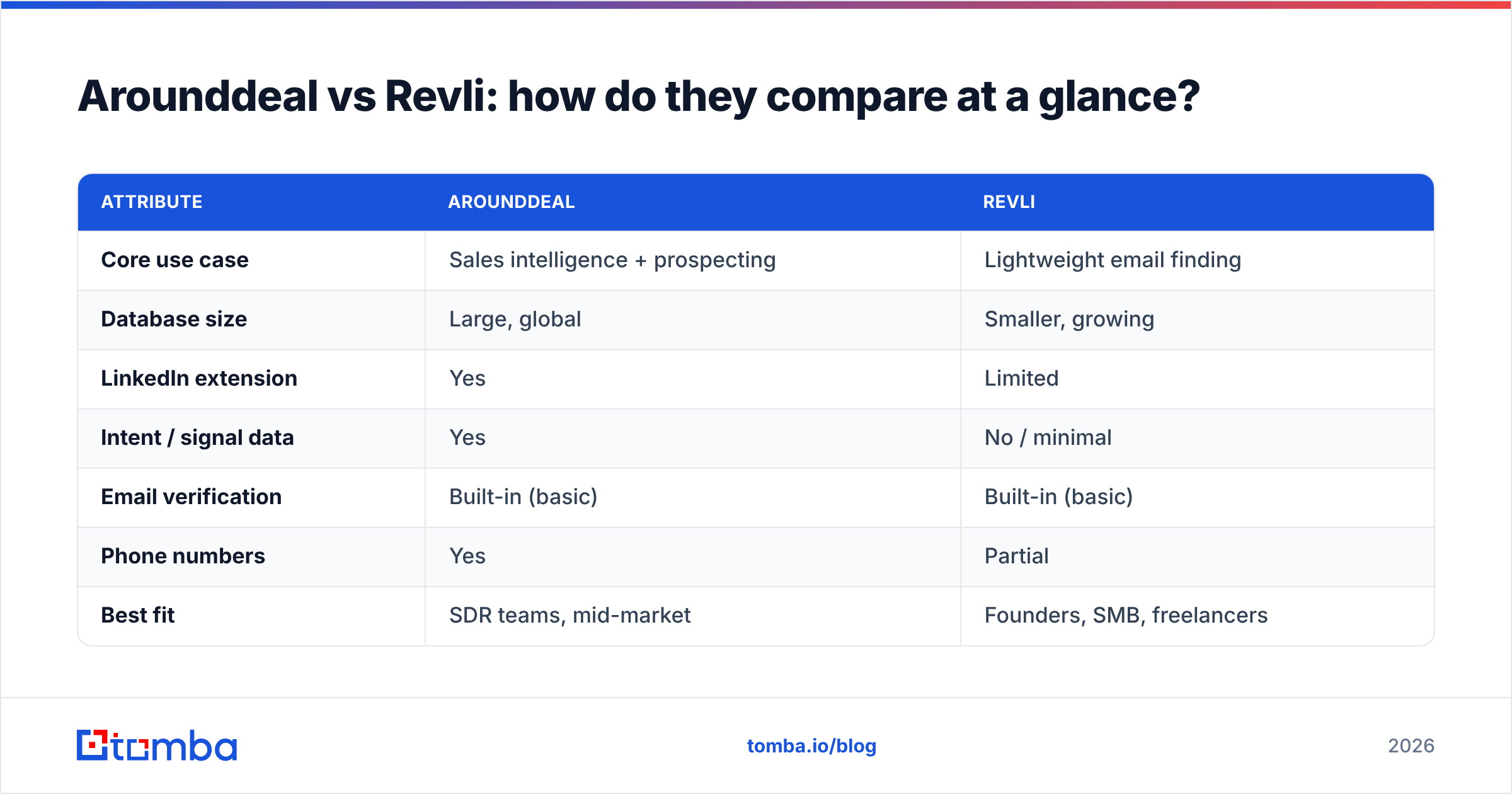
The two tools serve overlapping users but optimize for different buyers. Arounddeal wants to be the system of record for an SDR team; Revli wants to be the fastest way for a small team to get a usable list.
| Attribute | Arounddeal | Revli |
|---|---|---|
| Core use case | Sales intelligence + prospecting | Lightweight email finding |
| Database size | Large, global | Smaller, growing |
| LinkedIn extension | Yes | Limited |
| Intent / signal data | Yes | No / minimal |
| Email verification | Built-in (basic) | Built-in (basic) |
| Phone numbers | Yes | Partial |
| Best fit | SDR teams, mid-market | Founders, SMB, freelancers |
| Free tier | Limited credits | Limited credits |
| API access | Yes | Limited |
Read this table as a starting point, not a verdict. The "right" tool depends on whether your bottleneck is finding enough contacts (favoring Arounddeal's breadth) or finding contacts cheaply and fast (favoring Revli's simplicity).
Which one is more accurate?#
Accuracy is where marketing copy and reality diverge, so treat both vendors' headline numbers with skepticism. A "95% accuracy" claim usually describes a curated subset under ideal conditions, not the messy list you actually export on a Tuesday.

Three factors decide real-world accuracy, and they apply to Arounddeal and Revli equally:
- Recency of the source. B2B people change jobs constantly. A record verified 18 months ago is a coin flip today. Larger databases like Arounddeal's have more records but also more stale records to maintain.
- Catch-all handling. Many corporate domains accept every address at the SMTP layer, so a naive checker marks them "valid" when they may bounce. How a tool treats catch-alls matters more than its raw hit rate. If this is a frequent problem for your target accounts, a dedicated catch-all verifier is worth adding to your stack.
- Verification depth. "Found" and "verified" are different states. Both tools include basic verification, but neither replaces a purpose-built email verifier run as a final gate before you send.
The practical takeaway: whichever vendor you choose, run every exported list through independent verification. The cost of a verification pass is trivial next to the cost of a torched sender reputation.
)
How does pricing compare?#
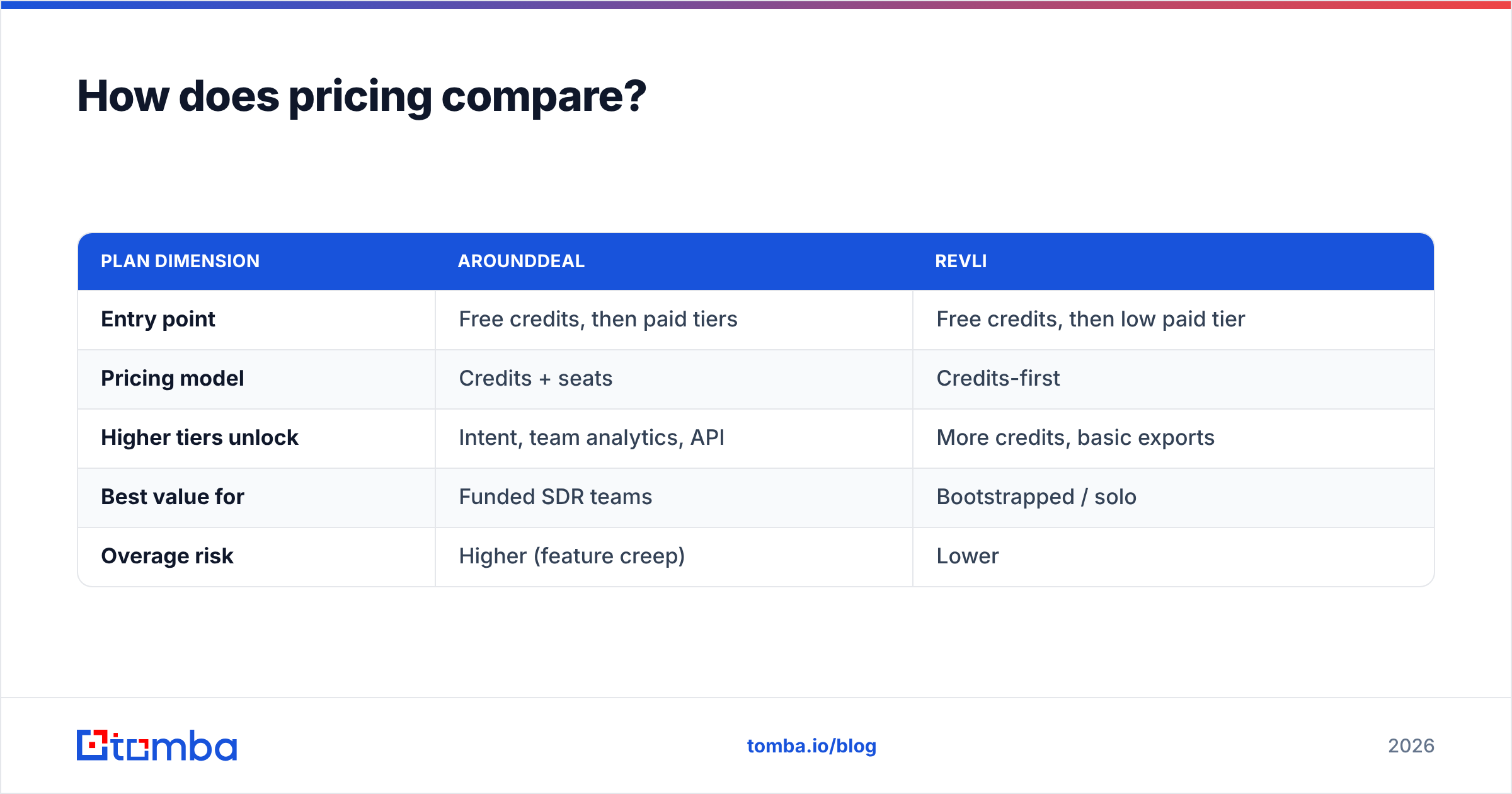
Pricing structures differ enough that a straight per-seat comparison misleads. Arounddeal tends to price like a sales-intelligence suite — credit bundles plus seats, with intent and team features gated to higher tiers. Revli prices like a utility — lower entry cost, fewer bells, credits that map closely to lookups.
| Plan dimension | Arounddeal | Revli |
|---|---|---|
| Entry point | Free credits, then paid tiers | Free credits, then low paid tier |
| Pricing model | Credits + seats | Credits-first |
| Higher tiers unlock | Intent, team analytics, API | More credits, basic exports |
| Best value for | Funded SDR teams | Bootstrapped / solo |
| Overage risk | Higher (feature creep) | Lower |
A note on comparing cost honestly: the cheapest sticker price is rarely the cheapest outcome. If Tool A finds the same contact at a 70% verified rate and Tool B at 90%, Tool B is cheaper per usable lead even at a higher headline price. Always normalize on cost per deliverable contact, not cost per credit. For a transparent reference point on how usage-based contact tooling is structured, see Tomba pricing, where the Starter plan is $49/mo and the Growth plan is $99/mo.
What about compliance and data sourcing?#
For any B2B data vendor, where the data comes from is a real risk, not a footnote. Both Arounddeal and Revli aggregate from public web sources, user contributions, and partnerships, which is standard — but the standard still carries GDPR and CCPA obligations for you as the sender.
Two questions to ask either vendor before you commit:
- Can you honor deletion and opt-out requests at the record level? You need this to stay compliant when a contact asks to be removed.
- Is there a documented lawful basis for processing EU contacts? "Legitimate interest" for B2B outreach is defensible only with the right safeguards.
Transparency about sourcing is a green flag. Vendors that publish how and where they collect data — the way Tomba documents its data sources — make your own compliance story easier to defend. If a vendor is vague about provenance, treat that as a cost, not a neutral.
For the underlying mechanics, the concepts of sender reputation and email deliverability are worth understanding before you scale outreach on data from any source.
When should you choose Arounddeal?#
Pick Arounddeal when breadth and workflow integration outweigh price sensitivity:
- You run a multi-rep SDR team that needs shared credits, seats, and basic analytics.
- Your motion is LinkedIn-first, and an inline extension saves real time per prospect.
- You want intent signals to prioritize accounts, not just raw contacts.
- You operate in mid-market or enterprise segments where Arounddeal's larger dataset has an edge on coverage.
The risk to manage is data freshness and overpaying for features your team will not adopt. Audit actual usage after 60 days.
When should you choose Revli?#
Pick Revli when speed, simplicity, and budget dominate:
- You are a founder or solo seller building lists yourself.
- You need occasional, targeted lookups, not a standing intelligence platform.
- Your targets are mostly US-based roles where lighter datasets still perform reasonably.
- You want to avoid feature bloat and pay close to per-lookup cost.
The risk to manage is coverage gaps on harder roles and geographies. Have a fallback finder ready for the contacts Revli misses.
Is there a better third option?#
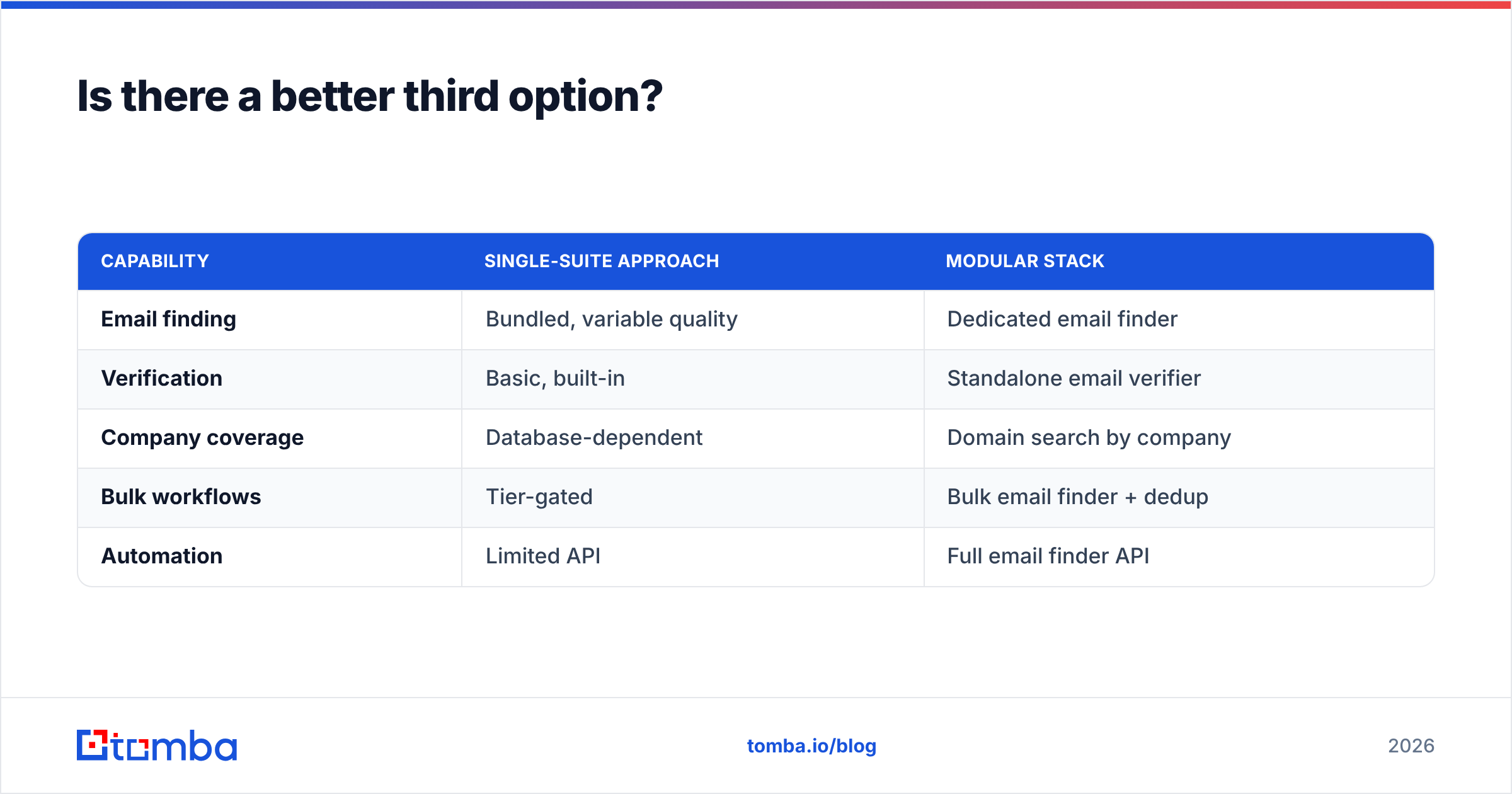
For many teams, the smartest answer to "Arounddeal vs Revli" is "neither alone." A modular stack — a high-accuracy finder, an independent verifier, and clean enrichment — often beats betting your whole motion on one database's claims.
That is the gap a focused tool fills. Instead of a sprawling suite, you compose exactly what you need:
| Capability | Single-suite approach | Modular stack |
|---|---|---|
| Email finding | Bundled, variable quality | Dedicated email finder |
| Verification | Basic, built-in | Standalone email verifier |
| Company coverage | Database-dependent | Domain search by company |
| Bulk workflows | Tier-gated | Bulk email finder + dedup |
| Automation | Limited API | Full email finder API |
The modular model also de-risks vendor lock-in. If one component underperforms, you swap that component — not your entire pipeline.
)
How should you actually test these tools?#
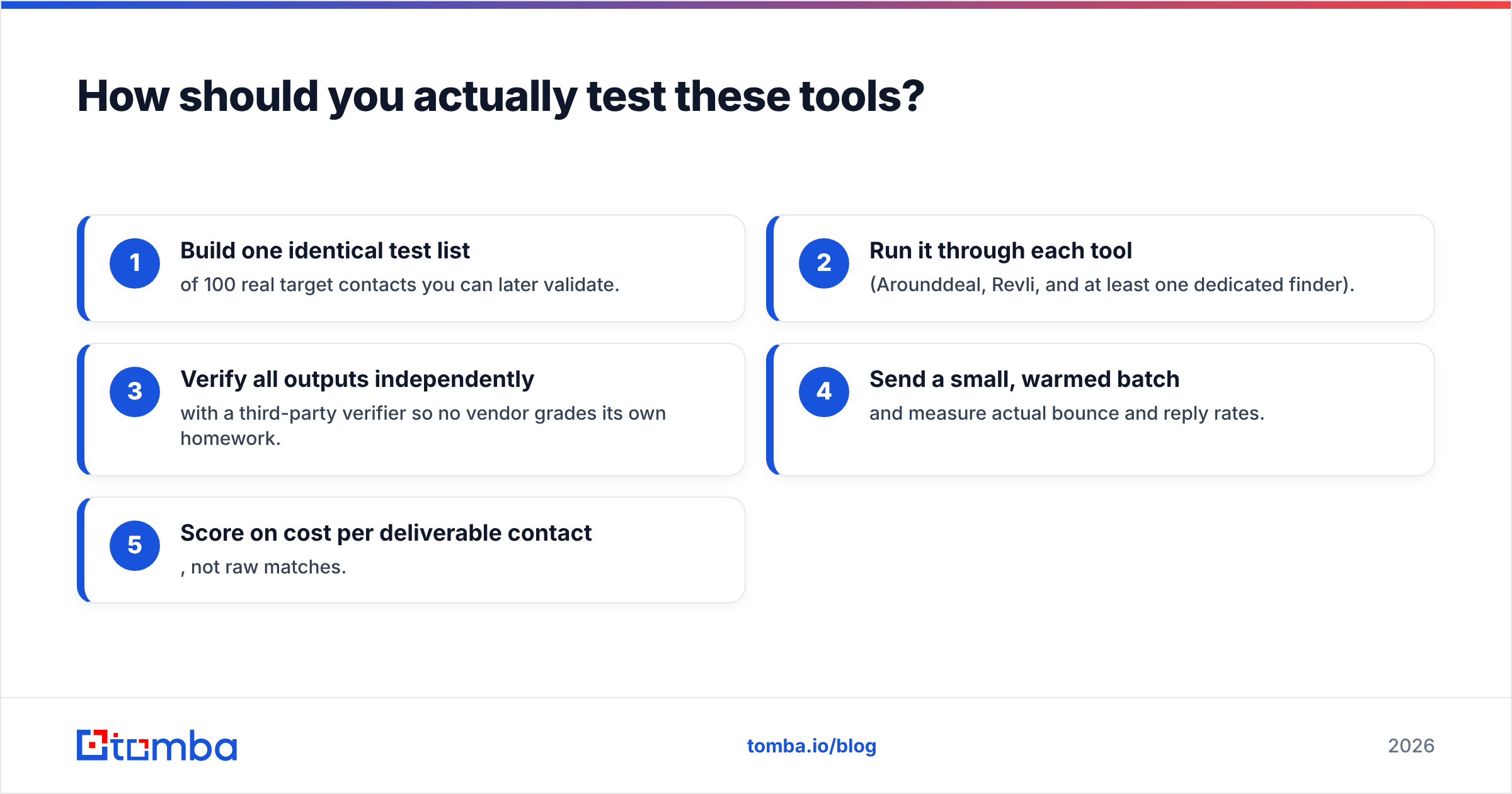
Do not trust any comparison post — including this one — over your own data. Run a controlled bake-off:
- Build one identical test list of 100 real target contacts you can later validate.
- Run it through each tool (Arounddeal, Revli, and at least one dedicated finder).
- Verify all outputs independently with a third-party verifier so no vendor grades its own homework.
- Send a small, warmed batch and measure actual bounce and reply rates.
- Score on cost per deliverable contact, not raw matches.
This takes an afternoon and replaces a month of guessing. The vendor that wins your bake-off on your segments is the right answer, full stop.

For broader context on how these tools sit in the market, independent review aggregators like G2 and Capterra are useful for reading unfiltered user sentiment — pay special attention to reviews mentioning bounce rates and data freshness, not just UI praise. HubSpot's sales statistics roundup is also a solid reference for benchmarking your outbound metrics against industry norms.
Frequently asked questions#
Is Arounddeal better than Revli? Neither is universally better. Arounddeal wins on breadth, LinkedIn workflow, and team features; Revli wins on price and simplicity for small teams. Match the tool to your bottleneck.
Are the emails from these tools safe to send to immediately? No. Always re-verify exported lists with an independent verifier before sending. Built-in verification is a starting filter, not a final gate.
Do either of these tools improve deliverability? No. They find contacts. Deliverability depends on your domain reputation, authentication (SPF/DKIM/DMARC), and sending behavior — separate disciplines entirely.
Can I use both alongside a dedicated finder? Yes, and many teams do. Use one for breadth, another for coverage gaps, and a dedicated finder-plus-verifier to clean and confirm the final list.
The bottom line#
Arounddeal and Revli solve the same problem at different scales: Arounddeal for SDR teams that need a broad intelligence layer, Revli for lean teams that want fast, affordable lookups. But both live or die on accuracy, and neither removes your obligation to verify before you send.
If your priority is verified emails, transparent data sourcing, and a clean API you can build on, run your bake-off with a dedicated finder in the mix. Start free with the Tomba Email Finder — find professional emails by domain, name, or company, then verify them in the same workflow before your first send. The 25-search free tier is enough to run the head-to-head test above and let your own deliverability data pick the winner.
// get started
Find, verify and enrich your first contacts today
Start on the free plan with 25 searches a month, then scale when your team is ready.
Free plan · No credit card required · GDPR & CCPA
// about the author