AroundDeal vs SignalHire 2026: Which B2B Data Tool Wins?
AroundDeal vs SignalHire compared on accuracy, pricing, coverage, and compliance — plus where each one falls short and the lighter alternative worth testing.
You have budget for one contact-data tool this quarter, and AroundDeal and SignalHire keep landing on your shortlist. They look interchangeable from the pricing page — both promise emails, phone numbers, and a Chrome extension that scrapes LinkedIn. They are not interchangeable. One leans on a community-style database with strong APAC coverage; the other built its name on real-time phone and email reveal from social profiles.
This is a head-to-head on the things that actually move reply rates: data accuracy, phone coverage, pricing math, compliance, and how each one behaves when you push it to bulk volume.
TL;DR — AroundDeal vs SignalHire at a glance#
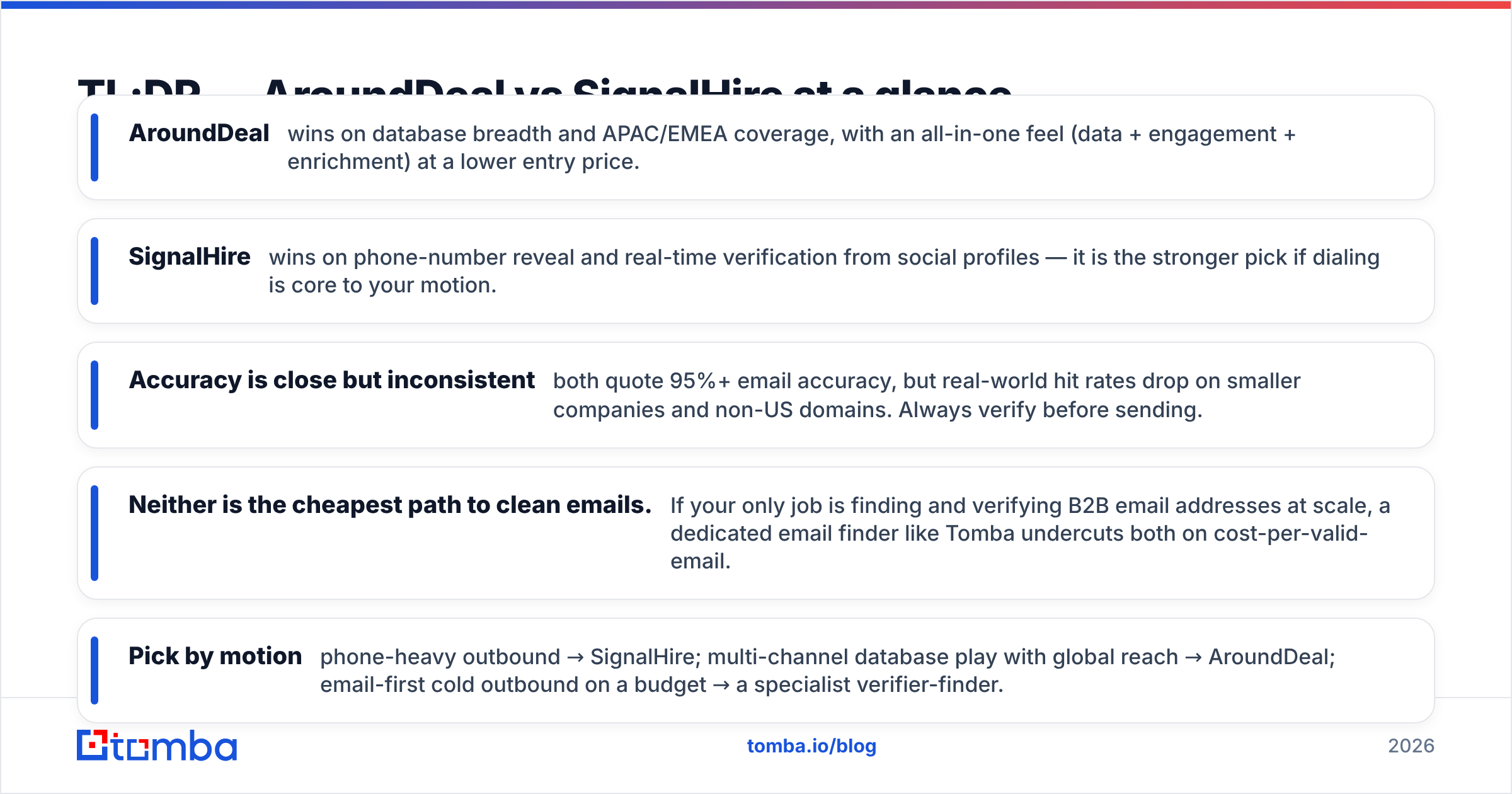
- AroundDeal wins on database breadth and APAC/EMEA coverage, with an all-in-one feel (data + engagement + enrichment) at a lower entry price.
- SignalHire wins on phone-number reveal and real-time verification from social profiles — it is the stronger pick if dialing is core to your motion.
- Accuracy is close but inconsistent: both quote 95%+ email accuracy, but real-world hit rates drop on smaller companies and non-US domains. Always verify before sending.
- Neither is the cheapest path to clean emails. If your only job is finding and verifying B2B email addresses at scale, a dedicated email finder like Tomba undercuts both on cost-per-valid-email.
- Pick by motion: phone-heavy outbound → SignalHire; multi-channel database play with global reach → AroundDeal; email-first cold outbound on a budget → a specialist verifier-finder.
What is AroundDeal and who is it for?#
AroundDeal is a B2B data and engagement platform built around a database of roughly 100M+ contacts, with unusually deep coverage in Asia-Pacific and EMEA compared to US-centric rivals. Beyond raw contact lookup, it bundles intent signals, a basic engagement/sequence layer, and CRM enrichment — positioning itself as an Apollo-style "all in one" rather than a pure finder.
It fits teams that:
- Sell into APAC or European markets where US-first databases thin out.
- Want prospecting, enrichment, and light sequencing under one login.
- Prefer a low entry price and credit-based flexibility over per-seat lock-in.
The trade-off is depth. AroundDeal's engagement features are serviceable, not best-in-class, and its data on small or privately held companies can be patchy. You can confirm current tiers on the AroundDeal site and read unfiltered user notes on G2.
What is SignalHire and who is it for?#
SignalHire is a contact-finder that specializes in real-time reveal: instead of only serving a pre-built database row, it resolves emails and — critically — phone numbers from social and professional profiles at the moment you request them. That makes it a favorite of recruiters and sales reps whose workflow is "I'm on this LinkedIn profile, give me a number I can dial."
It fits teams that:
- Live in the dialer and need mobile/direct numbers more than bulk email lists.
- Recruit candidates and need contact data tied to individual profiles.
- Want a straightforward credit model without a heavy platform around it.
The trade-off: SignalHire is narrower. There is no real sequencing engine, intent data is limited, and bulk email workflows feel secondary to the one-profile-at-a-time reveal. Check the SignalHire homepage for the latest credit packs.
How accurate is the data on each platform?#
Both vendors advertise 95%+ email accuracy. Treat that number the way you treat a "lose 10 lbs in a week" ad — true under ideal conditions, optimistic in the wild.
In practice:
- AroundDeal is strongest on mid-to-large companies and international domains. Accuracy on tiny startups and personal-domain founders drops, and stale data on job-changers is a recurring complaint.
- SignalHire benefits from real-time resolution, so it is less likely to serve a contact who left the company two years ago. But real-time lookups can also return nothing on thin profiles, where AroundDeal's database would at least guess a pattern.
The honest takeaway: a vendor's quoted accuracy is a ceiling, not a guarantee. Whatever you export, run it through an independent email verifier before it touches your sending domain. Bounces above 3-4% damage email deliverability and sender reputation faster than any single campaign can recover.


Wait — that's the wrong asset. Here's the one that belongs in this section:
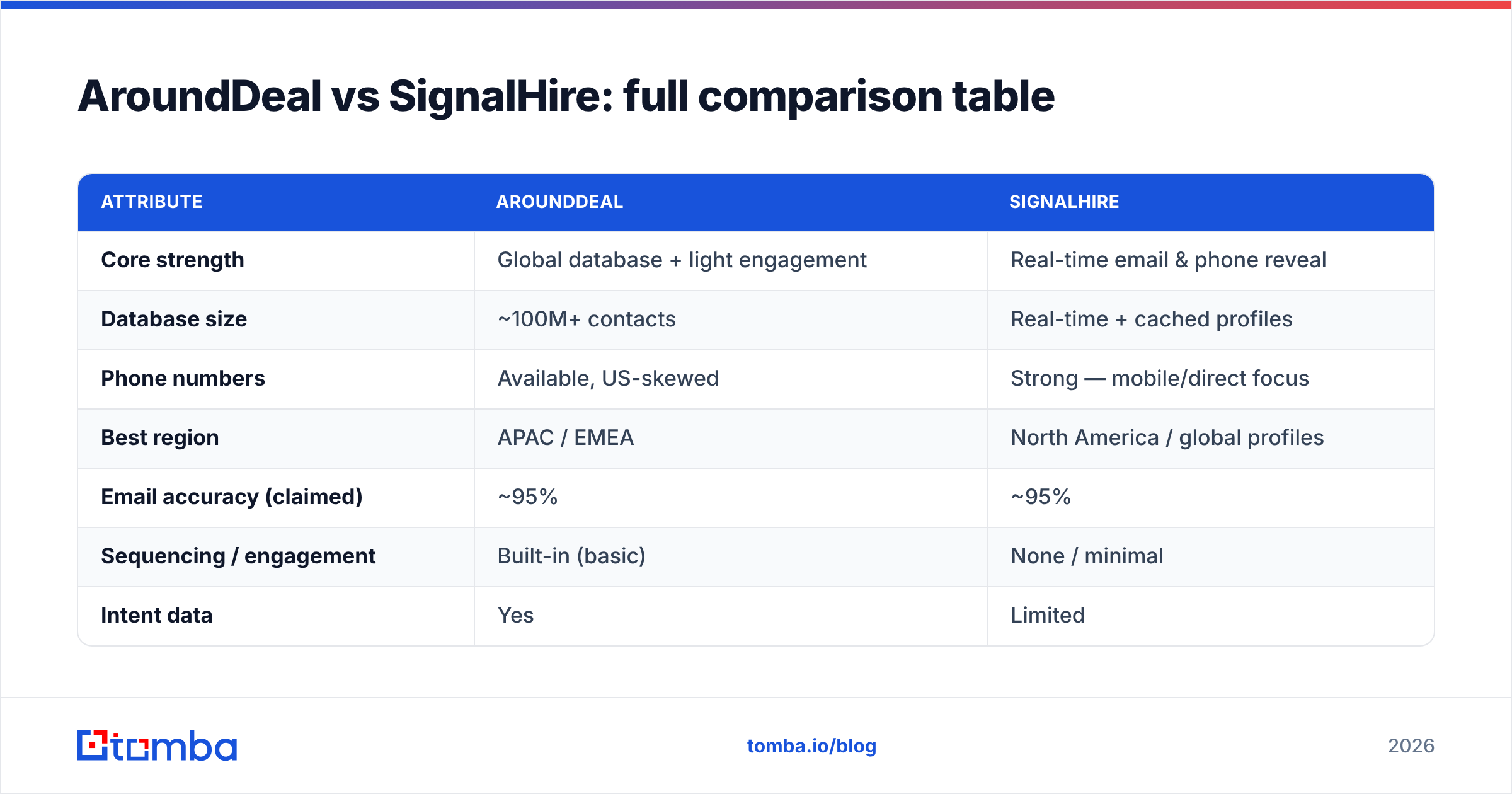
AroundDeal vs SignalHire: full comparison table#
| Attribute | AroundDeal | SignalHire |
|---|---|---|
| Core strength | Global database + light engagement | Real-time email & phone reveal |
| Database size | ~100M+ contacts | Real-time + cached profiles |
| Phone numbers | Available, US-skewed | Strong — mobile/direct focus |
| Best region | APAC / EMEA | North America / global profiles |
| Email accuracy (claimed) | ~95% | ~95% |
| Sequencing / engagement | Built-in (basic) | None / minimal |
| Intent data | Yes | Limited |
| Entry price | ~$59/mo range, credit-based | ~$49/mo range, credit-based |
| Free tier | Limited free credits | Limited free credits |
| Chrome extension | Yes | Yes |
| Bulk workflows | Good | Secondary |
| Best for | Multi-channel, global outbound | Phone-heavy dialing & recruiting |
Pricing on both shifts often and depends on credit packs, so verify on each vendor's page before committing. The pattern that holds: AroundDeal gives you more surface area per dollar, SignalHire gives you better phone reveal per credit.
Which one has better phone coverage?#
SignalHire, in most workflows. Phone-number reveal is its origin story, and reps who cold-call report higher mobile-number hit rates from SignalHire than from AroundDeal's database pulls. If your pipeline depends on connecting by dialer — recruiting, high-ACV sales, or any motion where email response rates have flattened — that edge is worth paying for.
AroundDeal does serve phone data, but it skews toward US office/direct lines and is less reliable for mobile. If you only occasionally need a number, AroundDeal is fine. If dialing is the primary channel, SignalHire is the safer pick — and you can pair either with a dedicated phone finder to fill gaps.
How do AroundDeal and SignalHire handle compliance?#
Both operate in the gray-to-defensible zone that all profile-scraping contact tools occupy. They claim GDPR and CCPA alignment, offer suppression/opt-out handling, and position their data as legitimate-interest B2B contact info.
What you should actually do, regardless of vendor:
- Keep your own suppression list and honor opt-outs at the sending layer, not just the data layer.
- Document your lawful basis for processing if you sell into the EU.
- Don't treat "the vendor says it's compliant" as your compliance program. Per Gartner guidance on data governance, accountability stays with the controller — you.
Neither tool is meaningfully more or less risky than the other here. Your sending behavior matters more than your data source's marketing copy.
When is a dedicated email finder the smarter buy?#
When your bottleneck is clean, verified email at volume — not phone reveal and not a second sequencing tool you won't use.
Here's the math that gets buried in "all-in-one" pitches: if you're paying for intent data, an engagement layer, and a database you only query for emails, you're subsidizing features you don't touch. A focused finder-plus-verifier stack often delivers a lower cost-per-valid-email and fewer bounces because verification is the core competency, not an afterthought.
This is where Tomba fits the comparison honestly. It won't dial for you and it isn't trying to be a CRM. What it does is find and verify professional emails — by name, by domain search, or in bulk — with verification built into the same flow. For an email-first cold outbound team, that's the whole job.
A simple decision rule:
| Your primary need | Best fit |
|---|---|
| Mobile numbers for dialing | SignalHire |
| Global database + light sequencing | AroundDeal |
| High-volume verified email, low cost | Dedicated finder (e.g., Tomba) |
| All three, deep, one tool | None — stack two specialists |
The "one tool does everything" promise is where both platforms quietly compromise. You'll usually get a better result wiring a strong finder to a strong dialer than buying one product that's mediocre at both.
How do they compare on integrations and workflow?#
AroundDeal has the wider native integration surface — CRM sync, enrichment-on-add, and its own sequencing — so a small team can run more of its motion inside one tool. SignalHire integrates with the major CRMs and ATSs but expects you to bring your own outreach engine.
For teams that already standardized on a CRM and a sequencer, integration breadth matters less than data quality flowing into that stack. In that case, an API-first approach — pulling verified contacts via an email finder API into your existing pipeline — beats adopting yet another platform UI your reps have to learn.
Whichever you choose, audit the export-to-CRM path during the trial. The most common post-purchase regret with both tools is discovering that the field mapping or dedupe behavior creates messy records you then pay to clean up.
Final verdict: AroundDeal vs SignalHire#
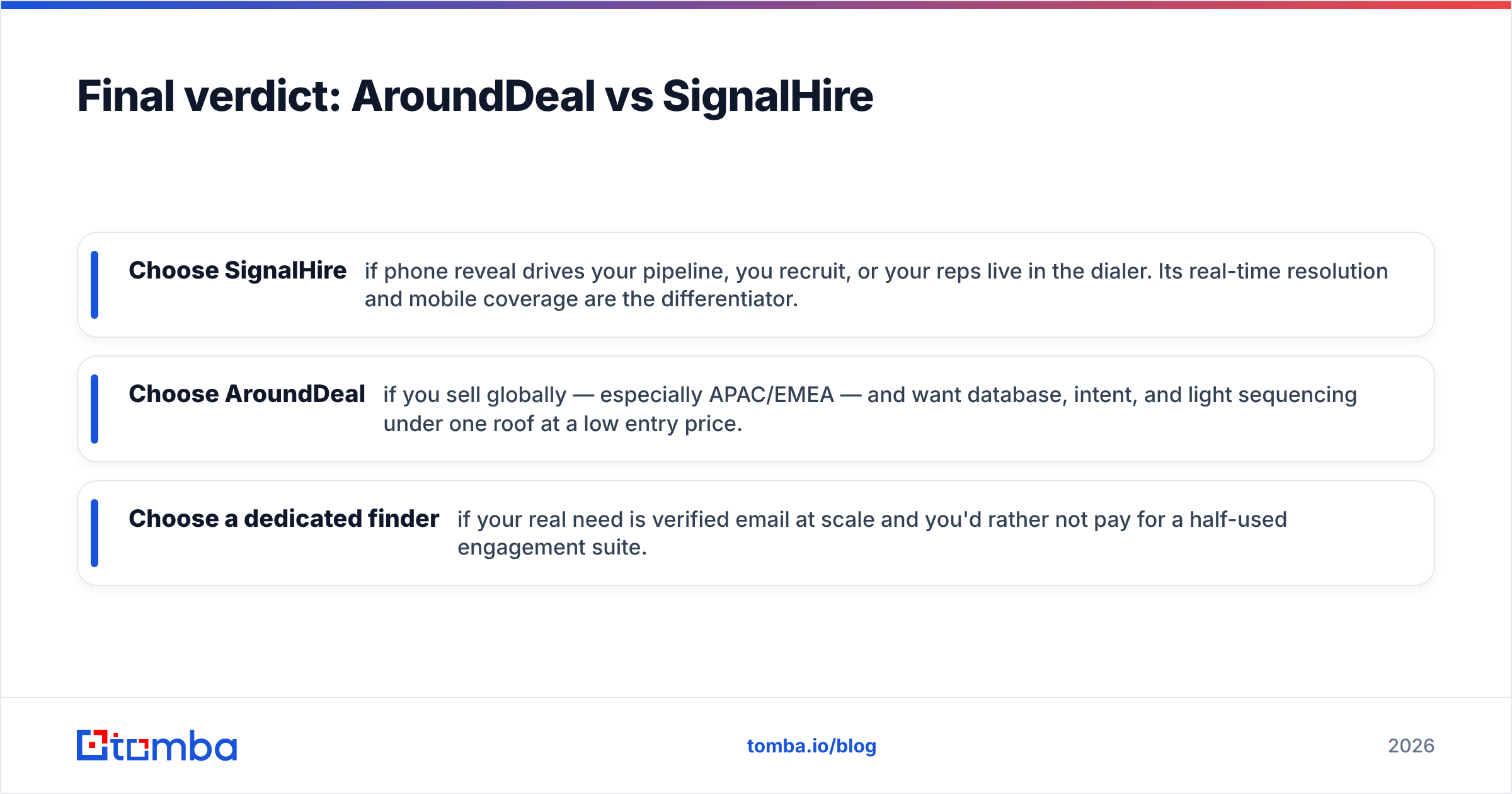
There's no universal winner — there's a winner for your motion:
- Choose SignalHire if phone reveal drives your pipeline, you recruit, or your reps live in the dialer. Its real-time resolution and mobile coverage are the differentiator.
- Choose AroundDeal if you sell globally — especially APAC/EMEA — and want database, intent, and light sequencing under one roof at a low entry price.
- Choose a dedicated finder if your real need is verified email at scale and you'd rather not pay for a half-used engagement suite.
Match the tool to the channel that actually generates your meetings, verify everything before you send, and don't let an "all-in-one" label talk you into paying for surface area you'll never use.
Find and verify B2B emails without the bloat#
If your outbound runs on email and your priority is deliverability over dashboards, start with the tool built for exactly that. The Tomba Email Finder finds professional addresses by name, company, or domain and verifies them in the same flow — so you're sending to inboxes that exist, not guessing at patterns. The free tier gives you 25 searches a month to test hit rates against your own list, and paid plans start at $49/mo with bulk and API access as you scale. Check the full Tomba pricing breakdown, then run your next list through it before you commit budget to a heavier platform.
// get started
Find, verify and enrich your first contacts today
Start on the free plan with 25 searches a month, then scale when your team is ready.
Free plan · No credit card required · GDPR & CCPA
// about the author