Arounddeal vs Warpleads: B2B Lead Data Compared (2026)
Arounddeal vs Warpleads, compared head-to-head on data coverage, accuracy, export limits, pricing, and accuracy so you can pick the right B2B lead source in 2026.
Picking between Arounddeal vs Warpleads usually comes down to one question you can't see on the pricing page: do you want a polished contact database with enrichment and a Chrome extension, or a raw, high-volume lead export machine that floods your pipeline and lets you sort the rest out later? They look similar in a feature grid and behave nothing alike in a real outbound workflow.
This guide breaks down both tools on data coverage, accuracy, export limits, integrations, and price — then shows where a dedicated email-finding-and-verification layer beats either one on the metric that actually decides your sender reputation: how many of those addresses bounce.
TL;DR — Arounddeal vs Warpleads at a glance#
- Arounddeal is a B2B contact-data platform: 100M+ company and contact records, a LinkedIn Chrome extension, enrichment, intent data, and a clean credit-based model. Best for sales teams that want quality-per-record and CRM hygiene.
- Warpleads is an outbound-volume tool built around unlimited exports and bulk lead scraping. Best for agencies and high-volume cold-email senders who need raw quantity fast.
- Accuracy is the dividing line. Arounddeal verifies more aggressively; Warpleads optimizes for volume, so you should plan to re-verify before you send.
- Neither is a true email-verification engine. Whatever you export, run it through a dedicated email verifier to protect deliverability.
- Verdict: Choose Arounddeal for data quality and enrichment, Warpleads for sheer export volume — and pair either with a finder/verifier like Tomba to keep bounce rates under control.
What is Arounddeal?#
Arounddeal is a B2B sales-intelligence platform that gives you access to a database of business contacts and companies, plus a browser extension that surfaces emails and phone numbers while you browse LinkedIn. Think of it as a contact rolodex with a research assistant attached: you look someone up, it returns their work email, direct dial, title, and company firmographics, and you push that into your CRM.
Its core modules are prospecting (search the database by filters), enrichment (fill in missing fields on records you already own), and intent signals (companies showing buying behavior). The pricing is credit-based, which rewards teams that target specific accounts rather than blasting everyone. You can see how their plans are structured on the official AroundDeal site, and read user sentiment on G2.
The strength here is per-record quality. Arounddeal leans toward verified, structured data, which makes it a sensible feeder for an ABM motion or a focused SDR team.
What is Warpleads?#
Warpleads is an outbound lead-generation tool built around a single, loud promise: unlimited exports. Instead of metering you by credit per contact, it leans on volume — scrape, filter, and export large lists of B2B leads to fuel cold-email campaigns at scale. The pitch lands hardest with lead-gen agencies and founders running aggressive outbound, where the bottleneck is "how many qualified contacts can I get into my sequencer this week."
Warpleads typically pairs a large prospecting database with bulk export and integrations into cold-email sending tools. You can check current positioning on the Warpleads homepage. The trade-off baked into any unlimited-volume model is predictable: when the business goal is quantity rather than cost-per-verified-record, accuracy and freshness tend to take a back seat. That's not a knock — it's a design choice that fits a specific buyer.
The risk is what that volume does downstream. A list that's 15% invalid doesn't just waste sends; it tanks your sender reputation and drags every future campaign down with it.
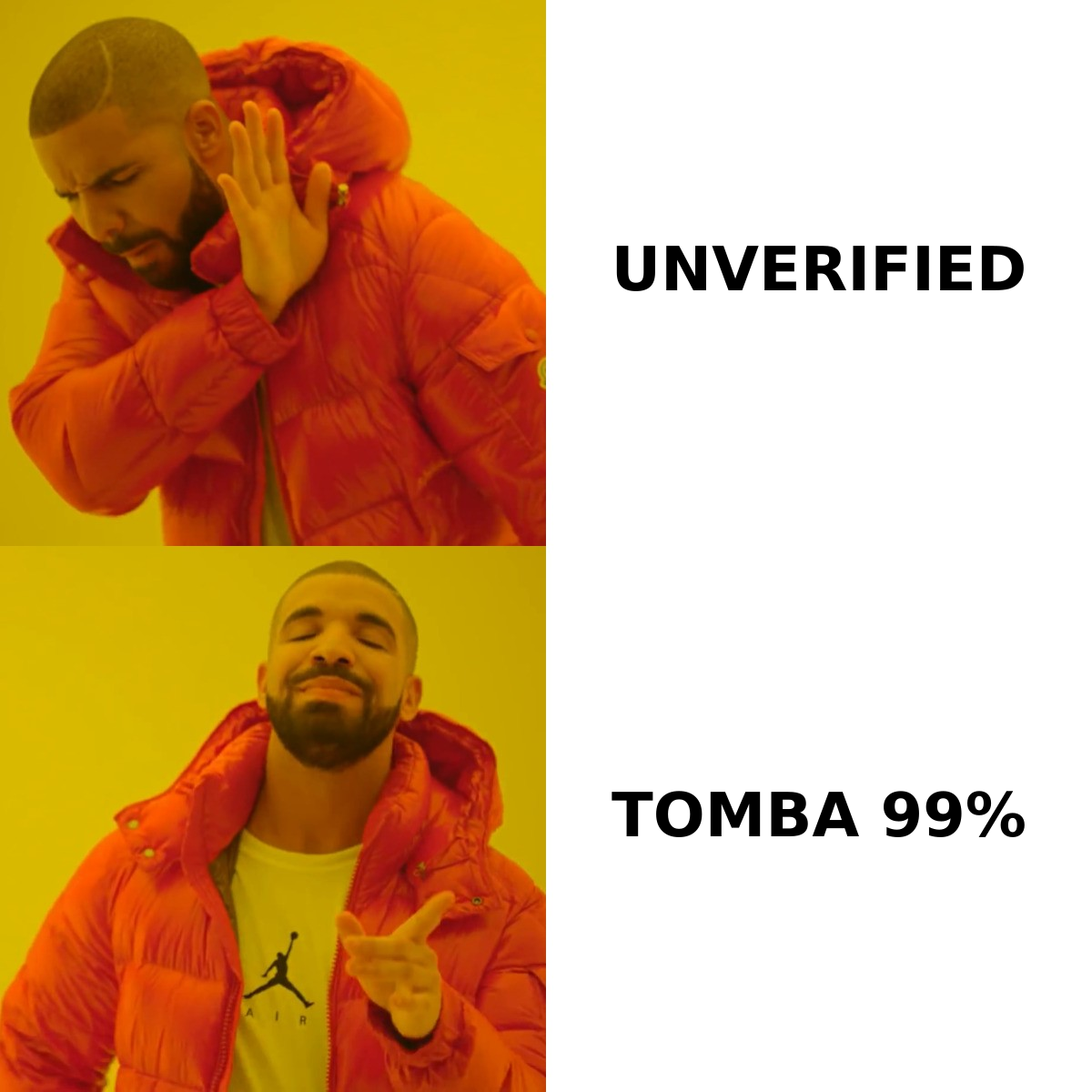
Arounddeal vs Warpleads: full comparison table#
Here's the head-to-head on the attributes that actually change your workflow.
| Attribute | Arounddeal | Warpleads |
|---|---|---|
| Primary use case | Contact data + enrichment | High-volume lead export |
| Pricing model | Credit-based tiers | Volume / unlimited-export focus |
| Free tier | Limited free credits | Limited trial |
| Data coverage | 100M+ contacts & companies | Large bulk database |
| LinkedIn extension | Yes | Limited / varies |
| Built-in email verification | Partial | Minimal — re-verify recommended |
| Enrichment | Yes (firmographics, intent) | Basic |
| Best for | ABM, focused SDR teams | Agencies, high-volume cold email |
| Bounce-risk control | Moderate | You own it |
The pattern is clear: Arounddeal optimizes for precision per contact, Warpleads optimizes for throughput. Your choice should follow your motion, not the louder marketing claim.
Which is more accurate — Arounddeal or Warpleads?#
Arounddeal generally returns cleaner data per record; Warpleads wins on raw volume but shifts the verification burden onto you. That's the honest summary, and it matters more than any single coverage number, because an unverified email isn't a lead — it's a liability.
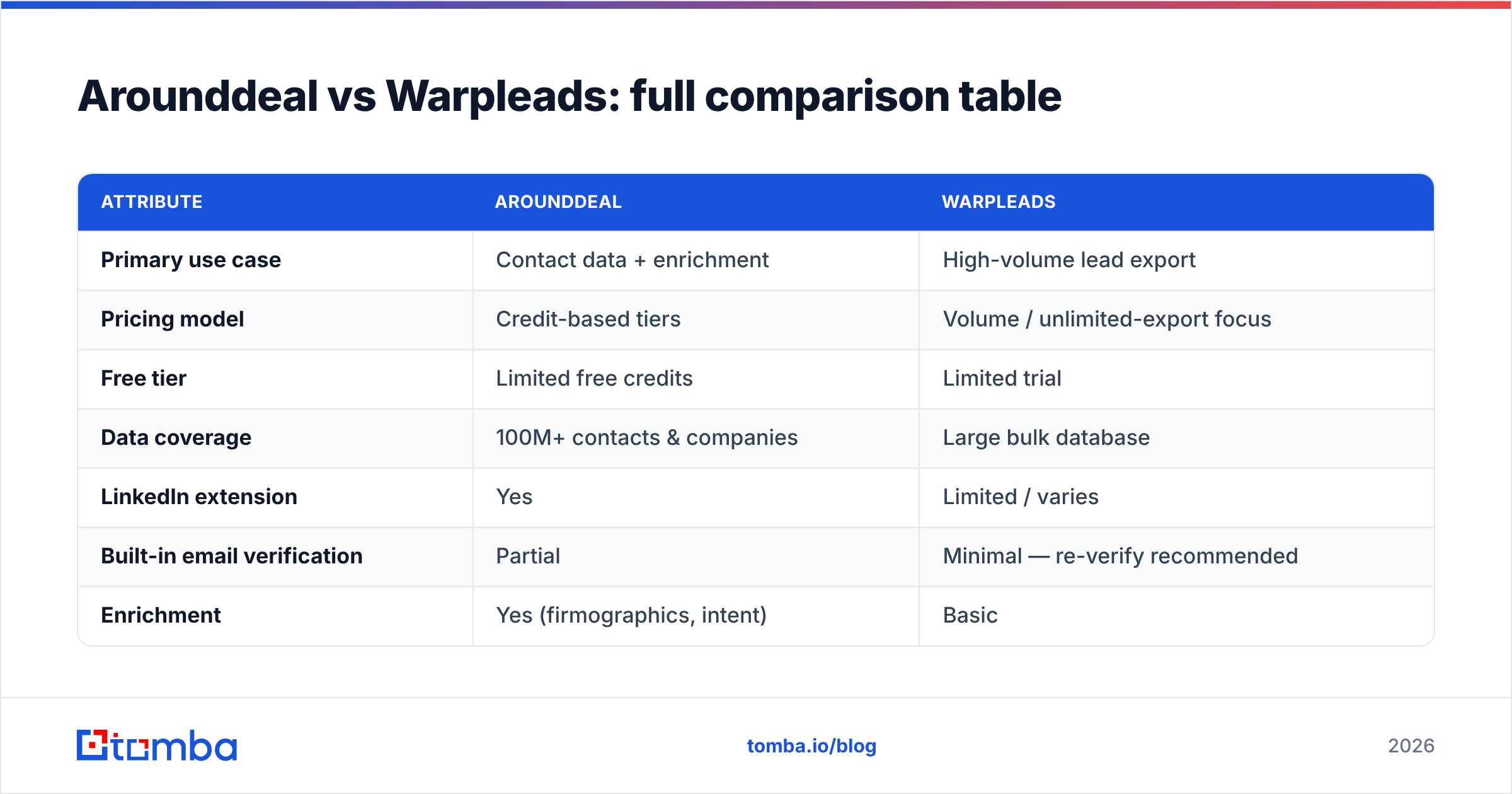
Data decays fast. Roughly 2–3% of B2B contacts change jobs every month, which compounds to 25–30% annually. Any database — Arounddeal, Warpleads, or anyone else — is fighting that decay curve. The difference is how aggressively each tool re-verifies before handing you the record.

This is the single biggest reason not to send straight from any exported list. Whether you export 200 contacts from Arounddeal or 20,000 from Warpleads, a verification pass catches the addresses that have gone stale since the database last touched them. The math is simple: a 2% bounce rate is healthy, 5% gets you throttled, and anything north of 8% can get your domain flagged. Re-verifying a list is cheaper than rebuilding a burned sending domain.

How should you choose between them? A decision framework#
Don't pick on feature count. Pick on the shape of your outbound motion. Use this framework:
- Volume vs precision. Are you running 50 hyper-targeted accounts (Arounddeal) or 5,000 cold contacts a week (Warpleads)? Match the tool to the number.
- Cost-per-usable-lead. Unlimited exports are only cheap if the leads convert. Divide your subscription by verified, deliverable contacts — not raw rows.
- CRM hygiene. If dirty data pollutes your CRM and breaks reporting, lean toward the higher-accuracy source and enrich rather than dump.
- Deliverability tolerance. New domain or shared inbox? You cannot afford a 10% bounce list. Older, warmed domain with monitoring? You have more room to absorb volume.
- The verification layer. Whichever you choose, budget for a separate verify step. This is non-negotiable for protecting email deliverability.
The framework keeps surfacing the same gap: both tools are sourcing engines, and neither is a dedicated verification engine. That gap is exactly where a finder-plus-verifier earns its place in the stack.
Where does a dedicated email finder fit in?#
A finder/verifier sits between your data source and your sequencer, and it solves a problem neither Arounddeal nor Warpleads is built to fully own: turning a name + company into a confirmed, deliverable address.
There are two ways this plays out:
- As a complement. Export from Arounddeal or Warpleads, then run the list through bulk verification and enrichment to strip out the bounces before they hit your sender reputation. This is the cheapest insurance you can buy in outbound.
- As an alternative. If your real need is "find and verify emails for a specific list of companies and people," a dedicated email finder plus domain search may replace the database subscription entirely — you find what you need, when you need it, verified on the way out.
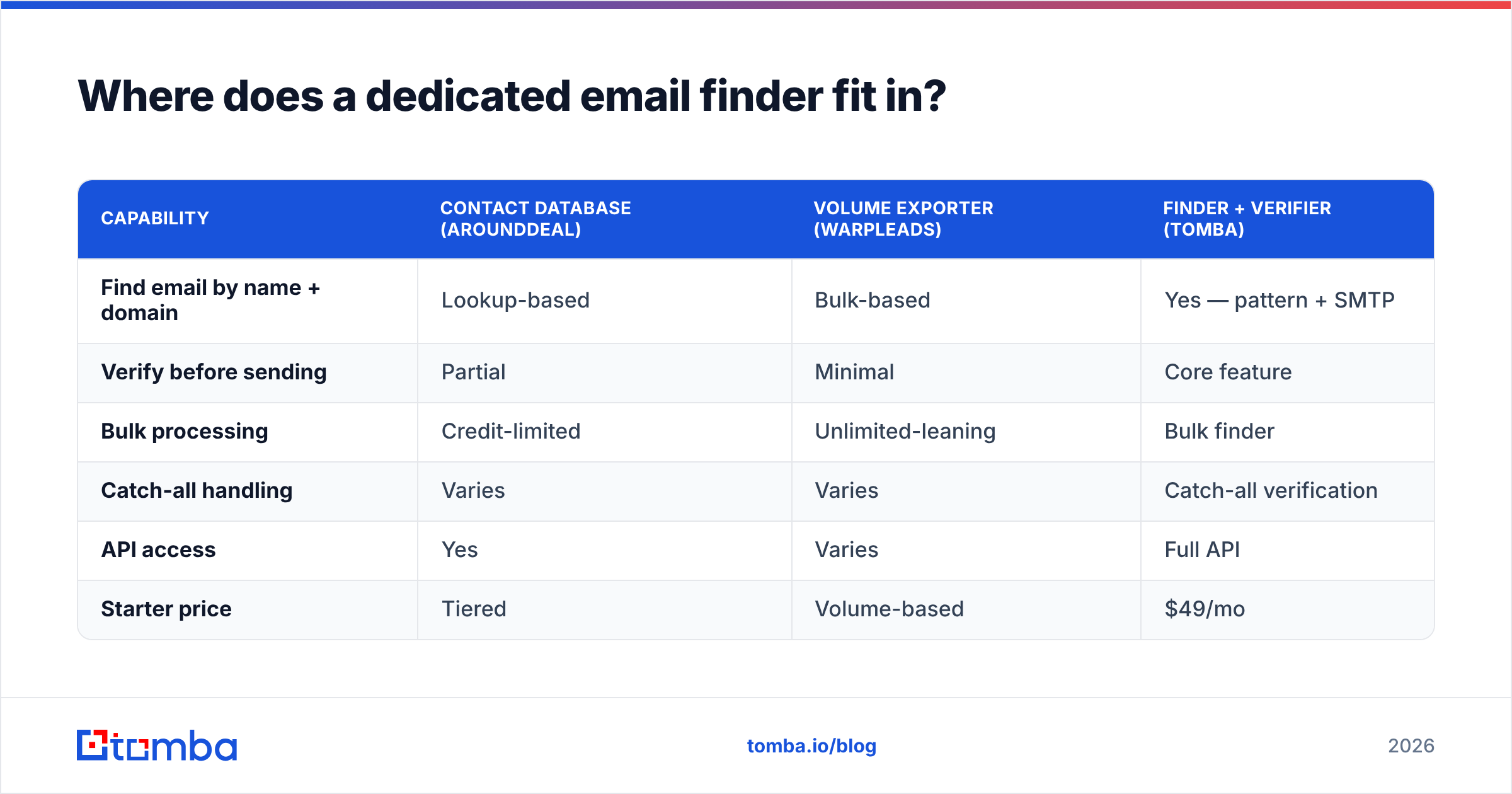
Here's how the categories stack up.
| Capability | Contact database (Arounddeal) | Volume exporter (Warpleads) | Finder + verifier (Tomba) |
|---|---|---|---|
| Find email by name + domain | Lookup-based | Bulk-based | Yes — pattern + SMTP |
| Verify before sending | Partial | Minimal | Core feature |
| Bulk processing | Credit-limited | Unlimited-leaning | Bulk finder |
| Catch-all handling | Varies | Varies | Catch-all verification |
| API access | Yes | Varies | Full API |
| Starter price | Tiered | Volume-based | $49/mo |

Tomba's role isn't to out-database the databases. It's to make sure the addresses you actually send to are real — using domain patterns, SMTP checks, catch-all detection, and data enrichment — so your bounce rate stays in the safe zone regardless of where the raw list came from.
How does pricing compare?#
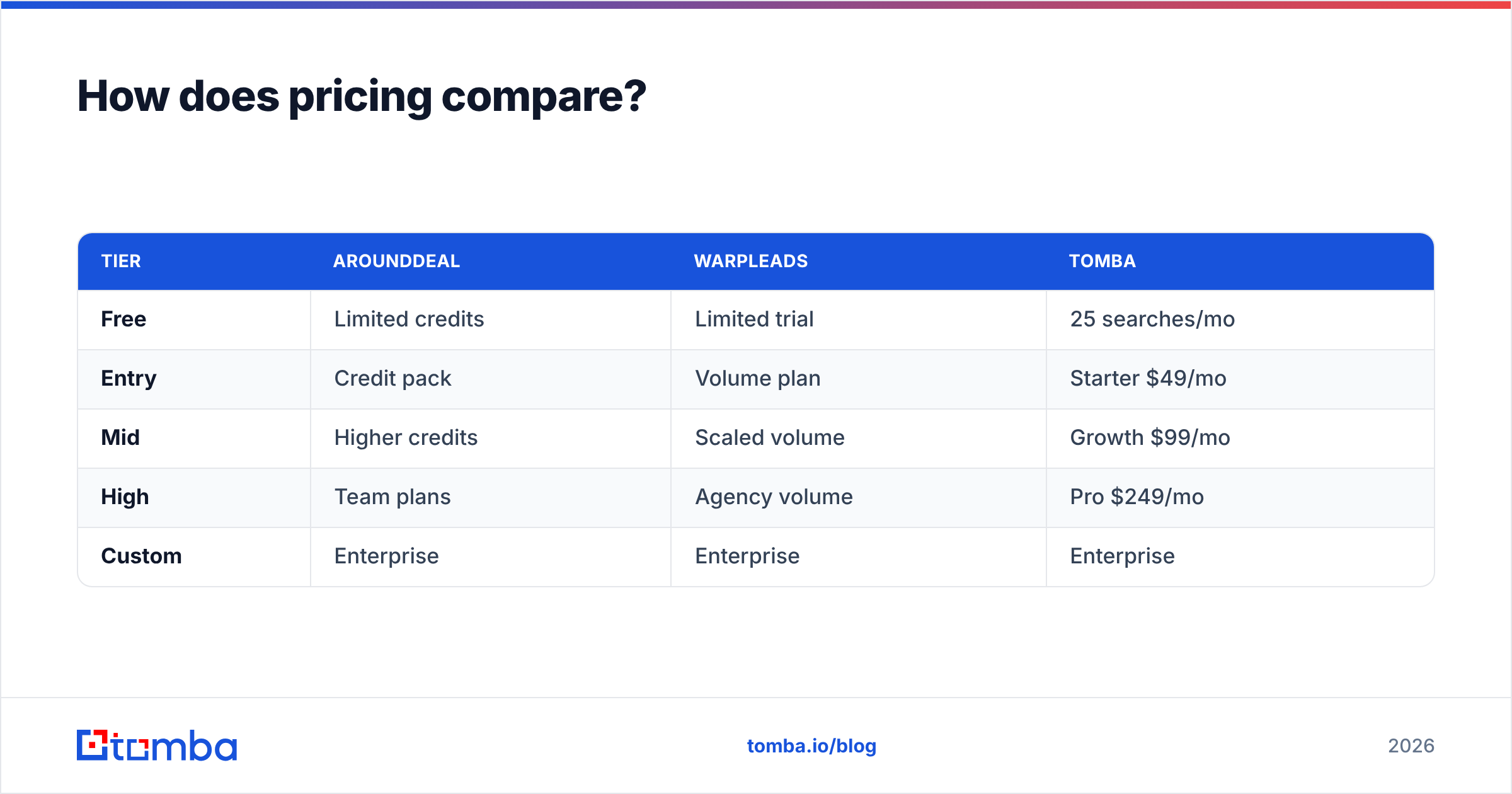
Comparing prices across these three is apples-to-oranges if you only look at the sticker. Arounddeal and Warpleads price on access to data (credits vs volume). A finder/verifier prices on find-and-verify operations.
| Tier | Arounddeal | Warpleads | Tomba |
|---|---|---|---|
| Free | Limited credits | Limited trial | 25 searches/mo |
| Entry | Credit pack | Volume plan | Starter $49/mo |
| Mid | Higher credits | Scaled volume | Growth $99/mo |
| High | Team plans | Agency volume | Pro $249/mo |
| Custom | Enterprise | Enterprise | Enterprise |
The real comparison is cost per deliverable contact, not cost per row. A Warpleads-style unlimited plan looks unbeatable until you discount it by your bounce rate. A credit model like Arounddeal's looks expensive until you realize you're only paying for records you actually target. And a verify-on-export tool looks like an extra line item until it saves the domain you spent months warming up. You can compare the operation-based model on Tomba pricing.
Arounddeal vs Warpleads: which should you pick?#
Pick Arounddeal if you run focused, account-based outbound and care more about clean records and CRM hygiene than raw volume. The enrichment and intent layers justify the credit model when each contact is part of a deliberate play.
Pick Warpleads if you're an agency or high-volume sender whose pipeline is starved for quantity and you have the deliverability infrastructure — warmed domains, monitoring, and a verification step — to safely absorb large lists.
Pick neither, or add a third tool, if your actual problem is "I have target companies and need verified emails for specific people." That's a finder-and-verifier job. Source where it makes sense, then route everything through verification before it touches your sequencer.
The decision isn't really Arounddeal vs Warpleads. It's sourcing strategy vs deliverability discipline — and the teams that win outbound in 2026 treat those as two separate, equally important jobs.
Final take and recommendation#
Arounddeal and Warpleads solve the same surface problem — getting B2B contacts into your pipeline — from opposite ends. Arounddeal optimizes for precision; Warpleads optimizes for throughput. Both leave the same job unfinished: confirming that the emails you export are actually deliverable on the day you hit send.
That's the gap to close. If you want to stop guessing whether your list will bounce, run it through the Tomba Email Finder and verifier before your next campaign. Start free with 25 searches a month, find and verify emails by name or domain, and protect the sender reputation you can't afford to rebuild. Source your leads wherever they're cheapest — just don't send a single one unverified.
// get started
Find, verify and enrich your first contacts today
Start on the free plan with 25 searches a month, then scale when your team is ready.
Free plan · No credit card required · GDPR & CCPA
// about the author