Arounddeal vs Xverum: Which B2B Data Tool Wins in 2026?
Arounddeal vs Xverum compared head-to-head: data coverage, accuracy, pricing, and the use cases each B2B data platform actually fits in 2026.
Choosing between Arounddeal and Xverum usually means you've already figured out one thing: you need more B2B data than your CRM gives you. The harder question is what kind of data, in what shape, and how much you'll pay to keep it fresh. These two tools answer that very differently.
This guide breaks down where each one wins, where each one struggles, and which type of team should pick which. No fluff, no "it depends" cop-out — concrete attributes and honest trade-offs.
TL;DR#
- Arounddeal is a contact-intelligence platform: a UI, a Chrome extension, prospecting lists, and verified emails/phones aimed at SDRs and individual reps.
- Xverum is a bulk B2B data provider: massive company and people datasets delivered as feeds, files, or API for data teams who want to own the pipeline.
- Pick Arounddeal if you want point-and-click prospecting and ready-to-email contacts. Pick Xverum if you're building an internal database, enrichment layer, or ML model and want raw scale.
- Both have accuracy gaps on hard-to-find personal work emails and catch-all domains — pair either with a dedicated email verifier before you send.
- If your real goal is finding and verifying work emails by domain or name, a focused finder like Tomba is usually cheaper and more accurate than either platform.
What is Arounddeal?#
Arounddeal is a sales-intelligence tool built for prospectors. You log into a web app, search a database of companies and people, apply filters (title, industry, headcount, geography), and pull verified emails and phone numbers into lists. A Chrome extension surfaces contact details while you browse LinkedIn, and there's an enrichment feature to fill gaps in a CSV or CRM.
The mental model: Arounddeal is like a staffed reference desk. You ask for contacts that match a profile, and it hands you a tidy stack of cards — name, title, email, phone — ready to use. It's designed so a single rep can self-serve without engineering help.
That convenience is the whole pitch. It's also the ceiling: you're working inside Arounddeal's interface and credit model, on Arounddeal's refresh cadence.
What is Xverum?#
Xverum is a B2B data provider, not a prospecting app. It sells large-scale, structured datasets — company profiles, people/contact records, firmographics, technographics — delivered as bulk files, scheduled feeds, or via API. The selling points are coverage (hundreds of millions of records), schema control, and the ability to plug data directly into your warehouse, CRM, or model.
If Arounddeal is the reference desk, Xverum is the wholesale supplier who ships you the whole shelf on a pallet. There's no friendly "search and click" workflow optimized for one rep. You get volume and structure, and you're expected to have the technical chops to load, dedupe, and operationalize it.
That's the trade: Xverum gives you scale and ownership; you give up the turnkey UI.
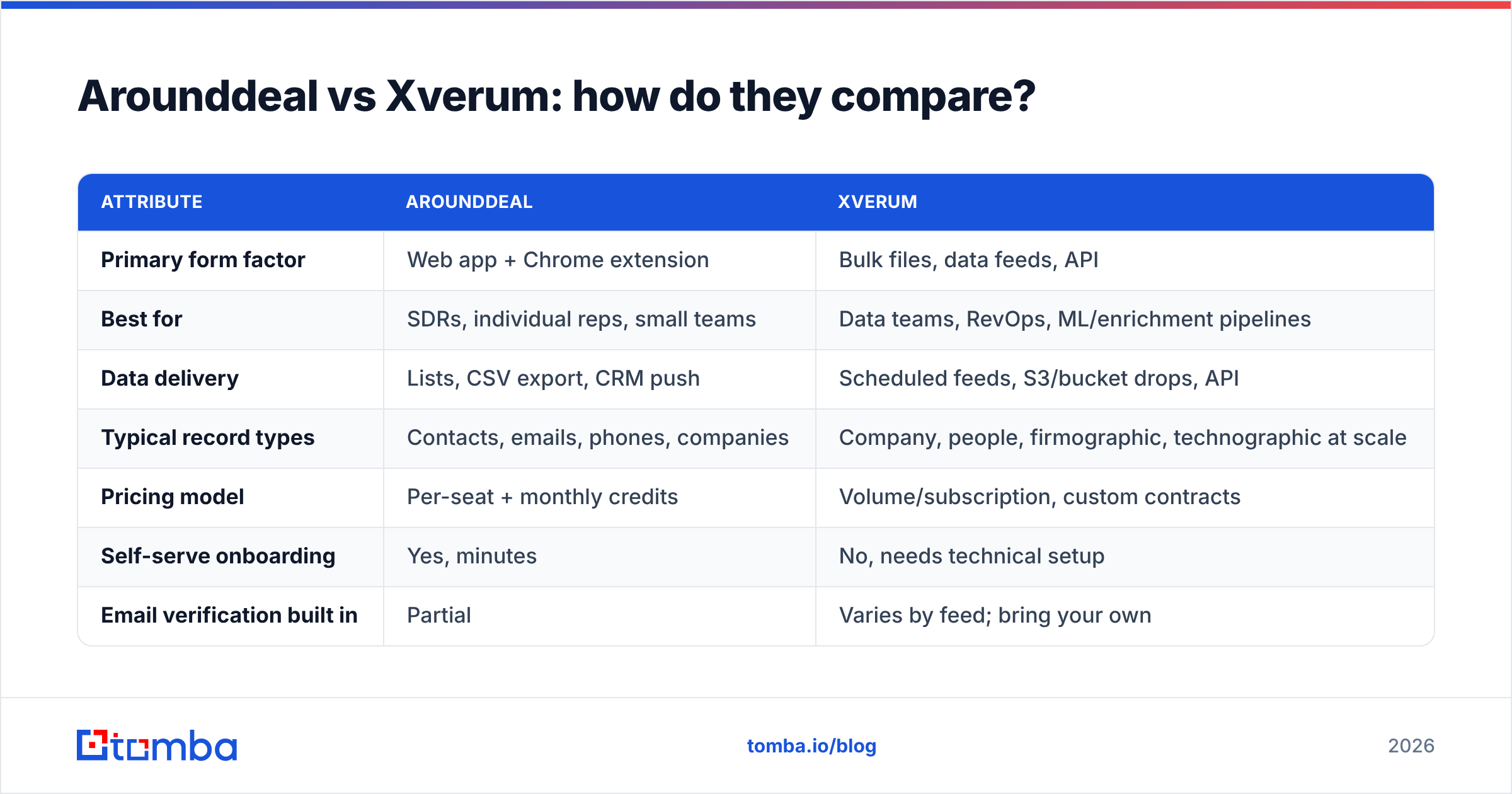
Arounddeal vs Xverum: how do they compare?#
Here's the head-to-head on the attributes that actually drive a buying decision.
| Attribute | Arounddeal | Xverum |
|---|---|---|
| Primary form factor | Web app + Chrome extension | Bulk files, data feeds, API |
| Best for | SDRs, individual reps, small teams | Data teams, RevOps, ML/enrichment pipelines |
| Data delivery | Lists, CSV export, CRM push | Scheduled feeds, S3/bucket drops, API |
| Typical record types | Contacts, emails, phones, companies | Company, people, firmographic, technographic at scale |
| Pricing model | Per-seat + monthly credits | Volume/subscription, custom contracts |
| Self-serve onboarding | Yes, minutes | No, needs technical setup |
| Email verification built in | Partial | Varies by feed; bring your own |
| Free tier | Limited free credits | Sample data on request |
| Engineering required | None | Yes |
The pattern is clear: these tools don't really compete for the same buyer. They overlap on "B2B data," but Arounddeal sells workflow and Xverum sells raw supply.

Which one has better data accuracy?#
Neither wins this cleanly — and that's the honest answer most comparison posts won't give you.
Arounddeal verifies a portion of its emails and surfaces confidence indicators, which helps reps avoid obvious bounces. But like every UI-first prospecting tool, its coverage thins out on smaller companies, non-US regions, and roles that don't keep a public footprint. Catch-all domains are a known soft spot.
Xverum's accuracy is a function of scale and freshness. You get enormous volume, but bulk datasets always carry a tail of stale records — people who changed jobs, domains that lapsed, emails that were valid at collection time and aren't now. When you buy a feed, you own the job of re-validating it.
The practical takeaway for both: don't trust any provider's "verified" flag as gospel before a cold send. Run the list through independent verification. A standalone email verification pass catches the stale and risky addresses that slip through either platform, and a catch-all verifier handles the domains that always read as "accept-all." This single step protects your sender reputation more than picking the "more accurate" vendor ever will.
What does Arounddeal vs Xverum cost?#
Pricing is where the two diverge most.
Arounddeal uses a familiar SaaS shape: per-seat subscriptions with monthly credit allotments for revealing contacts. There's a limited free tier so reps can test it. Costs scale with the number of seats and how aggressively each rep pulls contacts. It's predictable for a small team and gets expensive as you add seats or burn through credits.
Xverum prices like a data vendor: volume-based, subscription, or custom contracts negotiated against your record count and refresh frequency. There's no neat published per-seat number because you're buying a dataset, not a login. Entry commitments are typically higher, and you're paying for scale you then have to operationalize internally.
A blunt way to frame it: Arounddeal's cost is per rep, Xverum's cost is per record-at-scale. If you have five SDRs who each need a few hundred good contacts a month, Arounddeal's model fits. If you need to enrich a million CRM rows quarterly, Xverum's model fits — and Arounddeal's credits would bankrupt you trying.
This is also where a focused email-finding tool changes the math. If your bottleneck is specifically "find verified work emails for these people/companies," you don't need a full intelligence suite or a bulk feed — you need a precise finder. Tomba's plans run Free (25 searches/mo), Starter $49/mo, Growth $99/mo, and Pro $249/mo; see full Tomba pricing for credit details. That often undercuts both platforms for the find-and-verify job specifically.
Which should you choose?#
Map the decision to your team, not to a feature checklist.
Choose Arounddeal if:
- You're an SDR or small sales team that lives in a browser and LinkedIn.
- You want to point, click, and export without involving engineering.
- You value a polished prospecting UI and per-seat predictability over raw scale.
- Your volume is hundreds-to-low-thousands of contacts per rep per month.
Choose Xverum if:
- You're a data/RevOps team building an internal database or enrichment layer.
- You need hundreds of millions of records in a schema you control.
- You have engineers to load, dedupe, and re-validate feeds.
- You're powering an ML model, market map, or warehouse — not a single rep's outreach.
Choose a focused finder (like Tomba) if:
- Your core job is finding and verifying work emails by name, company, or domain.
- You want API-first access without a six-figure data contract — the email finder API and bulk lead generation cover both ad-hoc and high-volume.
- You'd rather pair best-in-class finding/verification with whatever CRM or sequencer you already use.
How do they handle enrichment and integrations?#
Enrichment is the overlap zone, and it's worth a close look.
Arounddeal offers contact-level enrichment from inside its app: upload a list, match against its database, fill in titles, emails, and phones. It pushes to common CRMs and works through its Chrome extension. It's convenient and rep-friendly, but it's bounded by Arounddeal's own coverage — if a record isn't in their database, the gap stays.
Xverum approaches enrichment as a data-supply problem. You match your records against their large dataset, typically via API or batch, and get back firmographic and technographic depth at scale. It's powerful for analytical use cases — scoring, segmentation, TAM modeling — but it assumes you've built the matching and dedupe logic.
For teams that want enrichment without committing to either model wholesale, a dedicated data enrichment layer plus a B2B database can sit between your CRM and your outreach tools. The advantage is you keep your stack modular: swap the finder, the verifier, or the sequencer independently instead of locking everything to one vendor's coverage and refresh cadence.
On integrations specifically, Arounddeal leans on native CRM connectors and its extension; Xverum leans on API and warehouse delivery. Verify the exact connectors you need against each vendor's current docs before you commit — these lists change quarterly, and a missing Salesforce or HubSpot path can quietly become a manual-CSV tax.
What do reviewers say?#
Treat third-party review sites as a sanity check, not gospel — but they're useful for spotting consistent complaints. Browse the live listings on G2 and compare them against each vendor's own claims at arounddeal.com and xverum.com.
The recurring themes worth watching for:
- Arounddeal: praised for ease of use and the extension; criticized when regional coverage or credit limits pinch.
- Xverum: praised for scale and schema flexibility; criticized when teams underestimate the engineering lift or the freshness re-validation work.
Neither pattern is a dealbreaker — they're just the predictable cost of each tool's design philosophy. A workflow tool trades scale for convenience; a data feed trades convenience for scale.
The verdict on Arounddeal vs Xverum#
There's no universal winner, because they're built for different buyers. Arounddeal wins for reps who want a fast, self-serve prospecting workflow. Xverum wins for data teams who need raw scale they can pipe into their own systems. The wrong move is buying the bulk-feed model for a five-rep team, or the per-seat app model for a warehouse-scale enrichment job — both waste money in opposite directions.
And if you strip the decision down to its most common core need — get me accurate, verified work emails I can actually send to — both platforms are heavier and pricier than the job requires. That's the gap a focused tool fills.
If finding and verifying professional emails by name, company, or domain is your real bottleneck, start with the Tomba Email Finder. It pairs domain and name search with built-in verification, runs through a clean API or bulk uploads, and slots alongside whatever CRM or sequencer you already use — no six-figure data contract, no per-seat credit anxiety. Try the free tier, run a sample of your hardest-to-find contacts, and compare the hit rate against your current stack before you commit to a bigger platform.
// get started
Find, verify and enrich your first contacts today
Start on the free plan with 25 searches a month, then scale when your team is ready.
Free plan · No credit card required · GDPR & CCPA
// about the author