AroundDeal vs Zintlr 2026: B2B Data Tools Compared
AroundDeal vs Zintlr compared on accuracy, pricing, coverage, and compliance — plus where a focused email finder beats both for cold outbound in 2026.
Choosing between AroundDeal and Zintlr usually comes down to one question: do you want a broad contact database with Chrome-extension prospecting, or a leaner intelligence platform that leans on personality and behavioral signals? Both promise verified B2B emails, phone numbers, and enrichment. Neither is a clean win for every team.
This comparison breaks down where each tool is strong, where each leaks budget, and when a dedicated email finder does the core job — finding and verifying contacts — more accurately than either.
TL;DR#
- AroundDeal is the broader play: large global contact database, Chrome extension, enrichment, and intent data, priced per credit with a usable free tier.
- Zintlr differentiates on "personality intelligence" (Zintellect) layered on top of a standard B2B database — useful for tailoring outreach, less so for raw coverage.
- Accuracy is the real battleground. Both publish high verification claims; real-world bounce rates vary by region and seniority.
- If your bottleneck is finding and verifying email addresses rather than browsing a database, a focused email finder like Tomba is cheaper and more accurate per contact.
- Pick AroundDeal for volume and intent, Zintlr for persona-led outreach, and a specialized finder when deliverability is the priority.
What are AroundDeal and Zintlr?#
AroundDeal is a B2B data and sales-intelligence platform built around a global contact database (it markets 120M+ contacts), a browser extension for pulling contacts off LinkedIn and company sites, plus enrichment and buyer-intent features. It's positioned as an all-in-one prospecting layer for SDRs and recruiters. You can see its positioning on the AroundDeal homepage.
Zintlr is a newer B2B database and prospecting tool whose signature feature is Zintellect — a personality-intelligence layer that infers communication styles and traits for a prospect so you can adapt your messaging. Underneath that, it offers the standard kit: contact search, email and phone lookup, and a Chrome extension. The Zintlr site frames the product around "knowing your prospect before you reach out."
In short: AroundDeal competes on breadth of data, Zintlr competes on context about the person. That framing matters more than any single feature checkbox.
How do AroundDeal and Zintlr compare on features?#
Here's the head-to-head on the attributes that actually affect a prospecting workflow.
| Attribute | AroundDeal | Zintlr |
|---|---|---|
| Core angle | Broad contact database + intent | Personality intelligence (Zintellect) |
| Stated database size | ~120M+ contacts | Smaller, growing |
| Chrome extension | Yes | Yes |
| Email finding | Yes | Yes |
| Phone numbers | Yes (direct dials) | Yes |
| Enrichment / API | Yes | Limited |
| Buyer intent | Yes | Partial |
| Free tier | Yes (limited credits) | Yes (limited credits) |
| Best fit | Volume outbound, recruiting | Persona-led, high-touch outreach |
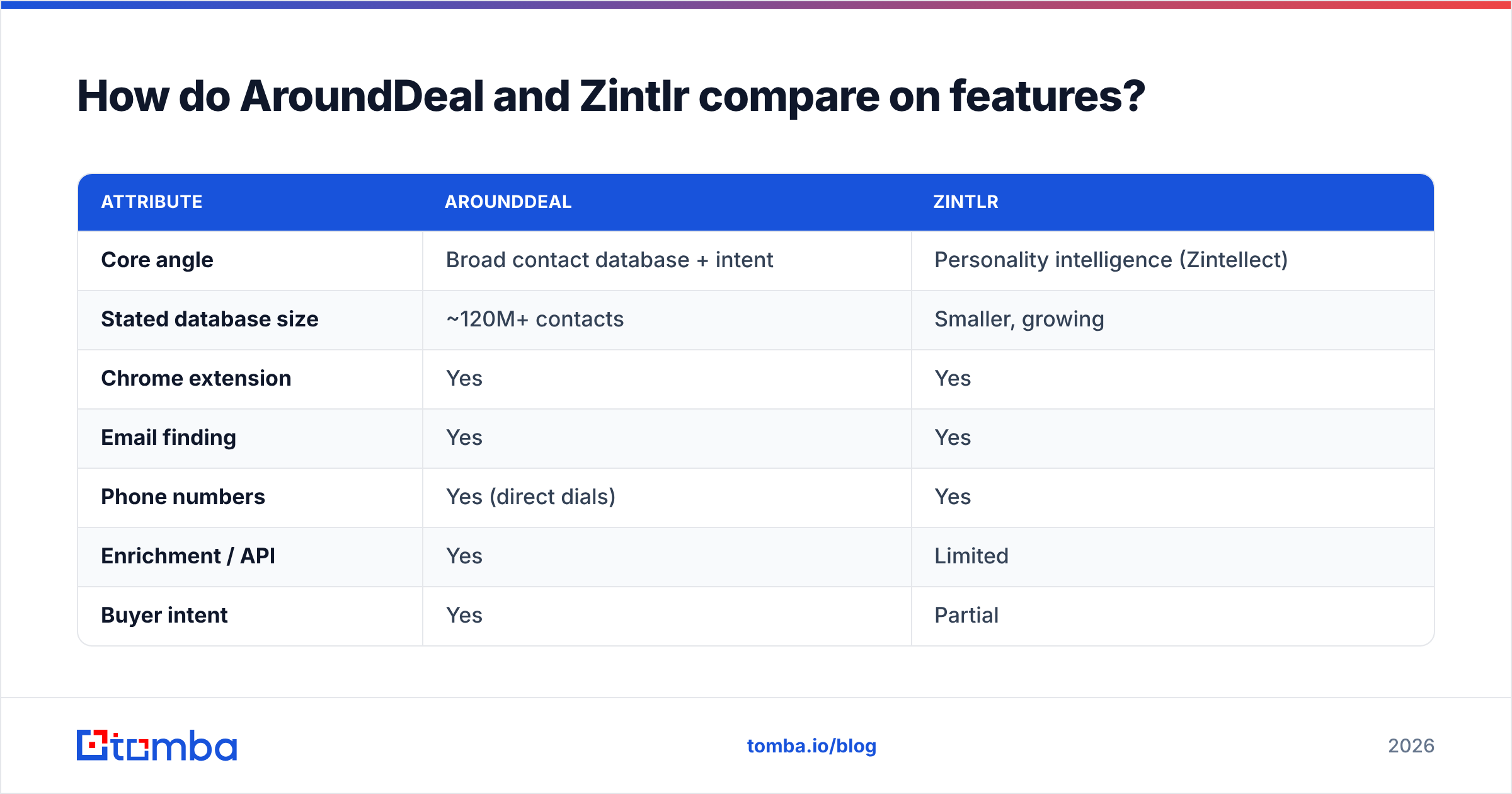
The pattern is consistent: AroundDeal gives you more raw reach and a more mature enrichment/API story, while Zintlr gives you a differentiated reason to personalize. If you run high-volume sequences, breadth wins. If you run a smaller number of high-value accounts where every message is hand-tuned, persona context can lift reply rates.
Which has better data accuracy?#
Accuracy is where most buyers get burned, because every vendor quotes a best-case verification number that rarely survives contact with a real send. AroundDeal and
Zintlr both claim high accuracy, but the metric that matters is your actual bounce rate on the segments you target.
A few realities to plan around:
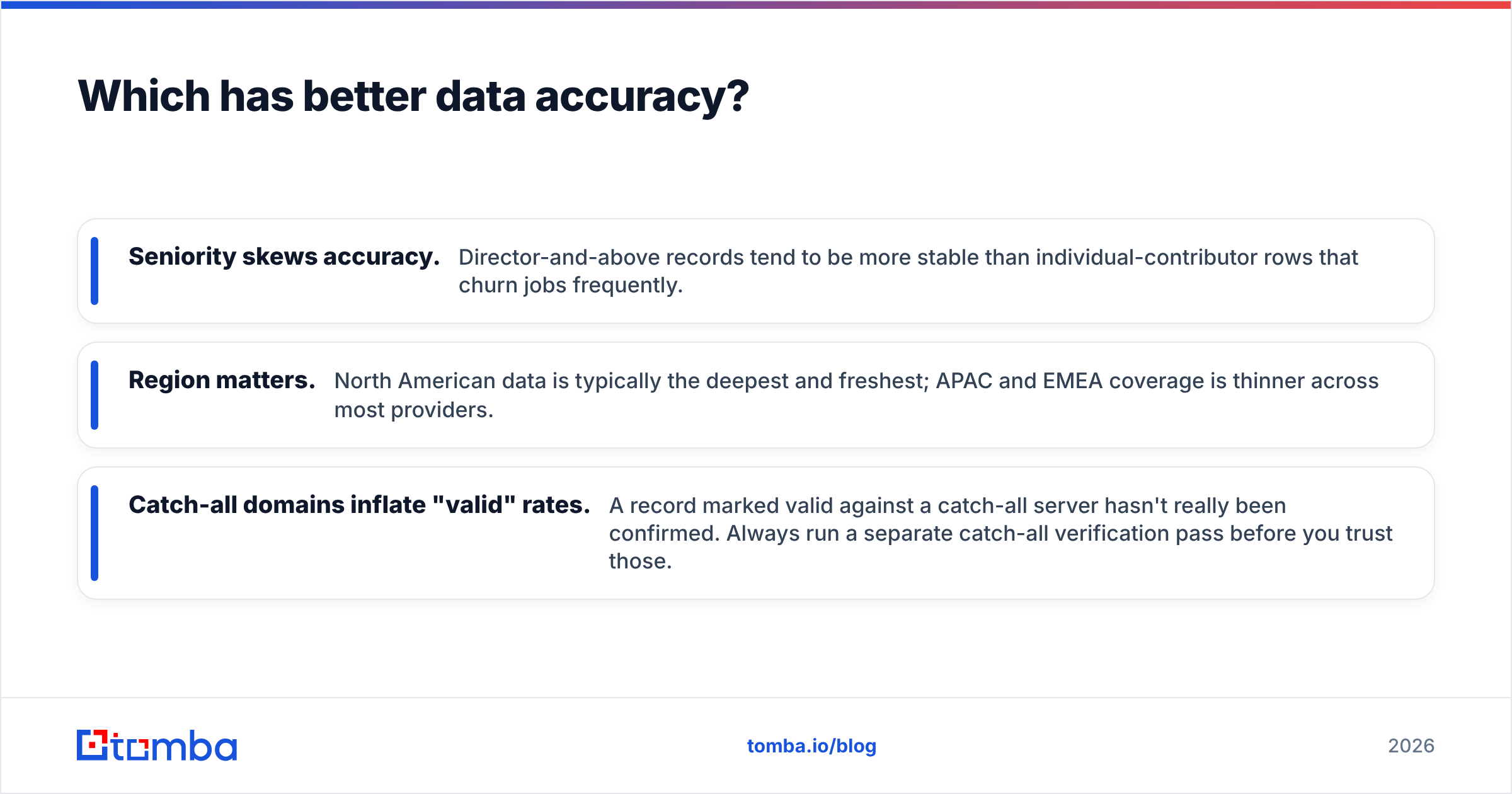
- Seniority skews accuracy. Director-and-above records tend to be more stable than individual-contributor rows that churn jobs frequently.
- Region matters. North American data is typically the deepest and freshest; APAC and EMEA coverage is thinner across most providers.
- Catch-all domains inflate "valid" rates. A record marked valid against a catch-all server hasn't really been confirmed. Always run a separate catch-all verification pass before you trust those.

The practical move regardless of which platform you pick: treat the database's "verified" flag as a first filter, not a guarantee. Re-verify before sending, especially for any list you exported more than a couple of weeks ago. A standalone email verifier catches the decay that database exports don't reflect.

How does pricing compare?#
Both tools use credit-based pricing with paid tiers that scale by credits, seats, and feature access. AroundDeal's plans tend to start lower for entry users and scale up for teams that need enrichment and intent.
Zintlr's pricing centers its persona features into higher tiers. Exact list prices move often, so check each vendor's pricing page and validate seat minimums before you commit annually.
The cost trap with both is the same one every credit-based database has: you pay to discover contacts whether or not they bounce. If 12% of a list is stale, you've effectively paid a 12% tax on every campaign. That's why the verification step isn't optional — it's the difference between paying for sends and paying for bounces.
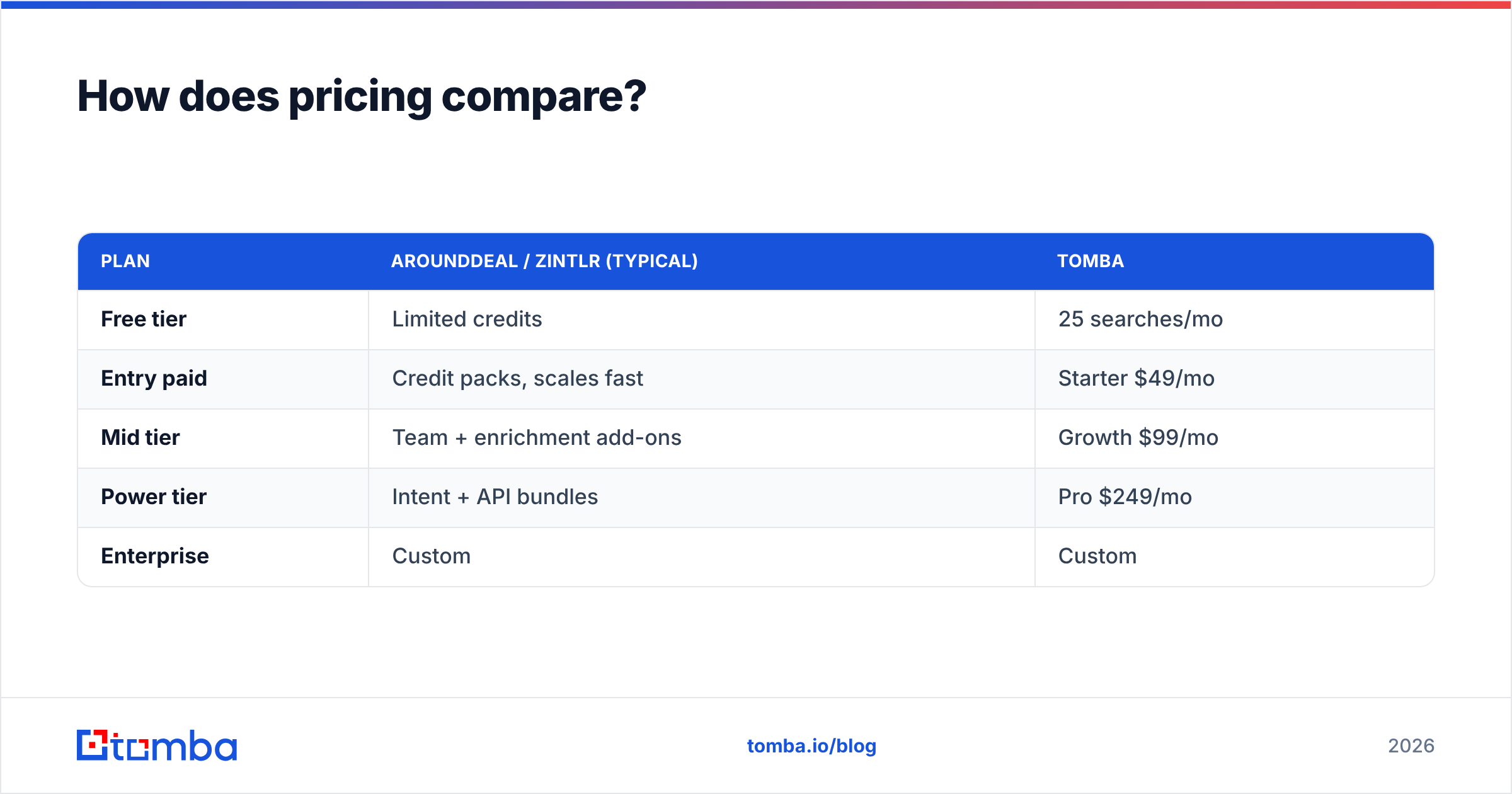
For reference, here's how a focused finder is priced against the "all-in-one database" model:
| Plan | AroundDeal / Zintlr (typical) | Tomba |
|---|---|---|
| Free tier | Limited credits | 25 searches/mo |
| Entry paid | Credit packs, scales fast | Starter $49/mo |
| Mid tier | Team + enrichment add-ons | Growth $99/mo |
| Power tier | Intent + API bundles | Pro $249/mo |
| Enterprise | Custom | Custom |
You can see the full breakdown on the Tomba pricing page. The point isn't that one is universally cheaper — it's that a database you browse and a finder you query are different cost models. If most of your spend goes toward finding specific people at specific companies, the per-search model is usually more economical than paying for database access you only partially use.
Is AroundDeal better than Zintlr?#
It depends on the job. AroundDeal is the safer default for most outbound teams because breadth and enrichment maturity reduce the number of "no record found" dead ends. Its API and intent features also make it easier to wire into a data enrichment pipeline.
Zintlr earns its place when personalization is your edge. If your reps already write strong custom messaging and you're targeting a finite set of high-value accounts, the Zintellect persona layer gives them something concrete to tailor around. For spray-and-pray volume, that context is wasted effort.
Choose AroundDeal if:
- You need wide coverage and direct dials across many industries.
- You want intent signals and a mature enrichment API.
- You're a recruiter or SDR running high-volume search.
Choose Zintlr if:
- You run low-volume, high-touch outreach where personalization drives replies.
- Persona/communication-style context will actually change how reps write.
- You value depth-of-insight per contact over sheer list size.
You can sanity-check both against real user reviews on G2 before committing — pay attention to recent reviews that mention data freshness and refund/credit policies, not just star averages.
Where does a dedicated email finder fit?#
Both AroundDeal and
Zintlr try to be the whole prospecting stack. That's convenient, but it also means the email-finding engine inside each is one feature among many — not the thing the company optimizes hardest. When your single biggest risk is deliverability, a tool built specifically to find and verify addresses tends to win on that one axis.

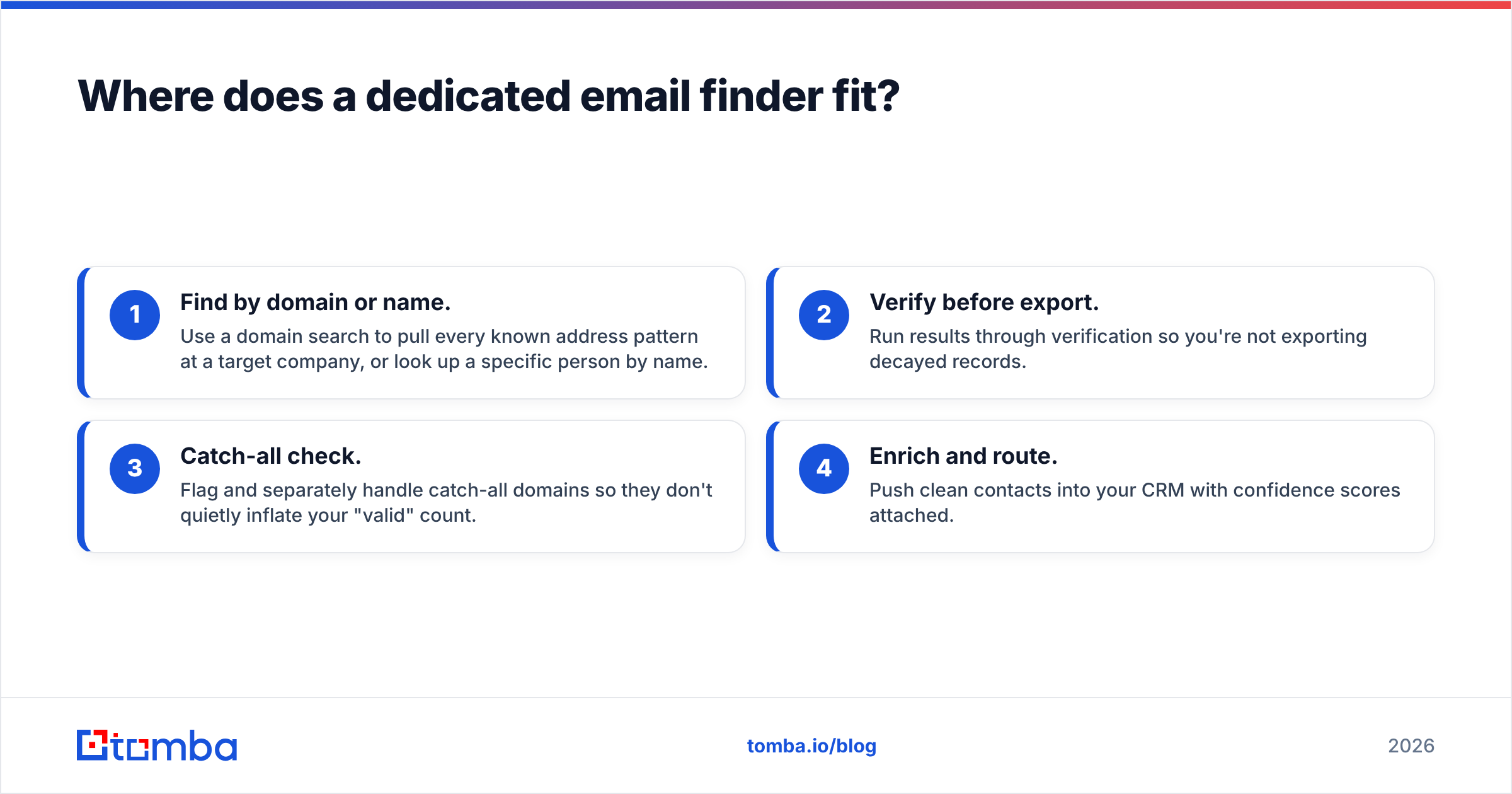
Here's the workflow that consistently outperforms relying on a database's built-in "valid" flag:
- Find by domain or name. Use a domain search to pull every known address pattern at a target company, or look up a specific person by name.
- Verify before export. Run results through verification so you're not exporting decayed records.
- Catch-all check. Flag and separately handle catch-all domains so they don't quietly inflate your "valid" count.
- Enrich and route. Push clean contacts into your CRM with confidence scores attached.
This is also where data provenance matters. Knowing where the data comes from and how often it's refreshed tells you more about long-term accuracy than any single headline percentage. Databases that don't refresh aggressively decay fast, and a stale "verified" record is worse than no record because it costs you a bounce and a reputation hit.
What about deliverability and compliance?#
Two things rarely show up in feature tables but decide whether your campaigns survive:
Deliverability. No database protects your sender reputation for you. If you blast an unverified export, your bounce rate climbs, mailbox providers throttle you, and even valid contacts stop landing in the inbox. Verification plus warmup is what keeps you out of spam — the tool that sourced the contact is only step one.
Compliance. Both AroundDeal and Zintlr operate as data providers, which means you're responsible for lawful processing under GDPR/CCPA when you use their data for outreach. Check each vendor's opt-out and data-subject-request handling, keep suppression lists current, and document your lawful basis. This isn't a tiebreaker between the two — it's table stakes for using either.
The honest summary: the platform you choose affects coverage and convenience. Your verification discipline affects whether the emails actually arrive. Teams that obsess over the first and ignore the second waste their data budget.
AroundDeal vs Zintlr: the verdict#
For most outbound and recruiting teams, AroundDeal is the more complete platform thanks to breadth, intent, and a stronger enrichment/API story. Zintlr is the sharper choice for small, high-value target lists where personality-led personalization is a genuine differentiator and you're willing to trade coverage for context.
But "which database" is the wrong question if your real problem is bounce rates and inbox placement. In that case, the leverage is in the find-and-verify layer, not the size of the directory you browse.
Closing: get the email part right first#

If your priority is finding accurate, verified professional emails — and keeping your sender reputation intact — start with a tool built for exactly that. The Tomba Email Finder finds addresses by domain, name, or company, verifies them, and flags catch-alls before you export, with a free tier (25 searches/mo) and plans from $49/mo. Use AroundDeal or Zintlr for breadth and persona context if you need them, but run every list through proper verification first. That's the difference between paying for sends and paying for bounces.
// get started
Find, verify and enrich your first contacts today
Start on the free plan with 25 searches a month, then scale when your team is ready.
Free plan · No credit card required · GDPR & CCPA
// about the author