AroundDeal vs ZoomInfo 2026: Which B2B Data Tool Wins?
AroundDeal vs ZoomInfo, compared head-to-head on data accuracy, coverage, pricing, and compliance — plus a cheaper, accuracy-first alternative for 2026.
Choosing between AroundDeal and ZoomInfo usually comes down to one tension: how much B2B data do you actually need, and how much are you willing to pay for it? ZoomInfo is the enterprise heavyweight with the deepest database on the market. AroundDeal is the scrappy, Chrome-extension-first challenger that costs a fraction as much. This guide breaks down where each one wins so you can stop guessing.
TL;DR#
- ZoomInfo is the most complete B2B data platform — intent signals, org charts, technographics, and phone coverage that nobody matches. It is also expensive (typically $15,000+/year, annual contracts) and built for funded enterprise teams.
- AroundDeal is a lighter, LinkedIn-extension-driven prospecting tool with transparent self-serve pricing (free tier plus paid plans under $100/mo) and solid APAC coverage, but a smaller database and fewer enterprise features.
- Accuracy is the real battleground: ZoomInfo leads on phone data; AroundDeal is competitive on emails but you should still verify before sending.
- If you mainly need accurate email addresses without a five-figure contract, a focused tool like Tomba Email Finder often beats both on cost-per-valid-email.
- Pick ZoomInfo for full GTM data infrastructure, AroundDeal for affordable LinkedIn prospecting, and a dedicated email finder when email is the only data point you actually use.
What is AroundDeal?#
AroundDeal is a B2B contact and company database that most people use through its Chrome extension while browsing LinkedIn. You land on a prospect's profile, click the extension, and it surfaces a work email and phone number along with company firmographics. It markets itself around a database of roughly 100M+ contacts with notably strong coverage in Asia-Pacific markets, which is where it differentiates from US-centric competitors.
The appeal is simplicity and price. AroundDeal runs a self-serve model with a free tier and paid plans that stay well under enterprise pricing. For a solo SDR, a founder doing their own outbound, or a small team that lives inside LinkedIn all day, it removes the friction of a long sales cycle and an annual commitment. You can see how this maps to a broader B2B database strategy when you start scaling lists.
The trade-off is depth. AroundDeal does not try to be a full revenue-intelligence platform. You will not find the same volume of buyer-intent signals, scoop-level news, or org-chart granularity that the enterprise tools sell.
What is ZoomInfo?#
ZoomInfo is the category-defining B2B data and go-to-market platform. It is widely regarded as having the largest and deepest contact database in the industry, and it layers a lot on top of raw contacts: buyer intent data, website visitor tracking, technographics (the tools a company uses), org charts, and integrations that push enriched records straight into your CRM and sequencer.
That depth comes at enterprise pricing and enterprise friction. ZoomInfo sells annual contracts that commonly start around $15,000/year and climb quickly with seats, credits, and add-on modules. There is no meaningful free tier, and you go through a sales process to buy. You can read more about its positioning directly on the ZoomInfo site and verified user reviews on G2.
ZoomInfo is built for organizations that treat data as core infrastructure — RevOps teams powering revenue operations, large SDR floors, and marketing teams running account-based programs. If you only need a handful of emails a week, you are paying for an engine you will never fully use.
AroundDeal vs ZoomInfo: the core comparison#
Here is the head-to-head on the attributes that actually drive a buying decision.
| Attribute | AroundDeal | ZoomInfo |
|---|---|---|
| Database size | ~100M+ contacts | 260M+ contacts (largest in market) |
| Best regional coverage | Strong APAC + global | Strongest North America |
| Buyer intent data | Limited | Extensive (core strength) |
| Phone / direct dial accuracy | Decent | Industry-leading |
| Pricing model | Self-serve, transparent | Annual contract, sales-led |
| Entry cost | Free tier + sub-$100/mo plans | ~$15,000+/year typical |
| Free tier | Yes (limited credits) | No real free tier |
| Chrome extension | Core workflow | Available |
| Org charts & technographics | Basic | Advanced |
| Best for | Solo reps, SMBs, APAC outbound | Enterprise GTM teams |
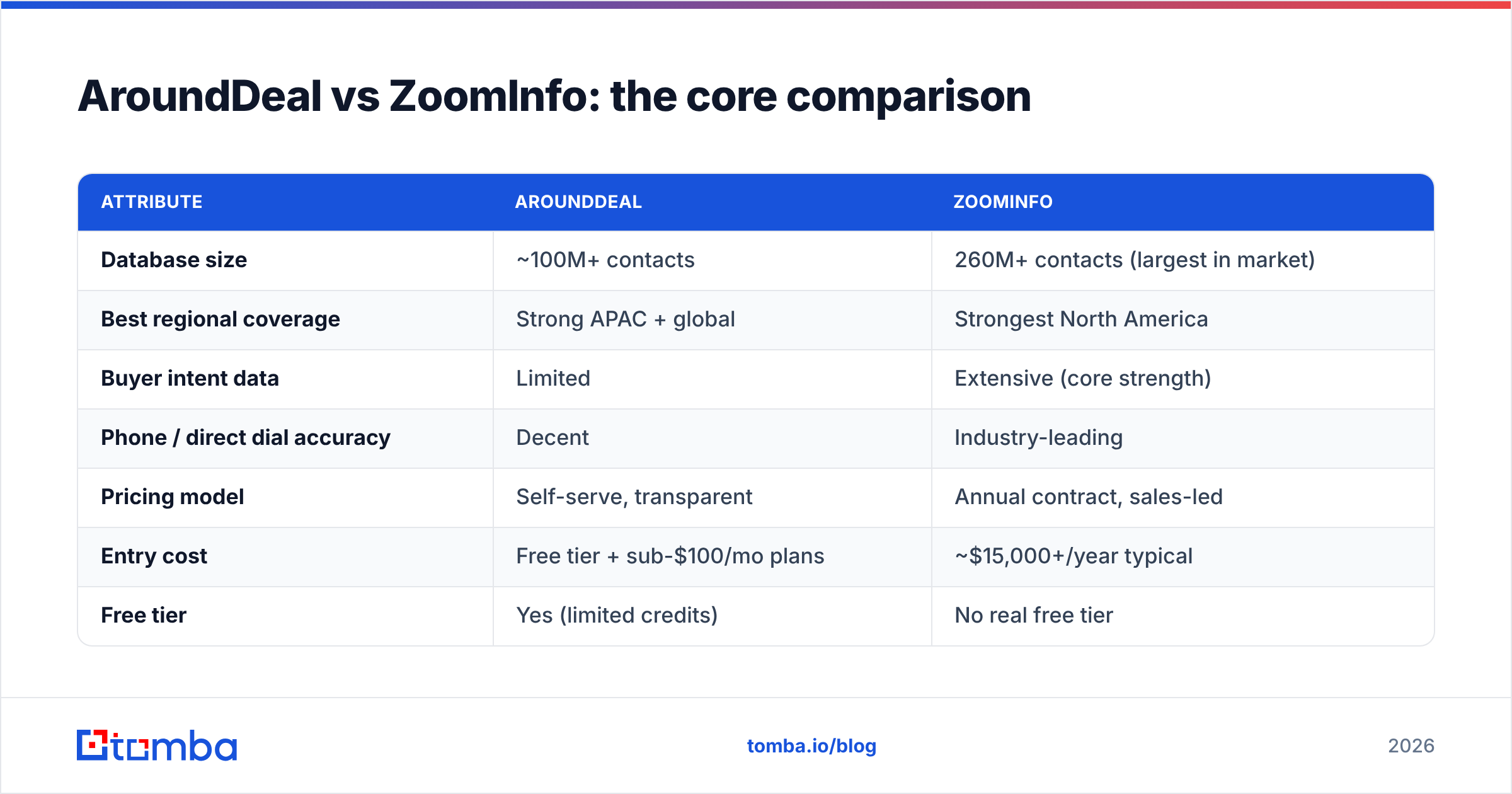
The pattern is clear. ZoomInfo wins on raw depth, intent, and phone accuracy. AroundDeal wins on price, transparency, and ease of getting started. Neither is "better" in the abstract — they are built for different budgets and different jobs.

Is ZoomInfo's data more accurate than AroundDeal's?#
Yes on phone numbers, closer than you'd expect on email.
ZoomInfo's direct-dial and mobile coverage is genuinely best-in-class, and that gap is real if cold calling is central to your motion. On email, AroundDeal is competitive enough that the price difference often outweighs the accuracy difference for email-led teams.
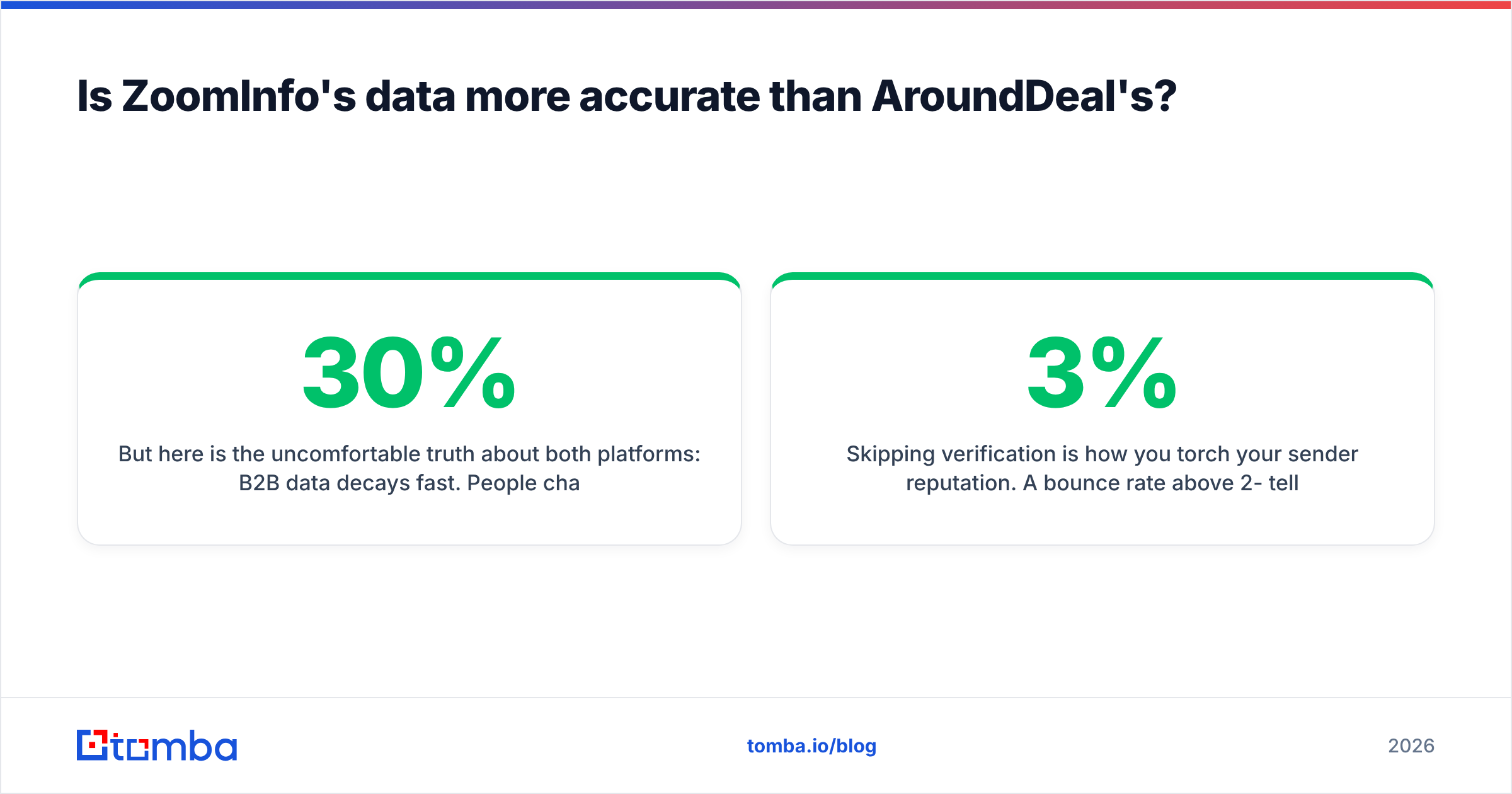
But here is the uncomfortable truth about both platforms: B2B data decays fast. People change jobs constantly, and roughly 25-30% of a contact database goes stale every year. No vendor — not even ZoomInfo — ships emails that are 100% deliverable on the day you export them. That is why the smartest teams treat any provider's data as a starting point and run it through an email verifier before a campaign ever sends.

Skipping verification is how you torch your sender reputation. A bounce rate above 2-3% tells inbox providers you are not maintaining your list, and your email deliverability drops for everyone on your domain — including the prospects whose addresses were perfect. Verification is cheap insurance against an expensive problem.
How does pricing really compare?#
This is where most of the decision gets made. AroundDeal and
ZoomInfo are not in the same pricing universe.
AroundDeal is self-serve and transparent: a free tier with limited monthly credits, then paid plans that scale up but stay accessible for small teams. You can sign up and start finding contacts in minutes, with month-to-month flexibility.
ZoomInfo is sales-led and contract-based. Expect a multi-thousand-dollar annual minimum, custom quotes based on seats and credits, and add-on costs for premium modules like intent and websites. The value can absolutely justify the spend for a large team — but only if you use the full platform.
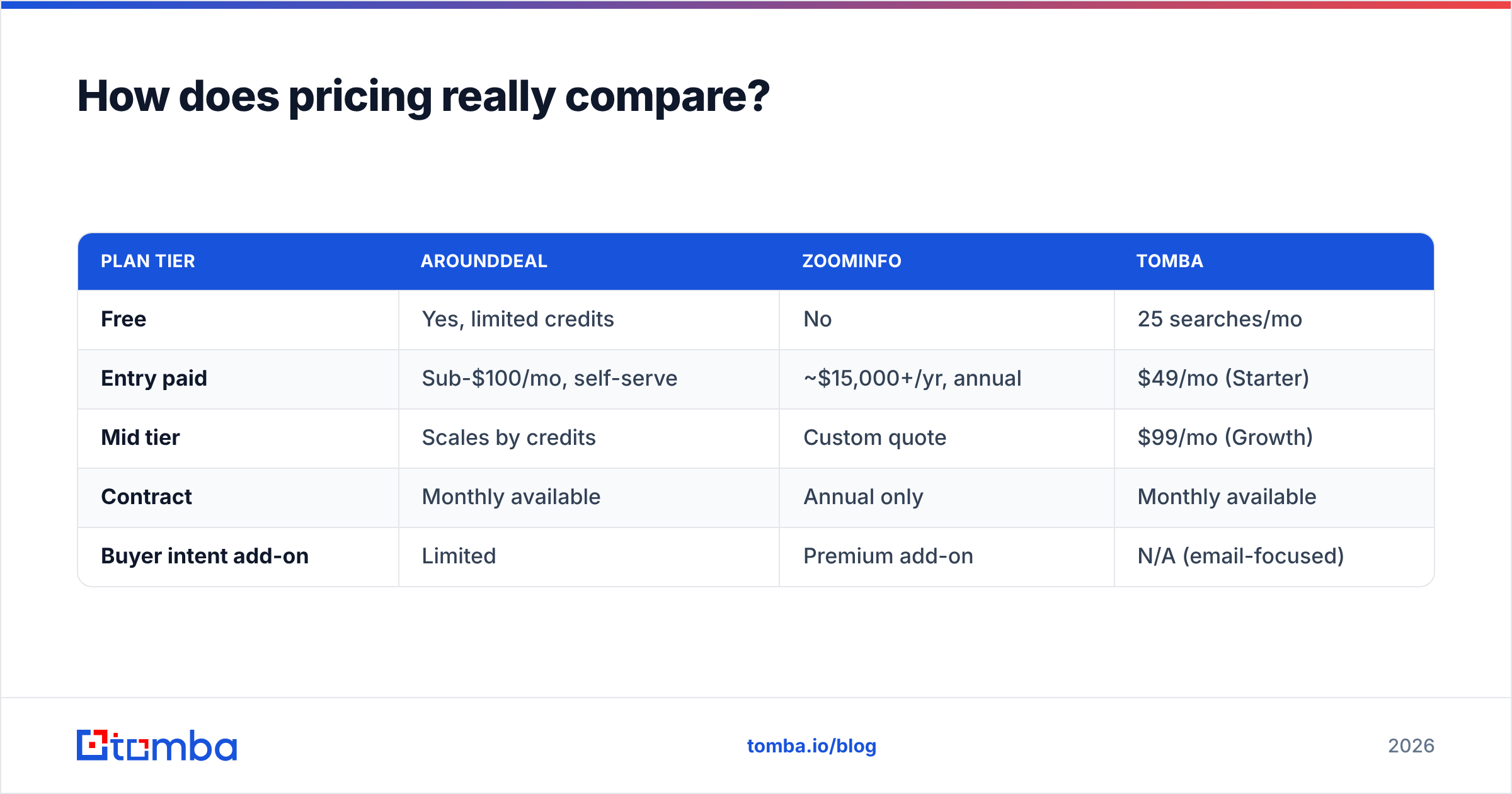
| Plan tier | AroundDeal | ZoomInfo | Tomba |
|---|---|---|---|
| Free | Yes, limited credits | No | 25 searches/mo |
| Entry paid | Sub-$100/mo, self-serve | ~$15,000+/yr, annual | $49/mo (Starter) |
| Mid tier | Scales by credits | Custom quote | $99/mo (Growth) |
| Contract | Monthly available | Annual only | Monthly available |
| Buyer intent add-on | Limited | Premium add-on | N/A (email-focused) |
If your real need is "I want accurate emails at a predictable cost," it is worth comparing all three against your actual monthly volume. You can see the full Tomba pricing for a sense of what dedicated email-finding costs versus a full data suite.
What about compliance and data sourcing?#
Both platforms have to navigate GDPR, CCPA, and the patchwork of regional privacy law, and both publish compliance documentation. ZoomInfo has invested heavily here given its enterprise customer base and offers notification and opt-out mechanisms; AroundDeal similarly states GDPR/CCPA alignment.
The practical takeaway: do not outsource your compliance judgment to a vendor's marketing page. Confirm your own lawful basis for outreach, honor opt-outs promptly, and keep records. If your buyers are in the EU, this matters more than any feature comparison. Transparency about where data comes from is a fair question to ask any provider — it is exactly why Tomba documents its data sources openly.

Which tool should you choose?#
Match the tool to your motion, not to the brand name. Here is the decision framework in plain terms.
**Choose
ZoomInfo if:**
- You run a large SDR or marketing team and data is core infrastructure.
- Buyer intent, org charts, and technographics drive your account targeting.
- Cold calling is central and you need best-in-class direct dials.
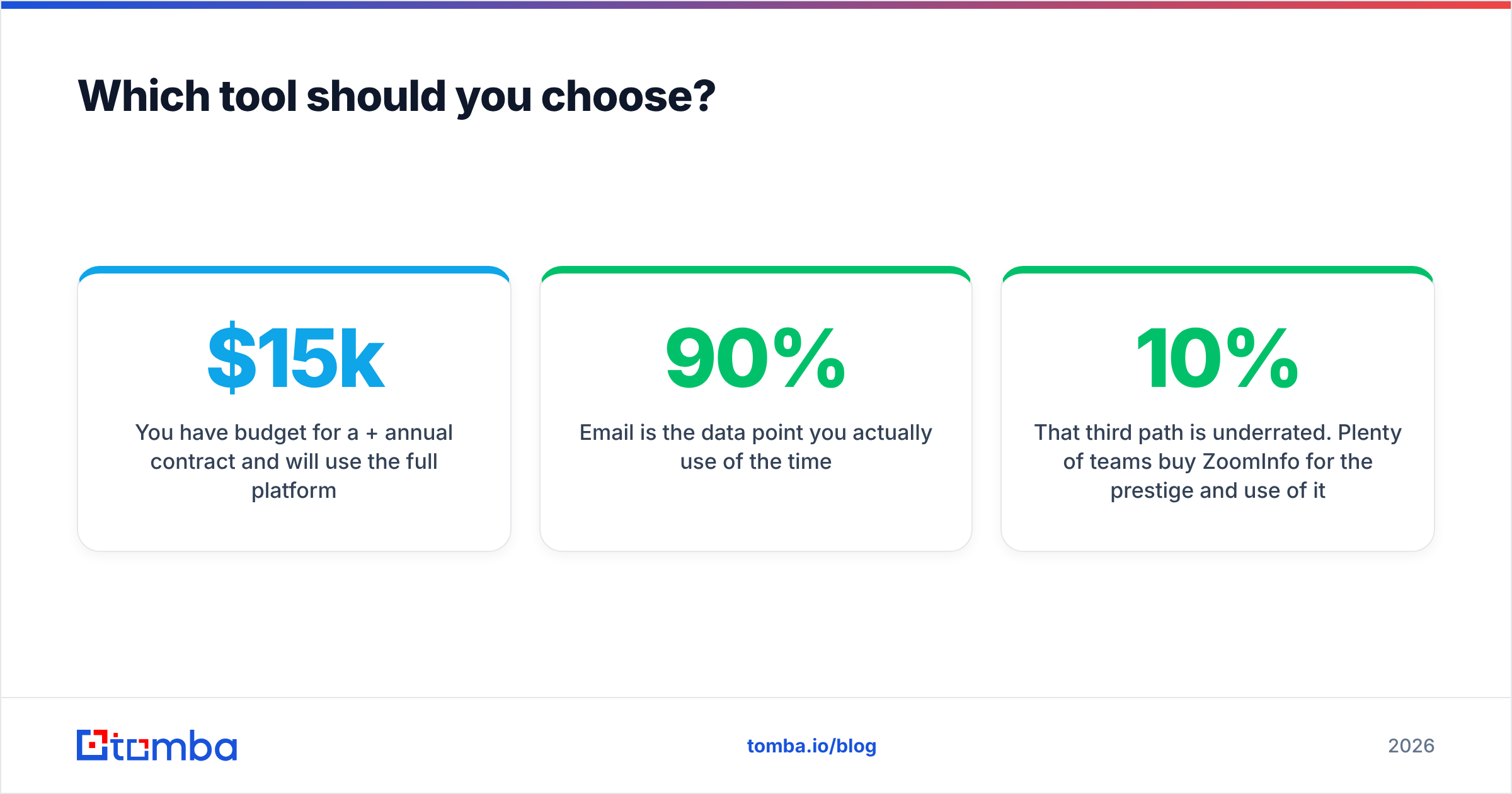
- You have budget for a $15k+ annual contract and will use the full platform.
Choose AroundDeal if:
- You are a solo rep, founder, or small team doing LinkedIn-based outbound.
- APAC coverage matters to your territory.
- You want transparent, self-serve pricing without a sales call.
- You need contacts more than a full revenue-intelligence stack.
Choose a dedicated email finder if:
- Email is the data point you actually use 90% of the time.
- You want the lowest cost-per-valid-email and a free tier to test.
- You would rather verify aggressively than pay for intent data you ignore.
That third path is underrated. Plenty of teams buy ZoomInfo for the prestige and use 10% of it, or stretch AroundDeal past what its database supports. If your workflow is "find the email, verify it, load it into a sequencer," a focused tool is leaner. Tomba covers that lane with an email finder, domain search for mapping a whole company's addresses, and a bulk email finder for list building at scale.

How do these tools fit into a real outbound workflow?#
The tool is one piece; the process is what converts. A clean workflow looks like this:
- Define the ICP and trigger. Know exactly who you are reaching and why now.
- Source contacts. Use AroundDeal, ZoomInfo, or a domain search to build the list.
- Verify every address. Run the list through verification to drop bounces before they cost you.
- Enrich the record. Add role, company size, and any signal that personalizes the first line — contact enrichment handles this.
- Sequence and measure. Track reply and bounce rates, and feed the learnings back into step 1.
Notice that data sourcing is only step two. Teams obsess over which database to buy and then skip verification and enrichment — the steps that actually protect deliverability and lift reply rates. Whichever platform you land on, the discipline around the data matters more than the logo on the invoice.
The verdict#
There is no universal winner — there is a winner for your situation. ZoomInfo is the right call when you are an enterprise GTM team that will genuinely use intent data, org charts, and the deepest database available, and you can absorb a five-figure annual contract. AroundDeal is the right call when you are a smaller team or solo operator who wants affordable, transparent, LinkedIn-friendly prospecting with strong APAC reach.
And if you strip the question down to "I just need accurate, verified emails without overpaying for features I won't touch," neither giant is the most efficient answer. That is the gap a dedicated tool fills.
Ready to stop paying enterprise prices for emails you could find directly? Start with Tomba Email Finder — find professional email addresses by name, company, or domain, verify them in the same workflow, and keep your bounce rate low. The free tier gives you 25 searches a month to test the accuracy against your own list before you commit a dollar. Find the email, verify it, send with confidence.
// get started
Find, verify and enrich your first contacts today
Start on the free plan with 25 searches a month, then scale when your team is ready.
Free plan · No credit card required · GDPR & CCPA
// about the author