Artisan AI Pros and Cons in 2026: An Honest BDR Review
Artisan promises an AI BDR named Ava that runs outbound on autopilot. Here is a neutral look at the real Artisan pros and cons, pricing, and alternatives in 2026.
Artisan is one of the loudest names in AI sales right now, mostly thanks to a billboard campaign telling you to "stop hiring humans." Behind the provocation sits a real product: Ava, an AI BDR that claims to source leads, write personalized emails, and run multichannel sequences with minimal human input. The question buyers actually have is simpler than the marketing: does it work, and is it worth the price?
This is a neutral breakdown of the Artisan pros and cons in 2026 — what it does well, where it falls short, what it costs, and when a leaner stack beats an all-in-one AI agent.
TL;DR#
- What it is: Artisan is an all-in-one outbound platform built around "Ava," an AI BDR that handles lead sourcing, email writing, and sequence automation in one seat.
- Biggest pro: Consolidation. You replace several point tools (data, copy, sending) with one workflow, which is attractive for small teams without a RevOps function.
- Biggest con: Price and data dependency. Plans typically start in the four-figures-per-quarter range, and the output is only as good as the contact data feeding it.
- Honest verdict: Strong for founders and lean teams who want hands-off setup; weaker for data-mature teams who already own their CRM, copy, and sending and just need accurate contacts.
- Smart alternative: Pair a precise data layer like a dedicated email finder with your existing sequencer for a fraction of the cost.
What is Artisan and what does Ava actually do?#
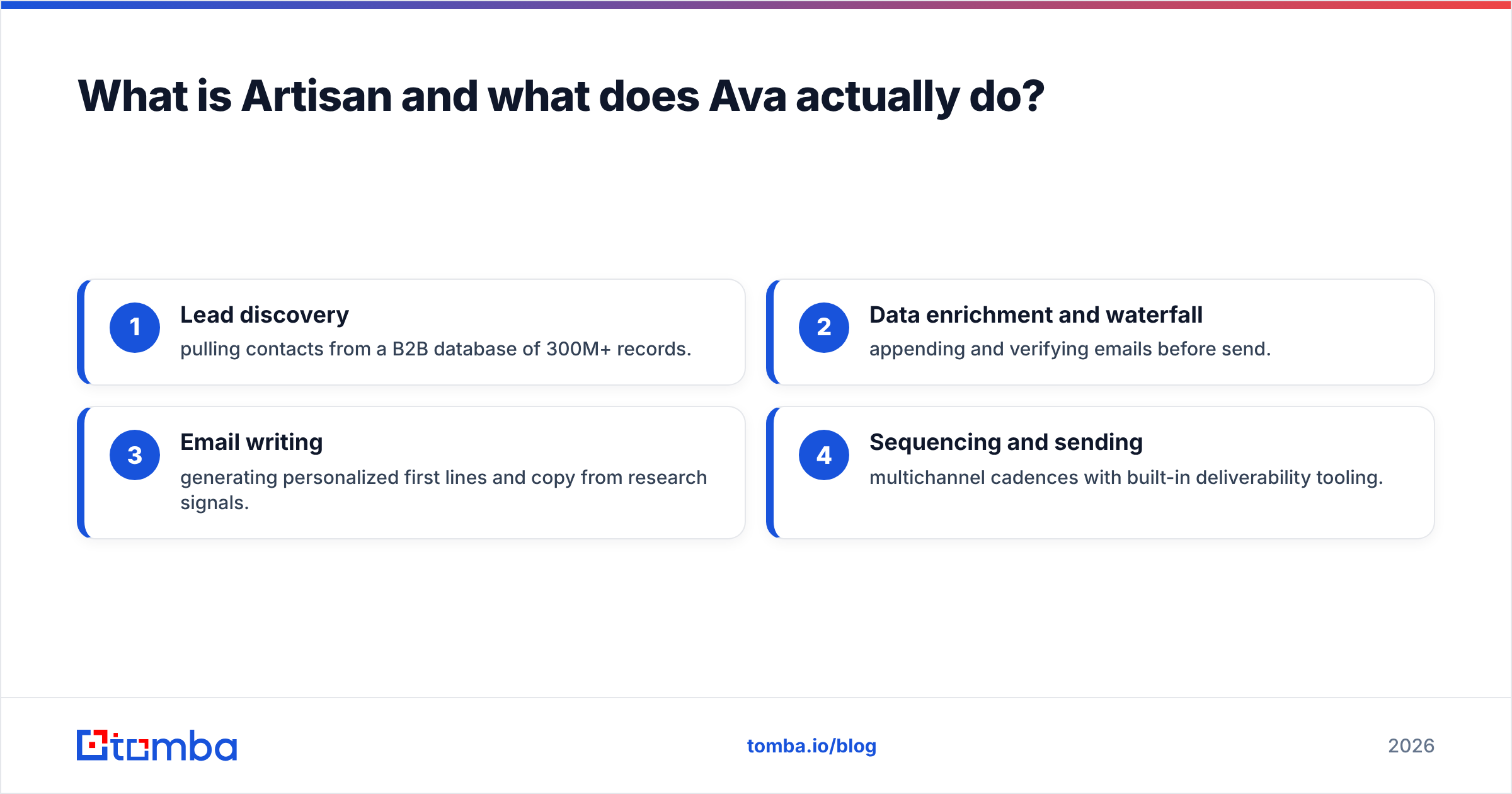
Artisan (see the official site at artisan.co) positions itself as an "AI employee" platform. The flagship is Ava, marketed as an autonomous BDR. In practice, Ava bundles four jobs that historically lived in separate tools:
- Lead discovery — pulling contacts from a B2B database of 300M+ records.
- Data enrichment and waterfall — appending and verifying emails before send.
- Email writing — generating personalized first lines and copy from research signals.
- Sequencing and sending — multichannel cadences with built-in deliverability tooling.
The pitch is that one AI agent runs the whole top-of-funnel motion while a human just approves and handles replies. That is genuinely useful framing — most of these tasks are glue work. The catch is that "autonomous" still needs supervision, and the quality of every downstream step depends on the accuracy of step one and two.
What are the main pros of Artisan?#
Credit where it is due — the product solves real pain for a specific buyer.
- One platform instead of five. For a founder running outbound solo, replacing a data tool, an enrichment tool, a copy tool, and a sequencer with a single login removes a lot of integration headache. This is the core value, and it is real.
- Fast time-to-first-campaign. Onboarding is guided. You describe your ICP, Ava drafts an audience and copy, and you can be sending within a day. For non-technical founders that speed matters.
- AI personalization at volume. Ava researches each prospect and writes first lines that beat generic mail-merge. It will not win copywriting awards, but it clears the "obviously a blast" bar most of the time.
- Human-in-the-loop controls. You can review audiences and messaging before anything sends, which reduces the risk of the AI emailing the wrong segment.
- Bundled deliverability. Warmup and inbox-health features are included rather than bolted on, which simplifies setup for people who do not know what SPF or DKIM are.
If your bottleneck is "I have no system at all," Artisan compresses weeks of stack-building into an afternoon.
What are the cons and limitations of Artisan?#
Now the honest other half of the Artisan pros and cons ledger.
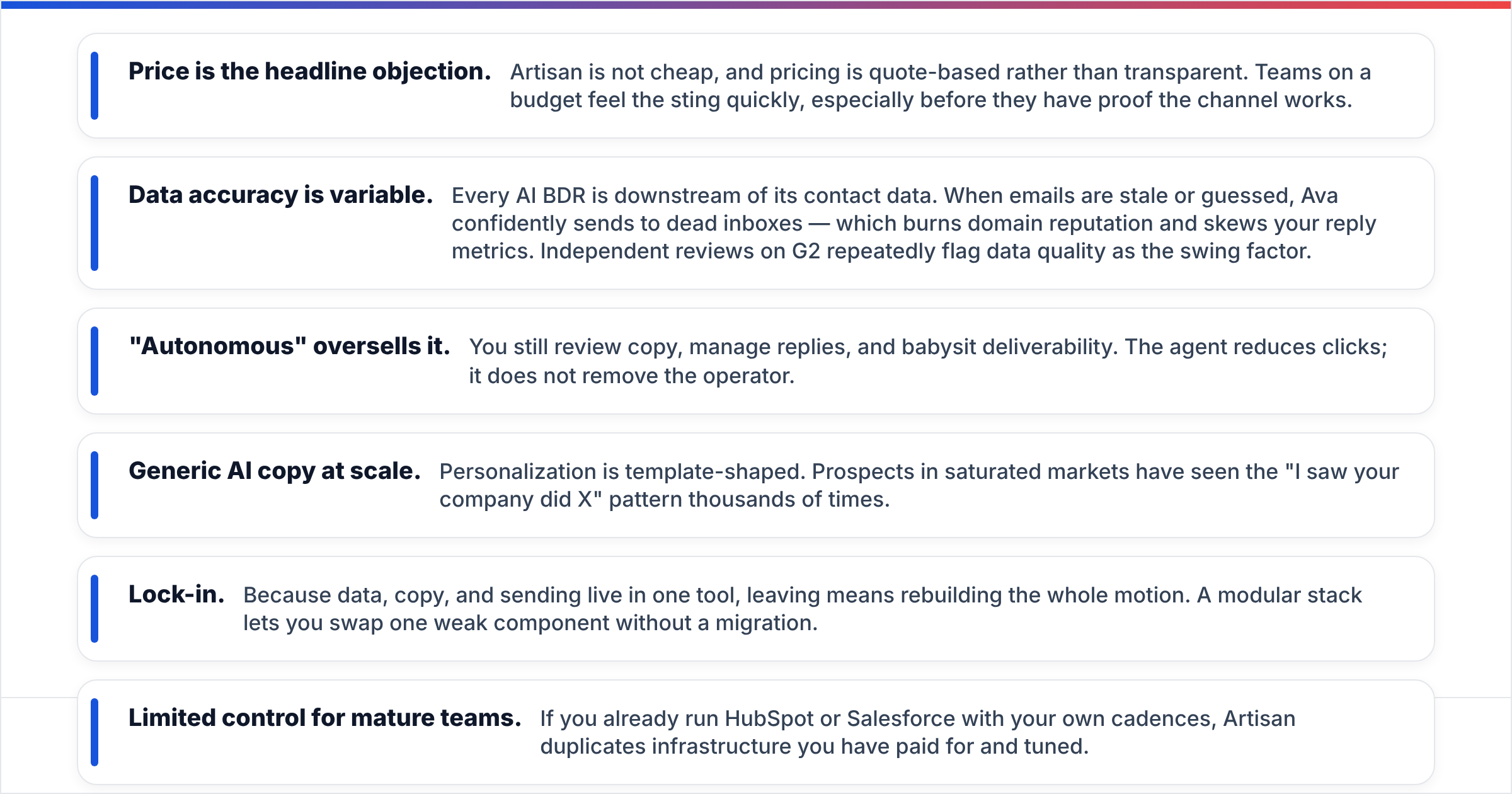
- Price is the headline objection. Artisan is not cheap, and pricing is quote-based rather than transparent. Teams on a budget feel the sting quickly, especially before they have proof the channel works.
- Data accuracy is variable. Every AI BDR is downstream of its contact data. When emails are stale or guessed, Ava confidently sends to dead inboxes — which burns domain reputation and skews your reply metrics. Independent reviews on G2 repeatedly flag data quality as the swing factor.
- "Autonomous" oversells it. You still review copy, manage replies, and babysit deliverability. The agent reduces clicks; it does not remove the operator.
- Generic AI copy at scale. Personalization is template-shaped. Prospects in saturated markets have seen the "I saw your company did X" pattern thousands of times.
- Lock-in. Because data, copy, and sending live in one tool, leaving means rebuilding the whole motion. A modular stack lets you swap one weak component without a migration.
- Limited control for mature teams. If you already run HubSpot or Salesforce with your own cadences, Artisan duplicates infrastructure you have paid for and tuned.
The recurring theme: Artisan's weakest link is the same as every AI BDR's — the contact data. A great agent sending to bad addresses is still bad outbound. That is why teams who care about results separate their data accuracy decision from their automation decision, and verify contacts with a dedicated email verifier before a single send.
How much does Artisan cost in 2026?#
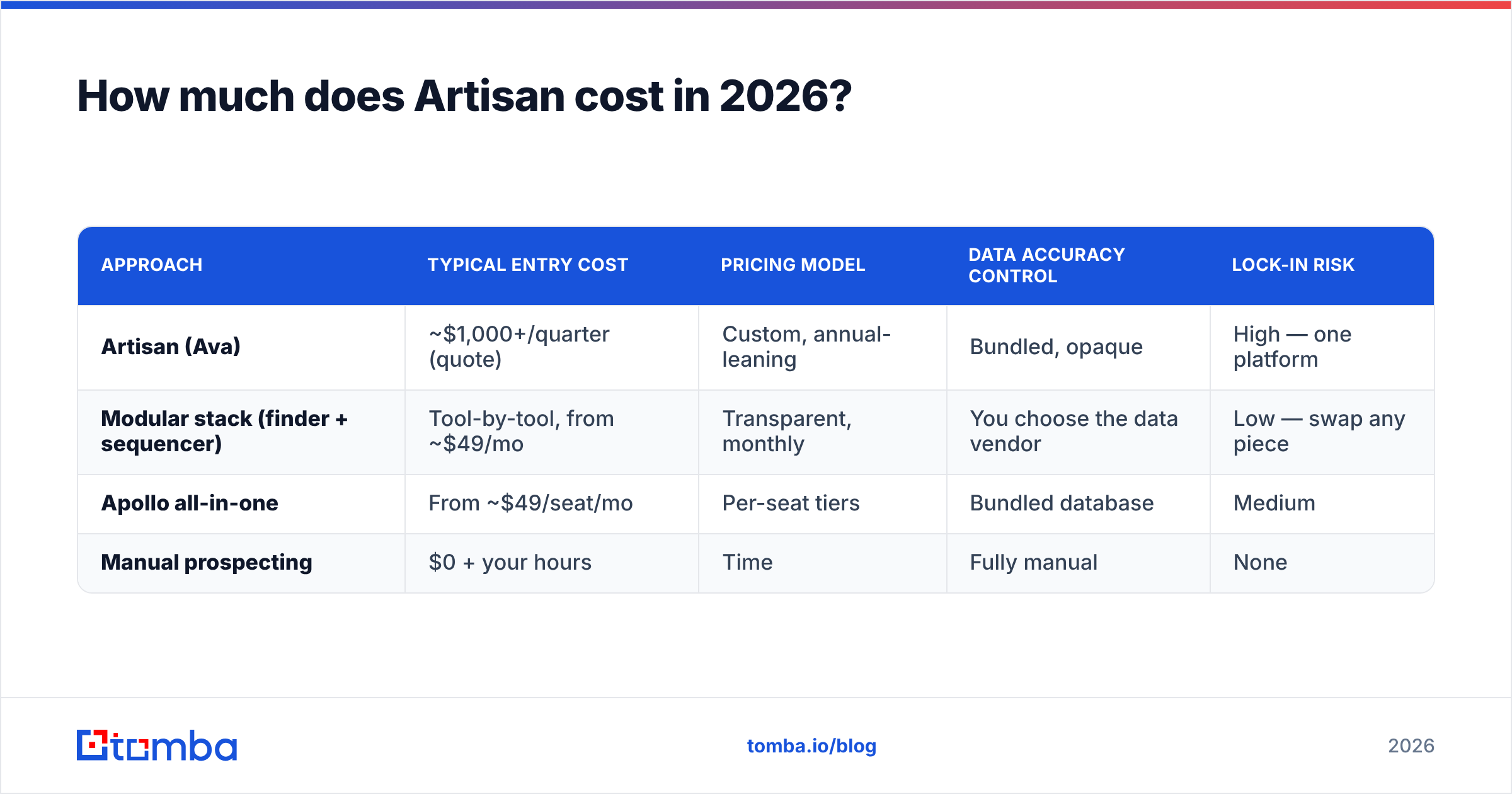
Artisan uses custom, quote-based pricing tied to lead volume and seats, so list prices move. As a planning anchor, contracts commonly land in the low-thousands per quarter once you include the data credits, and annual commitments are the norm. Compare that against a modular stack where each layer is transparently priced.
| Approach | Typical entry cost | Pricing model | Data accuracy control | Lock-in risk |
|---|---|---|---|---|
| Artisan (Ava) | ~$1,000+/quarter (quote) | Custom, annual-leaning | Bundled, opaque | High — one platform |
| Modular stack (finder + sequencer) | Tool-by-tool, from ~$49/mo | Transparent, monthly | You choose the data vendor | Low — swap any piece |
| Apollo all-in-one | From ~$49/seat/mo | Per-seat tiers | Bundled database | Medium |
| Manual prospecting | $0 + your hours | Time | Fully manual | None |
For reference, a focused data layer like Tomba runs a Free tier (25 searches/mo), Starter at $49/mo, Growth at $99/mo, and Pro at $249/mo — see the full Tomba pricing breakdown. The point is not that one number beats another; it is that opaque bundled pricing makes it hard to know what you are actually paying for the data versus the automation.
Is Artisan better than building a modular stack?#
It depends entirely on your maturity and what you already own.
Artisan wins when:
- You are a founder or a one-person GTM team with no existing stack.
- You value setup speed over per-component control.
- You do not have anyone to run RevOps or deliverability.
A modular stack wins when:
- You already have a CRM and a sequencer you trust (Smartlead, Instantly, HubSpot, Outreach).
- You want to control and audit your contact data quality independently.
- You want transparent, scalable pricing and zero lock-in.
- Your market is saturated and you need copy control beyond AI defaults.
The modular path is straightforward: use a precise data enrichment and finding layer to build clean, verified lists, then push them into the sequencer you already pay for. You keep the AI where it helps (drafting, summarizing replies) and you keep ownership of the part that actually determines results — the data.

How does Artisan compare to other AI BDR and outbound tools?#
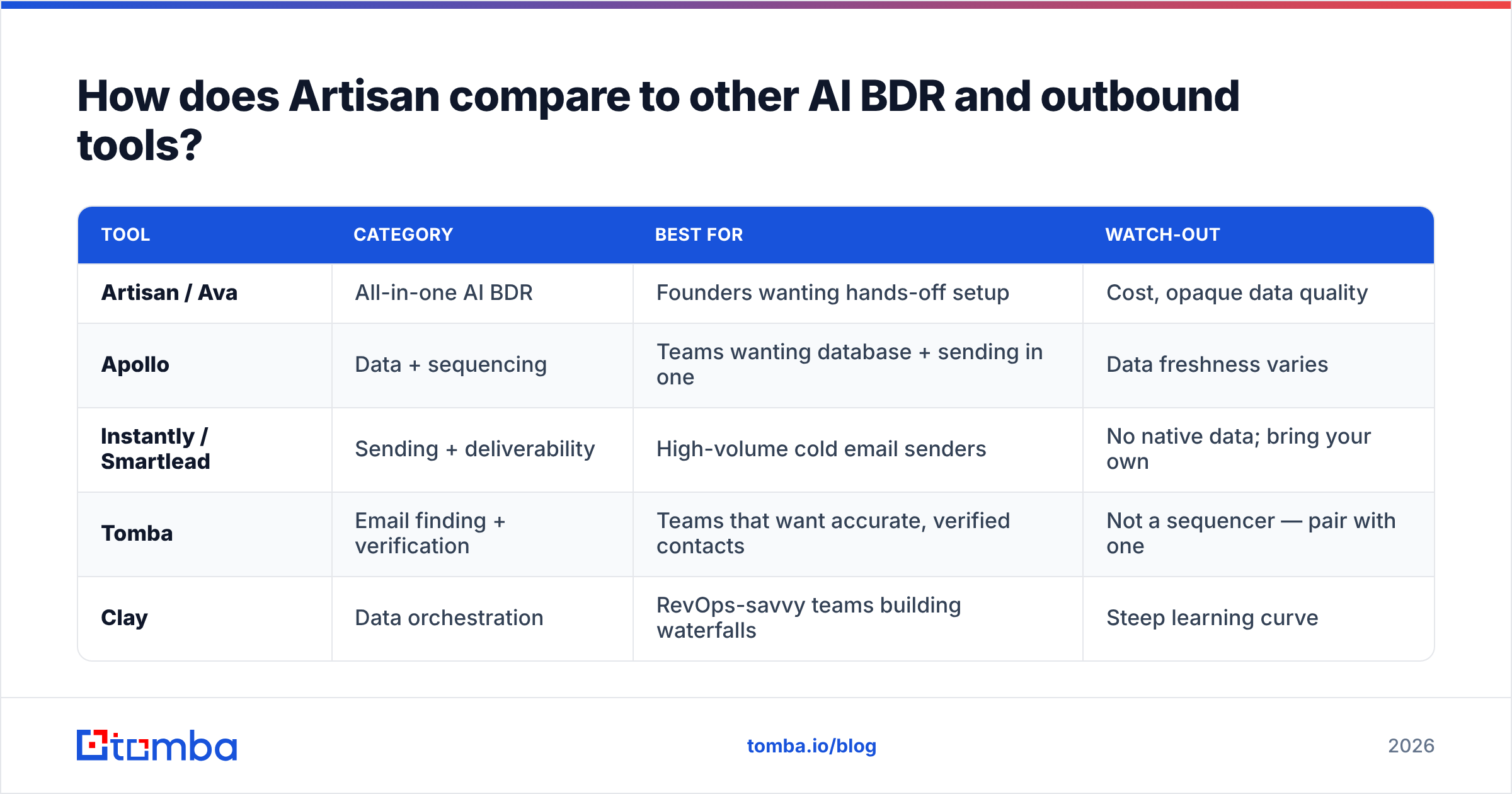
Artisan is not the only "AI does outbound" platform, and it is rarely a head-to-head with a pure data tool. Here is how the categories line up.
| Tool | Category | Best for | Watch-out |
|---|---|---|---|
| Artisan / Ava | All-in-one AI BDR | Founders wanting hands-off setup | Cost, opaque data quality |
| Apollo | Data + sequencing | Teams wanting database + sending in one | Data freshness varies |
| Instantly / Smartlead | Sending + deliverability | High-volume cold email senders | No native data; bring your own |
| Tomba | Email finding + verification | Teams that want accurate, verified contacts | Not a sequencer — pair with one |
| Clay | Data orchestration | RevOps-savvy teams building waterfalls | Steep learning curve |
The strategic takeaway: most "AI BDR vs AI BDR" debates miss the real lever. Whether you choose Artisan, Apollo, or a custom stack, the contacts feeding the machine decide your bounce rate and your reputation. Analysts like Gartner have noted for years that data decay — often 25–30% of B2B records annually — quietly erodes outbound performance. No agent fixes bad inputs.
If you go modular, you can plug accurate contact discovery directly into your workflow with the Tomba API, or pull verified emails by company using domain search before you ever load a sequence.
Who should actually buy Artisan?#
Buy Artisan if you are a non-technical founder or a tiny team that wants a single button for outbound and is comfortable paying a premium for convenience and speed. The consolidation is genuinely valuable when the alternative is "no system at all," and the human-in-the-loop controls keep the AI from doing anything reckless.
Skip Artisan if you already own a CRM and sequencer, if budget transparency matters, or if your differentiator is data quality and copy you control. In those cases you will pay twice for infrastructure you have already tuned, and you will inherit data accuracy you cannot independently audit.
The middle path most growing teams land on: keep your existing sender, use AI selectively for drafting, and invest the savings into the one thing that compounds — a clean, verified contact list.
Frequently asked questions#
Is Artisan's Ava fully autonomous? No. It automates sourcing, writing, and sending, but you still review audiences and copy, manage replies, and own deliverability outcomes. "Autonomous" is directional, not literal.
Why is data accuracy such a big deal with AI BDRs? Because every step after sourcing inherits the errors. Send to a guessed address and you bounce, hurt your sender reputation, and pollute your reply rate — making the AI look worse than it is.
Can I replace Artisan with cheaper tools? Often, yes. A transparent finder-plus-verifier data layer paired with a sequencer you already use covers most of the value at a fraction of the cost, with no lock-in.
The bottom line on Artisan's pros and cons#
Artisan is a competent all-in-one AI BDR with a real use case: founders and lean teams who want outbound running fast without assembling a stack. Its weaknesses — premium opaque pricing, variable data quality, lock-in, and template-shaped copy — all trace back to the trade-off you make when one tool owns the whole funnel.
Whatever you decide, protect the input. Outbound lives or dies on whether your emails reach real people. Start with accurate, verified contacts using the Tomba Email Finder — find professional addresses by domain, name, or company, verify them before you send, and feed any sequencer or AI agent with data it can trust. The Free tier gives you 25 searches a month to test accuracy before you commit a cent, so you can prove the data layer first and let the automation argument come second.
// get started
Find, verify and enrich your first contacts today
Start on the free plan with 25 searches a month, then scale when your team is ready.
Free plan · No credit card required · GDPR & CCPA
Get the Tomba newsletter
Product and data updates
// about the author