Artisan vs B2B Rocket 2026: Which AI SDR Platform Wins?
Artisan and B2B Rocket both promise an autonomous AI SDR — but they price, prospect, and personalize very differently. Here's the honest 2026 breakdown.
TL;DR
- Artisan sells one polished AI SDR named "Ava" that owns the full outbound motion — research, list-building, copy, and sending — and is priced as a seat-based platform aimed at funded teams.
- B2B Rocket sells configurable AI sales "agents" with a heavier focus on volume, multi-step automation, and lower entry pricing, but a steeper setup curve.
- Both are only as good as the contact data feeding them — an AI SDR that emails stale or unverified addresses just automates bounces.
- Pick Artisan if you want a done-for-you, high-touch agent and have budget; pick B2B Rocket if you want cheaper, tunable volume and don't mind configuration work.
- Whichever you choose, pair it with a clean data layer (a real email finder and email verifier) so your AI isn't sending into the void.
What are Artisan and B2B Rocket?#
Both are "AI SDR" platforms — software that tries to replace or augment the work a human sales development rep does: finding prospects, writing first-touch emails, sending sequences, and booking meetings. Think of them as a robotic junior rep who never sleeps. The difference is in how much you steer the robot.
Artisan is built around a single branded agent, "Ava." You give Ava an ICP (ideal customer profile), connect your inbox, and it researches accounts, drafts personalized outreach, and runs the sequence. The pitch is consolidation: one agent, one workflow, less tool sprawl. Their positioning leans premium and "human-like," and their public site (artisan.co) markets it as an all-in-one outbound platform.
B2B Rocket (b2brocket.ai) takes the multi-agent, configure-it-yourself route. You build AI agents that qualify leads, run conversations, and hand off to a calendar booking step. It leans toward higher volume and lower per-seat cost, which appeals to leaner teams and agencies running outbound for clients.
The core tension is the same one every buyer hits with autonomous outreach: automation amplifies whatever data you feed it. Good data, more meetings. Bad data, more spam complaints — faster.
How does an AI SDR actually work?#
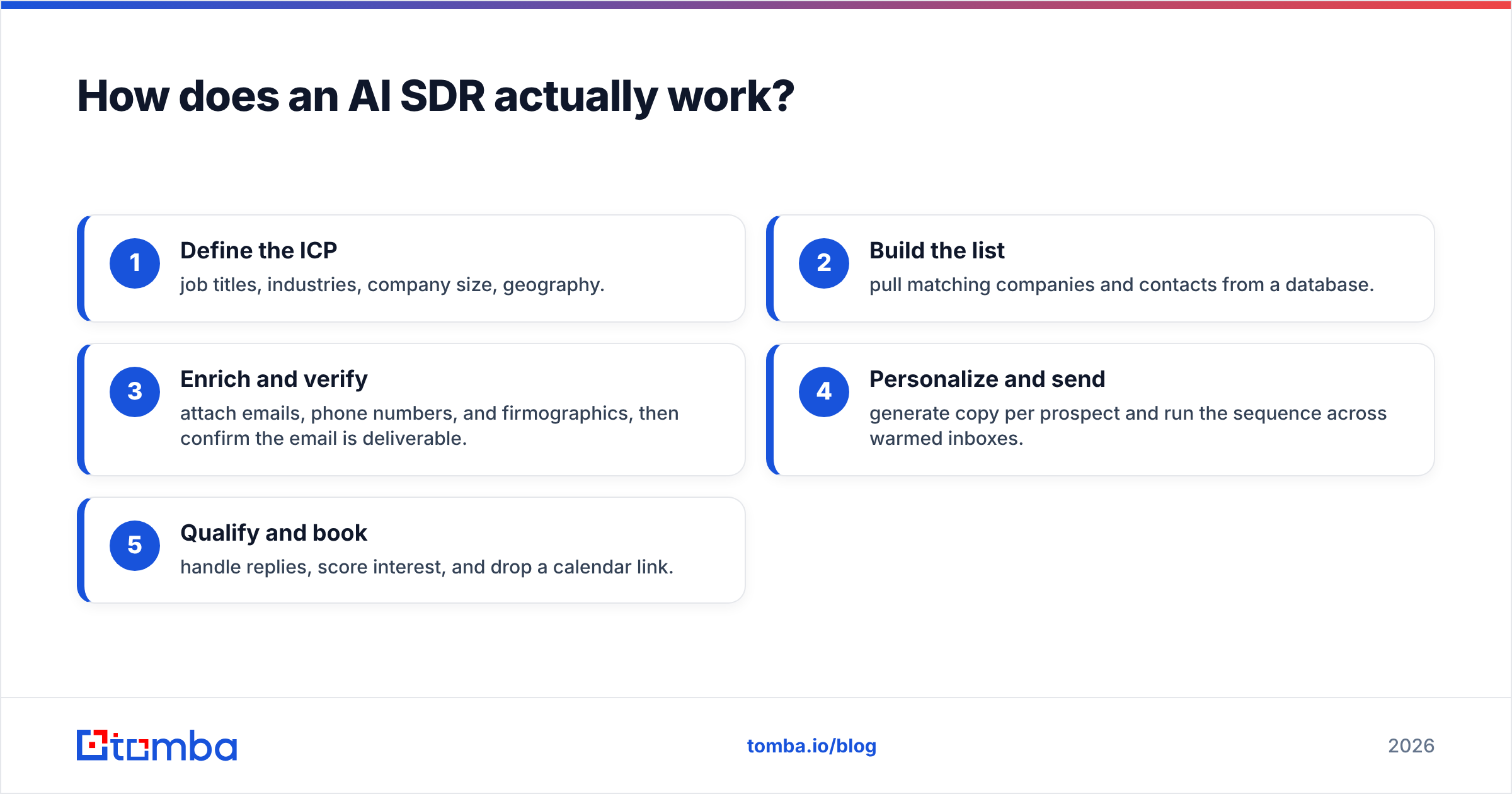
Under the hood, both tools run the same five-stage loop. Understanding it tells you exactly where each platform is strong and where it quietly relies on third-party data.
- Define the ICP — job titles, industries, company size, geography.
- Build the list — pull matching companies and contacts from a database.
- Enrich and verify — attach emails, phone numbers, and firmographics, then confirm the email is deliverable.
- Personalize and send — generate copy per prospect and run the sequence across warmed inboxes.
- Qualify and book — handle replies, score interest, and drop a calendar link.
Stages 2 and 3 are where most disappointment originates. Both Artisan and B2B Rocket bundle their own data sources, but bundled B2B data ages fast — people change jobs roughly every two to three years, so a list that was 95% accurate in January is materially worse by Q4. That's why teams who get real ROI almost always run an independent verification and data enrichment pass before the AI ever hits "send."
Artisan vs B2B Rocket: full feature comparison#
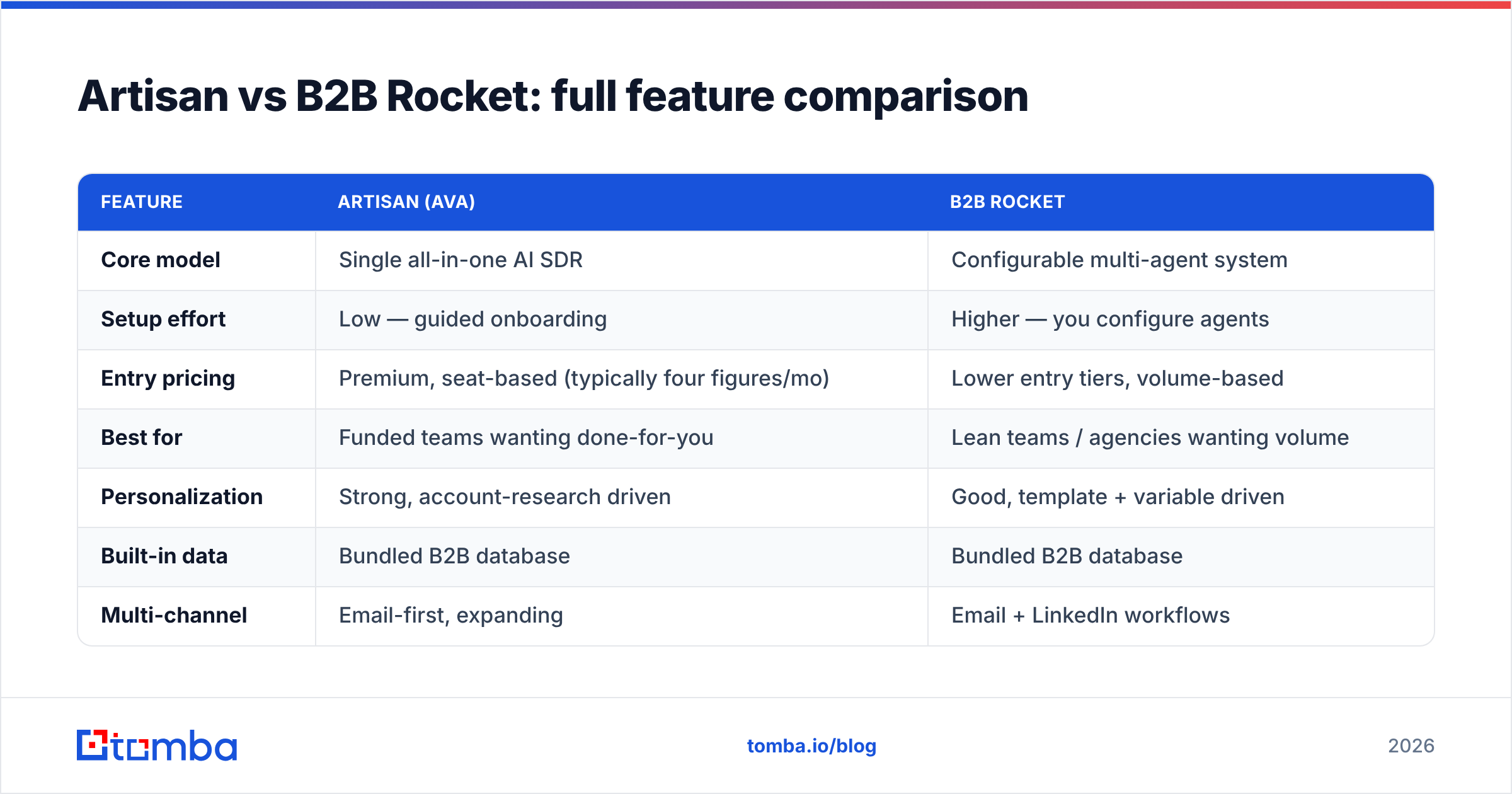
Here's the side-by-side. Treat published pricing as directional — both vendors gate exact numbers behind sales calls and adjust by seat count and contact volume.
| Feature | Artisan (Ava) | B2B Rocket |
|---|---|---|
| Core model | Single all-in-one AI SDR | Configurable multi-agent system |
| Setup effort | Low — guided onboarding | Higher — you configure agents |
| Entry pricing | Premium, seat-based (typically four figures/mo) | Lower entry tiers, volume-based |
| Best for | Funded teams wanting done-for-you | Lean teams / agencies wanting volume |
| Personalization | Strong, account-research driven | Good, template + variable driven |
| Built-in data | Bundled B2B database | Bundled B2B database |
| Multi-channel | Email-first, expanding | Email + LinkedIn workflows |
| Learning curve | Gentle | Moderate to steep |
| Transparency of data quality | Limited public benchmarks | Limited public benchmarks |
The honest summary: Artisan optimizes for fewer decisions and a cleaner output, while B2B Rocket optimizes for more control and lower cost. Neither publishes hard, third-party-audited deliverability numbers, which is exactly why you should own that layer yourself.
Which one personalizes outreach better?#
Artisan generally produces more natural first-touch copy out of the box, because Ava is tuned for account research and weaves in company-specific hooks without much operator effort. If you hand it a tight ICP, the drafts read like a competent rep wrote them.
B2B Rocket gets you there too, but it expects you to do more of the prompt and template engineering. That's a feature for power users — you can dial in exactly how aggressive or consultative the messaging is — and a tax for everyone else. If your team won't invest the configuration time, B2B Rocket's output can feel more templated.
But here's the part both marketing pages downplay: personalization quality is capped by contact accuracy. A flawless paragraph addressed to "Hi {first_name}" at a bounced mailbox converts at zero. The single highest-leverage upgrade to either tool is making sure every address is real before send. Run your list through a dedicated email verifier and a catch-all verifier, and your reply rate moves more than any copy tweak will.
What about deliverability and data quality?#
This is the make-or-break factor and it has almost nothing to do with which AI writes better sentences.
Autonomous senders fail in a predictable way: they scale volume before they scale list hygiene. The result is bounces, spam-trap hits, and a tanked sender reputation that follows your domain around for months. According to mailbox-provider guidance summarized by sources like HubSpot's deliverability research, bounce rates above ~2% start hurting inbox placement, and spam complaints above 0.1% can get a domain throttled.
Neither Artisan nor B2B Rocket can fully protect you here, because both rely partly on bundled data you didn't audit. Your defensive playbook:
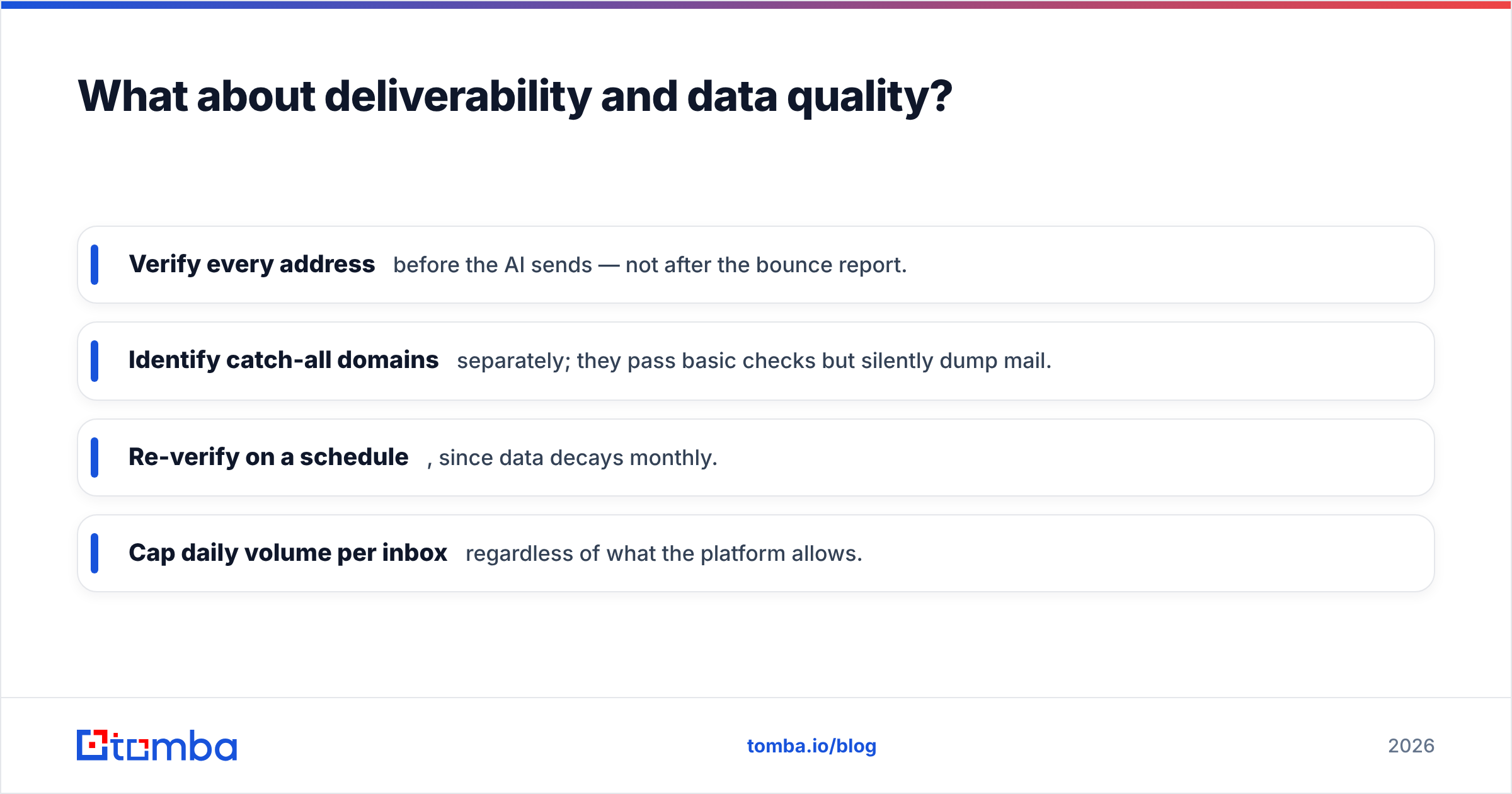
- Verify every address before the AI sends — not after the bounce report.
- Identify catch-all domains separately; they pass basic checks but silently dump mail.
- Re-verify on a schedule, since data decays monthly.
- Cap daily volume per inbox regardless of what the platform allows.
If you want to benchmark how clean your provider's bundled data actually is, export a sample and re-check it with an independent email finder. When the overlap is high, trust the bundle. When it isn't, you just found why your meetings booked number is soft.
Is Artisan or B2B Rocket better for a small team?#
For most teams under ten reps, the decision comes down to budget and appetite for configuration.
Choose Artisan if:
- You have funding and want results without a setup project.
- You'd rather pay more to remove decisions than save money and tune knobs.
- Your motion is account-based and personalization quality matters more than raw volume.
Choose B2B Rocket if:
- You're cost-sensitive or running outbound for multiple clients.
- You have someone who enjoys configuring agents and sequences.
- You want higher sending volume per dollar and will manage deliverability yourself.
There's also a third, increasingly common answer: skip the all-in-one AI SDR entirely and assemble your own stack. Many teams find that a focused data tool plus an existing sequencer (Instantly, Smartlead, or even native CRM sequences) costs less and gives them more control than a bundled agent. If that's you, look at building blocks like a bulk email finder, domain search, and the Tomba API to power your own pipeline. You can compare crowd-sourced experiences on a neutral marketplace like G2 before committing to any annual contract.
How do you evaluate either tool fairly?#
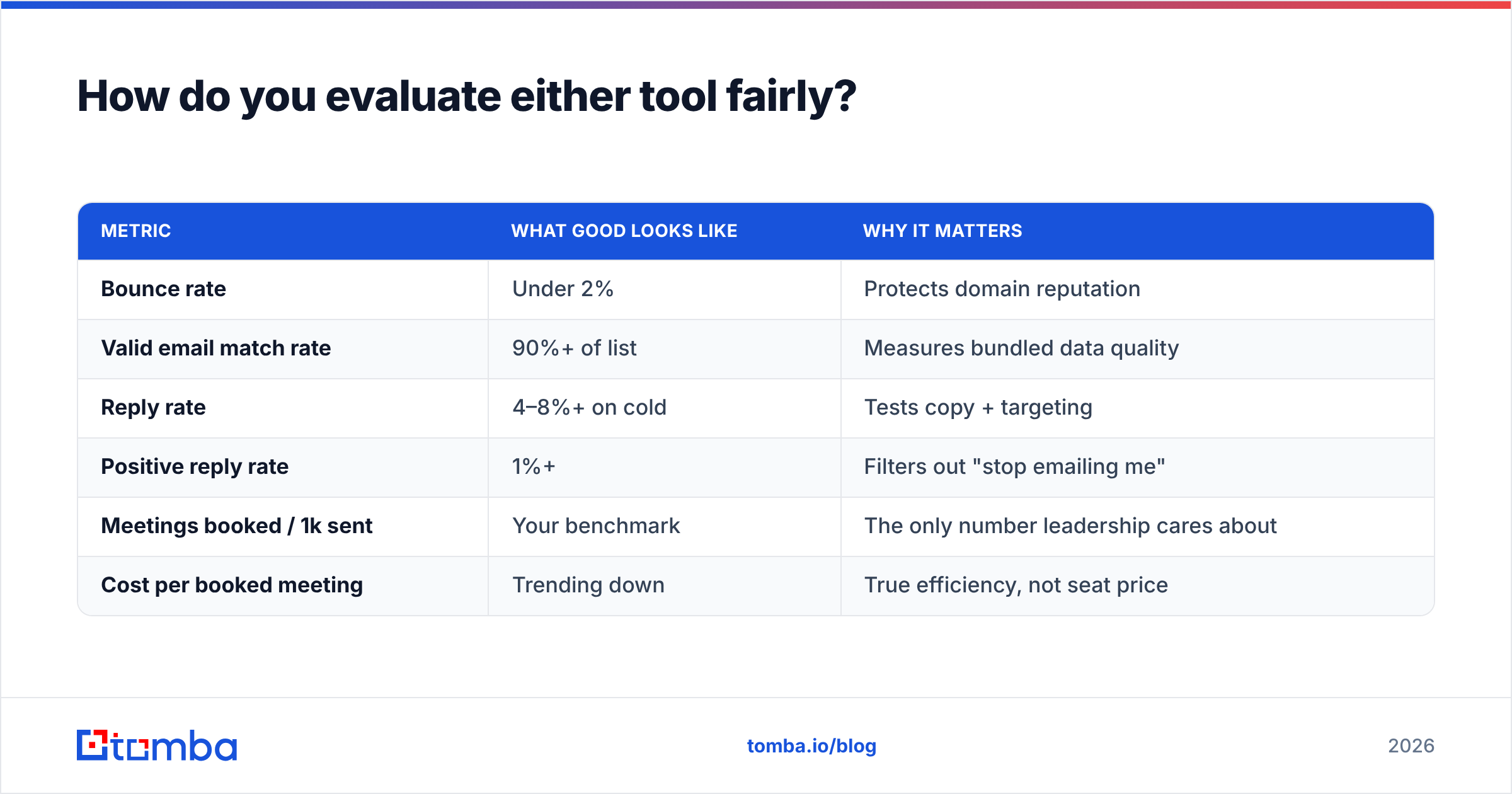
Run a 14-day bake-off instead of trusting demos. Use the same ICP, the same volume cap, and the same offer for both, and judge on the metrics that actually move revenue:
| Metric | What good looks like | Why it matters |
|---|---|---|
| Bounce rate | Under 2% | Protects domain reputation |
| Valid email match rate | 90%+ of list | Measures bundled data quality |
| Reply rate | 4–8%+ on cold | Tests copy + targeting |
| Positive reply rate | 1%+ | Filters out "stop emailing me" |
| Meetings booked / 1k sent | Your benchmark | The only number leadership cares about |
| Cost per booked meeting | Trending down | True efficiency, not seat price |
Notice that two of the top three are data metrics, not AI metrics. The platform that wins your bake-off will usually be the one whose list is cleanest — and you can level that playing field by pre-verifying both lists yourself.
A practical workflow: pull your target accounts, run them through domain search to map the right contacts, verify with the email verifier, and only then load the cleaned list into Artisan or B2B Rocket. Now you're testing the AI, not the data lottery.
Frequently asked questions#
Is Artisan more expensive than B2B Rocket? Generally yes. Artisan positions as a premium, seat-based platform, while B2B Rocket offers lower entry tiers tied to volume. Confirm current numbers with each vendor, since both gate exact pricing.
Can these tools fully replace a human SDR? Not yet. They replace the repetitive parts — research, list-building, first drafts, sending — but human judgment still wins on handling nuanced replies, strategic accounts, and edge-case objections. Treat them as a force multiplier.
Do I still need an email finder if the tool has built-in data? In practice, yes — as a verification and gap-fill layer. Bundled databases decay and have coverage holes. An independent email finder and email verifier catch the stale and missing records before they cost you reputation.
Which has the easier learning curve? Artisan. It's designed to be turnkey. B2B Rocket gives you more control at the cost of more setup.
The bottom line#
Artisan and B2B Rocket are both legitimate AI SDR platforms — the real choice is premium-and-simple versus cheaper-and-configurable. But the variable that decides your ROI sits underneath both of them: data accuracy. An AI SDR firing personalized emails at unverified addresses just automates the fastest path to a burned domain.
Before you sign either contract, own your data layer. Tomba's Email Finder finds and verifies professional addresses by name, domain, or company, so whichever AI SDR you pick is sending into real inboxes instead of dead ends. Start free with 25 searches a month, scale on the $49/mo Starter plan, and check full Tomba pricing when you're ready to feed your AI clean data. Win the data, and the rest of the bake-off takes care of itself.
// get started
Find, verify and enrich your first contacts today
Start on the free plan with 25 searches a month, then scale when your team is ready.
Free plan · No credit card required · GDPR & CCPA
// about the author