Artisan vs Ditlead 2026: AI Sales Platform Comparison
Artisan automates outbound with an AI BDR; Ditlead runs multichannel sequences at a lower price. Here's how the two stack up in 2026 — and where your data layer fits.
The Artisan vs Ditlead choice comes down to one question. Do you want a software platform that replaces part of your SDR headcount? Or a leaner engine that amplifies the reps you already have? Both promise more pipeline from outbound. But they attack the problem from opposite ends of the price and automation spectrum.
This comparison breaks down what each tool does and where the pricing lands. It also covers the one variable that quietly decides whether either platform works: the quality of the contact data you feed it.
TL;DR#
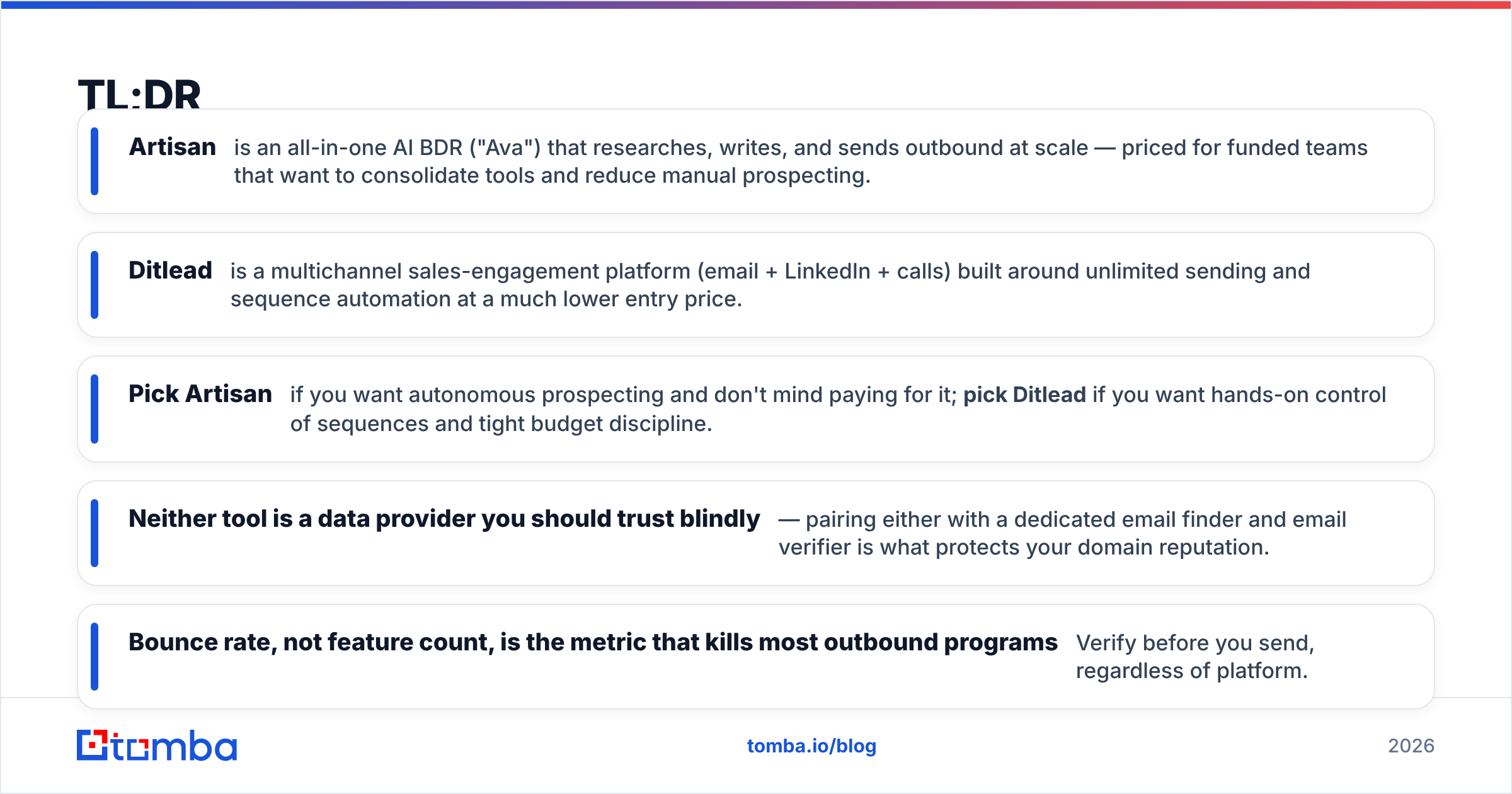
- Artisan is an all-in-one AI BDR ("Ava") that researches, writes, and sends outbound at scale — priced for funded teams that want to consolidate tools and reduce manual prospecting.
- Ditlead is a multichannel sales-engagement platform (email + LinkedIn + calls) built around unlimited sending and sequence automation at a much lower entry price.
- Pick Artisan if you want autonomous prospecting and don't mind paying for it; pick Ditlead if you want hands-on control of sequences and tight budget discipline.
- Neither tool is a data provider you should trust blindly — pairing either with a dedicated email finder and email verifier is what protects your domain reputation.
- Bounce rate, not feature count, is the metric that kills most outbound programs. Verify before you send, regardless of platform.
What is Artisan?#
Artisan is an outbound sales platform built around an AI agent called Ava, marketed as an "AI BDR." It bundles lead sourcing, research, personalization, and sending into one workflow. You define an ideal customer profile. Ava then drafts and queues personalized emails with little rep involvement.
The pitch is consolidation and automation. You get fewer seats and fewer point tools, plus a system that runs prospecting on autopilot. Human reps then focus on live conversations. You can see the positioning on the Artisan website. It targets mid-market and growth-stage teams that have outbound budget but are short on SDR capacity.
The tradeoff is cost and control. Autonomous sending means you trust an AI agent with your domain reputation and your brand voice. So guardrails and review matter more, not less.
What is Ditlead?#
Ditlead is a sales-engagement and cold-outreach platform focused on multichannel sequences — email, LinkedIn touches, and calling tasks. It emphasizes unlimited sending volume and inbox rotation. It sits in the same set as Instantly, Saleshandy, and Reply.io. You bring or build your lead list, design a sequence, connect multiple mailboxes, and let the platform pace delivery.
Where Artisan leans into "the AI does the work," Ditlead leans into "you control the machine cheaply." It's built for agencies, solo founders, and small sales teams. They want a lot of sending capacity without a per-seat enterprise contract. You can review its feature set on the Ditlead site.
The strength is flexibility and price. The cost is effort: you own the strategy, the copy, and — critically — the quality of the list you load.
How do Artisan and Ditlead compare on features and price?#
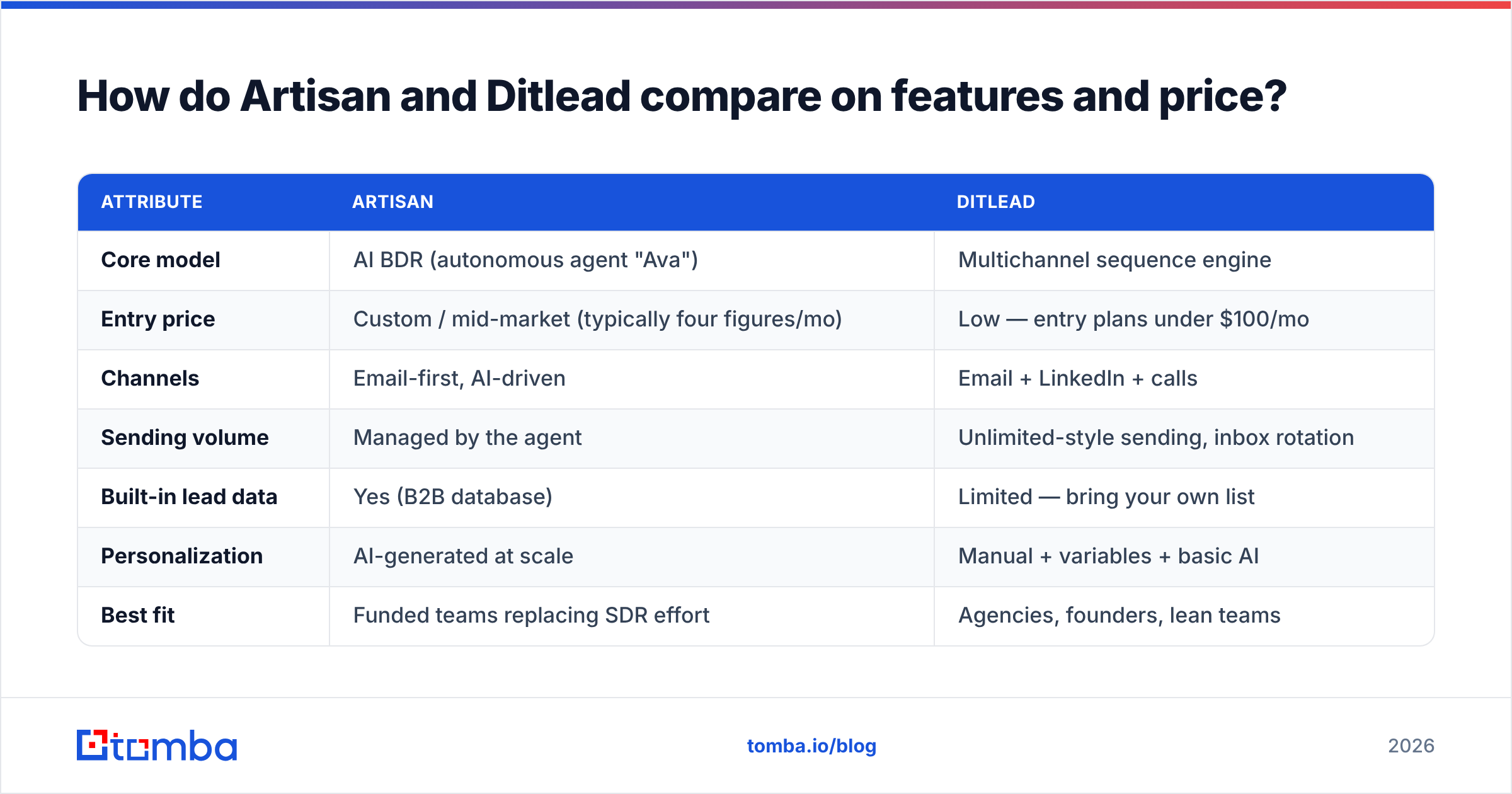
Here's the head-to-head on the attributes that actually change your buying decision.
| Attribute | Artisan | Ditlead |
|---|---|---|
| Core model | AI BDR (autonomous agent "Ava") | Multichannel sequence engine |
| Entry price | Custom / mid-market (typically four figures/mo) | Low — entry plans under $100/mo |
| Channels | Email-first, AI-driven | Email + LinkedIn + calls |
| Sending volume | Managed by the agent | Unlimited-style sending, inbox rotation |
| Built-in lead data | Yes (B2B database) | Limited — bring your own list |
| Personalization | AI-generated at scale | Manual + variables + basic AI |
| Best fit | Funded teams replacing SDR effort | Agencies, founders, lean teams |
| Learning curve | Low (agent does setup) | Moderate (you build sequences) |
| Data verification | Should still verify externally | Should still verify externally |
The pattern is clear. Artisan charges more and removes work. Ditlead charges less and hands you the controls. There's no universally "better" tool here. There's only the tool that matches your team's headcount, budget, and appetite for hands-on outbound.
One thing both platforms share: the contact data they send to is only as good as the source. That's the variable buyers consistently underestimate.

Is Artisan better than Ditlead?#
Artisan is better for a specific buyer: a growth-stage company with budget that wants to reduce manual prospecting and is comfortable letting an AI agent run the first-touch motion. If your bottleneck is SDR capacity and you'd rather buy software than hire, Artisan's model is compelling.
Ditlead is better for a different buyer: an operator who knows exactly what sequence they want to run, sends high volume, and treats every dollar of CAC as sacred. Agencies running outbound for multiple clients tend to land here because the unit economics scale.
Ask yourself three questions:
- Do you have the budget to pay for automation, or the time to run it yourself? Budget points to Artisan; time points to Ditlead.
- Do you want the AI to write and decide, or do you want to control copy and cadence? Control points to Ditlead.
- How many channels do you actually need? If LinkedIn and calls are core, Ditlead's multichannel design is native; with Artisan you're leaning on the email-first agent.
Notice that none of these questions is "which tool finds better emails?" Neither platform should be your single source of truth for contact accuracy — and that's the part worth slowing down on.
Why does data quality decide both tools?#
Because the most expensive line item in outbound isn't the software — it's the deliverability you burn when you send to bad addresses.
Think of your sending domain like a credit score. Every hard bounce is a missed payment. Send to a list with a 15% bounce rate and mailbox providers quietly route you to spam. There, even your good contacts never see you. Artisan's AI copy and Ditlead's unlimited sending are both worthless if 1 in 6 messages hits a dead inbox. The platform gets blamed; the data was the real culprit.
This is why experienced outbound teams treat the data layer as separate from the sending layer. You source and verify contacts with a dedicated tool, then load clean, validated addresses into Artisan or Ditlead. The sequence engine does what it's good at — pacing and personalization — and never has to compensate for a dirty list.
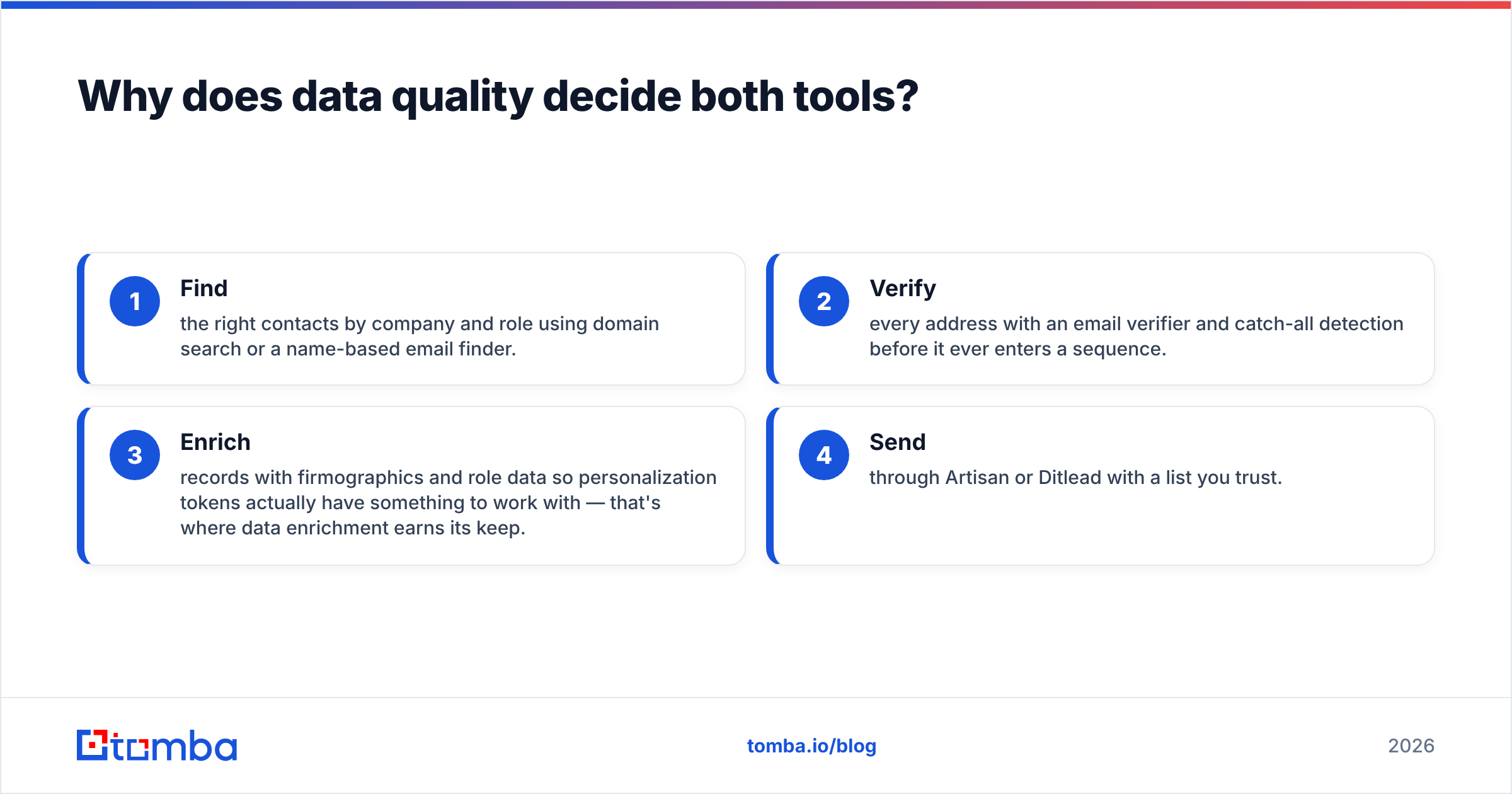
A practical pre-send pipeline looks like this:
- Find the right contacts by company and role using domain search or a name-based email finder.
- Verify every address with an email verifier and catch-all detection before it ever enters a sequence.
- Enrich records with firmographics and role data so personalization tokens actually have something to work with — that's where data enrichment earns its keep.
- Send through Artisan or Ditlead with a list you trust.
Skip step two and you're gambling your domain on someone else's database freshness.
How does Tomba fit alongside Artisan or Ditlead?#
Tomba is the data layer, not a competitor to either sending platform. It handles the "who do we contact and is this address real" problem so your engagement tool can focus on the "what do we say and when do we send it" problem.
The split looks like this:
| Job to be done | Tool that owns it |
|---|---|
| Find verified contact emails | Tomba |
| Verify and clean lists before send | Tomba |
| Enrich records with firmographics | Tomba |
| Build and run multichannel sequences | Ditlead |
| Autonomous AI prospecting/sending | Artisan |
Because Tomba exposes a Tomba API, bulk tools, and native integrations, you can wire verification directly into your workflow rather than exporting CSVs by hand. Pricing is transparent and built for scaling outbound. The Tomba pricing runs from a free tier (25 searches/mo) through Starter at $49/mo, Growth at $99/mo, and Pro at $249/mo, plus custom Enterprise plans. That's a fraction of what you'd lose to a single month of deliverability damage from an unverified list.
The point isn't "use Tomba instead of Artisan or Ditlead." It's "don't ask your sending tool to also be your data quality tool." Those are different jobs.

Artisan vs Ditlead: which should you choose in 2026?#
Here's the decision framework distilled.
Choose Artisan if:
- You're funded and want to cut manual prospecting effort.
- You'd rather buy automation than hire and train SDRs.
- Email-first, AI-driven outreach matches your motion.
- You're comfortable governing an autonomous agent's output.
Choose Ditlead if:
- Budget discipline is non-negotiable.
- You want hands-on control of copy, cadence, and channels.
- LinkedIn and calling are core to your outbound, not afterthoughts.
- You run high sending volume across many mailboxes (agency or founder-led).
In both cases:
- Put a dedicated find-and-verify layer in front of the sequencer.
- Treat bounce rate as your leading health metric, not open rate.
- Re-verify aging lists; B2B data decays roughly 2–3% per month as people change jobs.
If you want third-party signal before committing, check current user reviews on a neutral marketplace like G2 — both categories (AI SDR and sales engagement) have active review pages with recent feedback on deliverability and support quality.
Frequently asked questions#
Is Artisan or Ditlead cheaper? Ditlead, by a wide margin at the entry level. Artisan is priced for mid-market teams consolidating tools, while Ditlead's plans start low and scale on volume. If raw cost is the deciding factor, Ditlead wins; if cost-per-meeting after automation is the metric, the answer depends on your funnel.
Can I use both? Rarely necessary — they overlap on sending. Most teams pick one engagement layer. What you should pair with either is a separate data layer for finding and verifying contacts.
Do these tools verify emails for me? Not to the standard a deliverability-conscious team needs. Always run addresses through a dedicated email verifier with catch-all handling before sending, regardless of platform.
Which is better for an agency? Ditlead's pricing and multichannel design favor agency economics. Artisan suits a single funded company replacing internal SDR effort more than a multi-client agency.
The bottom line#
Artisan and Ditlead solve outbound from opposite directions — autonomous AI versus hands-on multichannel sequencing — and the right pick is the one that matches your budget and your appetite for control. But both live or die on the same input: clean, verified, well-enriched contact data.
Before your first send on either platform, build your list with Tomba. Use the Tomba Email Finder to source professional addresses by domain, name, or company, verify every one, and hand your sending tool a list that won't torch your domain reputation. The platform you choose decides how you reach people. The data you load decides whether you reach them at all.
// get started
Find, verify and enrich your first contacts today
Start on the free plan with 25 searches a month, then scale when your team is ready.
Free plan · No credit card required · GDPR & CCPA
// about the author