Artisan vs Jeeva AI (2026): Which AI SDR Platform Wins?
Artisan and Jeeva AI both promise to automate your SDR. We break down pricing, autonomy, data quality, and which one actually books meetings in 2026.
The pitch behind both Artisan and Jeeva AI is the same: hire a digital SDR that prospects, writes, and follows up while you sleep. The reality is that an AI sales rep is only as good as the data and deliverability underneath it. This guide compares the two platforms on the things that actually decide whether you book meetings — autonomy, data quality, pricing, and how well they slot into an existing outbound stack.
TL;DR — Artisan vs Jeeva AI in 30 seconds#
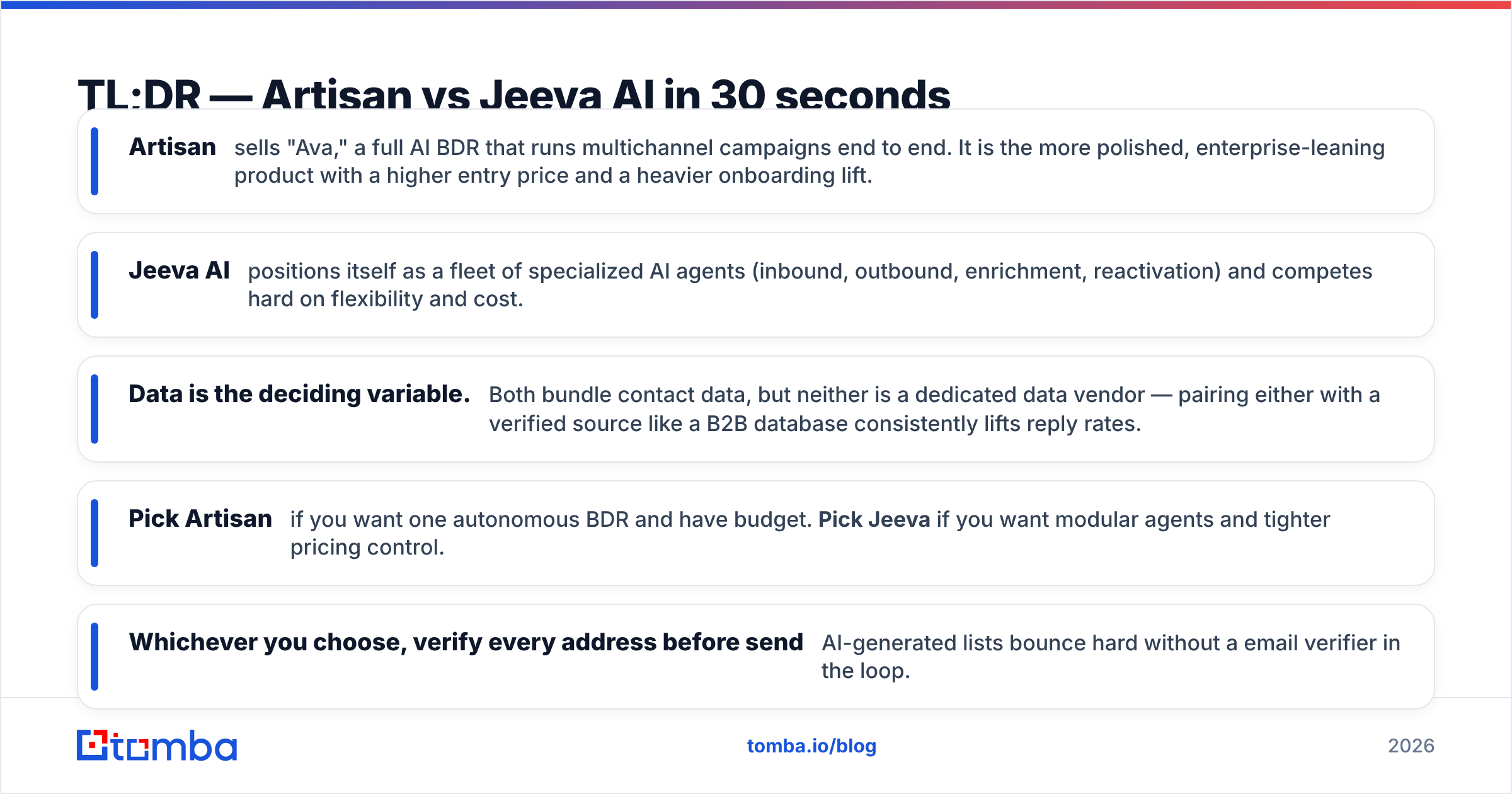
- Artisan sells "Ava," a full AI BDR that runs multichannel campaigns end to end. It is the more polished, enterprise-leaning product with a higher entry price and a heavier onboarding lift.
- Jeeva AI positions itself as a fleet of specialized AI agents (inbound, outbound, enrichment, reactivation) and competes hard on flexibility and cost.
- Data is the deciding variable. Both bundle contact data, but neither is a dedicated data vendor — pairing either with a verified source like a B2B database consistently lifts reply rates.
- Pick Artisan if you want one autonomous BDR and have budget. Pick Jeeva if you want modular agents and tighter pricing control.
- Whichever you choose, verify every address before send. AI-generated lists bounce hard without a email verifier in the loop.
What are Artisan and Jeeva AI?#
Both tools belong to the new "AI SDR" category — software that replaces or augments the manual work a sales development rep does: building a target list, finding contact details, writing personalized outreach, sending across channels, and handling replies.
Artisan launched its product around a single named agent, Ava, marketed as an "AI BDR." The framing is intentional: you are meant to treat Ava like a hire who owns a full outbound motion rather than a feature you toggle. It leans into a consolidated platform — data, sending, and a warm-up layer in one place.
Jeeva AI takes a more modular stance. Instead of one agent, it offers several role-based agents you can switch on as needed — an outbound SDR agent, an inbound qualifier, an enrichment agent, a LinkedIn agent, and so on. The bet is that teams want to compose their own automation rather than buy one monolith.
The category itself is young, so feature parity shifts month to month. What does not shift is the underlying dependency: an AI SDR sends email, and email only works when the addresses are real and the sending domain has a clean reputation.
)
How do Artisan and Jeeva AI compare on features?#
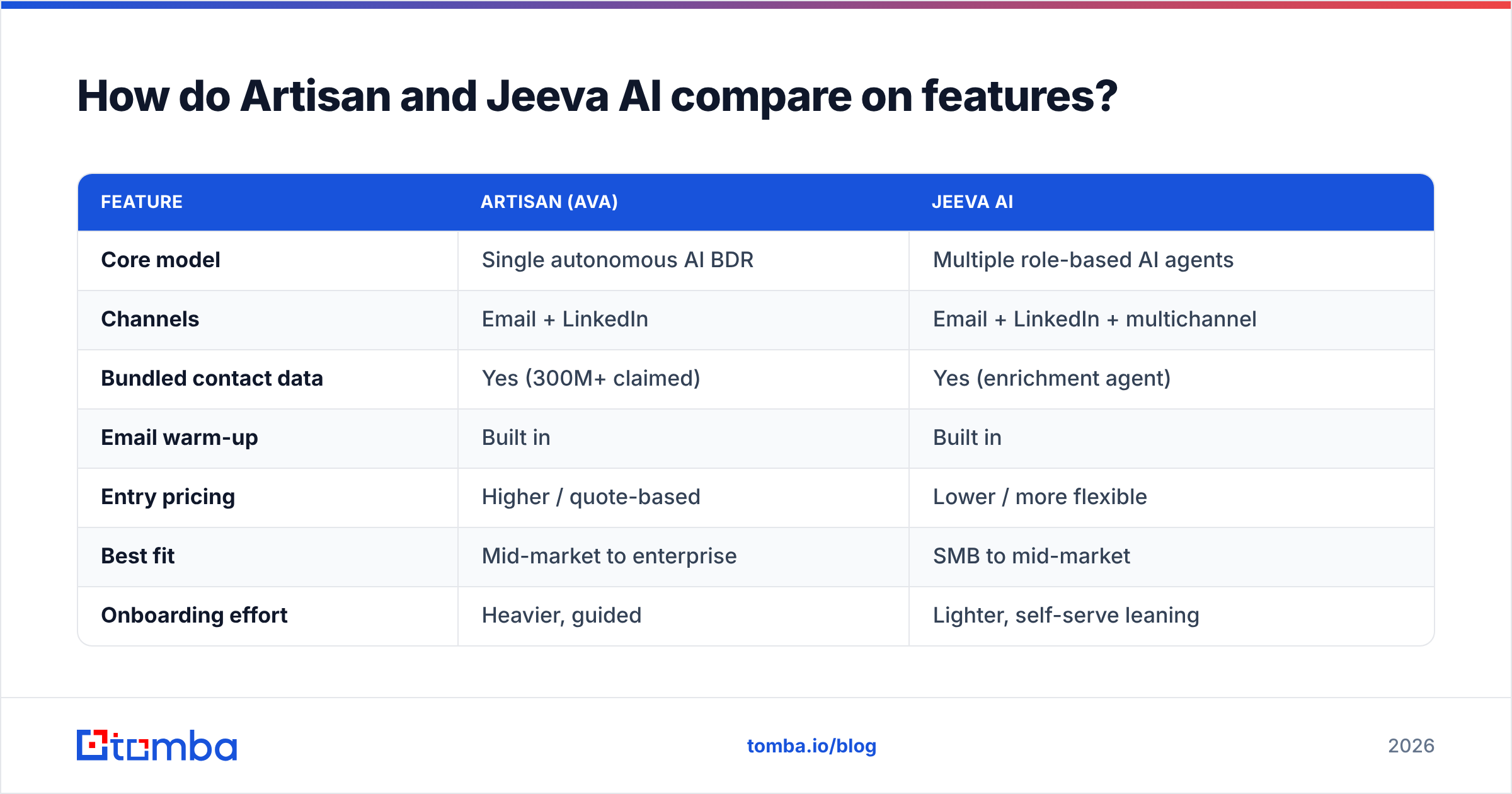
Here is a side-by-side on the attributes that matter when you are actually choosing. Treat any specific number as directional — both vendors iterate fast and pricing is frequently custom.
| Feature | Artisan (Ava) | Jeeva AI |
|---|---|---|
| Core model | Single autonomous AI BDR | Multiple role-based AI agents |
| Channels | Email + LinkedIn | Email + LinkedIn + multichannel |
| Bundled contact data | Yes (300M+ claimed) | Yes (enrichment agent) |
| Email warm-up | Built in | Built in |
| Entry pricing | Higher / quote-based | Lower / more flexible |
| Best fit | Mid-market to enterprise | SMB to mid-market |
| Onboarding effort | Heavier, guided | Lighter, self-serve leaning |
| Data verification | Internal | Internal |
The pattern is consistent: Artisan optimizes for a hands-off, "set the BDR loose" experience, while Jeeva optimizes for control and price. Neither is strictly better — it depends on whether you want a product that thinks for you or one you assemble.
Is Artisan better than Jeeva AI?#
Short answer: Artisan is stronger if you want a single autonomous rep and have the budget to back it; Jeeva is stronger if you want modular control at a lower entry point.
Artisan's advantage is cohesion. Because everything runs through one agent and one interface, there are fewer seams where a campaign can break. For a team that does not want to think about the mechanics — just outcomes — that consolidation is worth paying for. The trade-off is cost and a degree of lock-in; you adopt Artisan's worldview of what a BDR should do.
Jeeva's advantage is composability. If you already run sales automation and just want to bolt on an enrichment agent or an inbound qualifier, paying for a narrower slice is more rational than buying a whole BDR. The trade-off is that you are doing more of the orchestration yourself, and the experience is less "it just runs."
Where both stumble is the same place every AI SDR stumbles: data freshness and deliverability. A model that writes a beautiful email to a stale, unverified address still bounces — and bounces hurt your sender reputation, which then suppresses the deliverability of every other message you send.
What about data quality and deliverability?#
This is the part the demos gloss over. An AI SDR is a sending machine, and sending machines amplify whatever data you feed them — good or bad.
Both Artisan and Jeeva bundle contact data, which is convenient but creates a single point of failure. Bundled databases are optimized for coverage (big numbers in the pitch deck), not necessarily for the accuracy of the specific roles and regions you target. When the AI auto-generates a list and sends without an independent verification step, three things happen:
- Hard bounces climb. Anything over roughly 2% starts dragging your domain reputation down.
- Spam placement rises. Mailbox providers read high bounce rates as a spammer signal.
- Reply rates crater. Even delivered mail to a wrong-fit contact gets ignored.
The fix is to treat data as a separate layer rather than trusting the bundled source blindly. Run the AI's output through a dedicated email verifier and enrich thin records with a real-time contact enrichment source before the agent sends. For domains where you cannot get a definitive mailbox response, a catch-all verifier gives you a confidence signal instead of a coin flip.
)
This is also why many teams keep an independent email finder in the loop even after adopting an AI SDR — it gives you a second, auditable source to cross-check the agent's contacts rather than relying on one black-box database.
How much do Artisan and Jeeva AI cost?#
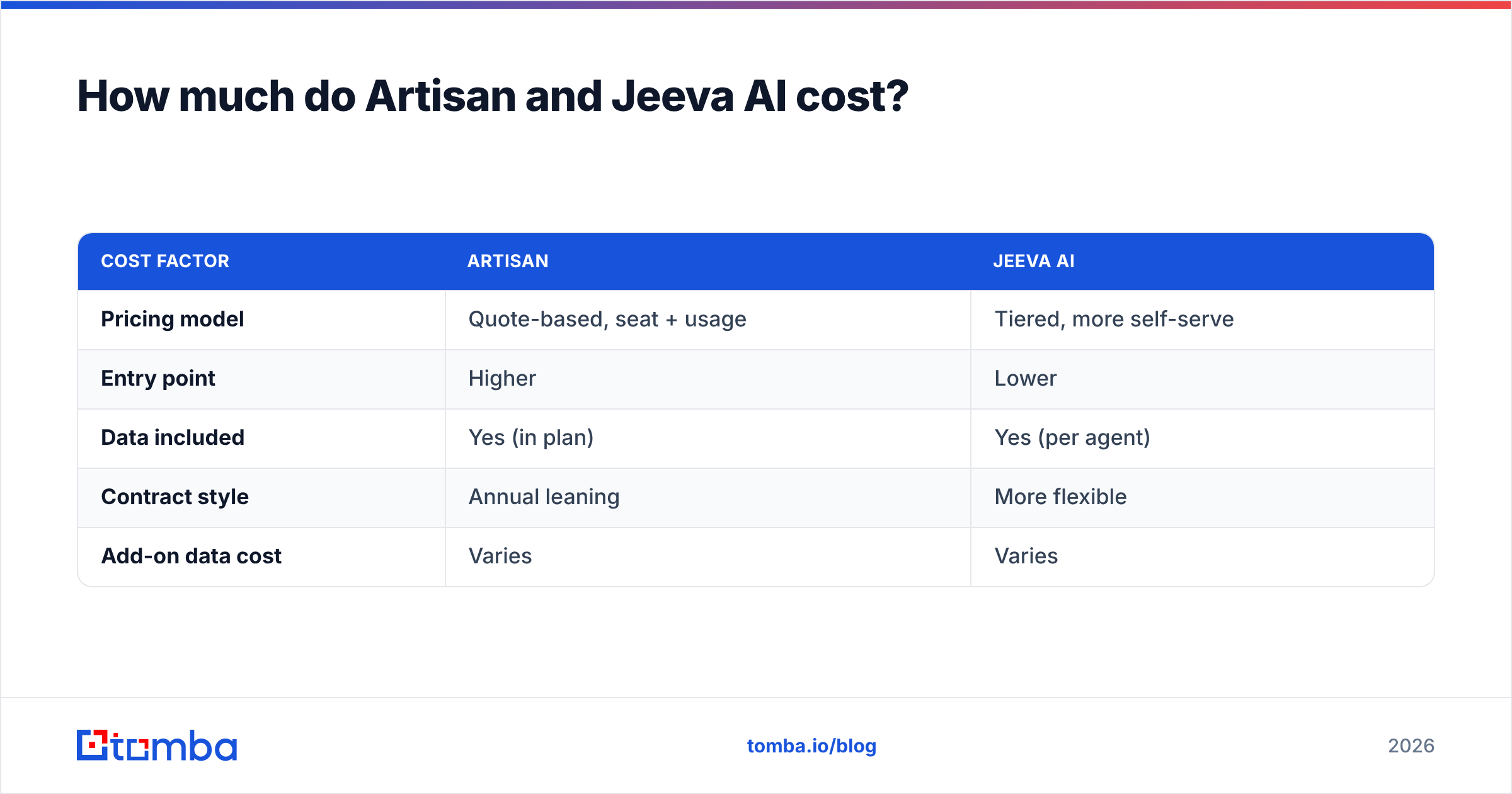
Both vendors lean on custom or seat-based pricing, so always confirm current numbers on their own sites and on review platforms like G2. As a planning rule of thumb:
| Cost factor | Artisan | Jeeva AI |
|---|---|---|
| Pricing model | Quote-based, seat + usage | Tiered, more self-serve |
| Entry point | Higher | Lower |
| Data included | Yes (in plan) | Yes (per agent) |
| Contract style | Annual leaning | More flexible |
| Add-on data cost | Varies | Varies |
The hidden line item with both is data top-ups and the cost of bounced sends. If you are budgeting, factor in a verification and enrichment layer as a deliberate spend — it is far cheaper than a torched domain. For reference, a standalone data tool like Tomba pricing starts with a free tier of 25 searches per month, then Starter at $49/mo and Growth at $99/mo, which is often a fraction of the data add-on cost inside an AI SDR platform.
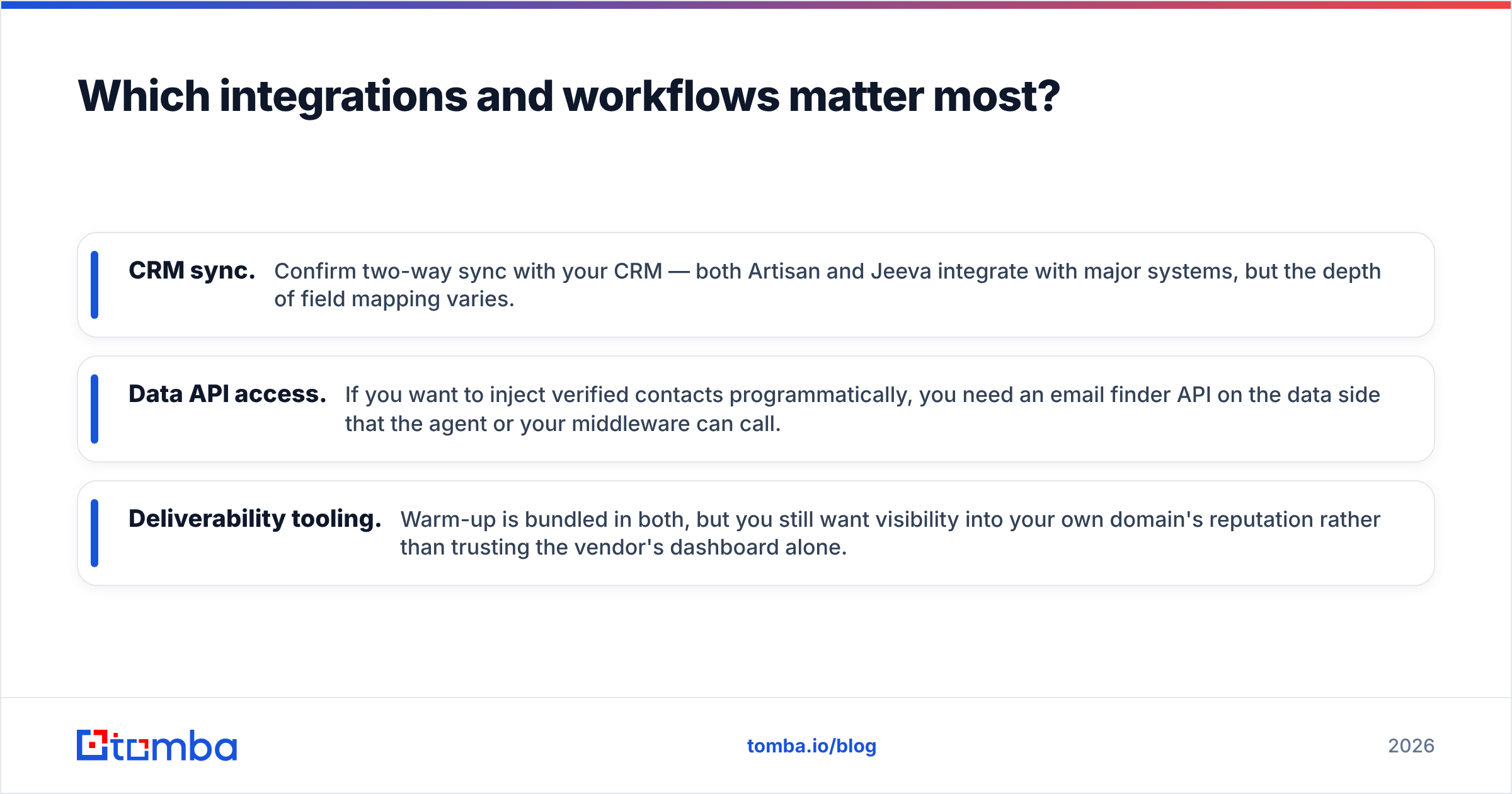
Which integrations and workflows matter most?#
An AI SDR that cannot write back to your CRM cleanly creates more work than it saves. Check three things before you commit:
- CRM sync. Confirm two-way sync with your CRM — both Artisan and Jeeva integrate with major systems, but the depth of field mapping varies.
- Data API access. If you want to inject verified contacts programmatically, you need an email finder API on the data side that the agent or your middleware can call.
- Deliverability tooling. Warm-up is bundled in both, but you still want visibility into your own domain's reputation rather than trusting the vendor's dashboard alone.
A pragmatic architecture looks like this: let the AI SDR own outreach and reply handling, but keep the data layer independent — find and verify contacts with a dedicated tool, push clean records in via API or a [
Zapier integration](https://tomba.io/integrations/zapier), and let the agent send only against verified addresses. That separation means switching SDR vendors later does not also mean rebuilding your data pipeline.
Who should choose Artisan, and who should choose Jeeva AI?#
Choose Artisan if: you are mid-market or enterprise, you want one autonomous BDR rather than a toolkit, you value a guided onboarding, and budget is not the binding constraint. Artisan rewards teams who want to delegate the whole motion.
Choose Jeeva AI if: you are SMB to mid-market, you already have parts of your stack and want to add specific agents, you want lower and more flexible pricing, and you are comfortable doing more of the orchestration yourself.
Choose neither (yet) if: your core problem is data quality, not labor. If your bounce rates are high and your lists are stale, an AI SDR will simply send bad email faster. Fix the data layer first with a proper email finder and verification workflow, then layer automation on top of clean inputs.
The bottom line#
Artisan and Jeeva AI are both credible answers to the same question — how do I run more outbound without hiring more reps — and the right pick comes down to autonomy versus modularity and budget. But the decision that moves your numbers most is not which agent you rent; it is the quality of the data each agent sends against.
Before you wire up any AI SDR, give it clean fuel. Use the Tomba Email Finder to source and verify professional email addresses by domain, name, or company, then feed only confirmed contacts into Artisan or Jeeva. Start free with 25 searches a month, scale on the $49/mo Starter plan, and let your AI rep spend its time on prospects who actually exist — not on bounces that quietly wreck your deliverability.
// get started
Find, verify and enrich your first contacts today
Start on the free plan with 25 searches a month, then scale when your team is ready.
Free plan · No credit card required · GDPR & CCPA
// about the author