Artisan vs ZoomInfo 2026: AI BDR vs Data Giant Compared
Artisan automates outbound with an AI BDR; ZoomInfo sells the biggest B2B database. Here's how they actually compare on price, data, and fit in 2026.
Choosing between Artisan and ZoomInfo is not really a head-to-head — it's a category mismatch dressed up as a comparison. One is an AI sales rep that does the work; the other is a database that feeds the work. This guide cuts through the positioning so you can see what you'd actually be buying, what it costs, and where a leaner stack beats both.
TL;DR#
- Artisan is an AI BDR platform ("Ava") that automates outbound prospecting end to end — find contacts, write sequences, send, and reply. You're buying labor replacement.
- **
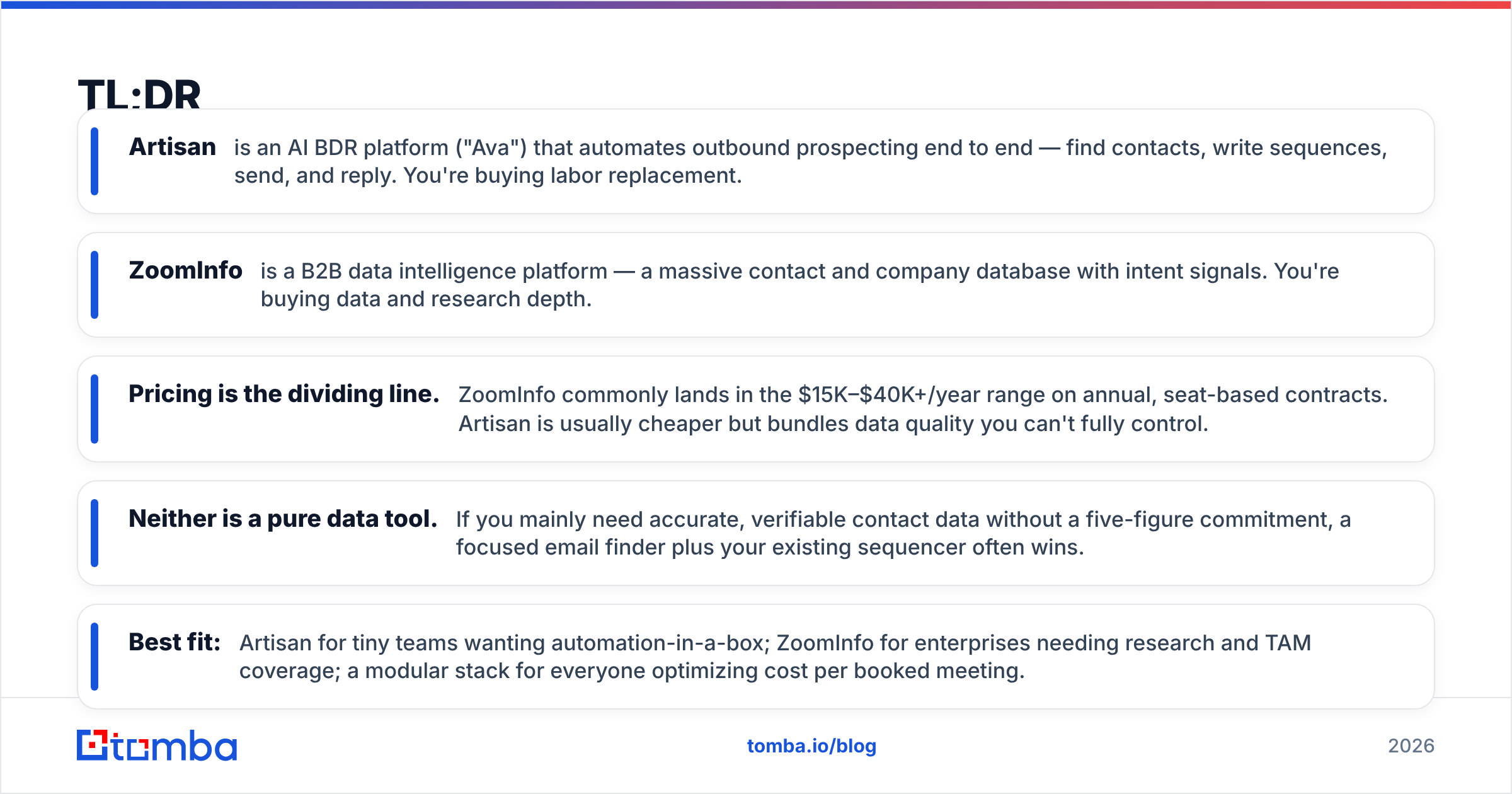
ZoomInfo** is a B2B data intelligence platform — a massive contact and company database with intent signals. You're buying data and research depth.
- Pricing is the dividing line. ZoomInfo commonly lands in the $15K–$40K+/year range on annual, seat-based contracts. Artisan is usually cheaper but bundles data quality you can't fully control.
- Neither is a pure data tool. If you mainly need accurate, verifiable contact data without a five-figure commitment, a focused email finder plus your existing sequencer often wins.
- Best fit: Artisan for tiny teams wanting automation-in-a-box; ZoomInfo for enterprises needing research and TAM coverage; a modular stack for everyone optimizing cost per booked meeting.
What is Artisan?#
Artisan (artisan.co) sells an "AI employee" named Ava — an autonomous BDR that handles the outbound motion most teams used to staff with junior reps. You give Ava an ICP, and it sources contacts from a bundled B2B data layer, drafts personalized cold emails, manages sending infrastructure and warmup, and triages replies.
The pitch is consolidation. Instead of stitching together a data provider, an email finder, a sequencer, and a deliverability tool, you rent one system that owns the whole pipeline. For a two-person founding sales team with no time to build a stack, that's genuinely appealing.
The trade-off is control and transparency. When data, copy, and sending all live inside one black box, it's harder to audit why a campaign underperformed. Was it bad data? Weak copy? A burned domain? Bundled platforms make those variables hard to isolate.
What is ZoomInfo?#
ZoomInfo (zoominfo.com) is the incumbent B2B data intelligence platform. Its core asset is one of the largest commercial contact and company databases on the market, layered with org charts, technographics, scoops, and intent data from its Bombora-style signal network.
ZoomInfo isn't trying to be your sending tool. It's the research and targeting brain that feeds your CRM and your outbound engine. Enterprise RevOps teams use it for total addressable market sizing, territory planning, lead enrichment, and account intelligence — not just for grabbing an email address.
That depth comes at a price, both literally and operationally. ZoomInfo is sold on annual, seat-based contracts with credit limits, and the all-in cost frequently crosses $15,000/year and climbs fast with add-ons like intent, Engage, or Operations. The platform is powerful, but it's a commitment, not a subscription you cancel on a slow month.

Artisan vs ZoomInfo: how do they compare?#
Here's the honest side-by-side. Notice that the two tools barely overlap in what they're for — which is exactly why the "vs" framing is misleading.
| Attribute | Artisan | ZoomInfo |
|---|---|---|
| Primary job | AI BDR / outbound automation | B2B data intelligence & research |
| What you buy | Labor replacement (Ava) | Data + signals + TAM coverage |
| Data control | Bundled, hard to audit | Granular, you own the queries |
| Sending / sequencing | Built in | Add-on (Engage) |
| Intent data | Limited | Strong (signal network) |
| Typical pricing model | Subscription, lower entry | Annual seat + credits |
| Typical annual cost | Lower, bundled | $15K–$40K+ |
| Best for | Tiny teams wanting automation | Enterprise RevOps & research |
| Contract friction | Lower | High (annual lock-in) |
| Learning curve | Low | Moderate to high |
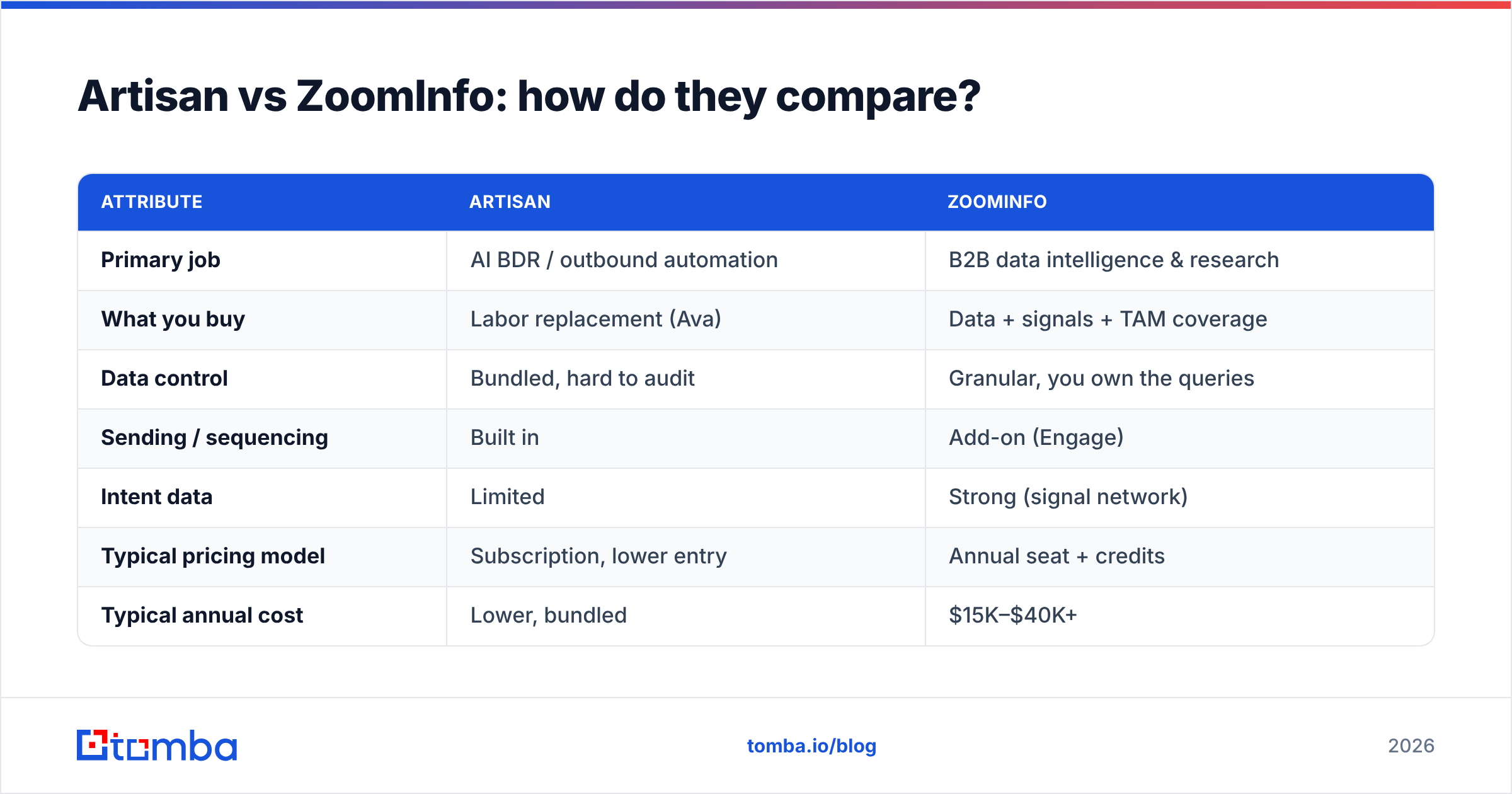
The pattern is clear: Artisan optimizes for doing the outbound for you; ZoomInfo optimizes for knowing your market in depth. If you try to use ZoomInfo as a send tool, you'll bolt on Engage and pay more. If you try to use Artisan as a research database, you'll hit the limits of its bundled data.
Which one actually has better data?#
ZoomInfo wins on breadth and research depth — full stop. Its database size, org charts, and intent signals are unmatched by an AI-BDR bundle. If your motion depends on knowing which 4,000 accounts in your TAM are showing buying intent this quarter, ZoomInfo is built for that.
But "more data" is not the same as "better outcomes per dollar." Three caveats matter:
- You pay for coverage you may never use. Most outbound teams hammer a defined ICP, not the entire database. Paying enterprise rates for global coverage you don't touch is a common source of waste.
- Email accuracy still needs verification. No database — ZoomInfo included — is immune to decay. Contacts change jobs constantly. Sending to stale addresses tanks your sender reputation regardless of how prestigious the source was. Run an email verifier before any send.
- Bundled data hides its own accuracy. With Artisan, you can't easily measure data quality independently because it's fused into the campaign. You see reply rates, not source accuracy.
This is where a modular approach earns its keep. A dedicated email finder with transparent confidence scoring and source attribution lets you measure accuracy instead of trusting a vendor's marketing. You can read how that data is sourced on Tomba's data sources page and judge for yourself.
How should you choose between them?#
Don't start with the tools. Start with the constraint that's actually limiting your pipeline, then map backward. The framework below sorts most teams into the right lane.
Choose Artisan if:
- You're a founder or a one-to-three person team with no SDRs and no time to assemble a stack.
- You value automation-in-a-box over granular control.
- Your ICP is simple enough that you don't need deep account research.
Choose ZoomInfo if:
- You run an enterprise outbound or ABM motion that lives on intent data and TAM analysis.
- You have RevOps headcount to operate credits, integrations, and territory planning.
- A five-figure annual contract is a rounding error against your ACV.
Choose a modular stack if:
- You want to control and measure each layer: data, verification, sequencing, deliverability.
- Cost per booked meeting is the metric you're judged on.
- You'd rather pay for precise contact data than for a database or an AI you can't audit.
That third path is where most growth-stage teams actually land — and it's worth its own section.
Is there a better-value alternative to both?#
For teams whose real bottleneck is accurate contact data, not automation or TAM research, the most cost-effective move is to unbundle. Pair a focused data provider with the sequencer and CRM you already run.
A modular stack typically looks like this:
| Layer | Bundled approach | Modular approach |
|---|---|---|
| Find contacts | Artisan /ZoomInfo bundle | Tomba Email Finder |
| Verify deliverability | Hidden / add-on | Email verifier |
| Enrich records | Premium tier | Data enrichment |
| Sequence & send | Built in / Engage add-on | Your existing sequencer |
| Sync to CRM | Native, locked | Open integrations |
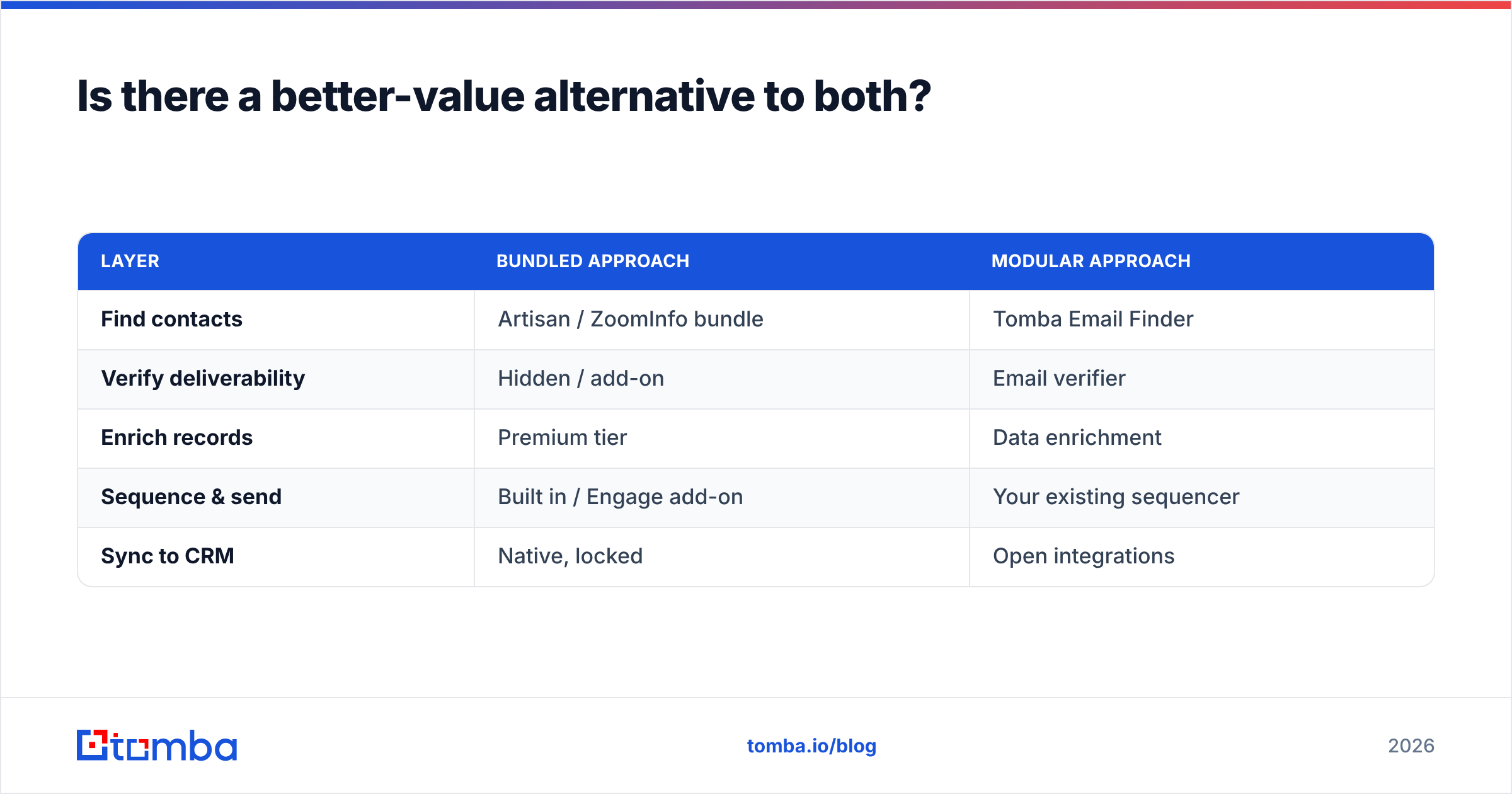
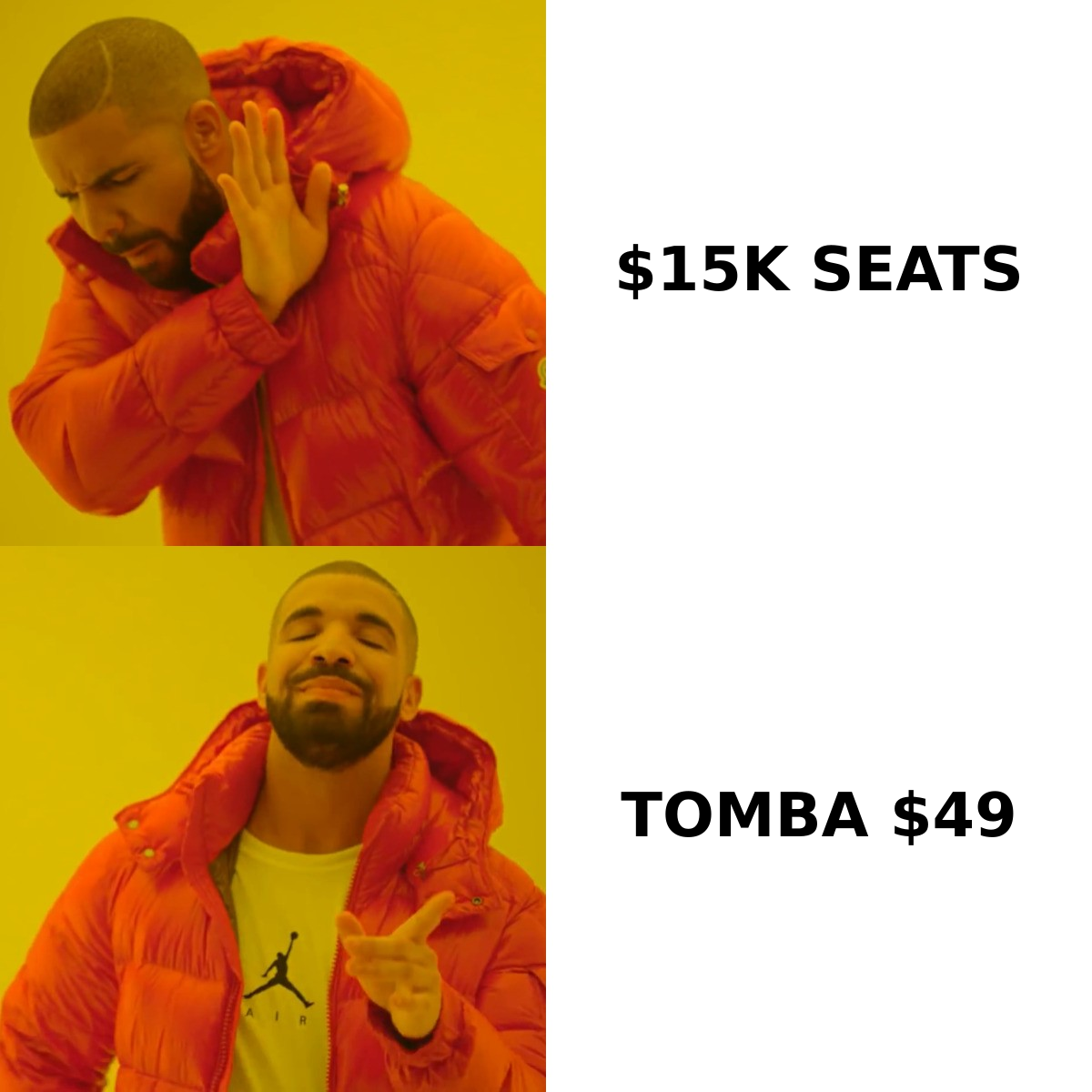
The advantage isn't only price — though paying $49/month instead of $15,000/year is hard to ignore. It's visibility. When data, verification, and sending are separate, you can pinpoint exactly which stage is dragging your numbers. Bad reply rate? Check the copy. Bounces spiking? Check verification. You can't run that diagnostic when everything hides behind one "AI employee."
You can scale data work through the bulk email finder for list-building or wire everything into your product with the Tomba API. Compare the full lineup on the Tomba pricing page — the free tier gives you 25 searches a month to test accuracy before committing a dollar.
For an objective third-party read on any of these platforms, G2 keeps current user reviews and feature breakdowns that are worth scanning before you sign anything.
What about deliverability — does the tool matter?#
Less than you'd think. Whether you go with Artisan's bundled sender or your own sequencer, the fundamentals of inbox placement don't change: authenticate your domain, warm it gradually, keep bounce rates low, and never blast unverified lists.
Bundled platforms can actually obscure deliverability problems because they manage sending for you — which feels convenient until a campaign quietly lands in spam and you can't see why. With a modular setup, you control warmup pace and can verify every address up front, which is the single highest-leverage thing you can do for email deliverability. Clean data in, clean reputation out.
The takeaway: don't let "it handles deliverability for you" be the deciding feature. Verification and list hygiene drive 80% of the result, and you can own both at a fraction of either platform's cost.
Final verdict: Artisan vs ZoomInfo in 2026#
There's no universal winner because they solve different problems. Pick by constraint:
- Artisan is the right call when your bottleneck is labor — you need outbound to happen and you have nobody to run it. It's automation-in-a-box for the smallest teams.
- **
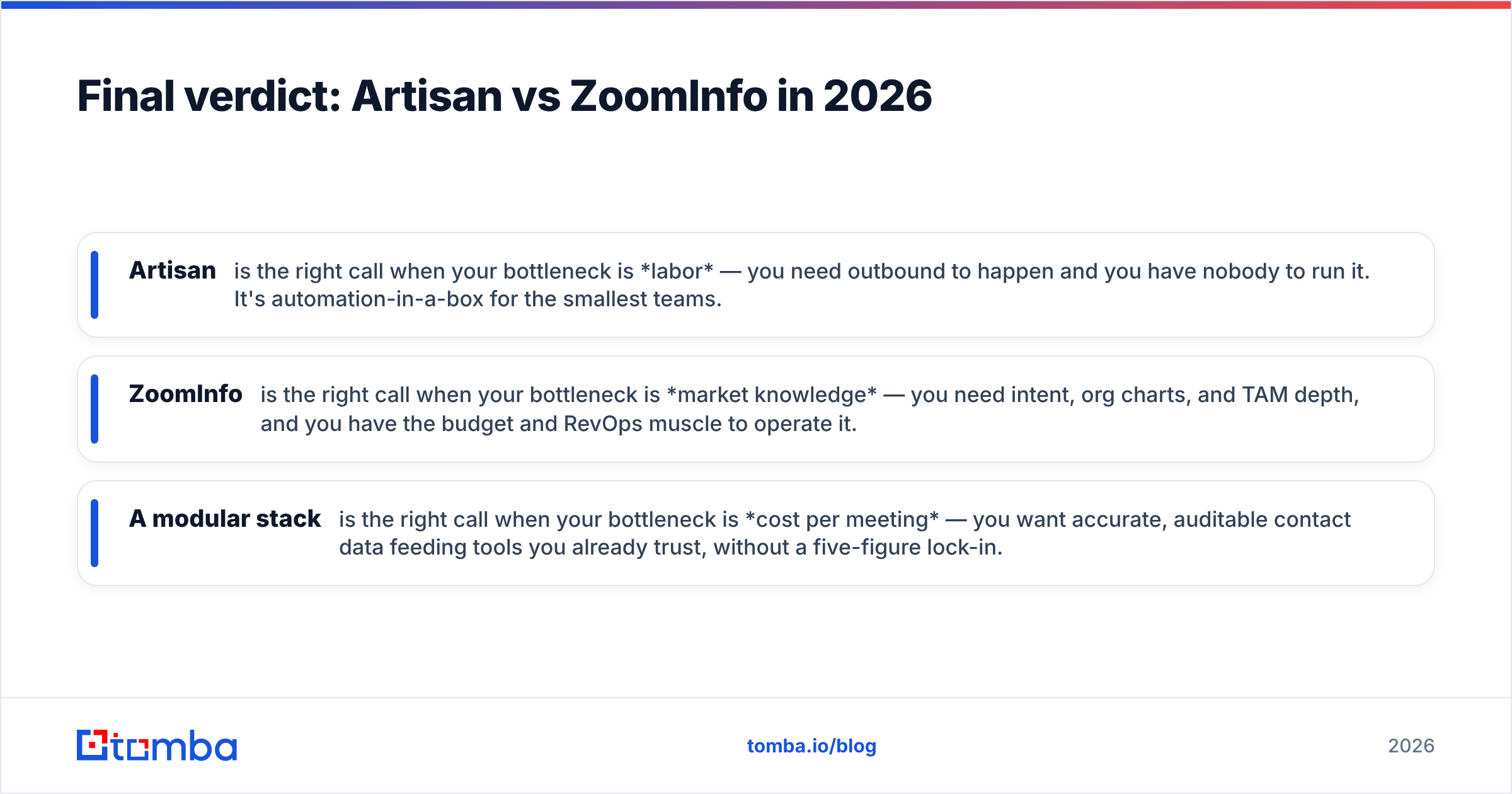
ZoomInfo** is the right call when your bottleneck is market knowledge — you need intent, org charts, and TAM depth, and you have the budget and RevOps muscle to operate it.
- A modular stack is the right call when your bottleneck is cost per meeting — you want accurate, auditable contact data feeding tools you already trust, without a five-figure lock-in.
Most growth-stage teams overpay by buying a bundle to solve a data problem. If accurate emails and clean lists are what's actually holding your pipeline back, you don't need an AI employee or an enterprise database — you need precise data and the freedom to wire it anywhere.
That's exactly what the Tomba Email Finder is built for: find verified professional emails by name, domain, or company, with transparent confidence scoring and source attribution. Start free with 25 searches a month, scale on the $49/month Starter plan, and plug it into your CRM, your sequencer, or your own code via the API — no annual contract, no black box. Test it against whatever ZoomInfo or Artisan quote you're holding and compare the cost per booked meeting. The math usually settles the debate.
Ready to find emails that actually work?
Join 150,000+ professionals who stopped guessing and started sending. Free credits on signup — no credit card required.
Get the Tomba newsletter
Practical outbound tactics and product updates — once every two weeks.
About the author