AtData vs EasyLeadz 2026: B2B Data & Contact Tools Compared
AtData leans on email intelligence and validation; EasyLeadz sells direct-dial phone numbers. Here's an honest 2026 breakdown of pricing, data, coverage, and the best-fit use case for each.
AtData vs EasyLeadz: Which B2B Data Tool Wins in 2026?
TL;DR
- AtData (formerly TowerData) is an email intelligence and validation platform. Its strength is verifying, scoring, and enriching email addresses at scale — not finding net-new contacts.
- EasyLeadz (via its "Mr. E" product) is a B2B contact finder built around direct-dial mobile numbers, with a Chrome extension for LinkedIn prospecting.
- They solve different problems: AtData cleans and enriches the data you already have; EasyLeadz helps you discover phone numbers for new prospects.
- Pricing models differ sharply — AtData is enterprise/volume-priced email validation, while EasyLeadz sells credit packs starting low and scaling per contact.
- If your real bottleneck is finding accurate work emails by domain or name, a dedicated email finder like Tomba Email Finder is usually the better-fit, lower-cost pick than either.
If you've landed here, you're probably staring at two tools that get lumped together as "B2B data" and trying to figure out which one actually maps to your problem. The short answer: they barely overlap. Let's break down where each one wins, where each one is overkill, and when neither is the right call.
What is AtData?#
AtData is an email-centric data company. It built its reputation on email validation, activity scoring, and enrichment — telling you whether an email is deliverable, how active the inbox is, and what demographic or behavioral data sits behind it. Marketers use it to scrub large lists before campaigns, reduce bounce rates, and append attributes for segmentation.
The core insight: AtData assumes you already have a pile of email addresses. Its job is to make that pile cleaner, richer, and safer to send to. It is widely used in the email service provider (ESP) and large-scale email marketing world, where list hygiene directly affects email deliverability and sender reputation.
What AtData is not is a discovery tool. You don't point it at a company domain and get a list of new people to contact. That's a fundamentally different motion.
What is EasyLeadz?#
EasyLeadz approaches B2B data from the opposite direction. Its flagship "Mr. E" tool is a contact discovery product, best known for surfacing direct-dial and mobile phone numbers for decision-makers. The primary workflow is a Chrome extension: you open a LinkedIn profile, click the extension, and it returns a phone number (and sometimes an email) for that person.
That makes EasyLeadz a natural fit for sales development reps and callers who live on LinkedIn and want a number to dial rather than an inbox to email. It sells data on a credit model — each revealed contact consumes credits, and you buy packs that scale with volume.
The trade-off is that phone-number data is inherently harder to keep accurate than email patterns, and coverage varies heavily by region (strong in some markets, thin in others). For more on the dialing side of outbound, see our guide to cold calling and phone sales.
How do AtData and EasyLeadz compare head-to-head?#
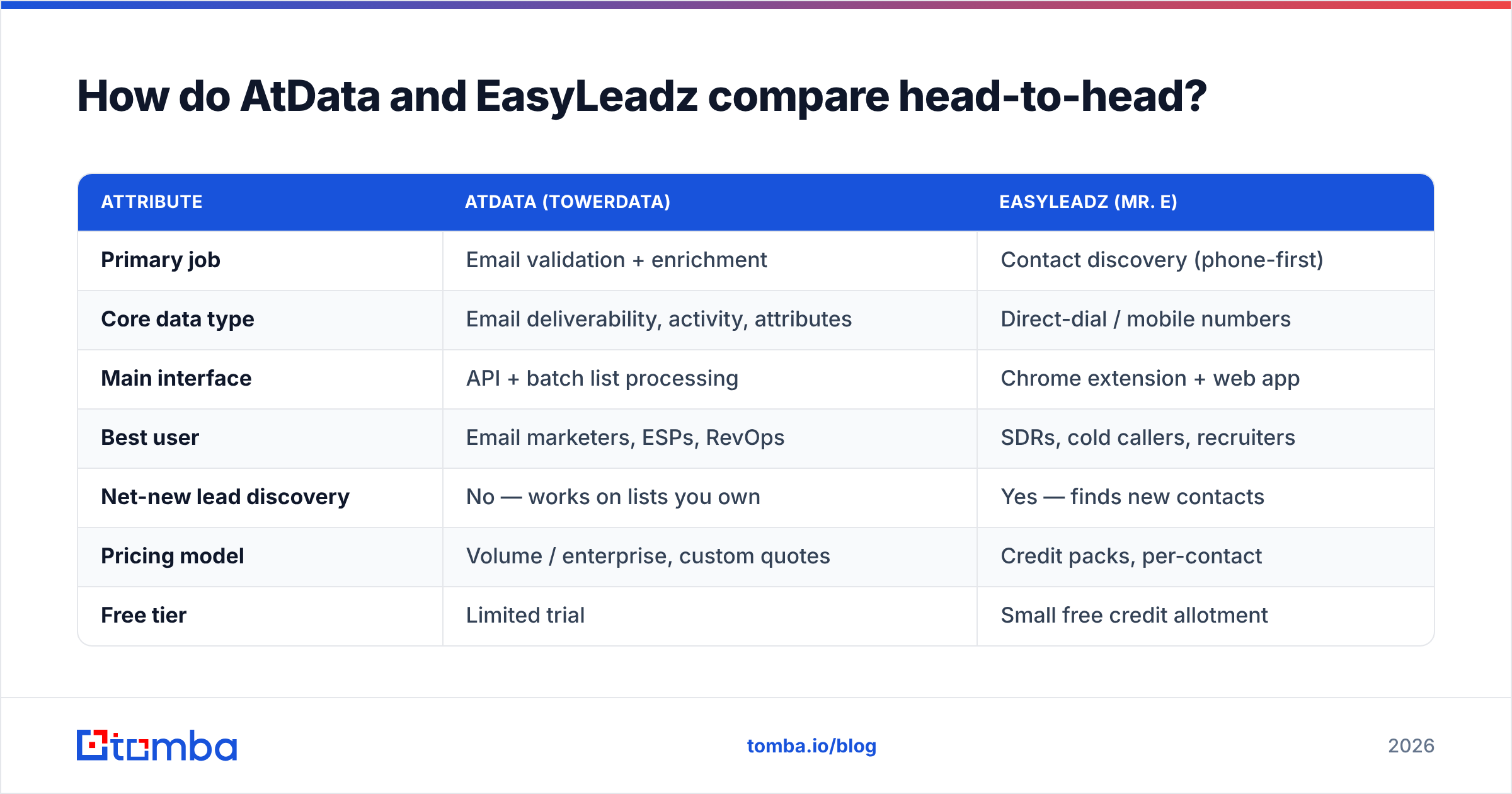
Here's the honest side-by-side. Notice that the two tools sit in different columns on almost every row — that's the whole point.
| Attribute | AtData (TowerData) | EasyLeadz (Mr. E) |
|---|---|---|
| Primary job | Email validation + enrichment | Contact discovery (phone-first) |
| Core data type | Email deliverability, activity, attributes | Direct-dial / mobile numbers |
| Main interface | API + batch list processing | Chrome extension + web app |
| Best user | Email marketers, ESPs, RevOps | SDRs, cold callers, recruiters |
| Net-new lead discovery | No — works on lists you own | Yes — finds new contacts |
| Pricing model | Volume / enterprise, custom quotes | Credit packs, per-contact |
| Free tier | Limited trial | Small free credit allotment |
| Geographic strength | Email data (US-strong) | Phone data (region-dependent) |
| Typical weakness | No prospecting, opaque pricing | Phone accuracy varies, email coverage thin |
The key takeaway from this table: if you ask "which is more accurate," you're asking the wrong question, because they're measuring different things. AtData accuracy means "is this email deliverable and active." EasyLeadz accuracy means "is this the right mobile number." You can't average those into one score.

Is AtData better than EasyLeadz for accuracy?#
It depends entirely on what you're trying to accurately do.
For email hygiene and deliverability, AtData is the stronger tool. It's purpose-built to catch invalid, risky, and dead addresses before you send, and it layers on engagement signals that a basic syntax checker can't. If your bounce rate is hurting your domain reputation, this is the category of tool you want — though a focused email verifier can cover most of the same ground at a fraction of the cost for smaller senders.
For phone accuracy, EasyLeadz is the only one of the two even in the conversation, since AtData doesn't sell phone data. But "accurate phone data" is a moving target. Mobile numbers churn, and third-party phone databases decay faster than email patterns do. Expect to validate before you dial — a dedicated phone validator helps here regardless of where the number came from.
According to independent review sites like G2 and Capterra, both tools draw a mix of praise and "coverage was hit-or-miss" feedback — which is normal for the data category. The lesson is to always run a paid pilot against your own target accounts before committing to an annual contract.
What does AtData vs EasyLeadz pricing look like in 2026?#
This is where the two diverge hardest, and where buyers get frustrated.
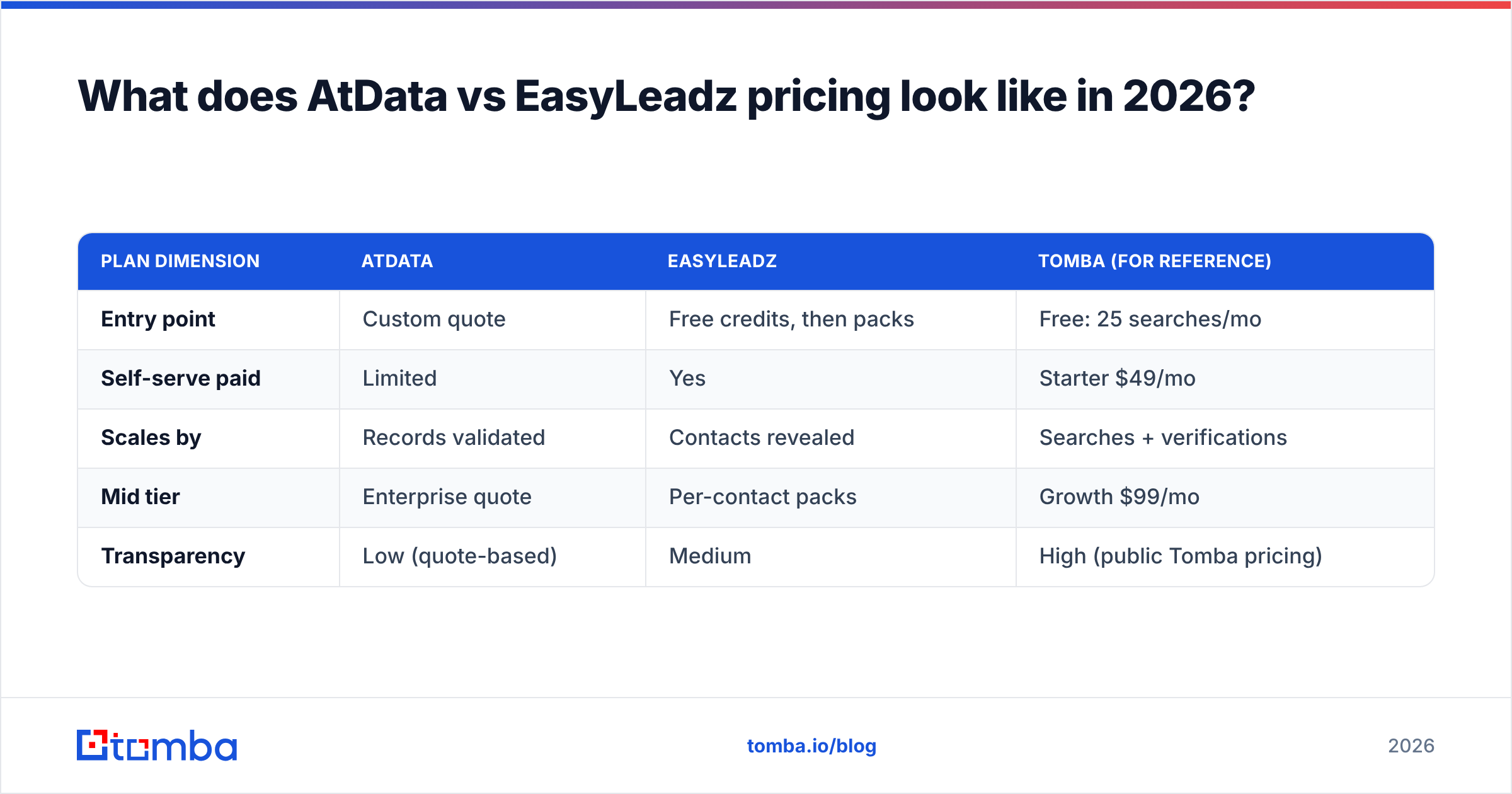
AtData uses enterprise-style, volume-based pricing. You typically request a quote, and the number scales with how many records you validate or enrich per month. There's no clean public price ladder, which makes it hard to compare apples-to-apples and signals that it's aimed at larger email programs rather than individual reps.
EasyLeadz is more transparent and self-serve. It sells credit packs, with a small free allotment to start and paid tiers that scale by the number of contacts you reveal. That makes it accessible to a solo SDR or a small team, but per-contact costs add up quickly at volume.
| Plan dimension | AtData | EasyLeadz | Tomba (for reference) |
|---|---|---|---|
| Entry point | Custom quote | Free credits, then packs | Free: 25 searches/mo |
| Self-serve paid | Limited | Yes | Starter $49/mo |
| Scales by | Records validated | Contacts revealed | Searches + verifications |
| Mid tier | Enterprise quote | Per-contact packs | Growth $99/mo |
| Transparency | Low (quote-based) | Medium | High (public Tomba pricing) |
If predictable, public pricing matters to you, neither incumbent is ideal — AtData hides its numbers and EasyLeadz's per-contact math gets expensive fast. A flat monthly plan that bundles finding and verification, like Tomba's, is often easier to budget around.
When should you pick a dedicated email finder instead?#
Here's the scenario neither tool handles well: you know the company, you know the person's name, and you need their work email — fast and accurately.
AtData can't do this; it validates emails you already have. EasyLeadz is phone-first and its email coverage is secondary. That gap is exactly what a dedicated email finder fills. With a tool like Tomba you can:
- Run a domain search to pull every discoverable email at a company in one shot.
- Use the email finder to get a single verified address from a name + domain.
- Push the results straight into your CRM via the Tomba API or a no-code HubSpot integration.
- Verify in the same workflow so you're not paying a second vendor for hygiene.
That find-then-verify loop is the most common B2B prospecting motion, and splitting it across an enrichment tool plus a phone tool means you're paying twice and stitching data manually.

What's the best B2B data stack for most teams?#
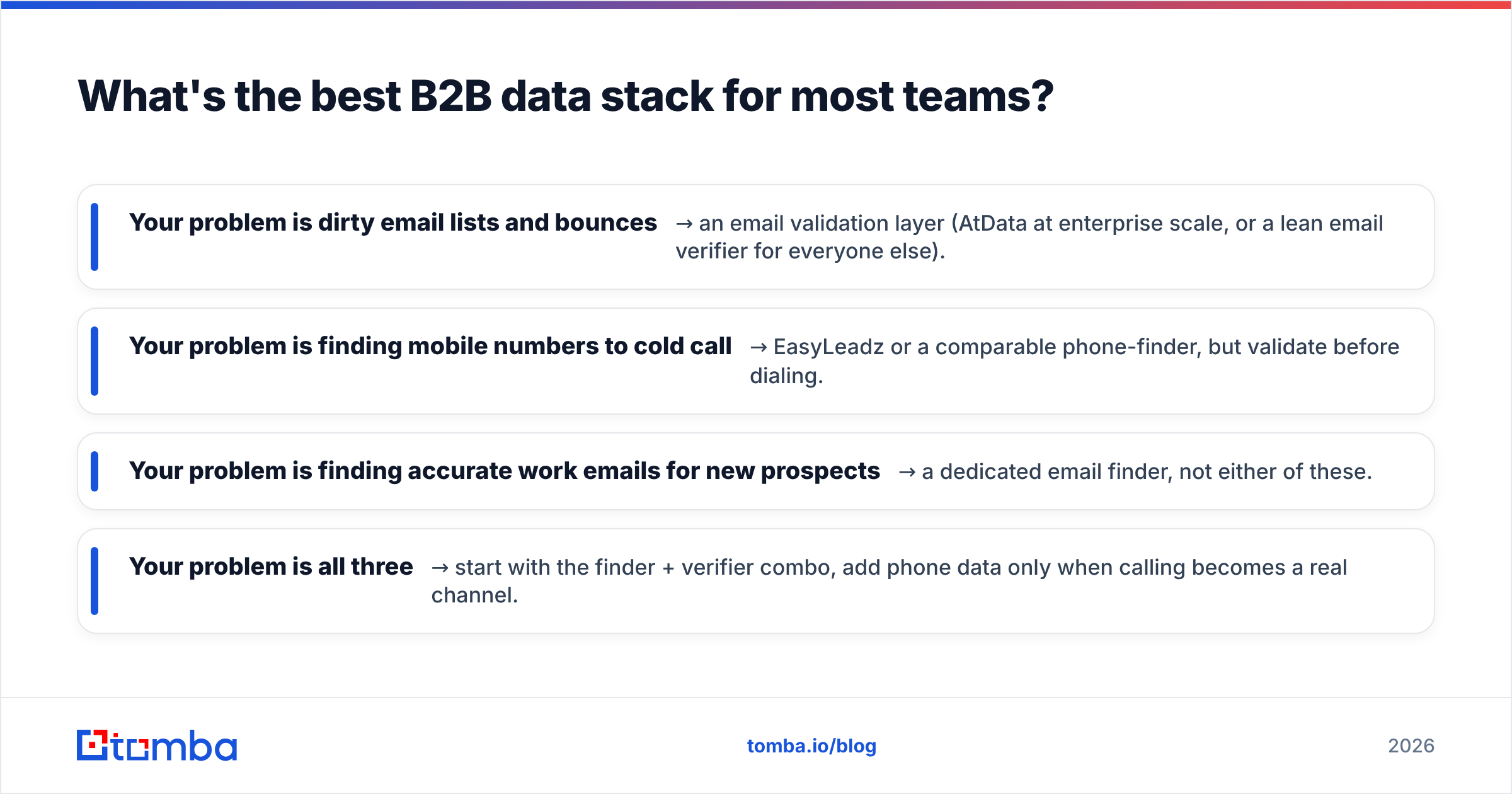
Conclusion first: most teams don't need to choose AtData or EasyLeadz — they need a clear job-to-tool map and should buy only what fills a real gap.
Use this quick decision framework:
- Your problem is dirty email lists and bounces → an email validation layer (AtData at enterprise scale, or a lean email verifier for everyone else).
- Your problem is finding mobile numbers to cold call → EasyLeadz or a comparable phone-finder, but validate before dialing.
- Your problem is finding accurate work emails for new prospects → a dedicated email finder, not either of these.
- Your problem is all three → start with the finder + verifier combo, add phone data only when calling becomes a real channel.
The mistake we see most often is buying a heavyweight enrichment contract to solve what is actually a prospecting problem. Match the tool to the bottleneck. For a deeper look at where contact data comes from and why accuracy varies, our note on data sources walks through the mechanics. You can also cross-check vendors on neutral directories like Gartner Peer Insights before you commit.
Frequently asked questions#
Is AtData the same as TowerData? Yes. AtData is the rebrand of TowerData, carrying forward the same email intelligence, validation, and enrichment focus.
Does EasyLeadz provide email addresses too? It can surface some emails, but its strength and primary positioning is direct-dial and mobile phone numbers. Email coverage is secondary and inconsistent.
Which is cheaper, AtData or EasyLeadz? EasyLeadz is more accessible for small teams thanks to a free tier and self-serve credit packs. AtData is quote-based and aimed at larger volumes, so it's harder to compare and usually more expensive at the entry level.
Can I replace both with one tool? Partially. If your core need is finding and verifying work emails, a single find-plus-verify platform covers most of it. You'd only add a phone-data vendor if cold calling is a serious channel for you.
The bottom line#
AtData and EasyLeadz aren't really rivals — they're specialists in different lanes. AtData cleans and enriches the email data you own; EasyLeadz helps you discover phone numbers for people you don't. Pick based on which bottleneck is actually slowing your pipeline, not on which brand shows up in the same comparison list.
But if your day-to-day reality is "I have a name and a company, I need a verified email, and I need it in my CRM by this afternoon," neither tool is built for that. That's the exact job Tomba Email Finder was made for — find professional emails by domain, name, or company, verify them in the same flow, and start free with 25 searches a month before scaling on a transparent Starter plan at $49/mo. Try it against your real target accounts and let the hit rate make the decision for you.
// get started
Find, verify and enrich your first contacts today
Start on the free plan with 25 searches a month, then scale when your team is ready.
Free plan · No credit card required · GDPR & CCPA
Get the Tomba newsletter
Product and data updates
// about the author