AtData vs Generect: Which B2B Data Tool Wins in 2026?
AtData cleans and enriches email data; Generect builds fresh B2B lead lists. Here's an honest, side-by-side look at which fits your stack in 2026 — and where a dedicated email finder beats both.
TL;DR
- AtData and Generect solve different problems. AtData is an email intelligence and verification platform — it cleans, validates, and enriches the email addresses you already have. Generect is a lead generation engine — it produces fresh B2B contacts and company records, often pulled in real time.
- Pick AtData if your pain is dirty lists, high bounce rates, and fraud signals on inbound data.
- Pick Generect if your pain is an empty pipeline and you need net-new prospects with firmographics.
- Pricing is opaque on both — neither publishes transparent self-serve tiers, which slows down small teams.
- If your real need is "find and verify a contact's email," a focused tool like Tomba covers the overlap of both at a published, predictable price.
What are AtData and Generect?#
The short answer: they sit on opposite ends of the B2B data pipeline.
Think of your contact data like a kitchen. Generect is the grocery run — it brings in raw ingredients (new leads, companies, job titles). AtData is the prep and quality check — it washes, trims, and confirms what you already brought home (validating and enriching emails so you don't serve something spoiled).
AtData (formerly TowerData) is a US-based email intelligence company that has been in market for well over a decade. Its core products are email validation, email-based fraud scoring, demographic and interest enrichment keyed off an email address, and email append. It is heavily used in marketing operations, ad tech, and risk teams that already hold large email databases and need them clean and enriched.
Generect is a newer B2B lead generation platform focused on real-time data. Instead of selling access to a static database that decays, it emphasizes building targeted lead lists on demand — company records, decision-maker contacts, and firmographic filters — often with an API-first workflow for outbound and RevOps teams.
So "AtData vs Generect" is less a head-to-head and more a "which job am I hiring for" decision. Understanding that distinction saves you from buying the wrong tool.
How do AtData and Generect compare at a glance?#
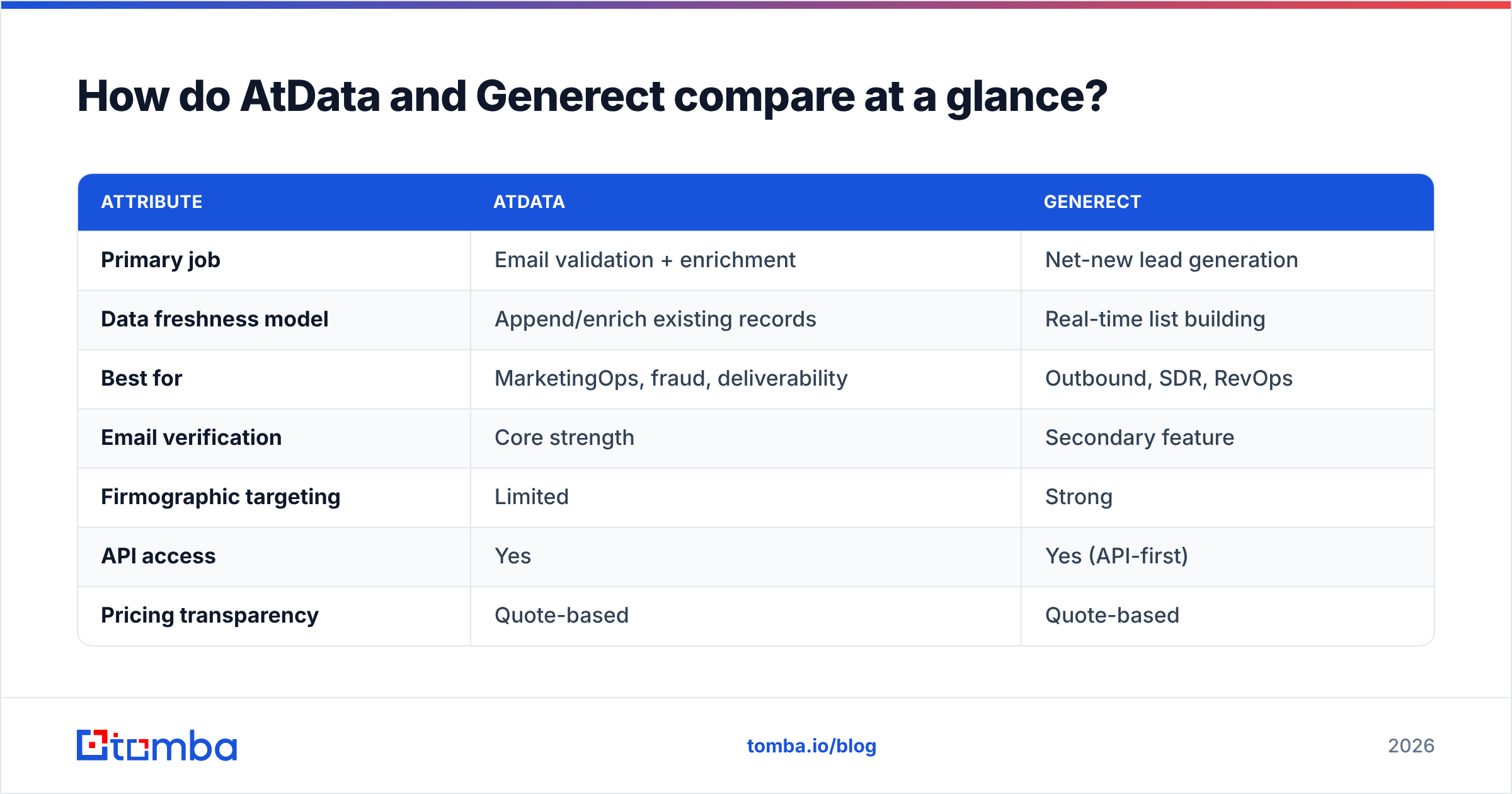
Here is the practical breakdown across the attributes that actually drive a buying decision.
| Attribute | AtData | Generect |
|---|---|---|
| Primary job | Email validation + enrichment | Net-new lead generation |
| Data freshness model | Append/enrich existing records | Real-time list building |
| Best for | MarketingOps, fraud, deliverability | Outbound, SDR, RevOps |
| Email verification | Core strength | Secondary feature |
| Firmographic targeting | Limited | Strong |
| API access | Yes | Yes (API-first) |
| Pricing transparency | Quote-based | Quote-based |
| Free self-serve tier | No | No |
| Typical buyer | Enterprise marketing/risk | Growth + sales teams |
The takeaway: if a row matters to you and the two columns disagree, that row is your decision. A deliverability team will weight "email verification" heavily and lean AtData. An SDR leader staring at an empty CRM will weight "net-new lead generation" and lean Generect.

Is AtData better than Generect for email quality?#
Yes — for pure email quality and enrichment, AtData is the stronger specialist.
AtData's reason for existing is email hygiene. It scores addresses for validity, flags risky or fraudulent signups, and attaches demographic and behavioral attributes to an email. If you run high-volume marketing sends and your sender reputation is suffering, that is squarely AtData's lane. Cleaning your list before a campaign directly protects email deliverability and keeps you off blocklists.
Generect does offer contact data with email fields, and many of those emails are usable, but verification is a supporting feature rather than the headline. You would not buy Generect primarily to scrub a 2-million-row email database. You would buy it to fill a pipeline.
A note on overlap: both tools touch "email," and that is where buyers get confused. If your actual task is narrower — "I have a name and a company, get me the verified work email" — neither platform's pricing or packaging is ideal. That job is exactly what a dedicated email verifier plus an email finder handles, usually at a fraction of an enterprise data contract.
Is Generect better than AtData for prospecting?#
Yes — if your goal is building new lead lists, Generect is the better fit.
Generect's real-time approach is its differentiator. Static databases — the model many legacy providers use — start decaying the moment they're compiled. People change jobs, companies restructure, and titles shift. SaaS contact data is often cited as decaying at roughly 30% per year, which means a list you bought in January is meaningfully wrong by autumn. Real-time generation aims to sidestep that staleness by pulling current records when you ask.
For an outbound team, that translates into:
- Targeted lists by industry, headcount, geography, and role
- Decision-maker contacts rather than generic info@ inboxes
- API delivery straight into your sequencing tool or CRM
AtData can append firmographics, but it is not designed to answer "give me 500 VPs of Engineering at Series B fintech companies in the EU." That is a prospecting query, and prospecting is Generect's home turf.
That said, real-time generation is only as good as its coverage and the verification layer behind it. Fresh-but-wrong is still wrong. Always test deliverability on a sample before committing budget — pair any prospecting tool with independent verification so a bounce spike doesn't torch your domain.
What does AtData vs Generect cost in 2026?#
Neither vendor makes this easy, and that is a legitimate strike against both.
AtData uses quote-based, volume-driven pricing. You contact sales, describe your record counts and use case, and get a custom number. That suits large enterprises with procurement teams but frustrates a three-person growth squad that wants to swipe a card and start today.
Generect similarly leans on demos and custom plans rather than a transparent self-serve checkout. The API-first positioning means pricing often scales with volume and endpoints used.
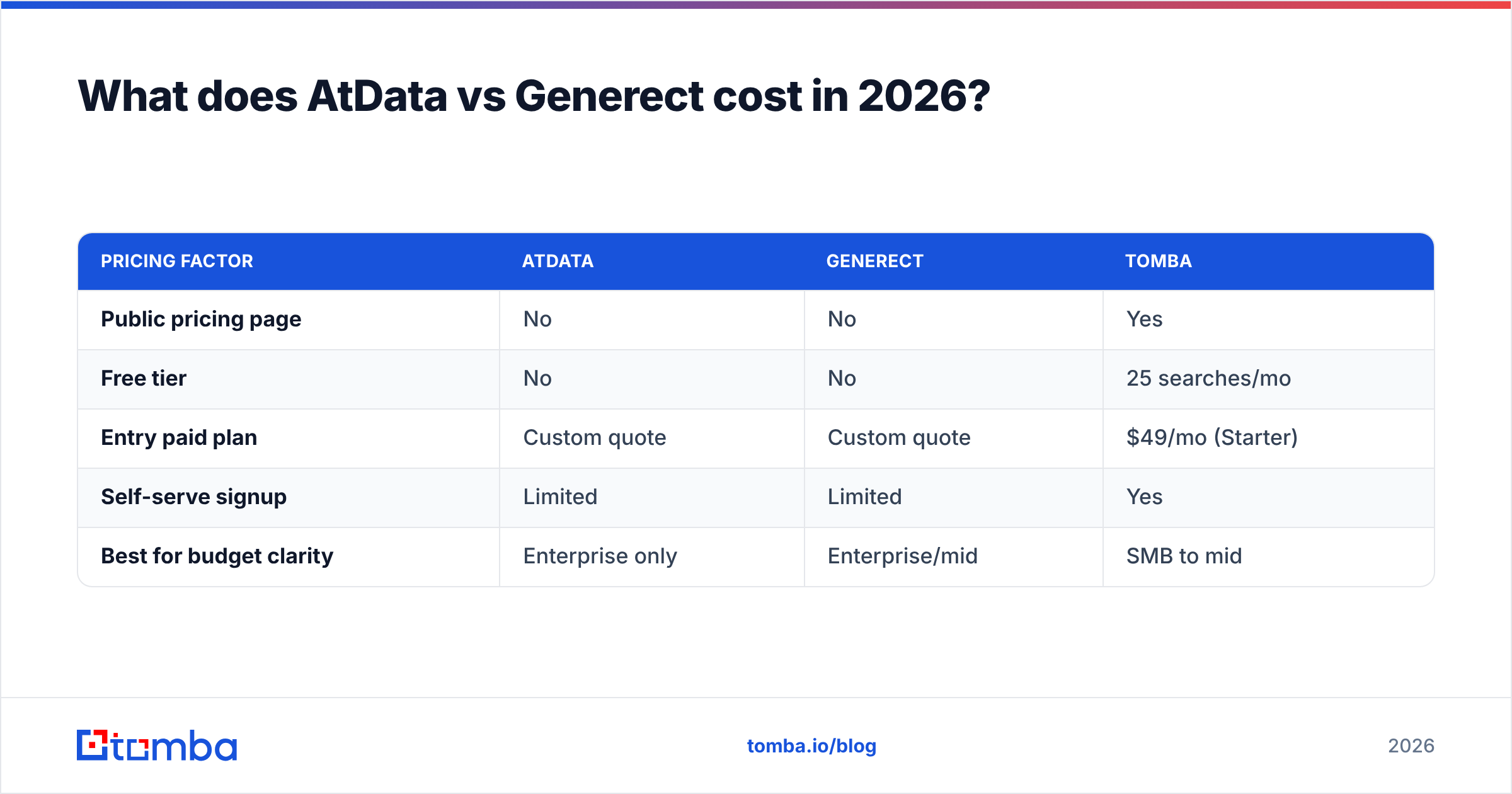
Here is the friction in table form:
| Pricing factor | AtData | Generect | Tomba |
|---|---|---|---|
| Public pricing page | No | No | Yes |
| Free tier | No | No | 25 searches/mo |
| Entry paid plan | Custom quote | Custom quote | $49/mo (Starter) |
| Self-serve signup | Limited | Limited | Yes |
| Best for budget clarity | Enterprise only | Enterprise/mid | SMB to mid |
For comparison, Tomba pricing is published outright: a free tier with 25 searches per month, Starter at $49/mo, Growth at $99/mo, Pro at $249/mo, and custom Enterprise. If you are evaluating tools and your finance team wants a number before a sales call, that transparency is worth something.

When should you choose a focused email finder instead?#
Choose a dedicated finder/verifier when your problem is "contact-level," not "database-level."
Both AtData and Generect are platform purchases aimed at teams with sizable budgets and either a hygiene mandate or a volume prospecting mandate. Plenty of teams don't need that. They need to:
- Find the verified email for a specific person at a specific company
- Pull every contact at a target domain with domain search
- Enrich a short list of accounts without a six-figure contract
- Verify a list before a send to protect their sender reputation
For those jobs, a specialized tool wins on cost and speed. You skip the demo cycle, you get a free tier to test accuracy first, and you only scale spend when results justify it. Tomba's data enrichment and bulk workflows cover the middle ground where many buyers actually live — needing both fresh contacts and clean emails, but not an enterprise platform commitment for either.
This is also the honest answer to a lot of "AtData vs Generect" searches: people land on that query because they want accurate B2B contact data, and they assume those two names are the only options. They aren't.
How do you decide between AtData, Generect, and an email finder?#
Run your situation through three questions.
1. What's broken — your list or your pipeline? Broken list (bounces, fraud, decayed enrichment) points to AtData. Broken pipeline (not enough qualified prospects) points to Generect. If the honest answer is "a bit of both, but I'm not enterprise yet," a focused finder/verifier is the pragmatic middle.
2. What's your volume and budget shape? Massive volume with a procurement process favors a platform. Variable or smaller volume with a need for budget clarity favors transparent, self-serve pricing.
3. How much do you trust the data sight-unseen? Insist on testing accuracy before you commit. Validate a sample, check bounce rates, and confirm coverage in your exact target segment. Vendor-reported accuracy numbers are marketing until you've run your own list through them. Cross-checking against an independent source like the reviews on G2 helps separate claims from reality.
Here's a simple decision matrix:
| Your situation | Best fit |
|---|---|
| Cleaning a large existing email DB | AtData |
| Building net-new outbound lists at scale | Generect |
| Finding/verifying specific contacts | Email finder (Tomba) |
| Small team, need budget clarity | Email finder (Tomba) |
| Enterprise risk/fraud scoring | AtData |
What about data accuracy and compliance?#
Treat accuracy as something you measure, not something you accept.
AtData's long history in email validation gives it credibility on hygiene, and its fraud-scoring lineage matters for risk teams. Generect's real-time model is built to fight decay, which is the right instinct, but coverage varies by region and seniority. Neither claim should be taken on faith.
On compliance, any B2B data vendor you choose in 2026 needs a clear GDPR and CCPA posture, documented data sourcing, and an opt-out mechanism. Ask both vendors directly where their data comes from and how a subject-access or deletion request is handled. If a provider is vague about sourcing, that's a risk you inherit. Transparency about data sources should be a baseline requirement, not a bonus.
A quick verification workflow that works regardless of which platform you pick:
- Pull a representative sample (200–500 records) in your real target segment.
- Run it through an independent verifier to measure true deliverable rate.
- Send a small warm batch and watch bounce and reply metrics.
- Only then scale spend toward the tool that performed.
This protects you from buying on a slide deck and discovering the decay in production.
The bottom line on AtData vs Generect#
AtData and Generect aren't really competitors — they're complements that buyers confuse because both say "B2B data." AtData makes the data you have trustworthy. Generect gives you data you don't have yet. The right choice is dictated entirely by which of those problems is bleeding the most.
But if you came here because you need accurate contact emails without an enterprise contract or a string of sales demos, you have a third, simpler option. Tomba's Email Finder lets you find professional email addresses by domain, name, or company, verify them before you send, and enrich your records — starting free with 25 searches a month and scaling on transparent pricing from $49/mo. Test it against your toughest target account today, measure the accuracy yourself, and let the bounce rate decide. That's the kind of evidence no sales deck can give you.
// get started
Find, verify and enrich your first contacts today
Start on the free plan with 25 searches a month, then scale when your team is ready.
Free plan · No credit card required · GDPR & CCPA
// about the author