AtData vs Kaspr 2026: B2B Data and Email Accuracy Compared
AtData vs Kaspr: one is an email intelligence and validation engine, the other a LinkedIn-first phone and email scraper. Here is which B2B data tool actually fits your pipeline in 2026.
TL;DR
- AtData (formerly TowerData) is an email intelligence and validation platform built for marketers who already own large email lists and need them cleaned, scored, and enriched at scale.
- Kaspr is a LinkedIn-first prospecting tool: you browse profiles, hit a button, and it surfaces phone numbers and emails for sales reps building outbound lists.
- They solve different jobs. AtData wins on email hygiene and deliverability data; Kaspr wins on fast, rep-driven LinkedIn sourcing.
- Pricing models differ sharply — AtData is volume/quote-based, Kaspr sells per-seat credit plans starting free.
- If your real bottleneck is finding and verifying B2B emails by domain and name, a dedicated email finder like Tomba often beats both for accuracy-per-dollar.
What are AtData and Kaspr, really?#
The fastest way to choose between these two: they are not competitors so much as tools from opposite ends of the data pipeline that happen to overlap on "B2B contact data."
AtData is an email-centric data company. Its core is a massive email activity and identity graph it uses to validate addresses, append demographic and behavioral attributes, and score how engaged or fraudulent an email looks. Marketers feed it a list; it hands back a cleaner, richer list. Think of it as a water-treatment plant — you pour in murky data and clean, drinkable records come out the other side. You can read more about the company on the official AtData site.
Kaspr is a sales prospecting tool owned by Cognism. It lives mostly as a Chrome extension over LinkedIn. A rep opens a prospect's profile, clicks Kaspr, and gets cached phone numbers and emails pulled from a shared contact database. Think of it as a metal detector you sweep over LinkedIn — it beeps when there's a contact buried under a profile. Details are on the official Kaspr site.
So the honest framing of atdata vs kaspr is: clean what you have versus grab what you see.

How do AtData and Kaspr compare at a glance?#
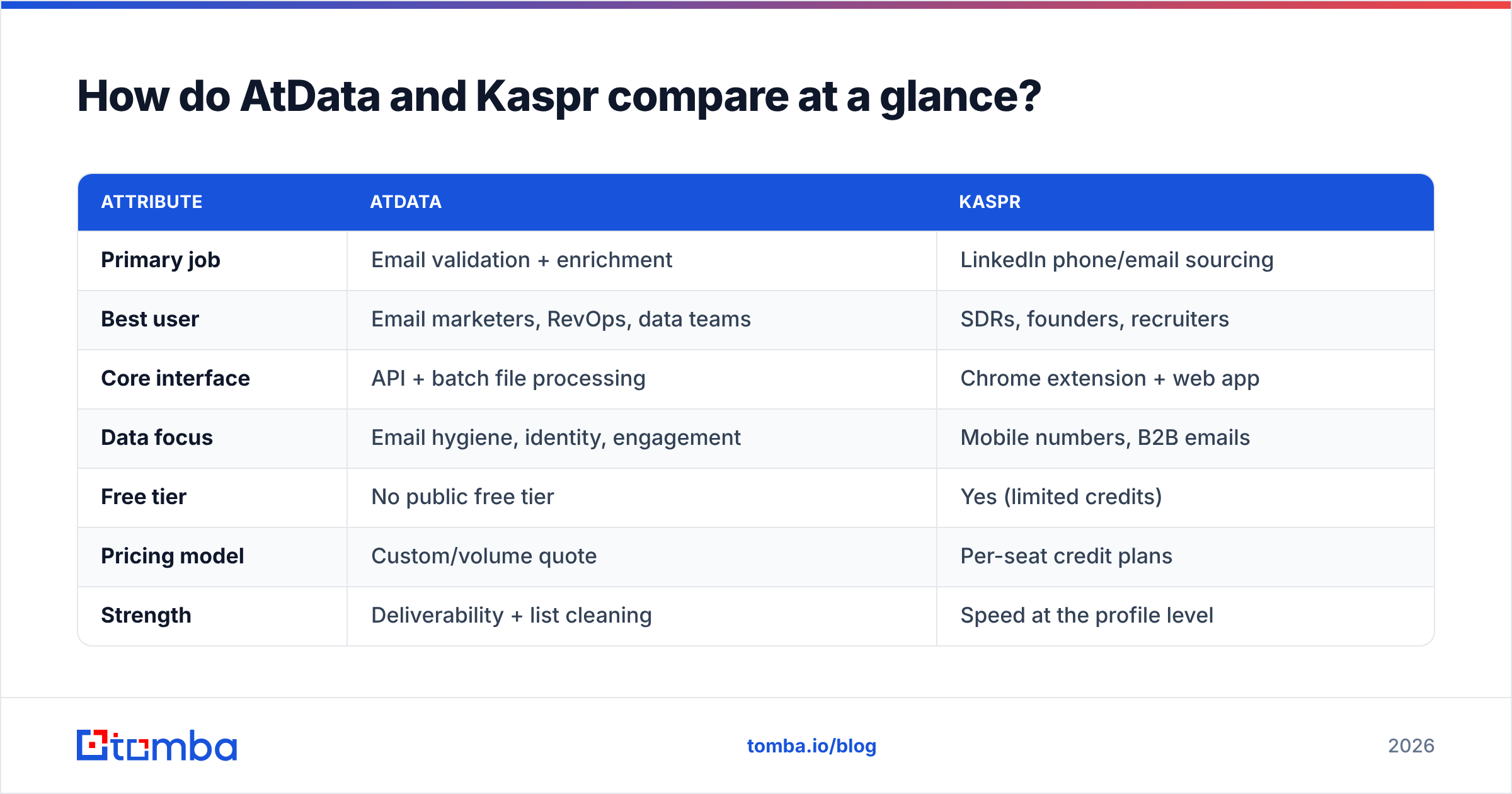
| Attribute | AtData | Kaspr |
|---|---|---|
| Primary job | Email validation + enrichment | LinkedIn phone/email sourcing |
| Best user | Email marketers, RevOps, data teams | SDRs, founders, recruiters |
| Core interface | API + batch file processing | Chrome extension + web app |
| Data focus | Email hygiene, identity, engagement | Mobile numbers, B2B emails |
| Free tier | No public free tier | Yes (limited credits) |
| Pricing model | Custom/volume quote | Per-seat credit plans |
| Strength | Deliverability + list cleaning | Speed at the profile level |
| Weakness | Overkill for small teams | Coverage outside LinkedIn |
| Compliance posture | US email-marketing focused | GDPR/CCPA, EU-friendly |
The table makes the split obvious. AtData is infrastructure you wire into a marketing stack; Kaspr is a point-and-click tool a rep uses 50 times a day. Picking by feature list alone misses this — you are really picking by who on your team touches it.
Which one is more accurate?#
Accuracy means two different things here, so compare them on the right axis.
For email validation accuracy, AtData is the stronger native tool. Its entire business is knowing whether an address is real, active, and safe to mail. If your problem is a 40,000-row list with an unknown bounce rate, AtData's validation and engagement scoring will protect your sender reputation better than a scraper ever could. Scrapers hand you an address; they rarely tell you it has been dormant for three years.
For contact discovery accuracy, Kaspr is the more practical tool — but with a catch. Because its data is community-sourced and cached, accuracy swings by region and seniority. EU mobile numbers tend to be a Kaspr strong point; a mid-market US email for a low-profile role can come back stale or missing. Independent reviews on G2 consistently praise Kaspr's phone data while flagging variable email hit rates.
The trap is assuming one tool covers both axes. It doesn't. A scraped email that Kaspr returns still benefits from a second-pass verification before you send. That is exactly why many teams pair a discovery tool with a dedicated email verifier instead of trusting a single source.


How does pricing compare for AtData vs Kaspr?#
Pricing is where the two tools feel like they live in different universes.
Kaspr uses a transparent, self-serve, per-seat model:
- Free — limited credits, a few phone/email reveals to test it.
- Starter / Sales / paid tiers — monthly per-user pricing with credit allotments for phones, emails, and exports.
- Credits reset monthly; you scale by adding seats.
This suits an individual SDR or a small team that wants to start today without a sales call.
AtData uses a custom, volume-based quote. There is no public self-serve price because deals depend on list size, which data attributes you append, and API call volume. This suits enterprises processing millions of records but creates friction for a five-person startup that just wants clean emails this afternoon.
Here's the practical read: if you can't articulate a multi-million-record use case, AtData's sales motion will feel heavy. And if you're a marketer who only needs validation, you may be paying enterprise pricing for capability you under-use.
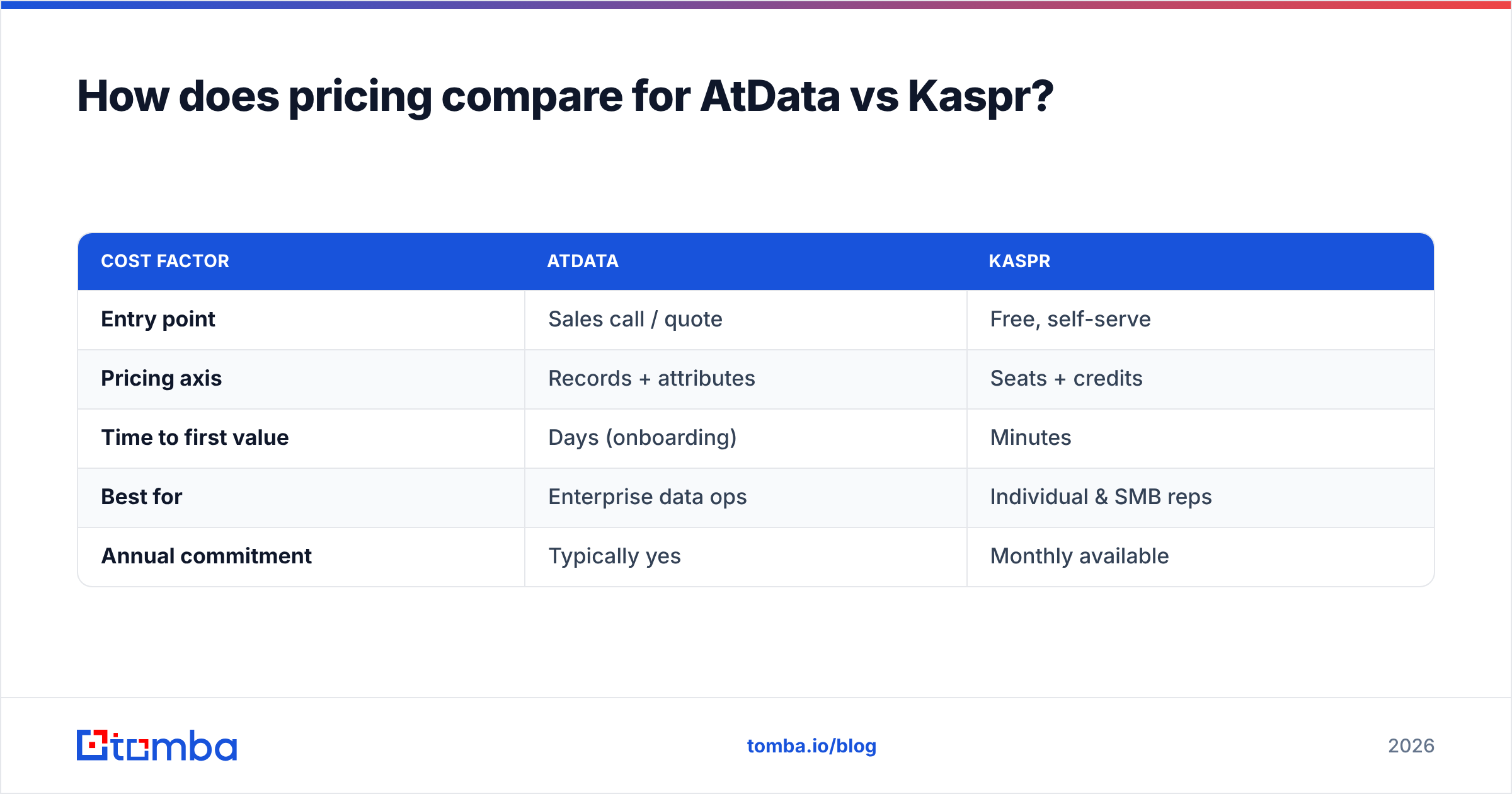
| Cost factor | AtData | Kaspr |
|---|---|---|
| Entry point | Sales call / quote | Free, self-serve |
| Pricing axis | Records + attributes | Seats + credits |
| Time to first value | Days (onboarding) | Minutes |
| Best for | Enterprise data ops | Individual & SMB reps |
| Annual commitment | Typically yes | Monthly available |
For a transparent middle path, compare both against published Tomba pricing: a Free tier at 25 searches/month, Starter at $49/mo, Growth at $99/mo, and Pro at $249/mo — credit-based but built around finding and verifying emails rather than per-seat LinkedIn reveals.
When should you choose AtData?#
Choose AtData when list hygiene is the bottleneck, not list building. Specific signals:
- You already have hundreds of thousands of email records and your bounce rate is hurting email deliverability.
- You run high-volume email marketing and need fraud, activity, and engagement scoring before each send.
- You want to append demographic or interest attributes to known emails for segmentation.
- You have a data team comfortable wiring an API into an ETL or CDP pipeline.
AtData is the wrong call if you're starting from zero contacts. It refines; it doesn't really prospect. Handing AtData an empty list is like booking a tailor when you don't own a suit yet.
When should you choose Kaspr?#
Choose Kaspr when a human rep is the engine and LinkedIn is the hunting ground. Specific signals:
- Your SDRs prospect account-by-account on LinkedIn and need phone numbers fast.
- You sell into EU markets where Kaspr's mobile coverage shines.
- You're a recruiter or founder who wants self-serve tooling without procurement.
- You value a Chrome extension workflow over batch file processing.
Kaspr struggles when you need contacts outside LinkedIn's graph, when you need to enrich a large CSV programmatically, or when email accuracy must be guaranteed before a cold send. In those cases its convenience becomes a coverage ceiling. A focused review of the Kaspr alternative landscape is worth doing before you standardize on one workflow.

Is there a better middle option than AtData or Kaspr?#
For many B2B teams, the real question isn't AtData or Kaspr — it's why am I forced to choose between cleaning and finding at all?
Most outbound pipelines need three things in sequence:
- Find the right professional email by name and domain.
- Verify it's deliverable before it touches your sending domain.
- Enrich the record with company and role context.
AtData nails step 2 and parts of step 3 but skips step 1. Kaspr does a rep-driven version of step 1 but leaves verification soft. That gap is where a dedicated email-finding platform fits — and it's why teams pair their workflow with tools like Tomba's domain search to pull every public email pattern for a company, then verify in the same pass.
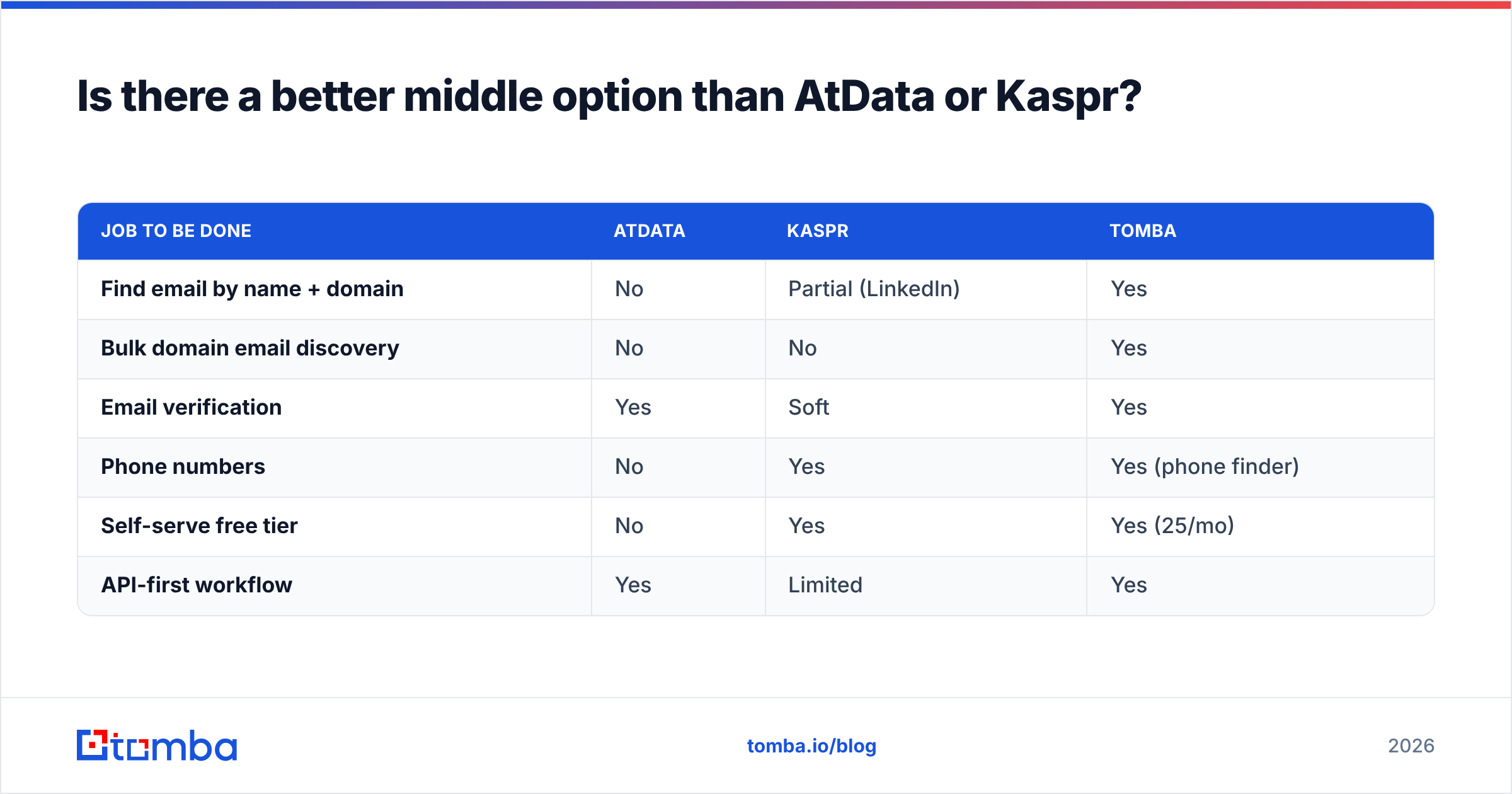
| Job to be done | AtData | Kaspr | Tomba |
|---|---|---|---|
| Find email by name + domain | No | Partial (LinkedIn) | Yes |
| Bulk domain email discovery | No | No | Yes |
| Email verification | Yes | Soft | Yes |
| Phone numbers | No | Yes | Yes (phone finder) |
| Self-serve free tier | No | Yes | Yes (25/mo) |
| API-first workflow | Yes | Limited | Yes |
This isn't a claim that one tool replaces both — it's that the "versus" framing hides a third path. If your core pain is getting accurate, verified emails into your CRM, a finder-plus-verifier beats forcing a validation engine or a LinkedIn scraper to do a job it wasn't built for.
What are the hidden costs and risks?#
A few things rarely make it into the comparison charts:
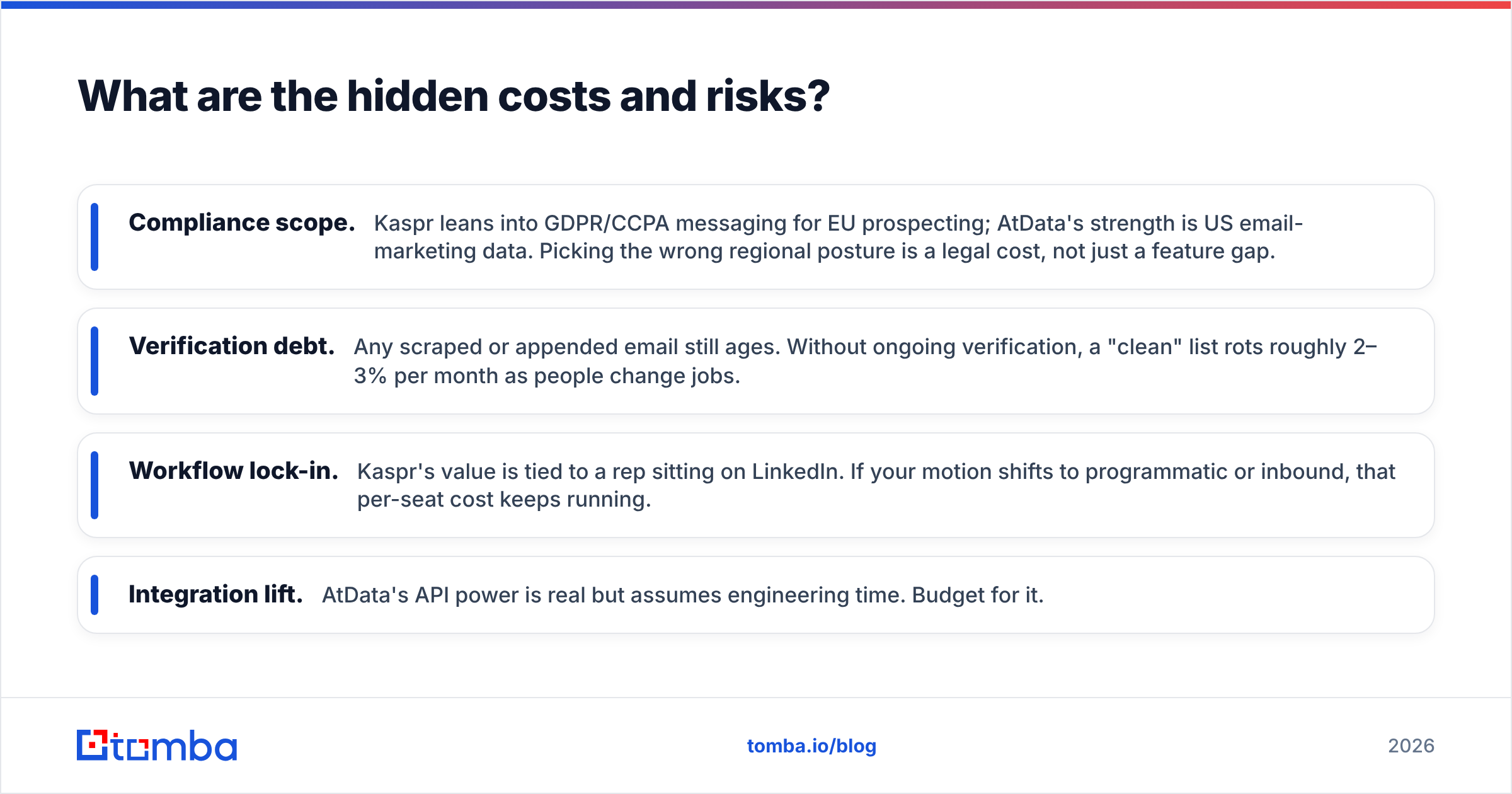
- Compliance scope. Kaspr leans into GDPR/CCPA messaging for EU prospecting; AtData's strength is US email-marketing data. Picking the wrong regional posture is a legal cost, not just a feature gap.
- Verification debt. Any scraped or appended email still ages. Without ongoing verification, a "clean" list rots roughly 2–3% per month as people change jobs.
- Workflow lock-in. Kaspr's value is tied to a rep sitting on LinkedIn. If your motion shifts to programmatic or inbound, that per-seat cost keeps running.
- Integration lift. AtData's API power is real but assumes engineering time. Budget for it.
You can de-risk most of this by keeping discovery and verification modular rather than betting everything on one monolithic vendor. The HubSpot team's writing on data quality and CRM hygiene is a solid neutral primer on why this matters more than raw record counts.
AtData vs Kaspr: the verdict#
There's no universal winner — there's a winner for your motion:
- Pick AtData if you own large email lists and need validation, scoring, and enrichment at enterprise scale.
- Pick Kaspr if individual reps prospect on LinkedIn and need fast phone and email reveals, especially in the EU.
- Pick a dedicated finder + verifier if your bottleneck is sourcing accurate, deliverable emails by name and domain across any company — not just the profiles a rep happens to open.
Most growing teams discover the third bucket is what they actually needed.
Start with accurate emails, then layer the rest#
If your pipeline keeps stalling on bad addresses, fix the input before you buy more enrichment. The Tomba Email Finder finds professional emails by domain, name, or company and verifies them in the same workflow — with a free tier of 25 searches/month and paid plans from $49/mo. Pair it with bulk verification and data enrichment, and you get the clean, deliverable list AtData promises and the fast contact discovery Kaspr promises, without forcing either tool to do a job it wasn't built for. Try the finder on your next target account list and measure the bounce rate yourself — that single number usually settles the debate.
// get started
Find, verify and enrich your first contacts today
Start on the free plan with 25 searches a month, then scale when your team is ready.
Free plan · No credit card required · GDPR & CCPA
// about the author