AtData vs Leadsrush 2026: B2B Email Data Tools Compared
AtData vs Leadsrush in 2026: how their email data, lead coverage, accuracy, and pricing stack up — plus where a finder like Tomba fits.
You have a contact-data problem. Maybe your email list is decaying faster than you can refill it, or your reps are burning hours chasing addresses that bounce. Two names that surface when you start shopping are AtData and Leadsrush — but they solve very different halves of the problem, and picking the wrong one wastes a quarter.
This breakdown cuts through the positioning. We compare what each tool actually does, how accurate the data is, what you pay, and where each one fits a real go-to-market motion.
TL;DR#
- AtData (formerly TowerData) is an email intelligence and validation layer — it scores, verifies, and enriches email addresses you already have. It is not a prospecting tool.
- Leadsrush is a lead-generation and scraping tool — it pulls business contacts from directories and the web so you can build new lists.
- They are complementary, not interchangeable: AtData cleans and enriches; Leadsrush sources. Buying one expecting the other's job is the most common mistake.
- For most B2B teams, the gap in the middle — find the verified email for a known person or domain on demand — is filled better by a dedicated email finder than by either of these.
- On price-to-value for everyday prospecting, a pay-as-you-grow finder like Tomba ($49/mo Starter) undercuts both for the find-and-verify job.
What is AtData?#
AtData is an email-centric data company aimed at marketing and risk teams. Its core value is taking an email address and telling you things about it: is it valid, is it risky or fraudulent, how engaged is the owner, and what demographic or firmographic attributes attach to it. Think of it as a credit bureau for email addresses — you hand over an identifier, and it returns a dossier.
Its main product lines are email validation, fraud and risk scoring, and identity enrichment. Large senders use it to scrub lists before campaigns and to suppress addresses likely to bounce or complain. You can read their positioning directly on atdata.com.
What AtData is not: a place to go find new prospects from scratch. It enriches what you already have. If your CRM is empty, AtData has nothing to act on.
What is Leadsrush?#
Leadsrush sits on the opposite end. It is a lead-generation tool that scrapes and aggregates business contact information — names, companies, emails, sometimes phone numbers — from online directories, maps listings, and public web sources. You give it a search (an industry, a location, a keyword) and it returns a list of businesses and contacts you didn't have before.
This makes Leadsrush a list-building tool. It is most popular with agencies and small sales teams who need volume: hundreds or thousands of local-business or niche leads to feed cold outreach. The trade-off with any scraping-first approach is data freshness and verification — scraped emails are only as good as the source page, which may be months stale.

AtData vs Leadsrush: how do they actually differ?#
The cleanest way to see the difference is by job-to-be-done. These tools rarely compete for the same purchase order once you understand them.
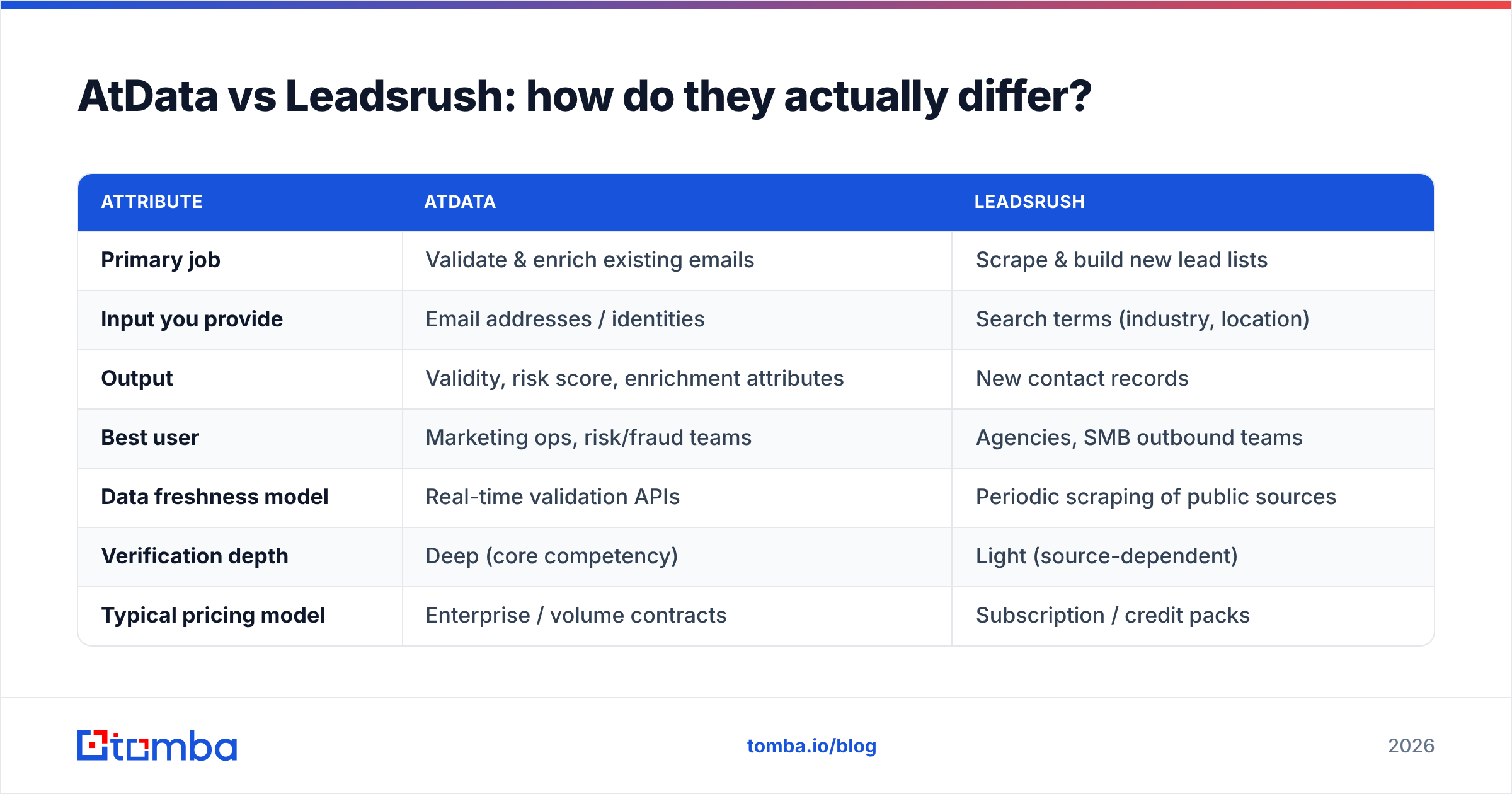
| Attribute | AtData | Leadsrush |
|---|---|---|
| Primary job | Validate & enrich existing emails | Scrape & build new lead lists |
| Input you provide | Email addresses / identities | Search terms (industry, location) |
| Output | Validity, risk score, enrichment attributes | New contact records |
| Best user | Marketing ops, risk/fraud teams | Agencies, SMB outbound teams |
| Data freshness model | Real-time validation APIs | Periodic scraping of public sources |
| Verification depth | Deep (core competency) | Light (source-dependent) |
| Typical pricing model | Enterprise / volume contracts | Subscription / credit packs |
| API-first | Yes | Limited |
The short version: AtData improves data you own; Leadsrush sources data you don't. If you confuse the two, you'll buy a validation engine and wonder why it isn't finding prospects, or buy a scraper and wonder why your bounce rate is climbing.
Which one is more accurate?#
Accuracy depends on which accuracy you mean. AtData wins on email validity because that is its entire reason to exist — it maintains real-time validation infrastructure and risk models honed over years of email data. If your question is "will this address bounce or hurt my sender reputation," AtData's answer is trustworthy.
Leadsrush wins on breadth of net-new contacts but its accuracy is inherently capped by its sources. Scraped data ages quickly: people change jobs, businesses close, listings go stale. Without a strong verification pass, a meaningful slice of any scraped list will be undeliverable on day one.

This is exactly why mature teams separate sourcing from verification. You source a name and company, then run a dedicated email verifier and a fresh email-finding pass before any of it touches a sending domain. Treating one vendor's raw output as send-ready is how deliverability dies.
What does AtData vs Leadsrush cost?#
Pricing transparency is where these two diverge again. Leadsrush leans toward published subscription or credit-pack pricing aimed at SMBs. AtData runs an enterprise motion — pricing scales with volume and product mix, and you typically talk to sales rather than swipe a card.
Here's a rough framing alongside a finder-first alternative so you can see where each lands:
| Plan dimension | AtData | Leadsrush | Tomba |
|---|---|---|---|
| Entry model | Enterprise / custom quote | Subscription or credit packs | Free tier (25 searches/mo) |
| Paid starting point | Volume contract | Mid-tier SMB pricing | $49/mo Starter |
| Free tier | No | Limited trial | Yes — 25/mo |
| Mid tier | Custom | Custom | $99/mo Growth |
| Best for budget | High-volume enterprise | SMB list builders | Teams wanting predictable cost |
| Pay-as-you-grow | Negotiated | Partial | Yes |
For exact, current numbers on the finder side, the public Tomba pricing page lists every tier — Free, Starter at $49/mo, Growth at $99/mo, Pro at $249/mo, and custom Enterprise. The point isn't that one is universally cheaper; it's that a pay-as-you-grow finder removes the enterprise-contract friction for teams that just need verified emails without a procurement cycle.
When you compare options, validate the live numbers on a neutral marketplace like G2 or Capterra rather than trusting any single vendor's framing.
When should you pick AtData?#
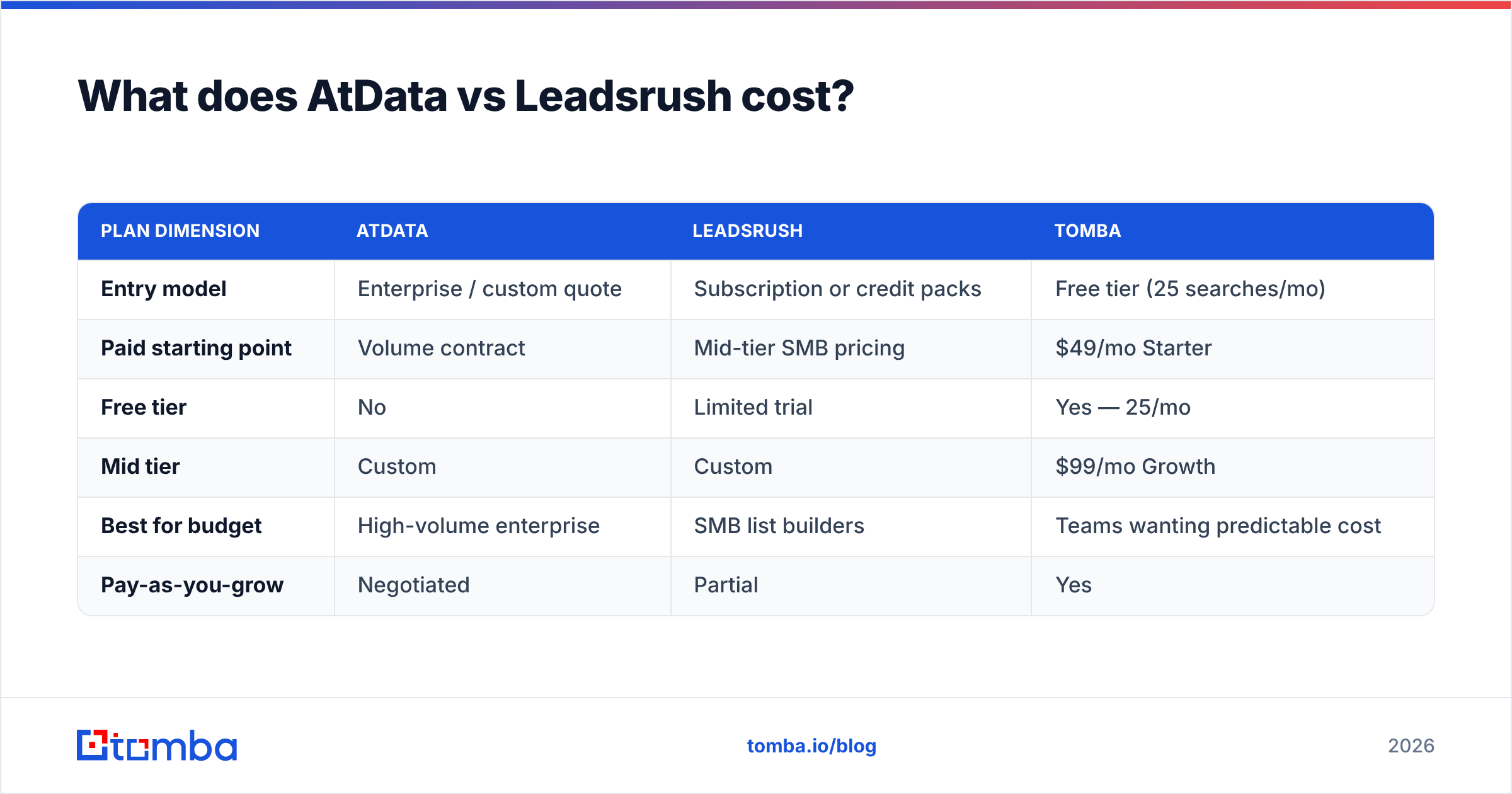
Pick AtData when these are true:
- You already own a large email database — a marketing list, a subscriber base, a customer file — that needs cleaning.
- Deliverability and risk are board-level concerns. High send volume means a 2% bounce rate is real money and reputation damage.
- You need enrichment at the identity level, appending demographic or engagement signals to known emails.
- You have an enterprise budget and can absorb a custom contract.
- Fraud or abuse screening matters — AtData's risk scoring is built for it.
If you're a 200-person marketing team scrubbing a million-record list before a campaign, AtData is in its element. If you're a three-person sales team trying to book meetings next week, it's overkill.
When should you pick Leadsrush?#
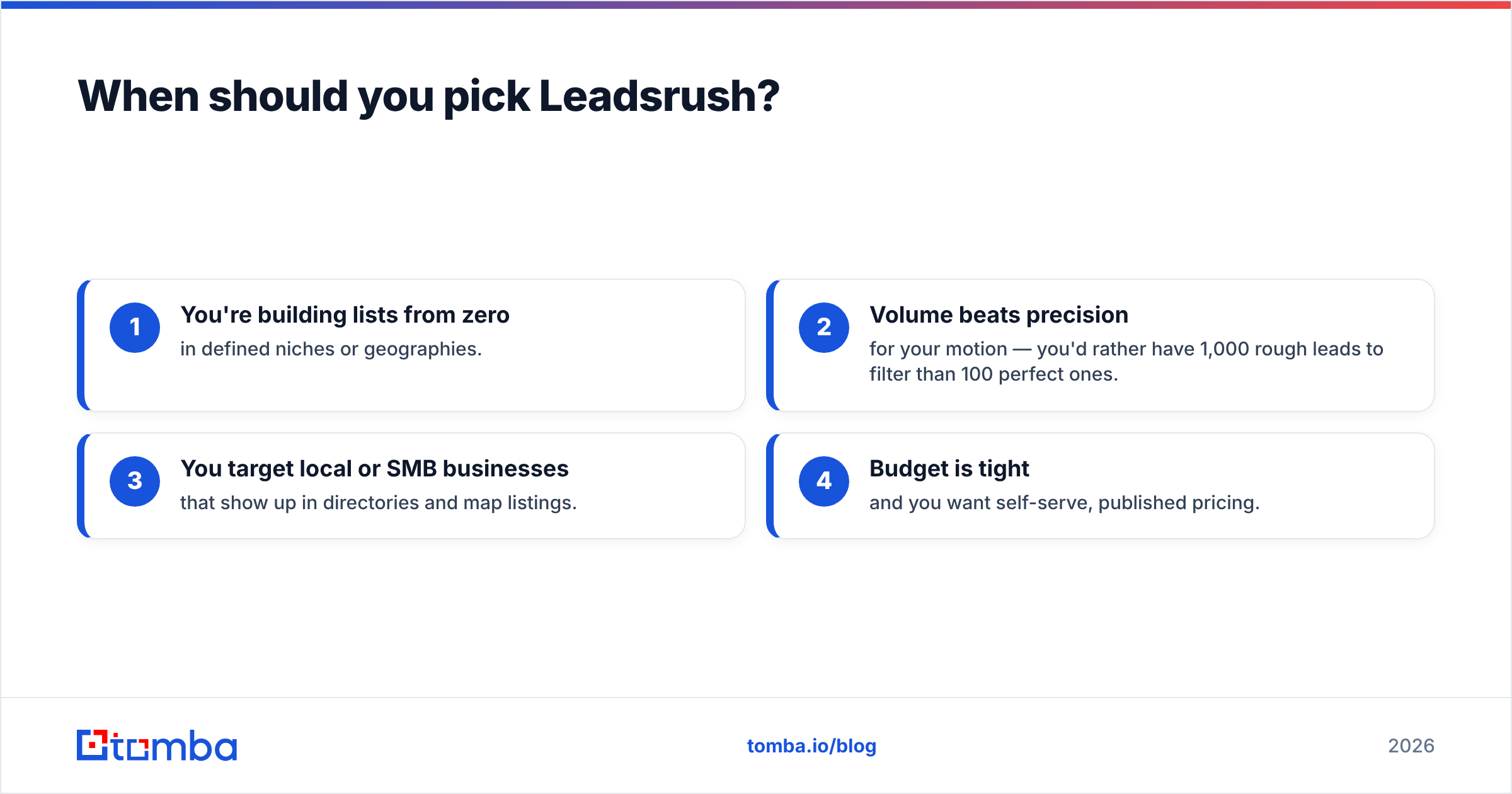
Pick Leadsrush when:
- You're building lists from zero in defined niches or geographies.
- Volume beats precision for your motion — you'd rather have 1,000 rough leads to filter than 100 perfect ones.
- You target local or SMB businesses that show up in directories and map listings.
- Budget is tight and you want self-serve, published pricing.
Just remember the asterisk: whatever Leadsrush hands you should pass through verification before you send. Scraped volume without a cleaning step is a deliverability liability.

Where does a dedicated email finder fit?#
Here's the gap neither tool fills cleanly: I know who I want to reach — give me their verified work email, right now. AtData needs the email as input. Leadsrush gives you bulk lists, not a precise lookup. The find-the-exact-person job belongs to a finder.
That's the lane a tool like Tomba owns. A few ways it plugs the hole between sourcing and validation:
- Find by name + domain. You have the prospect and company; the email finder returns the verified address with a confidence score.
- Domain search. Hand over a company domain and pull every discoverable email pattern for that org via domain search.
- Built-in verification. Every result is checked, so you're not bolting on a separate validation step for one-off finds.
- Enrichment on the same platform. Append role, company, and contact data with data enrichment instead of stitching two vendors together.
- API and bulk. Whether you need one lookup or ten thousand, the Tomba API and bulk tools handle both without an enterprise contract.
Used together, the picture is simple: source a target (Leadsrush-style or from your own research), find the verified email (Tomba), and — at high volume — enrich and risk-score (AtData territory). Most teams under a few million sends never need the third layer at all.
Quick comparison: which tool for which goal?#
| Your goal | Best fit |
|---|---|
| Clean a huge existing email list | AtData |
| Score emails for fraud/risk | AtData |
| Build net-new SMB/local lists | Leadsrush |
| Find one person's verified email | Tomba |
| Verify scraped lists before sending | Tomba email verifier |
| Enrich known contacts at scale | AtData / Tomba |
| Predictable self-serve pricing | Tomba / Leadsrush |
So who wins, AtData or Leadsrush?#
Neither "wins" outright — because they were never really in the same race. AtData is the right call if your problem is the quality and risk of email you already hold at scale. Leadsrush is the right call if your problem is generating raw lead volume cheaply. Choosing between them only makes sense once you've named your actual bottleneck.
But if you read this far hoping for the tool that does the everyday B2B job — find the right person's verified email and reach out — the honest answer is that a dedicated finder beats both for that specific task. It's faster than an enterprise onboarding, more precise than a scrape, and verified out of the box.
Start with the part that moves pipeline this week. Try the Tomba Email Finder — find and verify professional emails by name, domain, or company on a Free tier (25 searches/mo), then scale to Starter at $49/mo when it earns its keep. Source smarter, verify by default, and keep your sending reputation intact.
// get started
Find, verify and enrich your first contacts today
Start on the free plan with 25 searches a month, then scale when your team is ready.
Free plan · No credit card required · GDPR & CCPA
// about the author