AtData vs Salesbot 2026: Which B2B Data Platform Wins?
AtData and Salesbot solve different B2B data problems. This 2026 breakdown compares accuracy, pricing, use cases, and where each tool actually earns its keep.
Choosing between AtData and Salesbot is really a choice between two different jobs: validating and enriching the data you already have versus automating the outreach that data feeds. Picking the wrong one wastes budget on capabilities you never use. This guide breaks down what each platform actually does, how they price, and where they fit in a 2026 B2B stack — plus where a focused email-finding layer fills the gaps both leave behind.
TL;DR#
- AtData is an email-centric data intelligence and validation platform — strongest for cleaning large databases, identity resolution, and demographic/behavioral append at scale.
- Salesbot is an AI-driven sales automation tool — strongest for conversational prospecting, lead routing, and automating repetitive outreach steps.
- They are not direct competitors; many teams run a data-quality layer (AtData-style) and an automation layer (Salesbot-style) side by side.
- Pricing models differ sharply: AtData leans enterprise/volume contracts; Salesbot-style tools lean per-seat or per-credit SaaS.
- If your real bottleneck is finding and verifying contact emails before any of this runs, a dedicated email finder like Tomba is the cheaper, more direct fix.
What is AtData?#
AtData (formerly TowerData) is a B2B and B2C data intelligence company built around the email address as a primary identity key. Instead of generating new outreach, it focuses on what you already have: validating addresses, resolving identities, and appending demographic, firmographic, and behavioral attributes to thin records.
Think of AtData like a quality-control station on an assembly line. Raw contact records come in dented and mislabeled; AtData inspects each one, throws out the broken parts, and adds the missing specs before the record moves downstream. Technically, that means email validation, hygiene scoring, fraud/risk signals, and identity append delivered via API or batch file.
Its sweet spot is scale and accuracy — marketing databases with hundreds of thousands of rows, where a 2% bounce-rate improvement translates into real deliverability and revenue gains. You can read more about how email-based identity works on AtData's own site.
What is Salesbot?#
Salesbot refers to AI-powered sales automation and conversational prospecting tooling — the category of bots that qualify inbound leads, trigger sequenced outreach, route hot prospects to reps, and handle the repetitive "did they reply, follow up if not" cycle.
If AtData is the quality-control station, Salesbot is the conveyor belt and the robotic arms — it keeps things moving and reacts to events without a human pushing every button. The value is time saved per rep and faster response to inbound interest, not data cleanliness.
The trade-off: automation amplifies whatever data you feed it. Point a Salesbot at a stale, unverified list and it will cheerfully send thousands of emails to dead inboxes, torching your sender reputation at machine speed.
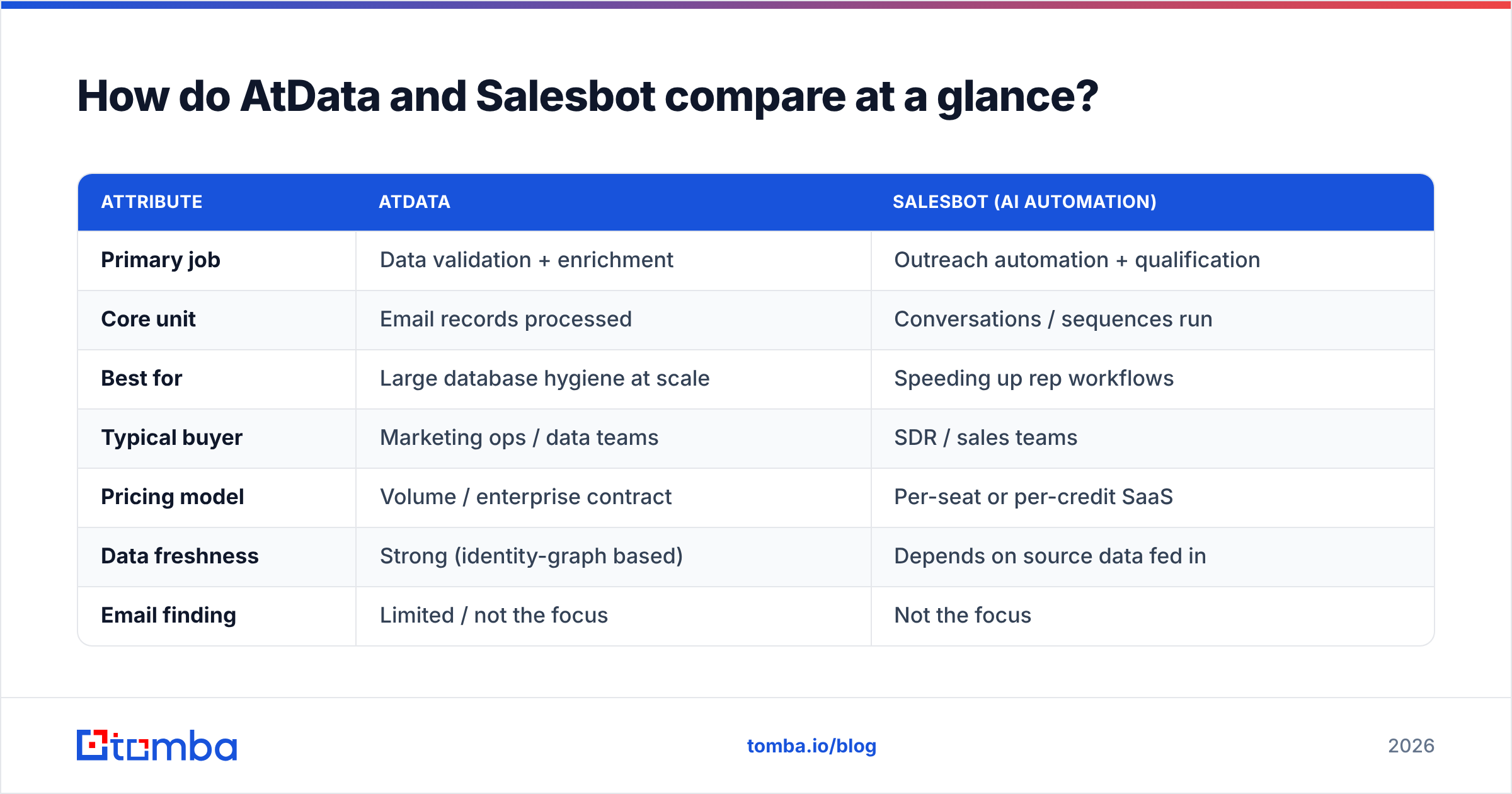
How do AtData and Salesbot compare at a glance?#
The cleanest way to see the difference is by primary job, not by feature checklist. These tools overlap less than their marketing pages suggest.
| Attribute | AtData | Salesbot (AI automation) |
|---|---|---|
| Primary job | Data validation + enrichment | Outreach automation + qualification |
| Core unit | Email records processed | Conversations / sequences run |
| Best for | Large database hygiene at scale | Speeding up rep workflows |
| Typical buyer | Marketing ops / data teams | SDR / sales teams |
| Pricing model | Volume / enterprise contract | Per-seat or per-credit SaaS |
| Data freshness | Strong (identity-graph based) | Depends on source data fed in |
| Email finding | Limited / not the focus | Not the focus |
| Setup effort | API or batch integration | Connect CRM + build flows |
| Free entry point | Sales-led, limited | Often a trial tier |
The takeaway: if your list is dirty, AtData fixes it. If your reps are slow, Salesbot speeds them up. Neither one is built primarily to discover new verified contact emails — which is the gap most teams underestimate.
Which one should you actually buy?#
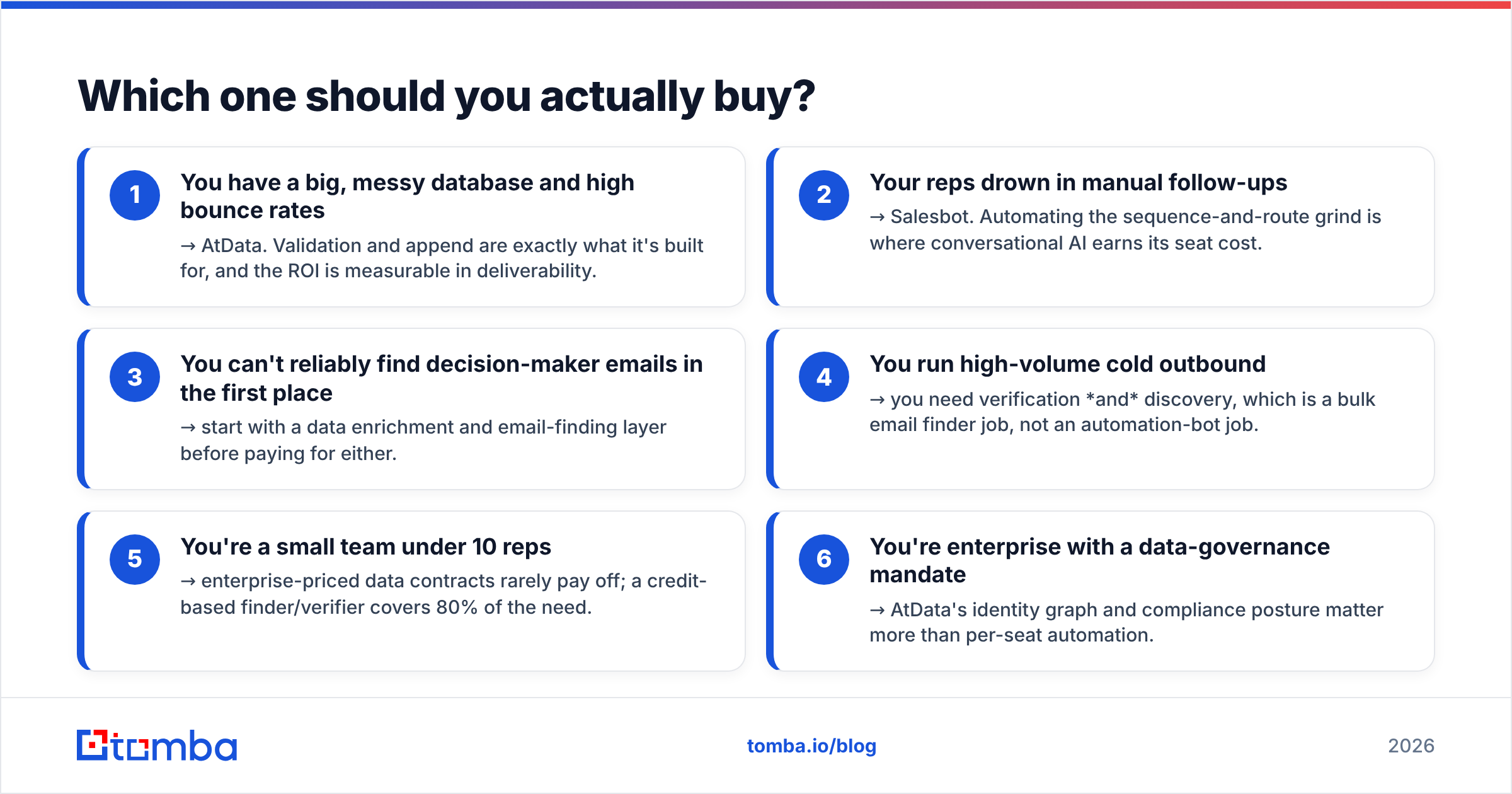
Conclusion first: buy AtData if your problem is data quality at scale, buy a Salesbot-style tool if your problem is execution speed, and buy neither if you can't yet build accurate lists. Use this decision frame:
- You have a big, messy database and high bounce rates → AtData. Validation and append are exactly what it's built for, and the ROI is measurable in deliverability.
- Your reps drown in manual follow-ups → Salesbot. Automating the sequence-and-route grind is where conversational AI earns its seat cost.
- You can't reliably find decision-maker emails in the first place → start with a data enrichment and email-finding layer before paying for either.
- You run high-volume cold outbound → you need verification and discovery, which is a bulk email finder job, not an automation-bot job.
- You're a small team under 10 reps → enterprise-priced data contracts rarely pay off; a credit-based finder/verifier covers 80% of the need.
- You're enterprise with a data-governance mandate → AtData's identity graph and compliance posture matter more than per-seat automation.
How do AtData and Salesbot price in 2026?#
Pricing is where the "they're not the same product" point becomes concrete.
AtData uses a sales-led, volume-based model. You don't self-serve a credit card; you scope your record count and use cases, and pricing scales with the size of your database and the enrichment attributes you want. That makes it predictable for enterprises and overkill for a five-person startup.
Salesbot-style automation tools typically price per seat (per rep using the bot) or per credit (per message/enrichment action), often with a free trial. Costs grow with headcount and send volume rather than database size.
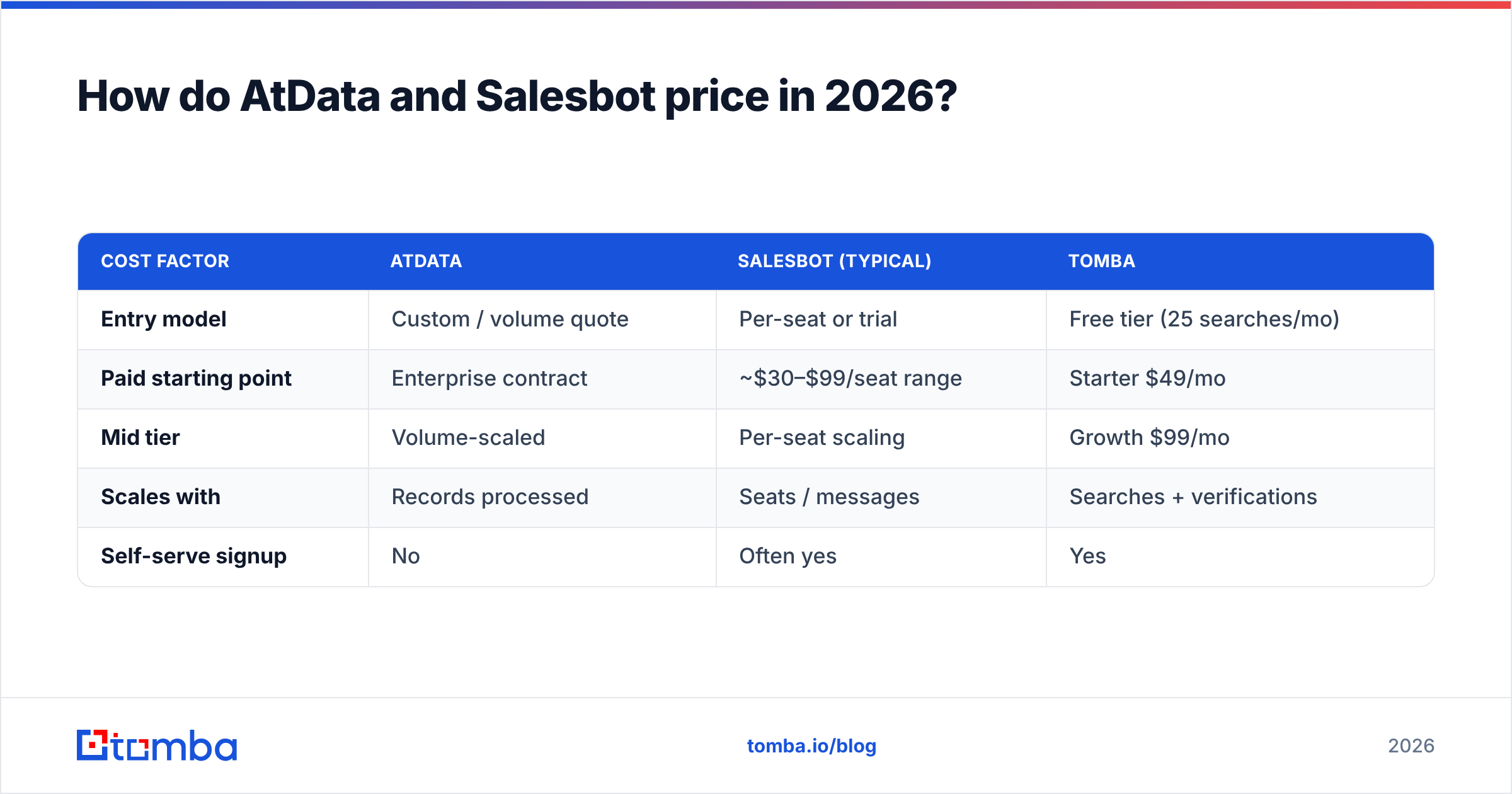
| Cost factor | AtData | Salesbot (typical) | Tomba |
|---|---|---|---|
| Entry model | Custom / volume quote | Per-seat or trial | Free tier (25 searches/mo) |
| Paid starting point | Enterprise contract | ~$30–$99/seat range | Starter $49/mo |
| Mid tier | Volume-scaled | Per-seat scaling | Growth $99/mo |
| Scales with | Records processed | Seats / messages | Searches + verifications |
| Self-serve signup | No | Often yes | Yes |
Tomba sits deliberately in the self-serve, credit-efficient lane: the Free tier covers 25 searches a month, Starter is $49/mo, Growth $99/mo, and Pro $249/mo, with custom Enterprise above that. Full Tomba pricing is public, no quote call required — a different philosophy from AtData's enterprise motion. (Note: AtData and Salesbot-style vendor prices shift; confirm current numbers on their sites or a review platform like G2 before committing.)
Where does data accuracy actually come from?#
Both categories live or die on data accuracy, but they earn it differently. AtData's accuracy comes from an identity graph — cross-referencing billions of email-linked signals to confirm an address is real, active, and tied to a real person. Salesbot accuracy is mostly inherited: it's only as good as the records you import.
This is the quiet failure mode of buying an automation bot first. The bot doesn't make your data correct; it just acts on it faster. Sending velocity without verification is how good domains end up on blocklists. If you care about email deliverability, the validation step is non-negotiable — and you want it before automation runs, not after the bounces roll in.
That's the layer a dedicated email verifier handles: SMTP checks, catch-all detection, and risk scoring on every address, so the records flowing into AtData enrichment or Salesbot sequences are already clean. Tomba documents where its data comes from openly, which matters when you're auditing accuracy claims.
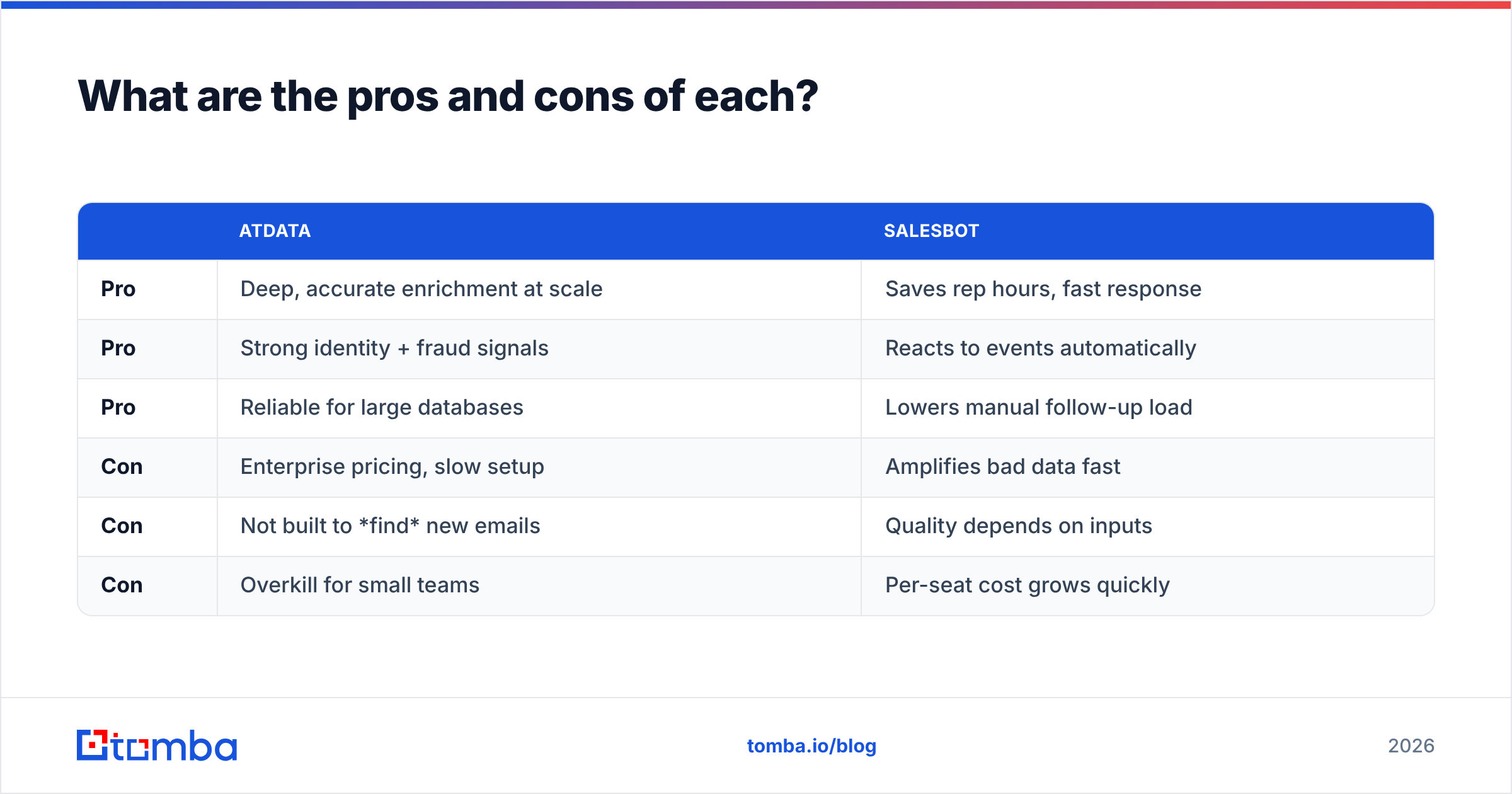
What are the pros and cons of each?#
No tool is universally better; each trades something away.
| AtData | Salesbot | |
|---|---|---|
| Pro | Deep, accurate enrichment at scale | Saves rep hours, fast response |
| Pro | Strong identity + fraud signals | Reacts to events automatically |
| Pro | Reliable for large databases | Lowers manual follow-up load |
| Con | Enterprise pricing, slow setup | Amplifies bad data fast |
| Con | Not built to find new emails | Quality depends on inputs |
| Con | Overkill for small teams | Per-seat cost grows quickly |
The honest pattern: AtData and Salesbot are complements, not substitutes. A mature team might validate and enrich with one, then automate outreach with the other. But both assume you already have contacts to work with — which loops back to the real first-mile problem.
Is there a simpler starting point than either?#
Yes — if your bottleneck is the first mile: finding and verifying the right contacts. Most teams reach for a heavyweight data contract or an automation suite when what they actually need is reliable contact discovery. You can't enrich or automate a record you don't have.
This is where a focused tool beats a broad platform. With Tomba you can:
- Find emails by domain or name with the email finder, instead of guessing patterns.
- Search a whole company at once using domain search to map every reachable contact.
- Verify before you send with the email verifier, so automation never burns reputation.
- Run it at scale through the bulk email finder or the Tomba API for programmatic pipelines.
For comparison shoppers, AtData's strength is enrichment depth and Salesbot's strength is automation — but neither replaces accurate, affordable discovery. Many teams use Tomba as the find-and-verify layer that feeds both. If you want a broader vendor view, cross-check categories on G2 and read how data platforms describe identity resolution on the AtData site before deciding.
How do these fit into a 2026 sales stack?#
A clean 2026 stack usually has three layers, and confusing them is the most expensive mistake teams make:
- Discovery + verification — find and confirm contacts (Tomba, email finders/verifiers).
- Enrichment — add firmographic/demographic depth (AtData-class platforms).
- Automation — sequence, route, and follow up (Salesbot-class tools).
Skip layer one and you pay premium prices to enrich and automate garbage. Skip layer two and your outreach is generic. Skip layer three and your reps stay buried in manual work. The order matters: accuracy in, automation out — never the reverse.
For most growing teams, the highest-ROI move in 2026 isn't another enterprise contract or a flashy AI bot. It's getting layer one right so the expensive layers above it actually perform.
The bottom line#
AtData wins for enterprise-scale data hygiene and enrichment. A Salesbot-style tool wins for automating rep workflows once your data is clean. But both assume you already have accurate contacts — and that assumption is exactly where pipelines quietly break.
If you want to fix the first mile before spending on enrichment or automation, start with the Tomba Email Finder. Find verified, professional emails by name, company, or domain, confirm them with built-in verification, and feed clean records into whatever enrichment or automation layer you choose next. Spin up the free tier — 25 searches a month, no quote call — and see how much of the "we need a data platform" problem disappears when discovery is solid first.
Ready to find emails that actually work?
Join 150,000+ professionals who stopped guessing and started sending. Free credits on signup — no credit card required.
Get the Tomba newsletter
Practical outbound tactics and product updates — once every two weeks.
About the author