AtData vs SalesIntel 2026: B2B Data Provider Comparison
AtData and SalesIntel solve different B2B data problems. This 2026 breakdown compares accuracy, pricing, coverage, and use cases so you pick the right one.
TL;DR
- AtData is an email intelligence and verification platform — its strength is scoring, hygiene, and fraud signals on email addresses you already collect.
- SalesIntel is a B2B contact database built on human-verified records and intent data — its strength is sourcing new accounts and contacts.
- They are not direct substitutes. AtData cleans and enriches; SalesIntel discovers and prospects.
- Pricing differs sharply: AtData is usage/CPM-style for verification, SalesIntel is an annual seat-plus-credits contract that often runs five figures.
- If your real job is finding accurate work emails on demand without an annual lock-in, a focused email finder like Tomba is usually the cheaper, faster fit.
If you searched "AtData vs SalesIntel," you are probably trying to fix one of two problems: your existing email data is dirty, or you do not have enough contacts to begin with. The honest answer up front is that these two tools sit on opposite ends of that problem. Picking between them is less about which is "better" and more about which job you are hiring a tool to do.
What are AtData and SalesIntel?#
Think of your contact data like a kitchen. AtData is the dishwasher and quality inspector — it takes the plates you already have and tells you which are clean, cracked, or risky to serve. SalesIntel is the grocery delivery service — it brings you fresh ingredients you did not have before. Both matter, but you would never confuse one for the other.
AtData (formerly TowerData) is an email-centric data company. Its core products are email validation, email-based identity and demographic enrichment, and fraud/risk scoring. Marketers and risk teams feed it an email address and get back deliverability signals, activity scores, and appended attributes. Its public positioning lives at atdata.com, and it leans heavily into email hygiene at scale and ad-tech use cases.
SalesIntel is a B2B sales-intelligence platform. Its pitch is human-verified contact and company data, technographics, and buyer intent, surfaced through a web app, a Chrome extension, and CRM integrations. SalesIntel sells the promise of accurate direct dials and emails that a research team re-verifies on a cadence. You can read its own framing at salesintel.io.
So the one-line distinction: AtData improves data you own; SalesIntel sells you data you do not.
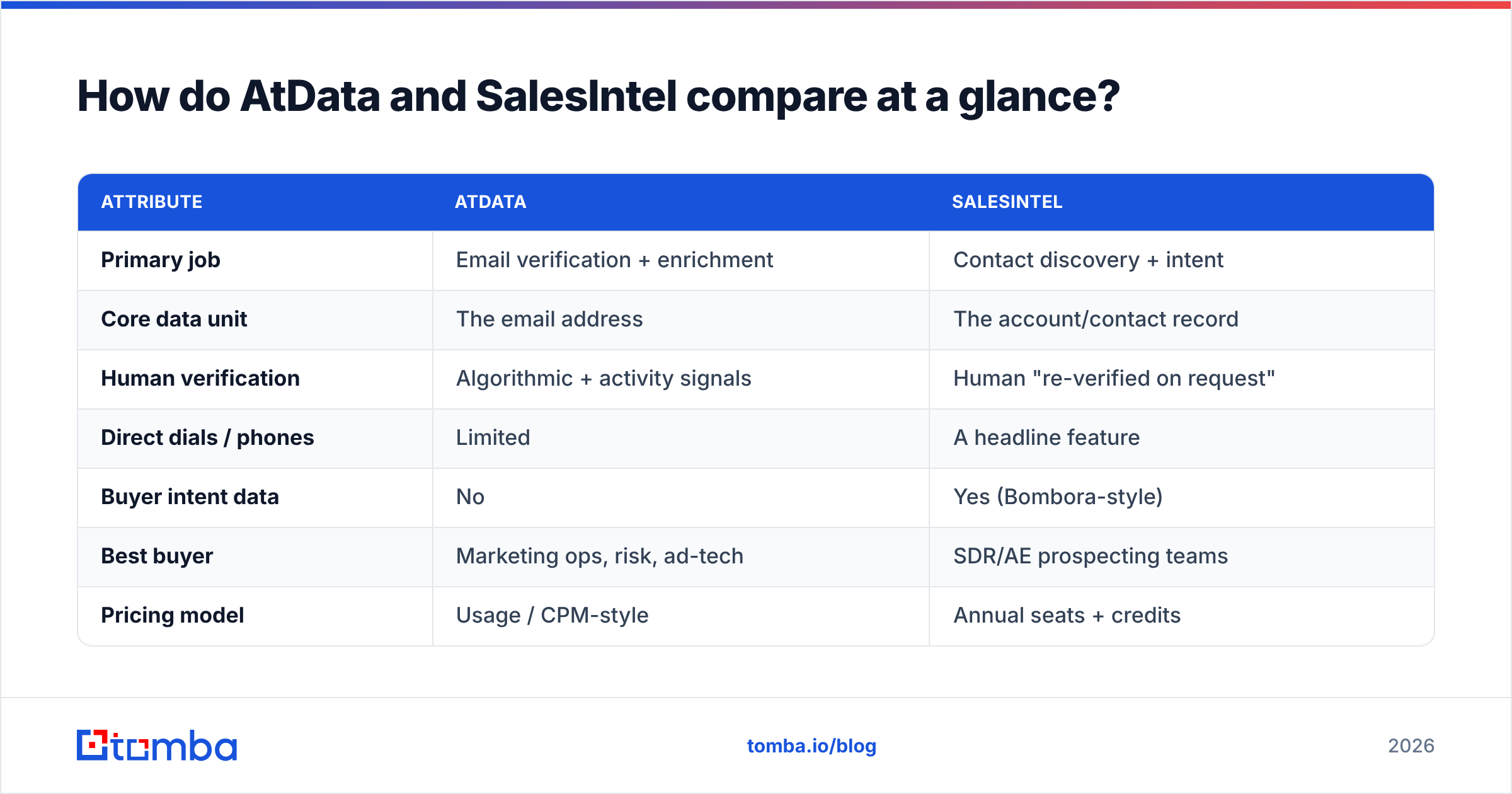
How do AtData and SalesIntel compare at a glance?#
| Attribute | AtData | SalesIntel |
|---|---|---|
| Primary job | Email verification + enrichment | Contact discovery + intent |
| Core data unit | The email address | The account/contact record |
| Human verification | Algorithmic + activity signals | Human "re-verified on request" |
| Direct dials / phones | Limited | A headline feature |
| Buyer intent data | No | Yes (Bombora-style) |
| Best buyer | Marketing ops, risk, ad-tech | SDR/AE prospecting teams |
| Pricing model | Usage / CPM-style | Annual seats + credits |
| Typical entry cost | Volume-based, quote | Often $10k+/year |
| Free self-serve tier | No | Limited trial |
The table makes the split obvious. If your weekly headache is "my list bounces and I do not know who these people are," AtData is aimed at you. If it is "I have 40 target accounts and no contacts inside them," SalesIntel is aimed at you.
)
What is AtData best at?#
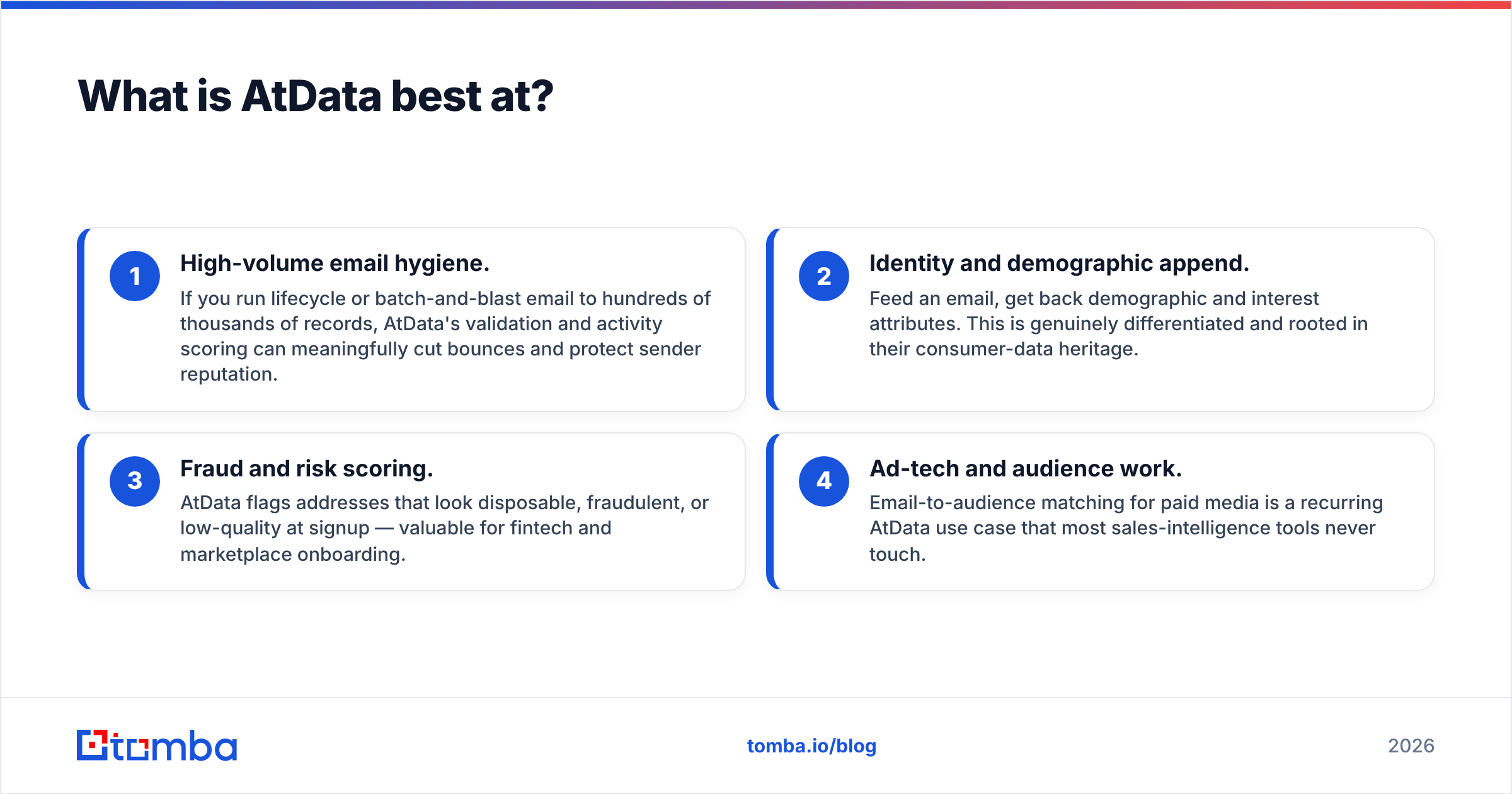
AtData wins when email is the center of gravity. Its strongest use cases cluster tightly:
- High-volume email hygiene. If you run lifecycle or batch-and-blast email to hundreds of thousands of records, AtData's validation and activity scoring can meaningfully cut bounces and protect sender reputation.
- Identity and demographic append. Feed an email, get back demographic and interest attributes. This is genuinely differentiated and rooted in their consumer-data heritage.
- Fraud and risk scoring. AtData flags addresses that look disposable, fraudulent, or low-quality at signup — valuable for fintech and marketplace onboarding.
- Ad-tech and audience work. Email-to-audience matching for paid media is a recurring AtData use case that most sales-intelligence tools never touch.
Where AtData is weak: it is not a prospecting engine. You do not open AtData to find the VP of Engineering at a target account — you open it to score the address once you have it. For a sales team starting from a cold account list, it solves the wrong half of the problem.
What is SalesIntel best at?#
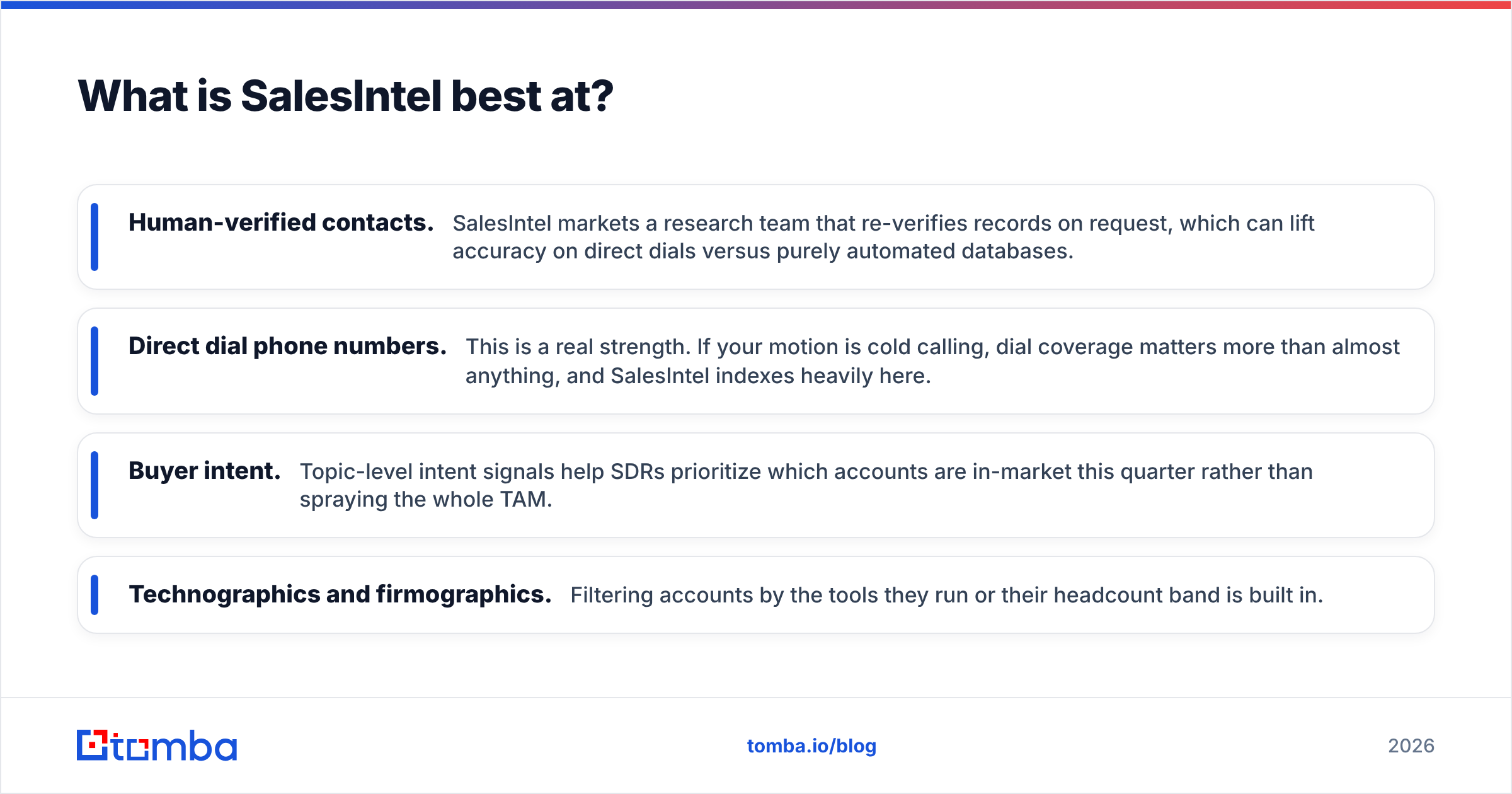
SalesIntel earns its keep at the top of the funnel. Its differentiators:
- Human-verified contacts. SalesIntel markets a research team that re-verifies records on request, which can lift accuracy on direct dials versus purely automated databases.
- Direct dial phone numbers. This is a real strength. If your motion is cold calling, dial coverage matters more than almost anything, and SalesIntel indexes heavily here.
- Buyer intent. Topic-level intent signals help SDRs prioritize which accounts are in-market this quarter rather than spraying the whole TAM.
- Technographics and firmographics. Filtering accounts by the tools they run or their headcount band is built in.
Where SalesIntel is weak: cost and commitment. It is an annual contract with seat licensing and credit caps. For a two-person startup that needs a few hundred verified emails a month, the floor price is hard to justify. Coverage is also strongest in North America and thins out internationally — a common limitation buyers flag on G2.
)
How do pricing and data accuracy compare?#
This is where the comparison gets uncomfortable for both tools, because neither publishes simple self-serve pricing.
AtData prices by usage. Verification and enrichment are billed on volume, closer to a CPM or per-record model. That is efficient if you have a predictable batch to clean, but you will be talking to sales to get a real number, and ad-hoc small jobs are not its sweet spot.
SalesIntel prices by annual contract — seats plus a credit allotment for unlocking contacts. Public reports and review-site threads consistently put realistic deals in the five-figure-per-year range once you add seats and credits. There is a trial, but no meaningful free tier.
On accuracy, the two are measuring different things. AtData's "accuracy" is about whether an email is deliverable, active, and low-risk. SalesIntel's "accuracy" is about whether a contact record — name, title, company, phone, email — is current. A record can be perfectly "real" and still bounce six months later, which is why even human-verified databases pair best with a fresh verification step at send time. If you care about how providers source records in the first place, it is worth understanding where the data comes from before you trust any vendor's accuracy claim.
The practical lesson: a static database, no matter how it was built, decays. People change jobs at roughly 20–30% per year. That decay is exactly why a real-time finder-plus-verifier loop often beats a once-a-year data dump.
Do you actually need either one?#
Maybe not both, and maybe neither at full price. Run this gut check:
- You blast large email volumes and fight bounces → AtData's hygiene is a fair fit.
- You cold call and need direct dials with intent → SalesIntel's coverage is a fair fit.
- You just need accurate work emails on demand, in any geography, without an annual contract → a focused email finder plus an email verifier covers it for a fraction of the cost.
The third scenario is the most common one, and it is the one both AtData and SalesIntel over-serve. You end up paying for a fraud-scoring engine or an intent platform when what you wanted was "give me the right email for this person at this company, and tell me it is valid."
Where does Tomba fit against AtData and SalesIntel?#
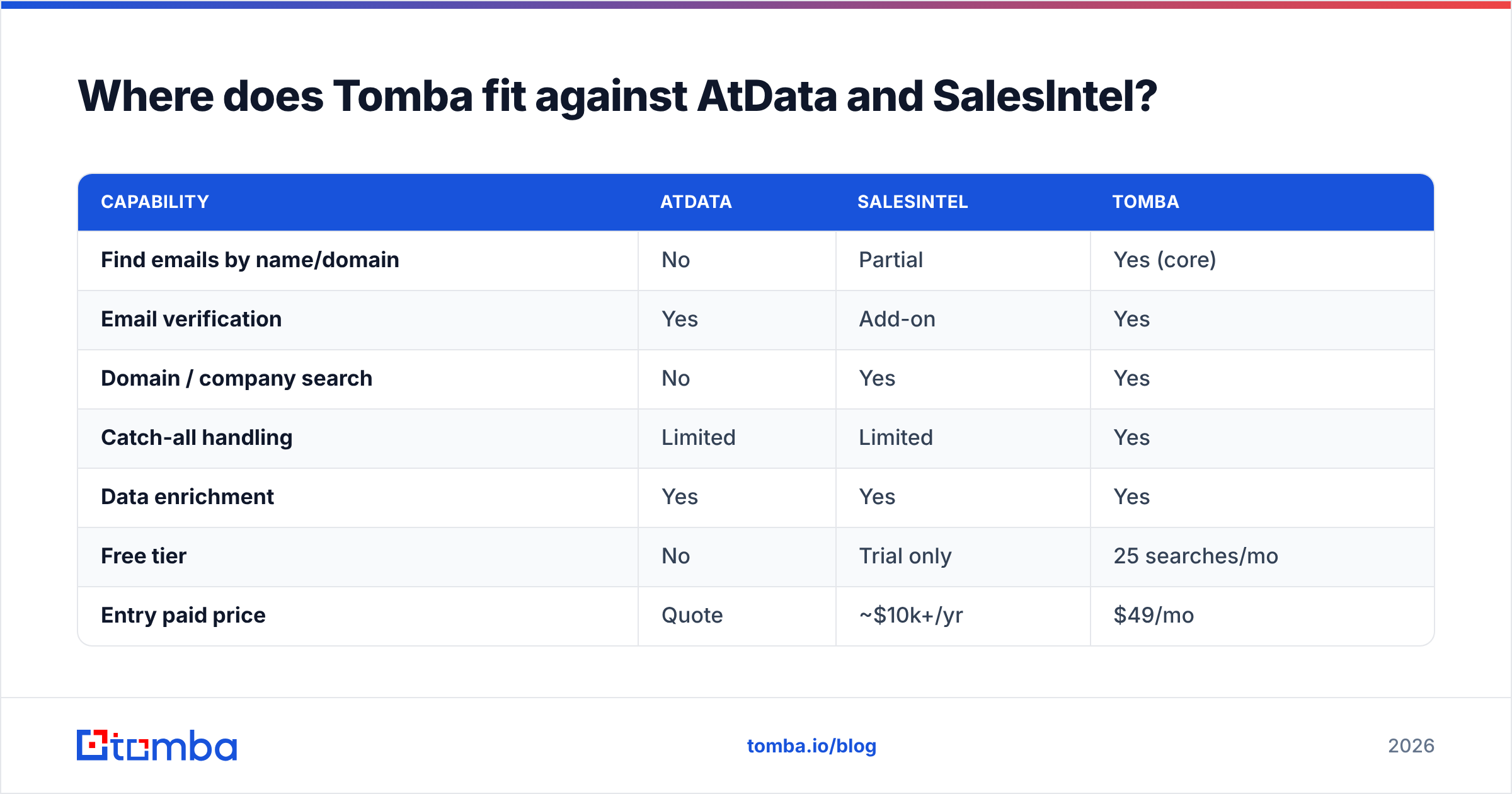
Tomba is not trying to be a five-figure intent platform or an ad-tech identity graph. It does one job extremely well: turn a name and domain into a verified professional email, on demand, at a price that does not require a procurement cycle.
| Capability | AtData | SalesIntel | Tomba |
|---|---|---|---|
| Find emails by name/domain | No | Partial | Yes (core) |
| Email verification | Yes | Add-on | Yes |
| Domain / company search | No | Yes | Yes |
| Catch-all handling | Limited | Limited | Yes |
| Data enrichment | Yes | Yes | Yes |
| Free tier | No | Trial only | 25 searches/mo |
| Entry paid price | Quote | ~$10k+/yr | $49/mo |
| API-first | Yes | Yes | Yes |
That free tier and the $49/mo Starter plan are the headline difference — you can validate the whole workflow before paying anything. From there, Growth runs $99/mo and Pro $249/mo, with full Tomba pricing published openly instead of hidden behind a sales call. Tomba also layers in data enrichment, domain search, and a catch-all verifier so the find-then-verify loop lives in one place.
Tomba is not the right tool if your need is genuinely topic-level buyer intent or large-scale consumer email scoring — that is where AtData and SalesIntel have real, specialized depth. Be honest with yourself about which problem you have.
So which should you pick: AtData or SalesIntel?#
Conclusion first: choose by the job, not the brand.
- Pick AtData if your problem is email quality at scale — hygiene, enrichment, and fraud scoring on addresses you already collect, especially in marketing and ad-tech.
- Pick SalesIntel if your problem is sourcing — you need human-verified direct dials, firmographics, and intent for a cold-calling motion, and you can absorb an annual contract.
- Pick neither if what you actually need is accurate, on-demand work emails with a verifier attached and no annual lock-in.
Most teams searching this comparison fall into that last bucket without realizing it. They think they need a database, when they need a precise finder.
Final take and next step#
AtData and SalesIntel are both legitimate tools that happen to share a search query and almost nothing else. AtData polishes the data you own; SalesIntel sells you data you lack. The mistake is buying either one to solve the everyday task of "find this person's email and confirm it's valid" — that is over-buying.
If that everyday task is your real need, start with the Tomba Email Finder. Use the free 25-search tier to test accuracy on your own target accounts, pair it with the built-in verifier, and only scale to a paid plan once the data proves itself. You skip the annual contract, keep global coverage, and pay for exactly what you find.
// get started
Find, verify and enrich your first contacts today
Start on the free plan with 25 searches a month, then scale when your team is ready.
Free plan · No credit card required · GDPR & CCPA
// about the author